
Written by Jorge Argota · Legal Marketing · United States
If you’re using Google Keyword Planner to find high volume terms and then bidding on “personal injury lawyer [city],” you’re building a strategy to compete with Morgan and Morgan’s budget. You will lose. The firms signing the most valuable cases in 2026 aren’t chasing search volume. They’re chasing case value. A keyword with 10 searches a month that implies a million dollar insurance policy is worth 100 times more than “car accident lawyer” with 10,000 searches, because the search volume keyword attracts fender benders and the low volume keyword attracts commercial fleet catastrophic injuries.
TL;DR
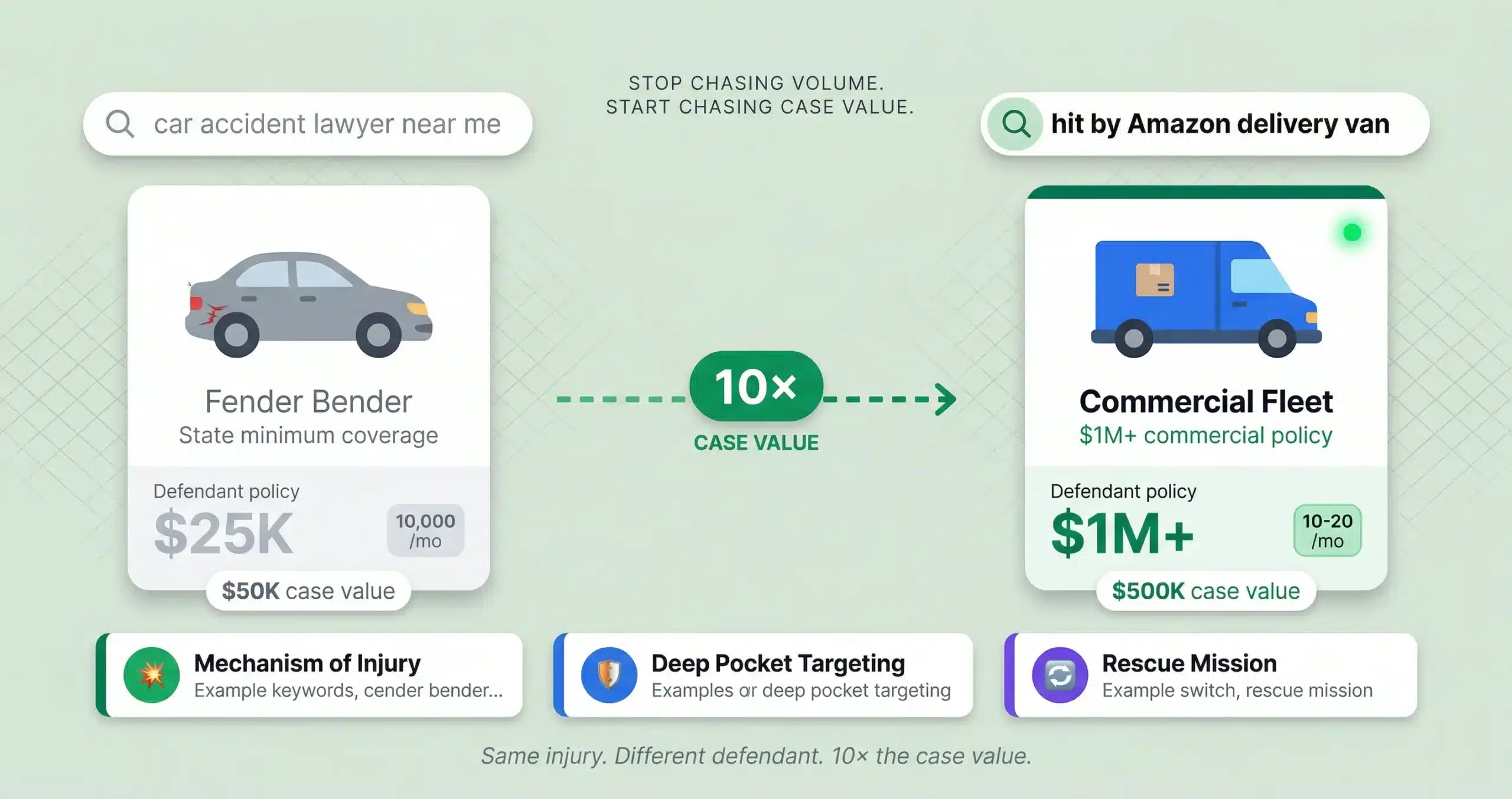
Stop bidding on the legal problem. Start bidding on the financial asset. The highest ROI keywords in legal PPC aren’t the ones with the most searches. They’re the ones that imply the deepest pockets on the defendant side. “Hit by Amazon delivery van” targets a $1M commercial policy. “Car accident lawyer” targets a private driver with state minimums. Same injury, 10x the case value. This page covers three keyword strategies that most firms and agencies miss entirely: mechanism of injury targeting, commercial defendant targeting, and second opinion client capture.
THE MECHANISM OF INJURY PROTOCOL
Victims don’t search for the legal definition of what happened to them. They search for the physics of the crash. And the physics tell you everything you need to know about case value before you ever answer the phone.
Liability Lock Keywords
“Rear ended at red light” · “T-boned in intersection” · “Left turn accident” · “Ran a stop sign hit me”
These imply the other driver is at fault. Liability is near-certain, which means the case moves faster and the settlement math is cleaner.
Severity Signal Keywords
“Rollover crash” · “Airbag deployment injury” · “Jaws of life accident” · “Helicopter transport after crash”
These filter out the fender benders naturally. Someone searching “bumper scratch” isn’t your client. Someone searching “rollover” is a catastrophic injury case worth six or seven figures.
So instead of building ad groups around the practice area (“personal injury lawyer Miami”), you build ad groups around the physics of the crash. The mechanism keywords pre qualify the lead before the click ever happens because a “rear ended at red light” search tells you three things: clear liability, the person was not at fault, and they’re searching because they’re hurt and need help now. That’s a case you want to answer the phone for, and the click costs a fraction of what “personal injury lawyer” costs because the search volume is low enough that the billboard firms aren’t competing for it.
THE DEEP POCKET HUNT
This is the strategy that changed how I think about keyword selection entirely. A broken leg case is worth maybe $50,000 against a private driver carrying state minimum coverage. That same broken leg is worth $250,000 or more against a commercial fleet carrying a million dollar policy. The injury is identical. The case value is 5x different. And the difference is entirely determined by who hit your client, not what happened to your client.
Target the defendant’s insurance, not the plaintiff’s injury. Bid on the specific commercial fleets and retail chains operating in your metro.
Delivery Fleets
“Hit by Amazon van” · “FedEx truck accident” · “UPS delivery crash” · “DoorDash driver hit me” · “USPS mail truck accident”
Retail and Premises
“Walmart slip and fall” · “Home Depot injury” · “Costco accident claim” · “Target store injury”
Rideshare (The Million Dollar Policy Layer)
“Uber accident passenger rights” · “Lyft driver hit me” · “Rideshare accident who pays”
Each of these keyword groups targets a specific defendant with known commercial insurance. The search volume on “hit by Amazon van [city]” is maybe 10 to 20 searches a month and Keyword Planner will tell you it’s not worth targeting. But one signed case from that keyword could produce $250,000 in fees on a million dollar policy, which means you only need one conversion a year to make the entire campaign profitable for the next decade. One technical note: while you can bid on the brand name as a keyword, Google will often flag your ad copy if you use trademarked names like “Amazon” or “FedEx” in the headlines. So the keyword catches the search but your ad text uses generic terms like “Commercial Delivery Crash” or “Corporate Fleet Accident” to stay compliant and keep the account from getting suspended. The keyword taxonomy page covers the general intent tiers; this is the advanced layer that sits on top of it for PI firms chasing high value cases specifically.
THE RESCUE MISSION (SECOND OPINION INTENT)
The shortest sales cycle in legal marketing is signing a client who already knows they need a lawyer but is unhappy with their current one. These people have a case. They’re motivated. They feel neglected. And they’re actively looking for someone to replace the attorney who stopped returning their calls three weeks ago.
Rescue Mission Keywords
“Can I fire my lawyer” · “Attorney not calling back” · “Change personal injury lawyer” · “Is 33% fee standard” · “How to switch lawyers mid case” · “Second opinion on my injury case”
The ad copy that converts these
Your ad needs to promise accessibility. “Talk to a Partner, Not a Case Manager” works because the reason they’re leaving their current firm is usually that a senior attorney signed them and then handed them off to a paralegal who never calls back. Your landing page should address the switching process directly: how it works, what it costs (usually nothing), and how long it takes.
GETTING AROUND THE LOW SEARCH VOLUME PROBLEM
So the technical problem with long-tail keywords is that if you upload “rear ended by Amazon van in Tampa” as an exact match keyword, Google flags it as “Low Search Volume” and refuses to show your ad. This frustrates firms into going back to broad terms, which is exactly how they end up paying for law students again.
The fix is phrase match on the core concept instead of exact match on the full tail. Don’t bid on “rear ended by Amazon van in Tampa” as exact match. Bid on “Amazon van accident” as phrase match. This captures the long-tail variation (“rear ended by Amazon van”) without triggering Google’s low search volume block. Build one ad group per concept (a Single Theme Ad Group, or STAG) so the ad copy matches the theme tightly and the quality score stays high. Each STAG targets one commercial defendant or one mechanism of injury, and the phrase match does the work of catching all the natural language variations people actually type.
THE PROPERTY DAMAGE FIREWALL
Long-tail keywords are specific, but they’re often specific about the wrong thing. A search for “rear end collision repair estimate” is specific and it sounds like a PI query, but that person cares about their bumper, not their back. And your campaign will happily show your ad for it unless you build the firewall.
The PI Property Damage Negative List
If they care about the paint, you don’t want the case. Add these to every PI campaign: blue book, diminished value, rental car, body shop, bumper repair, salvage title, fender bender, paint scratch, dent removal, collision repair, auto body, insurance adjuster estimate, windshield replacement, tow truck, car totaled value. These are vehicle-focused searches from people who weren’t injured or don’t think they were, and every click drains budget that should go to the mechanism and defendant keywords that produce real cases. The keyword taxonomy page has the general negative lists for students, no-money searchers, and wrong-service queries.
Stop guessing which trucks are hitting people in your city.
Send me your metro area and I’ll generate the deep pocket fleet list for your city; the top 20 commercial defendants you should be targeting by name right now, based on local accident reports and fleet registration data. If you’re already running long-tail campaigns I’ll audit the structure and tell you what’s working and what’s leaking.
Related: Keyword Intent Taxonomy (4 Tiers) · PPC Campaign Management · Cost Per Signed Case · Google Ads ROI · Marketing Budget Guide