

Written by Jorge Argota · Legal Marketing · United States
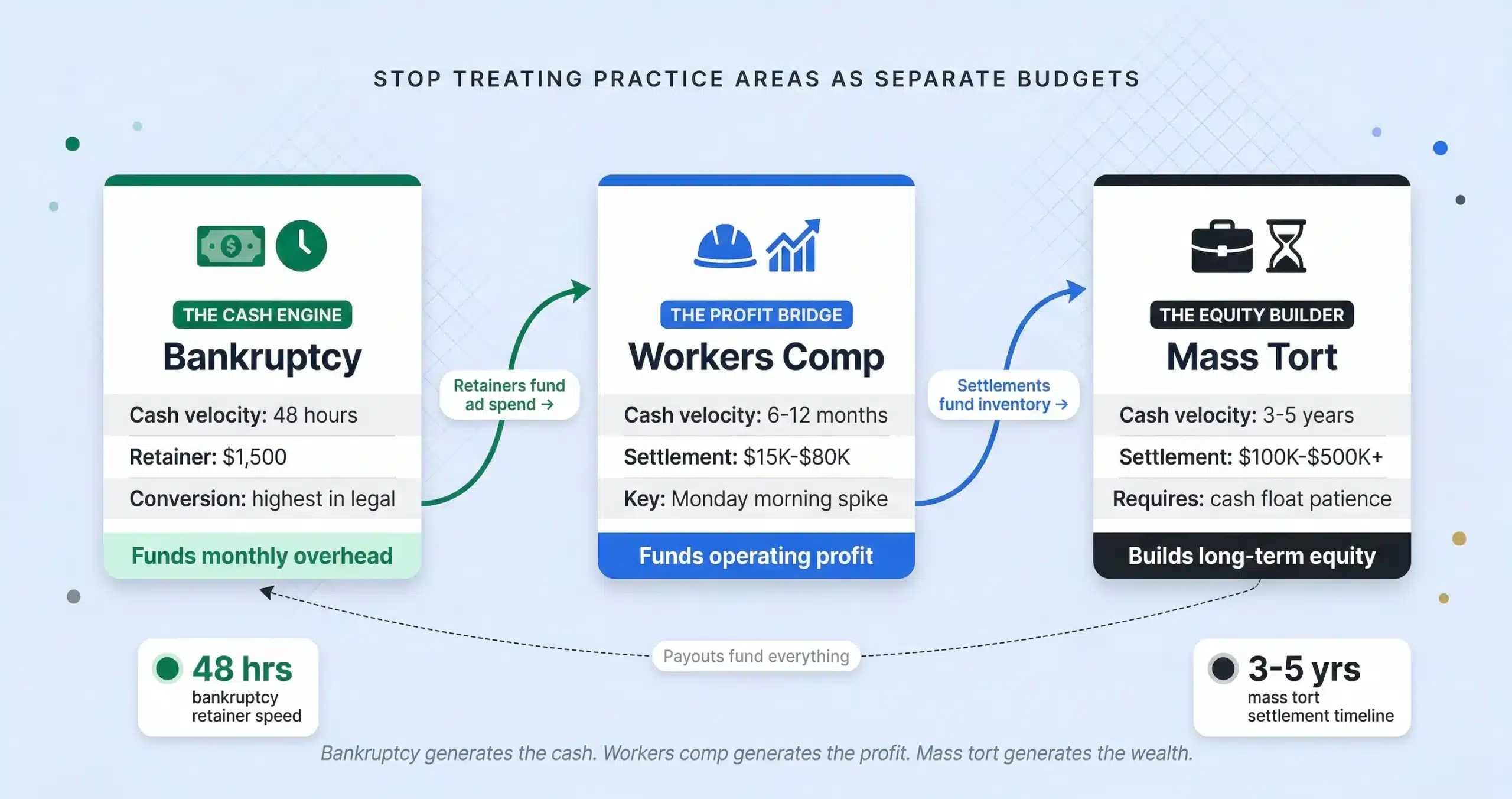
Right now most firms run their practice area campaigns like they’re separate businesses that have nothing to do with each other. The bankruptcy campaign has its own budget, the workers comp campaign has its own budget, and if they’re doing mass tort the partner writes a check every month and hopes something comes back in three years. The budgets don’t talk to each other, the cash flow from one never funds the other, and the partner ends up killing the mass tort campaign in month six because the monthly statement looks like a loss even though the cases won’t settle for another 30 months. But the firms that are growing fastest right now treat their practice areas like a portfolio; bankruptcy generates the cash that funds the workers comp clicks, and the workers comp settlements fund the mass tort inventory, and the whole thing becomes a self-funding cycle instead of three separate expenses competing for the same budget.
TL;DR
Stop treating practice areas as isolated campaigns. Treat them as a portfolio. Bankruptcy generates retainers within 48 hours to cover monthly overhead. Workers comp produces settlements in 6 to 12 months to fund operating profit. Mass tort builds equity over 3 to 5 years. The firms growing fastest in 2026 use the cash velocity from bankruptcy to fund the workers comp spend, and skim the workers comp settlements to buy mass tort inventory. The CPC benchmarks page has the exact cost data by practice area. This page covers the trigger event strategy for each vertical and the execution sequence that turns your ad budget into a self-funding cycle.
THE PORTFOLIO: THREE PRACTICE AREAS, THREE CASH VELOCITY TIMELINES, ONE BUDGET
BANKRUPTCY PPC: THE TRIGGER EVENT STRATEGY THAT TRIPLES CONVERSION RATES
Bankruptcy has the highest conversion rate in all of legal PPC (the CPC benchmarks page has the exact numbers), and the reason is that the person searching is in acute distress and needs help today, not next month. But the mistake most firms make is bidding on “bankruptcy lawyer” or “filing for bankruptcy” which are cluttered with people browsing free advice and students researching the process. The clients who sign retainers within 48 hours aren’t searching those terms; they’re searching for the specific event that’s about to happen to them.
The trigger event keywords (bid on these, not “bankruptcy”)
“Wage garnishment lawyer” · their paycheck just got cut. Deadline is now.
“Stop foreclosure before sale date” · their house is on the auction block.
“Car repossession attorney” · they lost their transportation to work.
“Creditor harassment lawyer” · they’re getting calls at work and need it to stop.
Lower search volume on every one of those, but the conversion rate is roughly 3x what you get on the generic terms because the person isn’t researching; they’re reacting to a specific event with a deadline attached to it. And the retainer comes in within 48 hours, which is the cash velocity that makes bankruptcy the engine of the whole portfolio. Bankruptcy filings hit their highest quarterly total since 2016 last year, with Subchapter 5 restructuring driving a surge in smaller commercial cases, which means the market is growing and the trigger event keywords haven’t caught up in CPC yet.
WORKERS COMP PPC: THE MONDAY MORNING SPIKE AND THE INDUSTRY OVERLAY
Workers comp sits in a tough middle ground where the CPCs are high enough to hurt but the case values don’t reach PI levels, so the margin for error is thin. The benchmarks page has the exact CPC ranges. The mistake is treating it like “auto accident lite” and running the same campaign structure. Workers comp has its own behavioral patterns that change the strategy entirely.
The Monday Morning spike
About 40% of searchable workers comp intent happens before noon on Monday. The pattern is consistent; injuries happen on Friday afternoon or over the weekend, the worker waits to see if it gets better, it doesn’t, and they search for a lawyer first thing Monday morning before their shift. If your campaigns run at the same bid 24/7 you’re overpaying for low-intent Tuesday afternoon clicks and underbidding during the window when the highest-value searches happen. Set your bid adjustments to increase 30% to 50% on Monday mornings and taper through the week.
The other lever is industry overlay bidding. “Workers comp lawyer” attracts everyone; injured nurses, construction workers, warehouse employees, office workers with carpal tunnel. But the case values vary dramatically by trade. A construction site fall or a nurse lifting injury produces higher settlements than a repetitive stress claim, and the keywords are more specific with lower competition. Bid on “construction site injury attorney” or “nurse back injury lawyer” instead of the generic term and you get higher case values at lower CPCs because the billboard firms aren’t targeting those variations. A documented case study showed that blending these industry-specific terms with standard keywords increased conversions from 4 to 26 in a single year while dropping the average cost per conversion from $530 to $180.
And the negative keywords page matters more for workers comp than almost any other practice area because “workers compensation” matches employer intent (buying insurance), HR intent (state guidelines), and student intent (researching labor law) at the same volume as client intent. Without the filters your budget evaporates on people who were never going to hire you. The construction industry data reinforces this; 70% of contractors face delayed payments and 1 in 4 have reduced bidding activity due to financial strain, which means more corners cut on safety, more injuries, and more search volume coming from people who actually need representation.
MASS TORT PPC: THE INVENTORY MINDSET AND WHY MOST PARTNERS KILL THE CAMPAIGN TOO EARLY
Mass tort doesn’t work on a month-to-month budget and the partners who try to run it that way kill the campaign before it produces anything. The cost per signed case is substantial, the settlements take 3 to 5 years to materialize, and the monthly P&L looks like a loss for the entire duration. You’re not buying leads; you’re building an inventory of future annuities, and if you can’t float the cash for the full litigation lifecycle you shouldn’t enter.
The firms making money in mass tort right now are the ones who bought inventory early in the litigation cycle before media coverage drove the lead costs up by 10x or more.
The specific torts, trial dates, and CPL ranges driving these campaigns are covered on the 2026 mass tort keyword calendar. But from a portfolio perspective, your job isn’t picking the tort; it’s surviving the cash float. Every active MDL has a window where lead costs are manageable relative to the projected settlement values, and that window closes once bellwether verdicts hit and the media cycle drives search volume through the ceiling. The question isn’t which tort to target; it’s whether your bankruptcy and workers comp engines are generating enough cash flow to fund the inventory without the partner writing checks out of personal reserves for three years straight.
THE VERTICAL STACK: HOW BANKRUPTCY CASH FUNDS WORKERS COMP FUNDS MASS TORT
The Cash Engine
Bankruptcy Retainers
$1,500 retainers in 48 hours fund the firm’s monthly overhead and marketing spend.
The Profit Bridge
Workers Comp Clicks
Cash flow from bankruptcy covers the ad spend. The resulting settlements (6 to 12 months) fund operating profit.
The Equity Builder
Mass Tort Inventory
Skim 20% of the workers comp settlements to buy mass tort inventory (3 to 5 year payout) without touching reserves.
The whole point is that marketing stops being a monthly expense line and becomes a self-funding cycle. The bankruptcy retainers cover overhead so the partner isn’t writing checks out of pocket for the workers comp spend. The workers comp settlements produce operating profit that funds the mass tort inventory without touching the firm’s reserves. And the mass tort settlements, when they come, produce returns that dwarf what any of the individual campaigns cost. The CPC benchmarks page covers the Panic Premium psychology that explains why each of these verticals prices the way it does and the Google Ads cost page covers the general conversion funnel math.
Want me to model the portfolio math for your firm?
Send me your practice areas, your average case values, and your current ad spend. I’ll map the cash velocity timeline for each vertical and show you how the self-funding cycle would work with your actual numbers. If your current allocation already makes sense I’ll tell you that too.
About Jorge Argota · 10 years in legal marketing. Built Percy Martinez P.A.’s digital operation from a $500 budget to 287 leads in 5 weeks. Manages multi-practice-area Google Ads portfolios spanning bankruptcy, workers comp, PI, and mass tort for firms across Florida. Google Ads certified. Full bio.
Related: CPC Benchmarks by Practice Area · Most Expensive Legal Keywords · 350+ Negative Keywords · Google Ads Cost and ROI · Marketing Budget Guide