

Written by Jorge Argota · Legal Marketing · United States
Originally published from channel performance data and campaign audits. Refreshed as benchmarks change.
How Most Firms Run Marketing
Hire an agency for SEO. Hire a different one for PPC. Post on social media when someone remembers. Answer the phone when they’re not in court. Check the bank deposit at the end of the quarter and hope the number went up.
How Firms That Grow Predictably Run It
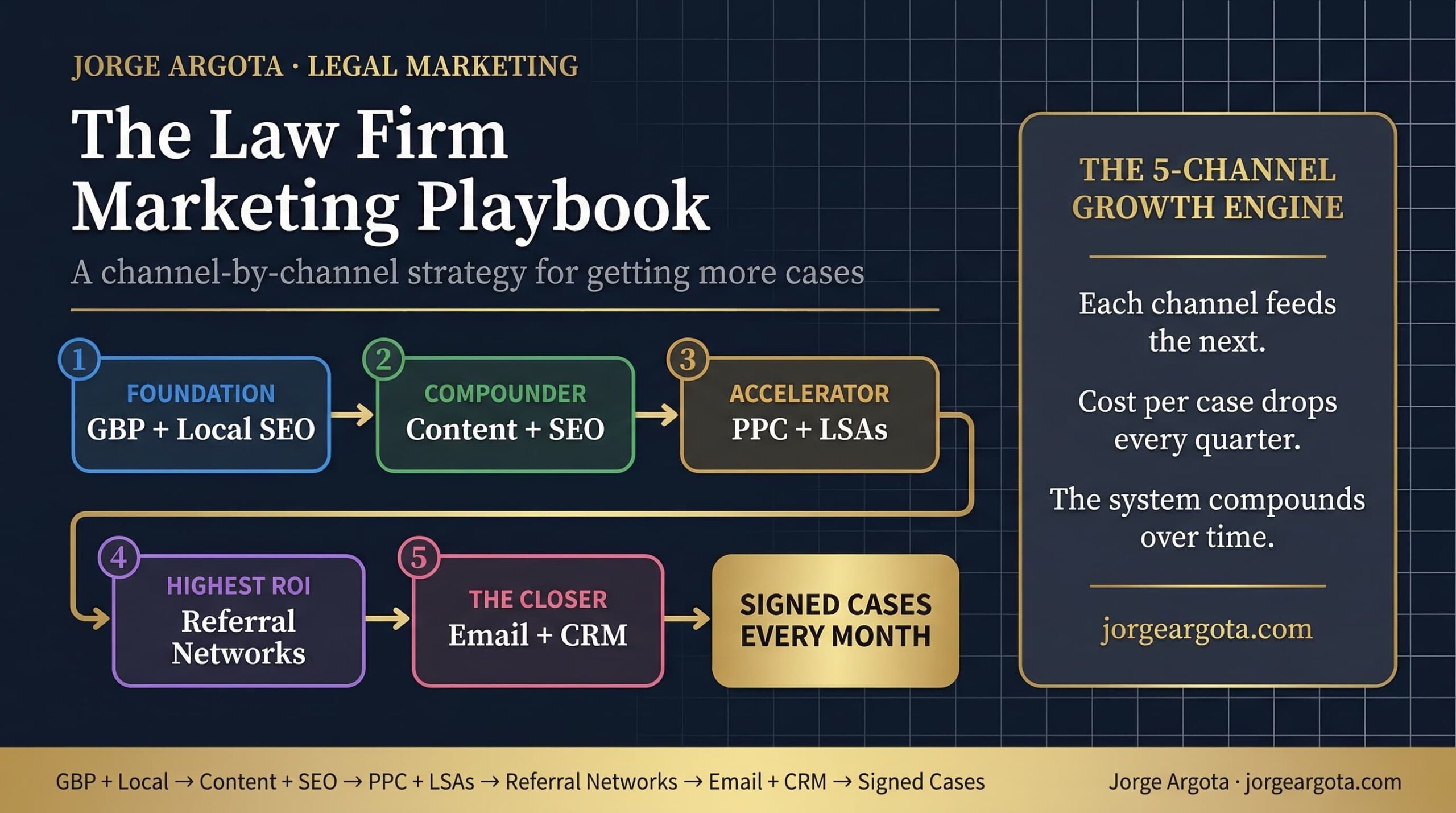
Five channels running in a specific order where each one makes the next one work better. Every dollar traced to a signed retainer. The channels compound over time so cost per case drops every quarter instead of staying flat.
Most law firm marketing advice tells you what channels exist. This page tells you what to do with each one, in what order, at what cost, and over what timeline. Because the question isn’t “should we do SEO” or “should we do PPC.” The question is which channels to run, how to sequence them so each one feeds the next, and how to measure whether the whole thing is producing cases or just producing activity.
TL;DR
What are the most effective marketing channels for law firms and how do you combine them? The 5-Channel Growth Engine: (1) Google Business Profile and local SEO as the foundation because it’s free, AI-safe, and produces the fastest return per hour. (2) Practice area content and organic SEO as the compounder that builds over 12 to 18 months. (3) Google Ads and LSAs as the accelerator for immediate cases. (4) Referral networks as the highest-ROI channel at almost zero cost. (5) Email and CRM nurture as the closer that converts the 95% of people who aren’t ready to hire today. Social media is the amplifier that feeds all five. The order matters because each channel makes the next one work better, and the strategy guide explains how the system connects.
THE 5-CHANNEL GROWTH ENGINE
I call this the 5-Channel Growth Engine because every firm I’ve audited that grows predictably runs some version of these five channels in roughly this sequence, and every firm that’s frustrated with marketing is usually running pieces of it out of order or running channels that don’t feed each other.
And the reason the order matters is that each channel makes the next one work. Your GBP feeds your local rankings. Your content feeds your organic visibility and gives your PPC somewhere useful to send traffic. Your PPC data tells you which keywords to build organic content around. Your referrals validate online through reviews that boost your GBP. Your email nurtures the people who aren’t ready yet so they come back when they are. Disconnect any one of them and the whole thing gets less efficient, which is the core argument of the strategy guide and the reason I keep coming back to it.
WHY MOST LAW FIRM MARKETING STRATEGIES FAIL BEFORE THEY START
Before walking through each channel, I want to explain the two numbers that change how you think about building a law firm marketing strategy. Because most firms violate both of these principles without realizing it, and it explains why the marketing feels expensive and random even when the individual tactics are working.
The 95:5 Rule
Only about 5% of your potential clients are actually in the market to hire a lawyer right now. The other 95% will need one eventually but not today. I think about this every time a firm tells me their Google Ads “aren’t working” after two months. The ads are working; they’re reaching people. But most of those people aren’t buying this quarter. They’ll remember who they saw when they need help later, which is why the channels that build familiarity matter as much as the channels that capture demand right now.
The 60/40 Rule
The research on marketing effectiveness says roughly 60% of budget should go toward building your brand and 40% toward capturing people who are ready to buy right now. Almost every law firm I’ve audited does the opposite; they spend almost everything on Google Ads and almost nothing on content, social presence, and reputation. The result is you’re only reaching that 5% who are actively searching and doing nothing to make the 95% think of you later. That’s why it feels like a treadmill; you stop spending and the leads stop immediately because you never built anything that compounds.
The 5-Channel Growth Engine is designed around these two principles. Channels 1, 2, and 4 build brand memory (GBP, content, referrals). Channel 3 captures the 5% who are ready now (PPC/LSAs). Channel 5 bridges the gap (email nurtures the 95% until they’re ready). When you understand this, the sequencing makes sense and you stop treating every channel like it should produce immediate cases. Some channels are investments that pay off over 12 to 18 months. Others are the cash register. You need both, and most firms only fund the cash register.
CHANNEL 1: GOOGLE BUSINESS PROFILE AND LOCAL SEO
This is the foundation because it’s free, it’s the safest channel against AI disruption, and it produces the fastest return per hour of any marketing activity I’ve seen. I’ve watched firms go from invisible in the Map Pack to top three in their market just by doing the basics consistently for a few months, and the reason it works is that most firms don’t do the basics at all. GBP signals make up about a third of what determines your Map Pack position, which means the profile itself is the single biggest lever you can pull for local visibility.
What to Do and When to Expect Results
- Complete every field in your profile. Primary category matters; “Personal injury attorney” outperforms generic “Lawyer”
- Post 2 to 3 times per week with real case updates (anonymized), community content, or educational tips
- Respond to every review within 24 hours. Review recency is the most underrated local ranking factor. Reviews mentioning specific services and locations carry extra weight
- Upload fresh photos monthly. Firms ranked #1 in the Map Pack average 101 photos versus 57 at #10
- Populate your Services menu with every practice area you handle
- Seed 15 to 20 Q&As from your verified owner account answering the questions prospects actually ask
Timeline: Visibility improvements within 2 to 4 weeks of consistent activity. Cost: Free (your time). The tactical playbook has the full GBP optimization cadence.
CHANNEL 2: PRACTICE AREA CONTENT AND ORGANIC SEO
This is the channel that compounds. It costs money upfront and produces nothing for the first few months, which is why most firms either never start or quit too early. But by month 12 it’s generating cases at a fraction of what PPC costs and the content you published six months ago is still producing leads today. I’ve seen this pattern play out dozens of times now; the firm that stays patient with SEO eventually pays less per case than the firm that’s been on PPC the whole time, because organic traffic doesn’t stop when you stop paying.
THE SEO TIMELINE (HOVER FOR DETAILS)
Foundation
Content Push
Payoff
The critical insight: firms that fail at SEO typically quit at month 8, right before the investment curve turns positive.
What to prioritize: Practice area pages first, blog posts second. Practice area pages are the highest priority because they target people ready to hire. Blog posts target people researching, which builds your site’s authority but doesn’t sign cases directly. Each practice area should have one main page with 10 to 15 supporting articles around it.
And the way you organize your website matters for both Google and the AI search tools. Think of it like building a case file. You have one main page on “car accident lawyer” that covers everything broadly, and then you have supporting pages that go deep on specific subtopics like rear-end collisions, Uber accidents, hit and run, uninsured motorist, and intersection crashes. Each supporting page links back to the main one. The main one links out to each supporting page. Google reads that internal link structure and understands that your firm actually knows this topic inside and out, which is the same way AI search engines decide who to recommend when someone asks for a lawyer.
Content Decay Is Real and Most Firms Ignore It
Practice area pages should be refreshed every 3 to 6 months or whenever significant legal changes occur. Blog posts need updating every 6 to 12 months with fresh statistics and current citations. Show “Last Updated” dates on every page. Run a quarterly check on what’s stale. Google notices when pages stop getting updated and starts showing them to fewer people, which creates a downward spiral because fewer visitors means Google thinks the page is less useful which means it shows it to even fewer people.
On AI Content for Legal
AI hallucinates court holdings roughly 75% of the time. Legal content falls under Google’s strictest quality scrutiny. Sites that published AI-generated legal content saw negative ranking impacts in the December 2025 core update. The approach that works: use AI for drafts and outlines, have licensed attorneys review and contribute, add original insights with clear bylines, and never publish unreviewed AI content on legal topics.
Cost: Small firms in less competitive markets pay $2,000 to $6,000 per month. Mid-size firms $4,000 to $10,000. Competitive metros $10,000 to $20,000+. The industry average runs $4,500 to $7,500 per month. Content creation runs $300 to $800 per blog post, $500 to $1,500 per practice area page. Link building runs $1,500 to $5,000 per month. The budget page has the full breakdown by firm size.
And here’s the payoff that makes the timeline worth it. Organic search is responsible for the majority of phone calls that turn into signed cases for law firms, and over three years the return on consistent SEO investment is several times what you put in.
But that only works if you stay long enough. The firms that fail at SEO are almost always the ones who quit around month 8, which is right before the investment starts paying off. I tell every firm I work with to commit to 18 months minimum before deciding whether SEO is working. Anything shorter and you’re measuring the construction phase, not the results.
And how fast you see results depends on your starting point. A brand new website adds 3 to 6 months to every estimate. An established site that’s been neglected can cut the timeline by about 25%. A rural estate planning firm may reach page 1 in 3 to 6 months. A PI attorney in Los Angeles or Chicago needs 12+ months minimum.
Budget matters too. $3,000 per month yields slow progress, while $8,000 per month can target page 1 between months 7 and 9. If you’re working with a limited budget, my advice is to fund SEO at the minimum level from day one even if most of the budget goes to PPC, because the compounding only starts once you start building and every month you delay is a month of compound growth you’ll never get back.
CHANNEL 3: GOOGLE ADS, LOCAL SERVICE ADS, AND PAID SEARCH
This is the only channel that produces signed retainers quickly. If you need cases this month, not six months from now, paid search is the only option. A well managed Google Ads campaign produces qualified leads within one to two weeks. LSAs can produce calls the same day.
Google Ads: The Accelerator
Produces leads within days. Full optimization takes 60 to 90 days. By month 3, most firms see a 20 to 30% drop in cost per acquisition. The minimum budget varies wildly by practice area; estate planning can start at $1,000 a month while PI firms in competitive markets need $10,000 or more before Google’s algorithm has enough data to optimize. The full Google Ads guide has the minimum budgets by practice area and the break-even math showing when the numbers work.
Local Service Ads: Pay Per Lead, Not Per Click
LSAs appear above everything in search results. Cost per lead by practice area: estate planning ~$50, criminal defense ~$75, family law ~$85, workers’ comp ~$150, personal injury $140 to $340 (average $240). Google retired all previous trust badges in late 2025 and replaced them with “Google Verified.” Response time is now a primary ranking factor; Google tracks how fast you answer and displays it in the ad.
Microsoft/Bing Ads: The Discount Channel
Legal CPC runs 25 to 40% lower than Google. The audience skews older, more educated, and more affluent, which is a good match for estate planning and employment law. Bing reaches roughly 30% of desktop legal searches. Allocate 70 to 80% of paid budget to Google, 20 to 30% to Bing. Import your Google Ads campaigns directly using Bing’s import tool and adjust bids down 30 to 40%.
PPC is the only channel that produces cases in days. SEO is the only channel whose cost per case drops every month. Running both together is how firms build a law firm lead generation system that delivers predictable new cases each month.
What Paid Leads Actually Cost by Case Type (From Real Campaign Data)
| Case Type | Avg Cost Per Lead | Regional Range |
|---|---|---|
| Slip and Fall | $312 | Midwest $260 to Northeast $400+ |
| Workplace Injury | $354 | Southeast $290 to West $420 |
| Auto Accidents | $391 | Midwest $314 to Northeast $468 |
| Product Liability | $476 | Varies widely by market |
| Medical Malpractice | $512 | Highest CPL of any practice area |
These numbers come from an analysis of 49 PI firms spending $21.4M annually, and they track with what I see in the accounts I audit. Remember these are cost per lead, not cost per signed case. With a 7 to 10% lead to retainer conversion rate, you’re looking at roughly 10 to 13 times the lead cost to actually sign a case, which is why the case value has to justify the spend. The full PPC economics guide has the break-even math showing where the numbers work and where they don’t.
The Dual-Presence Effect
The question I hear most often is how to balance SEO and PPC for law firms, and the answer is the dual-presence effect. When your paid ad and organic listing both appear on the same search results page, the combined click rate is higher than either one alone because seeing your firm name twice creates a trust signal the searcher doesn’t even realize they’re responding to. This is why I always tell firms to run both channels even when they think they can’t afford it; a small SEO investment alongside your PPC produces a multiplier effect that makes both channels more efficient. The cross-channel synergy page has the full data on how the compounding works.
CHANNEL 4: REFERRAL NETWORKS
This is the channel nobody talks about in marketing playbooks because there’s nothing to sell you. And yet in every audit I’ve done, the firms with the healthiest case flow have a referral system underneath it. Referrals close at a higher rate than any digital channel, referred clients tend to be easier to work with and stay longer, and the cost is essentially zero compared to what you’re paying per click on Google.
And the gap I keep seeing is enormous. Most people are willing to refer their lawyer, but the vast majority never do because nobody asked them. That gap is the highest ROI opportunity in legal marketing because closing it requires a system, not a budget.
The Partnerships That Produce Cases
- PI firms + chiropractors. Chiropractors treat auto accident victims daily. This is the classic pairing.
- Estate planning + financial advisors. One referral from an estate planning attorney is worth more revenue to the advisor than 20 referrals the other direction, which gives you negotiating power.
- Criminal defense to PI. DUI clients with injury claims need a separate attorney for the civil case.
- Family law to divorce financial planners. The cross-referral happens naturally.
Critical ethics note: Non-lawyer referral fees are prohibited under ABA Rule 5.4. You cannot pay chiropractors or financial advisors per referral. Attorney-to-attorney fee division under Rule 1.5(e) is permissible when proportional and the client agrees in writing. Typical referring attorney fee: 25 to 33%.
Timeline: 6 to 12 months of consistent relationship building before reliable case flow begins. Cost: Near zero; primarily relationship maintenance, meals, events, and professional association dues. The payoff compounds because a strong referral relationship sends you cases for years.
Networking is the most common marketing strategy in the legal industry and close to half of firms say it’s their highest ROI channel. Yet most firms run referrals informally; they wait for cases to come in rather than building a system.
The firms that formalize their referral program outperform the ones that don’t. That means tracking referral sources in your case management software, sending quarterly check-ins to referral partners, and having a structured ask process after case resolution. The difference between “we get referrals” and “we run a referral program” is the difference between luck and a system that produces predictable results.
And this is where online and offline marketing connect into one system. Your referral partners send you clients offline; those clients leave Google reviews that strengthen your online GBP rankings; those rankings produce more organic leads online; those leads enter your email nurture; and the cycle compounds. The firms that treat online and offline as separate buckets miss the compounding. The ones that connect them into a single system get more out of both than they would running each one in isolation.
CHANNEL 5: EMAIL AND CRM NURTURE
And this is the channel most law firms ignore entirely, which is strange because email performs better in legal than in any other industry I’ve looked at. The click rates are more than double the average across all industries and the return on every dollar spent is somewhere in the $36 to $42 range, which makes it one of the highest ROI channels available to any business, not just law firms.
The reason email matters at the strategy level goes back to the 95:5 rule from earlier on this page. Email is how you capture that 95% who aren’t ready to hire today. It keeps you in their inbox until they become the 5%, and when they do, they already know who to call. You’re converting people at nearly zero cost because the relationship was already built.
The Drip Structure That Works
- Immediate: Auto-text plus auto-email the moment a lead submits a form
- Days 1 to 7: 3 to 5 email welcome series with practice-area-specific educational content
- If they don’t sign: Consultation follow-up sequence for non-signers (most firms follow up once; top firms follow up 5 to 7 times automatically)
- After the case closes: Post-case review request plus referral ask
- Ongoing: Past-client re-engagement sequence so they refer you when someone asks
Segmented campaigns dramatically outperform generic broadcasts. When you send a family law prospect educational content about custody versus sending them the same newsletter you send your PI list, the click rates roughly double. Segment by practice area interest, client status, engagement level, and referral source. CRM options: Clio Grow for firms already on Clio ($59/user/mo), Lawmatics for firms wanting full marketing automation ($199+/mo), or HubSpot’s free tier if you need a starting point.
THE AMPLIFIER: SOCIAL MEDIA
Social media is not a lead generation channel for most law firms. It’s an amplifier that feeds the other five channels. I’ve seen attorneys sign cases from social media, and about a third of lawyers say they have at some point, but the primary function is brand awareness and trust, not direct case acquisition.
Facebook/Meta: Best for consumer-facing practices (PI, family law, criminal defense). CPC $1 to $8. Average 29% return on ad spend for law firms.
LinkedIn: Dominates B2B legal (corporate, employment, IP). 100% of solo lawyers and 91% of lawyers at firms use it. CPC $6 to $10. Best for thought leadership.
Video (YouTube + TikTok): 70% of people check Google or YouTube for legal answers before calling. The #LawTok hashtag has 1.6+ billion views. Video generates 3x higher engagement than text-only posts. Massively underused; only 24% of law firms use video marketing.
The zero-click principle: Posts without links get roughly 10x the reach of posts with links because platform algorithms penalize outbound links. Deliver value natively on-platform rather than always linking to your website. The 80/20 rule: 80% educational content, 20% promotional.
HOW TO SEQUENCE IT BY BUDGET AND FIRM STAGE
So the most common question I get is “I have $X per month, what should I do with it?” And the answer depends on whether you need cases now or you’re building for the long term, but the sequencing stays the same. Here’s how the budget allocation should shift as your firm matures.
BUDGET ALLOCATION BY FIRM STAGE
| Channel | Year 1 (Need Cases Now) | Year 3+ (Compounding) |
|---|---|---|
| PPC + LSAs | 60% | 25% |
| SEO + Content | 25% | 45% |
| Social Media | 10% | 10% |
| Referrals | 5% | 10% |
| Email / CRM | 0% | 10% |
Year 1 is PPC-heavy to generate immediate cash flow while SEO builds. By Year 3+, organic rankings have matured and the cost per case through SEO is a fraction of PPC, so the allocation flips.
| Practice Area | Primary Channel | Why |
|---|---|---|
| Criminal Defense | PPC + LSAs (60%+ of budget) | Clients search immediately after arrest; urgency makes paid channels non-negotiable |
| Estate Planning | Content + Email Nurture | Long consideration cycle; educational content and drip campaigns outperform paid search |
| Immigration | Community + Multilingual Content | Local events, immigrant organization partnerships, and native Spanish content reach the audience |
| Employment Law | Dual: LinkedIn (B2B) + PPC (B2C) | Employer-side needs thought leadership; employee-side needs local SEO and paid search |
| Personal Injury | SEO + PPC (largest budget required) | Highest case values justify the spend; organic leads convert at 15 to 20% versus 5 to 8% for paid |
| Family Law | PPC + Content + Referrals | Moderate CPCs, decent case values, and strong referral network potential from financial advisors |
The way to align your marketing strategy with your most profitable practice areas is to look at this table and put the most money behind the channels that match your highest-value cases. If your firm handles both estate planning and personal injury, the PI cases are worth more per signed retainer, so the PI budget should be larger and pointed at the channels that work for PI specifically. The estate planning budget can be smaller but should go toward content and email where the economics make sense for lower case values. Stop spending the same amount on every practice area and start spending proportionally to what each one is worth when it signs.
THE DIRECTORIES QUESTION: WHAT’S WORTH IT AND WHAT ISN’T
The directory landscape consolidated dramatically in late 2024 when Internet Brands acquired FindLaw. They now own Avvo, Martindale-Hubbell, FindLaw, Nolo, Lawyers.com, and Super Lawyers under one corporate roof. That’s important context because these directories compete directly with the websites of their own clients for the same search queries.
Free Profiles You Should Claim Immediately
- Google Business Profile (highest priority; covered above)
- Avvo (97% of licensed attorneys already have auto-created profiles; claim and optimize yours)
- Justia (free profile with valuable backlinks, unlike Avvo’s)
- Martindale.com / Lawyers.com
- State bar directory, Yelp, BBB, HG.org
On paid directory advertising: Justia Premium ($100 to $300/mo) is widely recommended as the best value for solo and small firms because it provides backlinks that improve your SEO, unlike most directories. Avvo paid advertising draws mixed reviews; some firms attribute cases to it, others report zero leads after months. FindLaw’s paid packages should be approached with extreme caution; firms do not own their website domain if FindLaw builds it. The agency selection guide covers why platform ownership matters more than any directory listing.
HOW THE CHANNELS FEED EACH OTHER (THE INTEGRATION THAT MAKES IT WORK)
So the reason I call this the 5-Channel Growth Engine and not just “five channels” is that the channels aren’t independent. They feed each other. And whether they feed each other in a way that helps you or hurts you depends on whether the law firm marketing strategy connects them into a system or runs them in silos. This is the key component of a law firm marketing strategy that generates qualified leads consistently; it’s not any single channel, it’s the connection between them.
And the way people actually hire lawyers makes this real. Almost nobody calls the first firm they find. Most potential clients talk to two or three firms before deciding, they visit five or more websites during their research, and a growing number use AI search tools like ChatGPT to narrow the field before they ever pick up the phone.
That means if you’re only looking at “who clicked the ad before they called,” you’re ignoring most of the marketing that actually produced the case. For PI firms, the decision can stretch 60 to 90 days. If you’re measuring results in a 7 day window, you’ll end up cutting channels that are working because you can’t see their contribution yet.
The strategy guide covers the full mechanics of how channels compound when connected and destroy each other when siloed. But here’s the practical version for this playbook:
The Practical Integration: PPC Data Drives Your SEO Calendar
PPC → SEO: Run PPC for 90 days. Find which keywords produce signed cases. Build organic pages around those exact terms. Over 6 to 12 months, organic replaces paid on those terms. Your PPC budget shifts to the next batch of keywords you haven’t ranked for yet. This cycle is why cost per case drops every quarter instead of staying flat.
Referrals → GBP: Every referral client who leaves a review mentioning your practice area and location strengthens your Map Pack signals. Email → Everything: Your list captures the 95% and brings them back at nearly zero cost. CRM → Ads: Push signed case data back to Google so the algorithm learns what a good lead looks like. The measurement connecting all of it is cost per signed retainer by channel, tracked through CallRail or WhatConverts into your CRM. The pipeline guide has the full setup.
THE INTAKE GAP WHERE REVENUE DISAPPEARS
The Industry Average
33% of firms respond to emails. 40% answer phone calls. Only 12% of secret shoppers would recommend the firms they contacted. 86% of firms never collect email addresses from leads.
What Top Firms Do
Respond within 5 minutes (21x more likely to qualify the lead than at 30 minutes). 67% of clients choose the first firm to respond. Trained intake staff convert at 30%+ versus 10% without dedicated intake.
Every channel on this page feeds into the same intake process, and if that process is broken, the best marketing in the world produces expensive reports instead of signed cases. The strategy guide covers why intake has to be the first thing you fix and how it either multiplies or destroys every marketing dollar you spend. But the short version is that most firms aren’t even answering the phone, which means they’re paying hundreds per click and letting the lead call someone else.
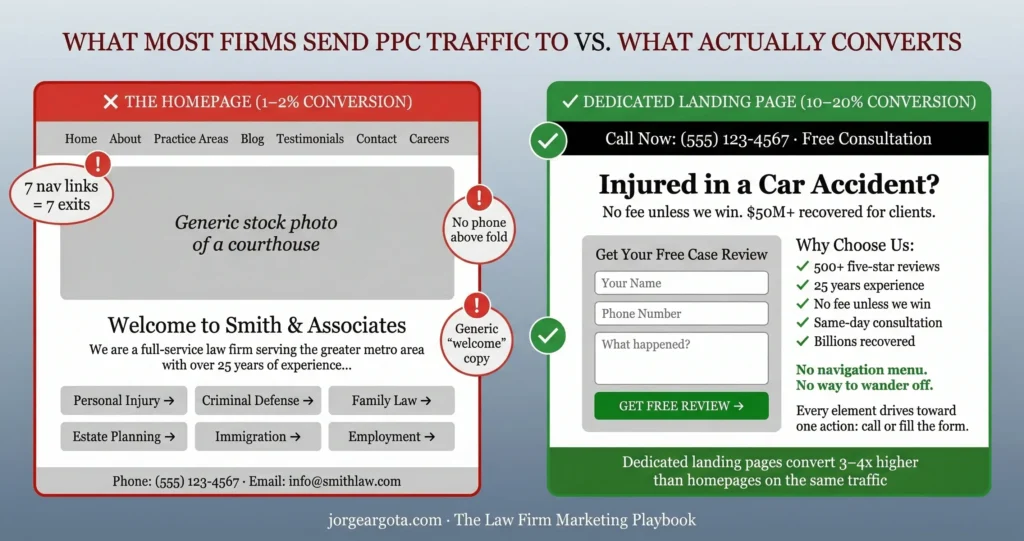
What high converting landing pages need:
- Clear CTAs above the fold with a phone number and short form visible before any scrolling
- Social proof: 80% of potential clients consider reviews before hiring
- Page load under 3 seconds; each additional second costs roughly 4.4% in conversions
- Click-to-call buttons on every mobile page (mobile drives 7x more traffic than desktop in legal)
- Live chat or chatbot integration; 51% of clients find chatbots useful for exploring legal options
And the intake technology to support it doesn’t have to be expensive:
- Smith.ai live chat: $140/mo for 20 chats
- Smith.ai virtual receptionist: $293/mo for 30 calls
- Ruby: $135/mo for 10 chats
- For context: a full-time in-house receptionist costs $58,000 to $68,000/year including benefits
The math on after-hours answering services almost always works at legal case values.
And the thing that ties all five channels together is the tracking system that tells you where every case came from. In plain terms: different phone numbers for different marketing sources so you know which calls came from Google Ads versus organic versus your GBP. Your case management software carries that source data from the first contact all the way through to the signed retainer. And when a case signs, that outcome gets sent back to Google so the algorithm learns what a good lead looks like. Without this tracking, every channel on this page is flying blind and you can’t answer the only question that matters: what did it cost to sign this case? The pipeline guide has the full technical setup.
The 5-Channel Growth Engine in One Paragraph
Start with GBP because it’s free and produces results in weeks. Build practice area content and start SEO because it compounds over 12 to 18 months and eventually produces the cheapest cases. Layer on PPC and LSAs to generate immediate cases while SEO builds, then use the converting PPC keywords to prioritize your SEO content calendar. Build referral partnerships because they convert at the highest rate at nearly zero cost. Set up email nurture to stay in touch with the 95% who aren’t ready today but will be eventually. Connect everything through call tracking, CRM integration, and offline conversion imports so every channel gets smarter over time. The firms doing this outperform the firms spending more money on disconnected tactics, which is the whole point of the strategy guide and the reason the system matters more than any individual channel.
Want me to build the 5-Channel Engine for your firm?
Send me your current setup, your budget, and what you’re trying to grow to. I’ll map which channels to prioritize, in what order, and what to expect. If the system you have is already working I’ll tell you that too.
P.S. The average customer journey in legal involves 6 to 8 touchpoints before someone hires a lawyer, and some research puts it at 10. That’s why single-channel marketing feels random; you’re seeing one sixth of the picture. The 5-Channel Growth Engine isn’t about doing more things. It’s about doing the right things in the right order so each touchpoint builds on the last one instead of happening in isolation. And the measurement that connects all of it is cost per signed retainer by channel, which is the number that tells you whether the engine is working or just burning fuel.
Related: Complete 2026 Strategy Guide · Google Ads Costs and ROI · Budget Benchmarks by Firm Size · Predictable PI Lead Pipeline · Google Ads and GBP Tactics · Channel Economics by Signed Cases · How to Choose an Agency · Best Law Firm Marketing Agencies