
The First Thing I Look at on an Ohio Law Firm’s Website Is Whether the Words Are Right
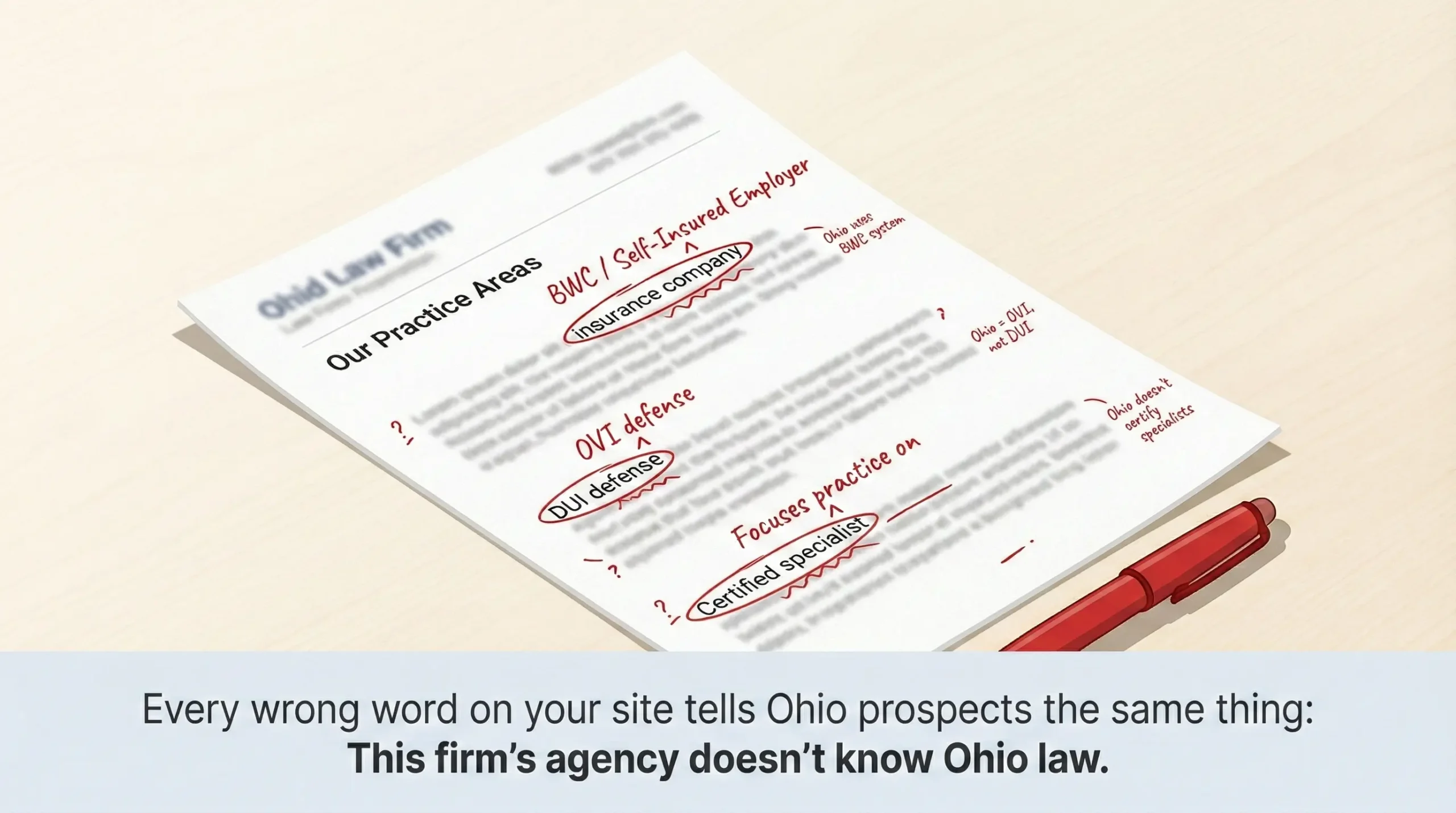
So there’s this thing I do when I’m auditing an Ohio firm’s site where I search the page for three specific phrases, and if I find any of them I know the agency that built it doesn’t understand Ohio law, which honestly tells me everything I need to know about the rest of the campaign. The three phrases are “insurance company” on a workers’ comp page, “DUI” without “OVI” anywhere near it, and “certified specialist” without an Ohio Supreme Court CCAS credential backing it up. And I find at least one of them on maybe 70% of the Ohio firm sites I audit, which means the agency either used a template from another state and swapped in “Ohio” or they just didn’t research the jurisdiction, and either way the firm is paying for content that signals to every Ohio prospect that nobody on the marketing side actually knows how things work here.
Because Ohio workers’ comp is a state monopoly. It’s one of four states where businesses buy coverage from the state fund, the Bureau of Workers’ Compensation, not from a private insurer. About 1,200 large employers like Honda, Cleveland Clinic, and Kroger are self-insured but still regulated by the BWC. When your website says “we’ll fight the insurance company for your workers’ comp benefits” you’ve told every injured worker in Ohio that you don’t know who you’re actually fighting, and that’s not a small thing when the person reading it has a BWC claim number in their hand and they’re trying to figure out if you understand their situation or not.
And Ohio’s drunk driving statute is OVI; Operating a Vehicle Impaired. Not DUI. People search “DUI” because that’s what they’ve heard on TV, but the citation in their hand says OVI, the police report says OVI, and the court docket says OVI. A firm that only optimizes for “DUI” captures the broad search but misses the local signal that tells the prospect this attorney actually practices in Ohio courts. You need both terms but the OVI vocabulary is what converts because it matches what the person is holding.
36,946 registered attorneys. 75% concentrated in six counties serving 42% of the population. The rest of the state has attorney-to-resident ratios exceeding 1:1,500. The vocabulary problem and the geographic concentration problem are the same problem; agencies treat Ohio as one market with one set of terms and it’s not.
The Cap Nobody Explains and the Exception That Changes Everything
Ohio tort reform put a ceiling on non-economic damages for most personal injury cases and I think maybe 10% of law firm websites in the state explain it clearly. Under ORC §2315.18 the cap is the greater of $250,000 or three times economic damages, up to $350,000 per plaintiff or $500,000 per occurrence. For a standard car accident with soft tissue injuries that means pain and suffering has a statutory limit, and the marketing that promises “we’ll get you what you deserve” without acknowledging this cap is setting expectations the law won’t let the firm meet.
But there’s a catastrophic injury exception that removes the cap entirely and this is where the money math changes. If the injury involves permanent and substantial physical deformity, loss of use of a limb, or loss of a bodily organ system, the cap disappears. No limit on non-economic damages. A single catastrophic case can settle for more than a hundred standard capped cases combined, and the firms winning those cases are the ones whose content targets the exception specifically; “amputation lawyer Ohio,” “traumatic brain injury attorney Columbus,” “permanent paralysis” not just “car accident lawyer.” I’d bid five to ten times higher on those keywords because the return per case justifies it and the competition is lower because most agencies don’t know the exception exists.
Ohio also runs modified comparative negligence with a 51% bar, which means if the plaintiff is found more than 50% at fault they recover nothing. That cliff creates the same kind of intake filter problem I see in contributory negligence states, just with a higher threshold. The ad copy that works is “they’ll try to blame you to pay you nothing” because that’s the exact fear the 51% bar creates and the prospect reading it either recognizes the risk or they don’t, and either way the content has done its filtering job.
Five City-States and Each One Has Its Own Vocabulary
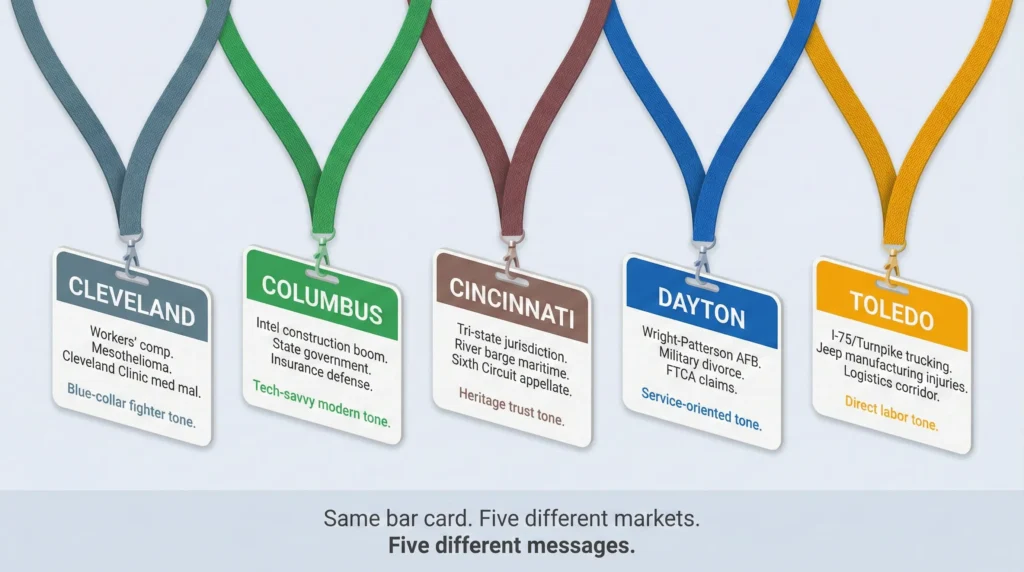
Cleveland is the industrial legacy market and the vocabulary is blue-collar. Cuyahoga County has the highest attorney density in the state at 1:250 and the ad costs reflect it; $200 to $500 per click for PI terms. But the real Cleveland play is the VSSR; Violation of a Specific Safety Requirement. If the employer violated a specific Ohio safety code and caused the injury, the worker gets a bonus award of 15% to 50% on top of standard BWC benefits, paid as a penalty by the employer, which honestly changes the whole value calculation on those cases. “Was the machine guard missing” and “did your employer ignore safety rules” are better hooks than “injured at work” because they target the mechanism that leads to bonus compensation, and I build content around specific Ohio Administrative Code violations because that’s what the claim actually references. Medical malpractice tied to Cleveland Clinic and University Hospitals fills in the other high-value vertical. Criminal defense targets OVI in the Cuyahoga County courts and the Mayor’s Courts across the suburbs.
Columbus is the growth engine and the vocabulary is modern. Intel’s $20 billion semiconductor facility in Licking County is creating a construction boom that drives personal injury cases specific to construction accidents; a time-sensitive opportunity that I think has maybe two or three years of peak volume before it levels off, which probably makes it the most urgent marketing play in Ohio right now. State government drives administrative and regulatory law. The Ohio State University campus generates its own criminal defense demand. The client base is younger, more educated, and more likely to research extensively before calling. The “fighter” rhetoric that works in Cleveland doesn’t work here; Columbus prospects respond to “smart” and “strategic” and the website has to look like it belongs in a tech company’s portfolio, not a 1990s legal directory. Employment law for Nationwide, Huntington, and the corporate relocations.
Cincinnati is the border market and the vocabulary is jurisdictional. The Ohio River, I-71 and I-75 bridges, Kentucky and Indiana on the other side; accidents here involve multi-state jurisdictional questions that most agencies honestly don’t address in the content and I think that’s probably the biggest missed opportunity in the Cincinnati market. River barge traffic creates Jones Act maritime claims. The Sixth Circuit Court of Appeals makes it a federal appellate hub. Family law and estate planning serve a more conservative, heritage-oriented client base where “serving Cincinnati since” carries more weight than “aggressive” ever will. Immigration for the cross-border workforce.
Dayton is the military market and Toledo is the logistics corridor. Wright-Patterson Air Force Base makes Dayton the state’s military family law center; military pension division, custody during deployment, FTCA claims for on-base accidents. “Military divorce lawyer Wright-Patt” is a low-competition keyword with high case value. Toledo sits where I-75 meets the Turnpike and the trucking accident volume is disproportionate to the population; “Turnpike accident lawyer” and “I-75 truck crash attorney” target the corridor. Jeep manufacturing in Toledo drives workers’ comp with the same BWC and VSSR vocabulary as Cleveland. Bankruptcy and mass tort serve both markets.
The Right Words in the Right Market
Every Ohio campaign I build starts with a vocabulary audit because the words on the page tell the prospect whether the firm’s agency understands Ohio or not. BWC not insurance company. OVI not just DUI. “Focuses practice on” not “certified specialist.” Catastrophic exception not unlimited damages. VSSR not generic “workplace injury.” 51% bar not “we’ll fight for what you’re owed.” Once the vocabulary is right the geography determines the tone; Cleveland gets grit, Columbus gets polish, Cincinnati gets heritage, Dayton gets service, Toledo gets directness.
GEO-structured content targeting Mayor’s Courts by name captures high-intent leads that cost a fraction of what broad city terms cost. “Dublin Mayor’s Court lawyer” or “Blue Ash Mayor’s Court OVI” target someone with a citation in hand and a court date approaching, and the budget efficiency on those terms is better than almost anything else in Ohio criminal defense. Local Services Ads by county. Tracking from click to signed retainer by city-state, practice area, and whether the case clears the cap or the exception. Full data ownership. Everything is yours. Reports → ROI →
Ohio allows trade names for law firms as of June 2020 but the name can’t imply a public or charitable connection. Domain names implying a city presence require an actual physical office in that city; virtual offices don’t qualify. Attorneys are personally responsible for all content posted by agencies on their behalf and every digital ad must include the firm name and office address. Testimonials are permitted but must not create unjustified expectations; “we get millions” must become “we recovered $X in a specific trucking case involving catastrophic injury.” Superlatives like “best” or “top-rated” require objective substantiation. We build all of this in. Ethics → Review management → Review ethics →
Ohio Markets We Serve
Cleveland, Columbus, Cincinnati, Dayton, Toledo, Akron, Canton, Youngstown, New Albany, Licking County, Cuyahoga County, Franklin County, Hamilton County, Montgomery County, Lucas County, and throughout the state. We work with firms nationwide too. Tell us about your market →
Are the Words on Your Site Right or Are They Telling Every Ohio Prospect Your Agency Doesn’t Know the State?
Send me your site and I’ll run the vocabulary audit I described; BWC vs insurance company, OVI vs DUI, specialist vs focuses on, capped vs catastrophic. Takes maybe 15 minutes. If the words are right I’ll tell you and we can both move on. If they’re wrong, which honestly they usually are, that’s the conversation worth having, or don’t send anything, either way.
Talk to Jorge → Phone or text: 941 626 9198