

Florida Is Five Markets, Not One
A click on “car accident lawyer” costs $450 in Miami and $180 in Jacksonville. Same state. Same practice area. Same Google. But the person clicking in Miami is searching in a market where over half the population was born outside the US and bilingual campaigns aren’t optional, they’re baseline. The person clicking in Jacksonville is searching in a city built around a naval base and a logistics corridor where the dominant case types are trucking accidents and military divorce. The demographics, the competition, the ad costs, and the practice area demand are so different between those two cities that a single statewide strategy would waste money in both of them.
That gap runs across every metro in the state. South Florida is immigration and international law. Orlando is tourist injury and hospitality disputes, and it’s where Morgan & Morgan is headquartered with an estimated $218 million to $350 million annual ad spend that raises the cost floor for everyone else. The Gulf Coast is estate planning and elder law for one of the oldest median-age populations in the country. Tampa is construction litigation and the I-4 corridor, statistically one of the deadliest highways in America. A firm that treats all of Florida as one market is building a strategy that fits none of these regions well.
Florida has roughly 80,000 active attorneys and the number grew 17% over the past decade. But they’re not spread evenly. Tallahassee and Miami have some of the highest attorney density in the country. Rural areas between the metros are comparatively underserved, and a firm that targets those gaps strategically can build a practice without competing against the billion-dollar advertising machines.
What a Click Costs in Each Market
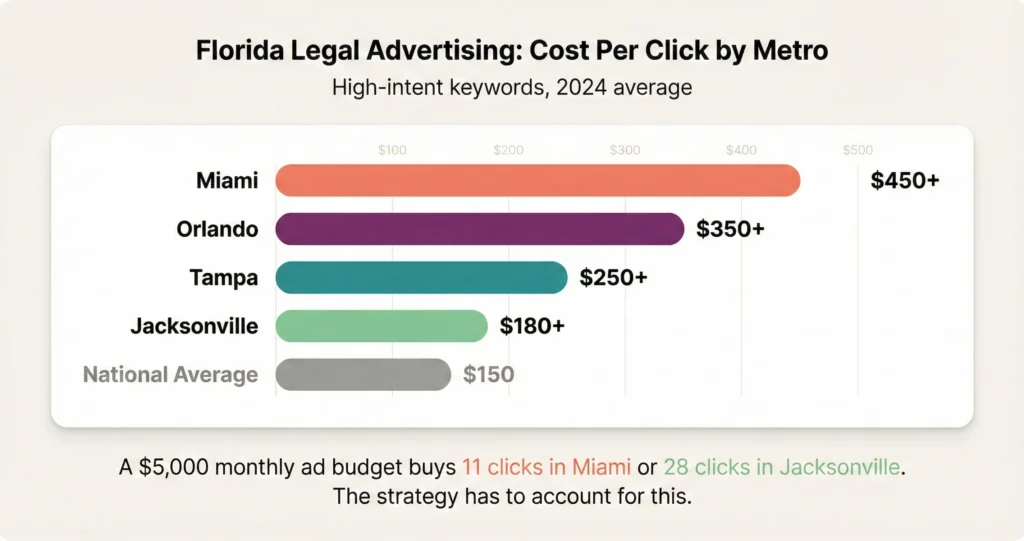
The cost gap between Florida’s most expensive and most affordable markets is larger than most firms realize. A personal injury click in Miami can cost more than three times what the same click costs in Jacksonville. That doesn’t mean Miami is a bad market. The case values are higher, the settlement amounts are larger, and the revenue per signed case justifies the cost. But it means the budget allocation and the strategy have to be built around each market’s specific economics.
In Miami, a firm spending $5,000 a month on ads can’t bid on broad terms. The budget runs out in a day. The strategy has to shift to long-tail targeting, specific intersections and hospitals, and heavy investment in organic search to bring the blended cost per lead down over time. In Jacksonville, that same $5,000 buys real coverage across the entire metro, and the strategy can afford broader targeting with paid ads while building organic presence simultaneously.
The “Morgan & Morgan effect” is real. When a single firm spends an estimated $218 million to $350 million a year on advertising nationally and is headquartered in Orlando, it raises the cost floor for every other firm in the state. You can’t outspend them. You outmaneuver them with precision targeting and deeper content in the niches they process impersonally.
Florida Practice Areas With Market-Specific Dynamics
Each practice area in Florida has something that makes it different from the same practice area in other states. Some of these are legal (tort reform, no-fault insurance, pre-suit requirements). Some are demographic (bilingual markets, retiree populations, military communities). All of them change how the marketing needs to work.
Personal injury runs through Florida’s no-fault insurance system. The $10,000 PIP requirement means marketing has to filter for “threshold” cases involving permanent injury that get past the PIP cap. Recent tort reform shortened the statute of limitations to two years and introduced modified comparative negligence, which means speed to lead matters more here than in almost any other state. The I-95, I-75, and I-4 corridors are among the deadliest in the country.
Medical malpractice in Florida requires a 90-day pre-suit investigation before filing. Most potential clients don’t know this. Content that explains the process, including the requirement for a verified expert medical opinion, filters out leads that won’t convert and builds the kind of authority that AI search tools cite as sources.
Immigration in South Florida is segmented by nationality. Cuban adjustment, Venezuelan TPS, Haitian asylum, and CHNV parole programs each require different content, different keywords, and often different languages. A firm marketing “immigration services” generically in Miami is competing against firms with content written specifically for each community in their own dialect.
Mass tort has a veteran audience in Florida. Camp Lejeune claims are particularly relevant in Jacksonville and Pensacola because of the large military population. Floridians also prefer local firms over national lead aggregators even for federal MDLs, which creates opportunity for firms that can combine local trust with national case capability.
Family law in Florida includes “Snowbird divorce.” Jurisdictional battles over whether to file in Florida or a northern state are common among high-net-worth retirees, particularly in Sarasota and Palm Beach counties. The “Gray Divorce” market for couples over 50 is growing on the Gulf Coast.
Criminal defense handles “vacation arrests.” Tourists arrested in Florida who live elsewhere need representation, and the marketing has to reach people who are panicking in a hotel room searching on their phone. Spring Break in Panama City and nightlife in Ybor City create seasonal DUI spikes.
Bankruptcy benefits from Florida’s unlimited homestead exemption. This is a massive differentiator that drives specific searches like “can I keep my house filing Chapter 7 in Florida” and makes Florida a uniquely favorable state for debtors with home equity.
Estate planning dominates the Gulf Coast. Sarasota and Naples have some of the oldest median ages in the US. The demographic responds to trust-first marketing: larger fonts, clear navigation, referral relationships with financial planners, and website design built for readability.
Employment law in Florida operates in an at-will state with limited exceptions. Marketing focuses on the narrow grounds that are actionable: discrimination under federal and Florida Civil Rights Act, retaliation, wage theft, and FMLA violations. The hospitality industry workforce in Orlando creates a specific employment law client base.
What We Build for Florida Law Firms
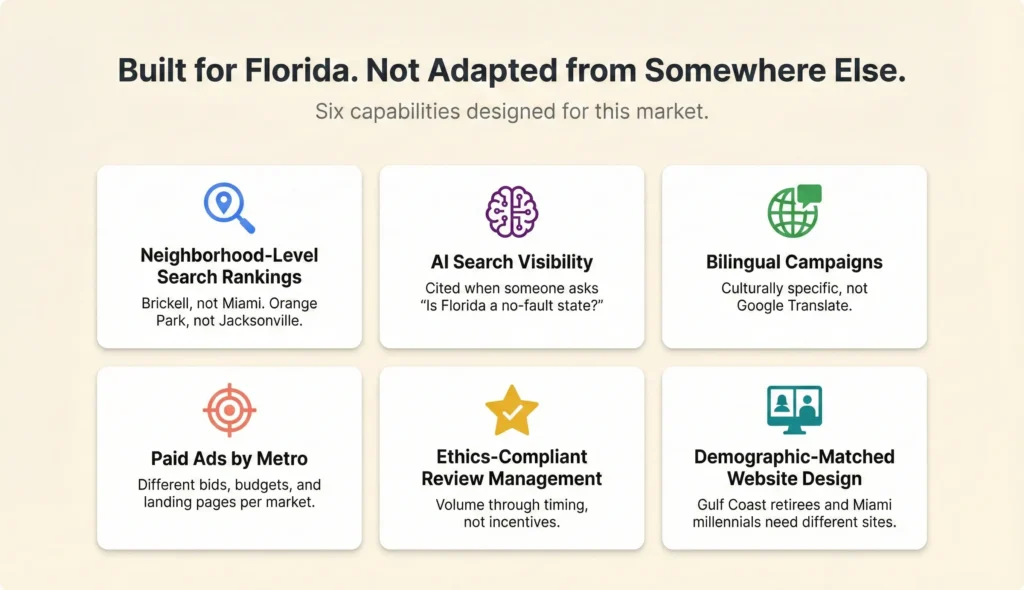
Every service we offer is built around Florida’s specific competitive dynamics. Not generic “legal marketing” dropped into a Florida template.
Search rankings built at the neighborhood level, not the metro level. In Miami, ranking for “Miami” is nearly impossible without a massive budget. Ranking for “Coral Gables personal injury lawyer” or “Hialeah abogado de accidentes” is viable and converts better because the person searching wants someone local to their neighborhood. In Tampa, separate strategies for each side of the bay because residents rarely cross the Howard Frankland or Skyway for a lawyer. In Jacksonville, suburb-level pages for Orange Park and Jacksonville Beach because the city is too geographically large for generic targeting.
AI search visibility answering Florida-specific legal questions. “Is Florida a no-fault state?” “What is the homestead exemption in Florida?” “What is the statute of limitations for medical malpractice in Florida?” These get answered by AI directly now, and if your firm’s content is the cited source with the specific Florida statute referenced, your name is what appears. We structure every page with code that tells AI systems exactly what your firm covers, where you practice, and who your attorneys are.
Bilingual campaigns in South Florida. Not a Google Translate toggle. Culturally specific content in the dialect relevant to the community you’re reaching, whether that’s Cuban, Venezuelan, Puerto Rican, Colombian, or Brazilian Portuguese. In Miami-Dade, where over 50% of the population was born outside the US, an English-only website is voluntarily ignoring half the market.
Paid ads calibrated to each market’s cost structure. The bidding strategy for Miami PI and Jacksonville PI are completely different campaigns with different keyword targets, different budgets, and different landing pages. We use Local Services Ads in every Florida market because the Google trust badge converts anxious clients, and we track every lead from click to signed case so you know the actual cost per retained client in each metro, not just the cost per click.
Review management that complies with Florida Bar restrictions. You can’t incentivize reviews in Florida. You can’t pay for testimonials. You can’t respond to negative reviews with case details. We run ethics-compliant review systems that generate volume through timing and follow-up, not incentives, and we respond to every negative using the Bar-safe framework. More on review ethics by state →
Websites built for Florida’s demographics. A site targeting the Gulf Coast retiree market needs different design than a site targeting Miami’s 30-year-old bilingual population. Font sizes, navigation complexity, imagery, mobile optimization, and ADA compliance all shift based on who’s visiting. Florida is a hotspot for serial ADA litigation against websites, so compliance protects both the firm and its clients.
The Florida Bar Rules You Have to Know
Florida enforces some of the strictest attorney advertising rules in the country. Every ad, every website page, every social media post is subject to Rules 4-7.11 through 4-7.23, and the Bar actively monitors for violations. Competitors report each other. It happens regularly.
Every advertisement must include the name of a responsible lawyer and a real office location. Not a virtual office. Not a P.O. Box. A physical location where clients can meet the attorney. This prevents firms from creating fake map listings in cities where they have no presence.
Past results require disclaimers. If you list a specific settlement amount, you generally must include language like “most cases result in a lower recovery” and disclose whether the figure is gross or net. The disclaimer has to be visible, not buried in a footer.
Testimonials can’t be paid, can’t be drafted by the lawyer, and the person giving it must be qualified to evaluate what they’re commenting on. A client saying “they returned my calls and explained everything” is compliant. A client saying “best trial lawyer in Florida” is not, because a layperson isn’t qualified to make that comparative judgment.
You cannot reveal confidential information in review responses. Even if the client attacks you publicly, your response cannot reference case facts, outcomes, missed payments, or anything else about the representation. The safe response acknowledges the feedback, disputes the characterization, and invites direct contact.
How We Track Results in Florida
We track from first click to signed retainer in every Florida metro separately. Your Miami campaigns, your Tampa campaigns, and your Jacksonville campaigns each have their own cost per signed case, their own conversion rates, and their own ROI. Because a $300 lead in Miami that converts to a $500,000 PI case is a better investment than a $100 lead in a smaller market that converts to a $15,000 case, and you can’t see that without tracking the full path by location.
Full data ownership: website, hosting, analytics, ad accounts. You keep everything. What to look for in your reports →
Florida Markets We Serve
We work with law firms across every Florida metro. Miami, Fort Lauderdale, West Palm Beach, Tampa, St. Petersburg, Orlando, Jacksonville, Sarasota, Naples, Tallahassee, and everywhere in between. We also work with firms across the United States. Every campaign is built around the specific market’s costs, demographics, and competitive dynamics. Tell us about your market →
Which Florida market are you in, and is your strategy built for that market specifically?
Send me your current setup and I’ll show you whether your campaigns are calibrated to your specific metro’s costs and competition, whether your content covers the Florida-specific legal questions that AI tools are answering right now, and whether your review management and advertising comply with Florida Bar rules. If it’s already working, I’ll tell you.
Talk to Jorge → Phone or text: 941 626 9198