
TL;DR
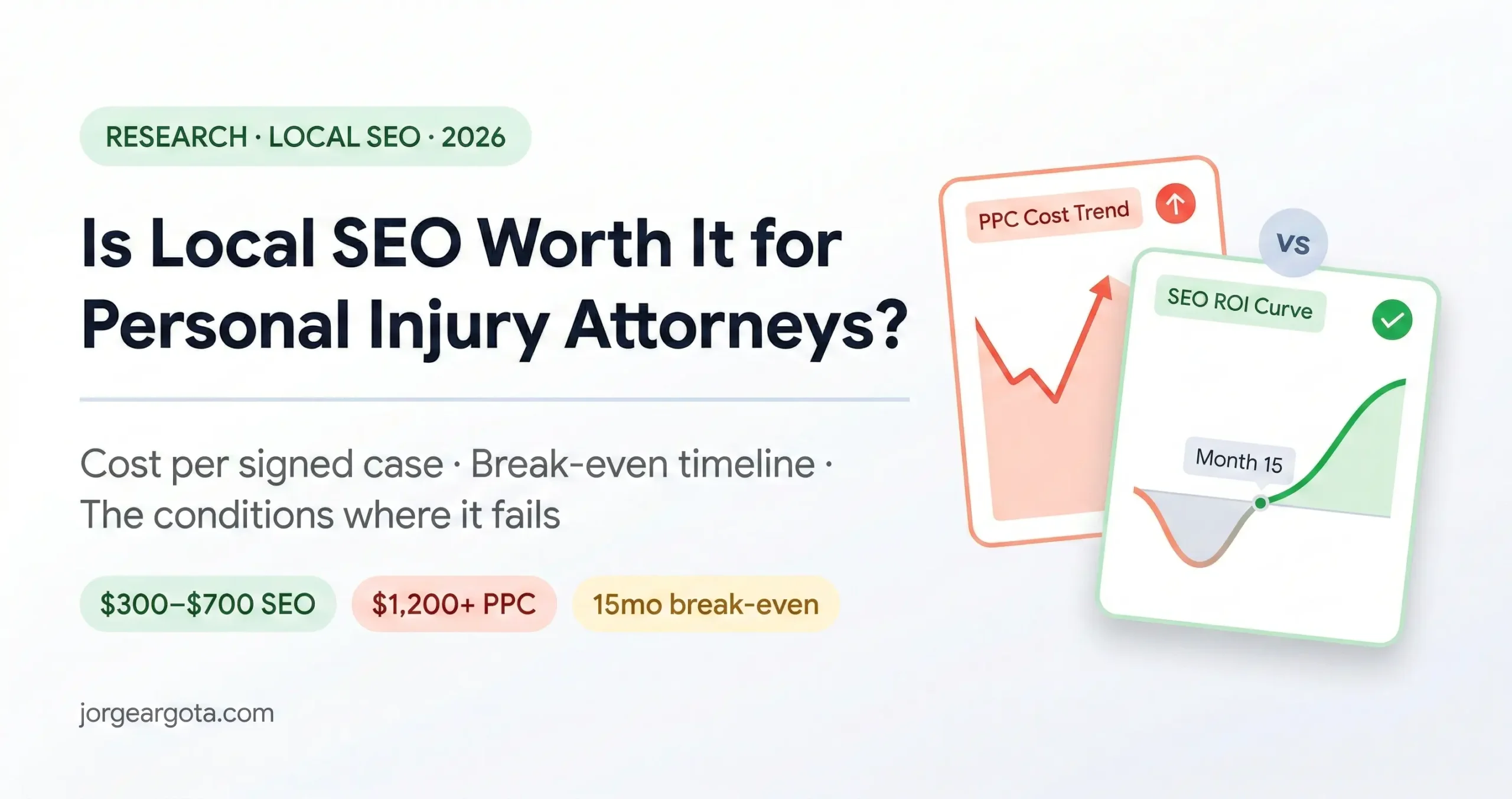
Is local SEO worth it for personal injury attorneys? For most firms in most markets with a budget above $5,000 a month and a realistic timeline of 12 or more months, yes. SEO generated cases cost $300 to $700 each compared to $960 through LSAs and $1,200 or more through PPC. But 48% of PI firms misattribute their Google Business Profile traffic entirely which means nearly half the industry is making investment decisions on wrong data. The honest answer is conditional and the conditions matter more than anyone selling you SEO wants to admit.
Why the 526% ROI Number Everybody Cites Is Misleading
Is local SEO a good investment for personal injury law firms? Local SEO remains the lowest cost per case acquisition channel available for PI attorneys at $300 to $700 per signed case versus $960 for LSAs and $1,200 or more for PPC. The widely cited 526% three year ROI has not been debunked but also has not been independently verified and almost certainly overstates future returns given that Google has tripled LSA presence and injected sponsored ads into 22% of local pack results since 2024. Source: Jorge Argota, 10 years in legal marketing, Miami.
The legal marketing industry loves telling personal injury attorneys that SEO delivers a 526% three year ROI and everybody repeats it like it’s settled science but nobody ever asks where that number came from or whether it still holds in a market where Google has tripled the presence of Local Services Ads and started injecting sponsored listings into 22% of local pack results, which is up from under 3% just two years ago. I’ve been running SEO campaigns for law firms long enough to know that the number isn’t wrong exactly; it’s just incomplete in a way that costs people money because it describes what happened historically and not what’s happening right now in 2026, and the gap between those two realities is the gap between a good investment and a six figure mistake.
So here’s what I found when I stopped reading agency blog posts and started pulling primary data, and I want to be upfront that some of these numbers come from vendors who sell SEO services which means there’s a structural incentive to make the numbers look favorable, and some of it comes from institutional research with less bias, and I’ll tell you which is which because the personal injury legal market is a $61.7 billion industry with over 135,000 competing attorneys and at those stakes the difference between reliable data and marketing claims is the difference between building equity and lighting money on fire.
WHERE THE CLICKS ACTUALLY GO
44%
Of total SERP clicks captured by the local Map Pack when it appears on the page.
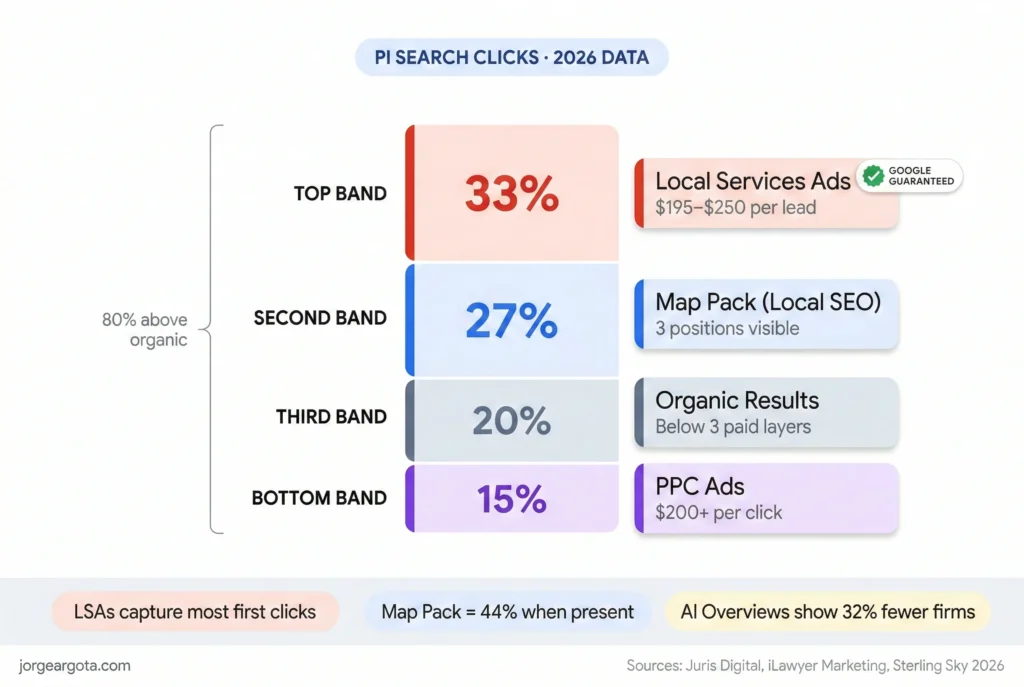
Two PI specific click studies tell the clearest story available. Juris Digital found LSAs capture 33% of first clicks with the Map Pack getting 27% and organic results at just 20%. iLawyer Marketing found even heavier LSA dominance at 42% with the Map Pack at 29% and organic at 22%. Both studies predate AI Overviews and use simulated screenshots rather than real clickstream data so take them directionally not literally, but the pattern is unmistakable; the local pack is getting squeezed from the top by paid placements and from below by Google’s own monetization push.
33%
LSAs (first click)
27%
Map Pack
20%
Organic
And Sterling Sky’s 2026 report makes this worse; analyzing 1,200 mobile ranking reports across 322 markets they found AI generated local packs display 32% fewer unique businesses in 88% of tracked markets. Joy Hawkins said it plainly; Google is going pay to play. The current personal injury SERP stacks LSAs on top then PPC ads then the Map Pack then organic, meaning your organic listing sits beneath three paid layers before a single person even sees it.
THE REAL COST PER SIGNED CASE
The metric that actually matters isn’t cost per click or cost per lead; it’s cost per signed case because you can’t deposit a consultation. And this is where local SEO still looks favorable, with a caveat I’ll get to that nobody publishing these numbers ever mentions.
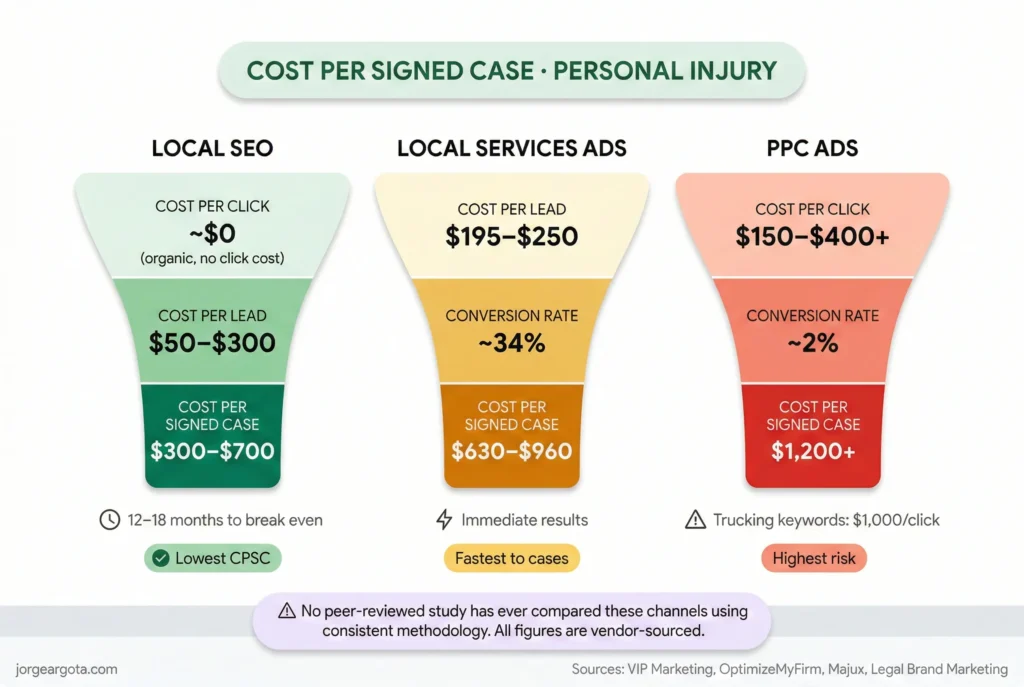
Local Organic SEO — $200 to $750 per signed case
CPL of $50 to $300 with 25% to 40% retainer conversion once the infrastructure matures. Demands 12 to 18 months. The cheapest channel once you’re in, but the slowest to produce.
Local Services Ads — $630 to $960 per signed case
Phone verified, geographically exclusive leads at $195 to $250 per lead. About 34% convert to retainer. Immediate results, no website optimization required. Fastest path to cases for firms that need revenue now.
PPC — Frequently exceeds $1,200 per signed case
Individual clicks hit $200 routinely with trucking and maritime keywords approaching $1,000 per click. At a 2% conversion rate the theoretical CPL inflates to $10,000 making PPC a dangerous channel for any firm lacking elite intake.
No single study has ever compared cost per signed case across LSAs, PPC, and local SEO for personal injury using consistent methodology. Every comparison stitches together numbers from different agencies, different markets, and different definitions of what counts as a conversion.
And that’s the caveat; every cost per case figure circulating in legal marketing traces back to agencies selling the service. VIP Marketing benchmarks SEO cases at $300 to $700. OptimizeMyFirm puts LSA leads at $240 average. Majux reports PPC leads at $600 to $1,000. Vendor sourced numbers with structural incentives to make their channel look best. Not a single peer reviewed academic study has ever examined local SEO effectiveness for legal services specifically, or at least none that I’ve been able to find and I’ve looked extensively, which doesn’t make the vendor data wrong but should make you skeptical about treating any individual number as gospel.
THE 15 MONTH VALLEY OF DESPAIR
15
Months to break even on personal injury local SEO. The most competitive and aggressively funded legal vertical.
This timeline is what kills most campaigns before they produce a return. I’ve watched it play out in South Florida specifically where a firm starts an SEO engagement in January, sees meaningful keyword traction start somewhere around month five or six, and then the managing partner pulls the budget at month seven because he got a call from an LSA rep offering cases this week. The data says cracking the top three map pack positions in saturated markets like Miami or Los Angeles or Houston frequently takes 12 to 18 months of sustained aggressive work, and in that stretch the firm absorbs pure negative cash flow with nothing tangible to show the accountant.
⚠️ The number nobody mentions upfront: At competitive market rates of $10,000 to $15,000 per month a PI firm invests $120,000 to $360,000 before breaking even. If your firm can’t absorb that without panicking and canceling at month five, LSAs are your better starting point and there’s nothing wrong with that.
But the long term numbers are real when firms survive the valley. High performing PI firms allocating roughly $210,000 annually to SEO report a three year ROI of 423%. A documented case showed a New York PI firm generating $1.2 million in new client revenue over eight months strictly from organic search representing a 25X return, though isolated agency case studies carry survivorship bias; the firms that quit at month six never appear in anyone’s portfolio which inflates the averages in ways the industry doesn’t acknowledge or at least doesn’t acknowledge loudly enough.
REVIEWS, GBP, AND THE INTAKE GAP
555
Avg reviews (Map Pack #1)
14
Median PI attorney reviews
SearchLab Digital analyzed 3,200 personal injury law firm profiles across 20 major U.S. cities and the numbers expose a brutal gap. Firms holding Position 1 in the map pack average 555 reviews which is a 40% volume advantage over Position 10 firms averaging 395. But here’s what makes velocity matter more than volume; a business consistently generating 5 new reviews monthly with a total of 50 will frequently outrank a competitor sitting on 200 historically aged reviews that lack recent activity, and 39% of legal consumers read seven or more reviews before making contact. That’s why review management isn’t optional; it’s the compounding engine underneath everything else.
THE INTAKE PROBLEM NOBODY WANTS TO TALK ABOUT
Clio’s secret shopper study found 48% of law firms are effectively unreachable by phone and only 33% respond to email inquiries. ABA data says 65% of PI leads are lost due to delayed follow up. And 79% of legal consumers hire the first attorney who responds. Firms answering within 5 minutes see a 400% higher conversion rate. This means fixing your intake might deliver more ROI than any marketing channel because a firm converting 25% of leads with fast response will outperform a firm converting 7% regardless of where those leads came from.
Sources: Clio Legal Trends Report 2024, ABA, FindLaw Consumer Legal Needs Survey 2024
And the mobile piece amplifies all of this; 73% of personal injury organic traffic comes from mobile devices and 88% of legal landing page traffic overall is mobile according to Unbounce which is the highest mobile share of any industry they studied. PaperStreet found 84% of phone calls originate from mobile versus only 16% from desktop which means your local pack optimization directly feeds the highest converting action from the dominant device type, and if your website loads in four seconds instead of two you’re bleeding cases before anyone ever talks to your intake team.
AI OVERVIEWS AND ZERO CLICK RISK
Whitespark tested 540 queries across Houston, Phoenix, and Denver with personal injury lawyers as one of six industries and found only about 15% of local intent legal queries trigger an AI Overview compared to roughly 68% of all legal queries including informational ones. Ahrefs corroborates; just 7.9% of local searches trigger an AI Overview. So the core “personal injury lawyer near me” search pattern remains relatively insulated from AI disruption for now, and that “for now” is doing a lot of heavy lifting because the trajectory is what should concern you.
💡 Where the real damage is landing: A QS Digital analysis of 18 law firms found the median firm experienced a 19% traffic decline in 2025 with some dropping nearly 80%. But this loss concentrates on blog and informational content not local pack visibility. Firms whose SEO strategy depends on content marketing for top of funnel face a materially different risk profile than firms focused purely on local pack ranking for high intent queries.
BrightLocal’s 2026 survey found ChatGPT usage for local recommendations surged from 6% to 45% in a single year and iLawyer Marketing reports 21% of consumers would use ChatGPT to research lawyers, doubled from 9% the prior year. The generational shift is stark; 53% of millennials prioritize online reviews in attorney selection versus 25% of boomers, while boomers favor referrals at 60% versus millennials at 46%. Firms optimizing for today’s referral heavy client base are structurally underinvesting in the channel that will dominate within five to ten years and that’s a strategic bet most managing partners aren’t even aware they’re making, or at least haven’t framed it that way when they’re deciding where the marketing budget goes this quarter.
WHEN THE ROI EQUATION BREAKS ENTIRELY
Local SEO is likely not worth it under a specific set of conditions and I think naming them honestly is more useful than pretending SEO works for everybody because it doesn’t. The investment thesis collapses when a firm allocates less than $5,000 monthly and demands ROI within six months because they’ll cancel at month five having realized a functionally negative 100% return before any compounding kicks in. It breaks for a solo practitioner operating from a single poorly located office in a Tier 1 metro and targeting broad keywords from a suburb because the algorithmic distance constraint will mathematically exclude them from the local pack regardless of content quality. And it breaks for any firm with a sub 5% lead to retainer conversion rate because at the $620 average cost per SEO lead the math simply doesn’t pencil and the money should go to fixing intake and operations before another dollar touches traffic generation.
Honest moment: 59% of solo and small firms still report referrals as their highest lead source according to Clio. For attorneys with deep medical provider and chiropractic networks the capital required to compete in local SEO might genuinely be better deployed expanding those offline pipelines. Referrals remain the highest ROI channel with near zero acquisition costs. The limitation is scalability; you cannot invest $X more in referrals and get proportional returns. But if referrals are already generating 50% or more of your caseload and you’re in a top 20 metro competing against firms with 500 plus reviews and years of domain authority, maybe the honest answer is that SEO isn’t your move right now and that’s okay.
And the next thing someone usually asks is whether there’s a middle ground and there is; the practitioners I respect most run a blended strategy where LSAs handle immediate case flow while SEO compounds in the background, and they treat review velocity and Google Business Profile optimization as the bridge between the two because GBP signals now account for roughly 33% of local pack ranking weight according to Whitespark’s 2026 ranking factors survey, up from 25% in 2018. The firms winning right now aren’t choosing one channel; they’re stacking channels in a sequence that matches their cash flow reality and I think that’s the part of the conversation that gets lost when agencies present SEO as a standalone solution because for most firms it isn’t one, or at least it shouldn’t be.
Want someone to run the actual math on whether SEO makes sense for your firm specifically?
The total market hasn’t changed; $61.7 billion in personal injury revenue and 135,000 attorneys competing for it. What’s changed is the split between channels and the cost of entry in each one. If your current marketing mix is already producing signed cases at a cost you can sustain then don’t let anyone talk you into adding SEO just because the three year ROI sounds impressive. But if you’re spending $200 per click on Google Ads and converting at 2% and your intake team takes three hours to return a call, there’s a math problem that gets more expensive every quarter you ignore it, and sometimes it helps to hear that from someone who’s run the numbers before and isn’t afraid to tell you the answer is “not yet” if that’s what the data says.
Related
- Search Engine Optimization for Law Firms
- Paid Advertising for Law Firms
- Law Firm Review Management
- Why Google’s AI Cites Some Law Firms and Ignores Others
- AI Tools Every Law Firm Should Be Using in 2026
- How Much Does a Law Firm Website Cost in 2026
- Attorney Advertising Ethics Rules
- Personal Injury Lawyer Marketing
- Marketing Multiple Practice Areas