

TL;DR
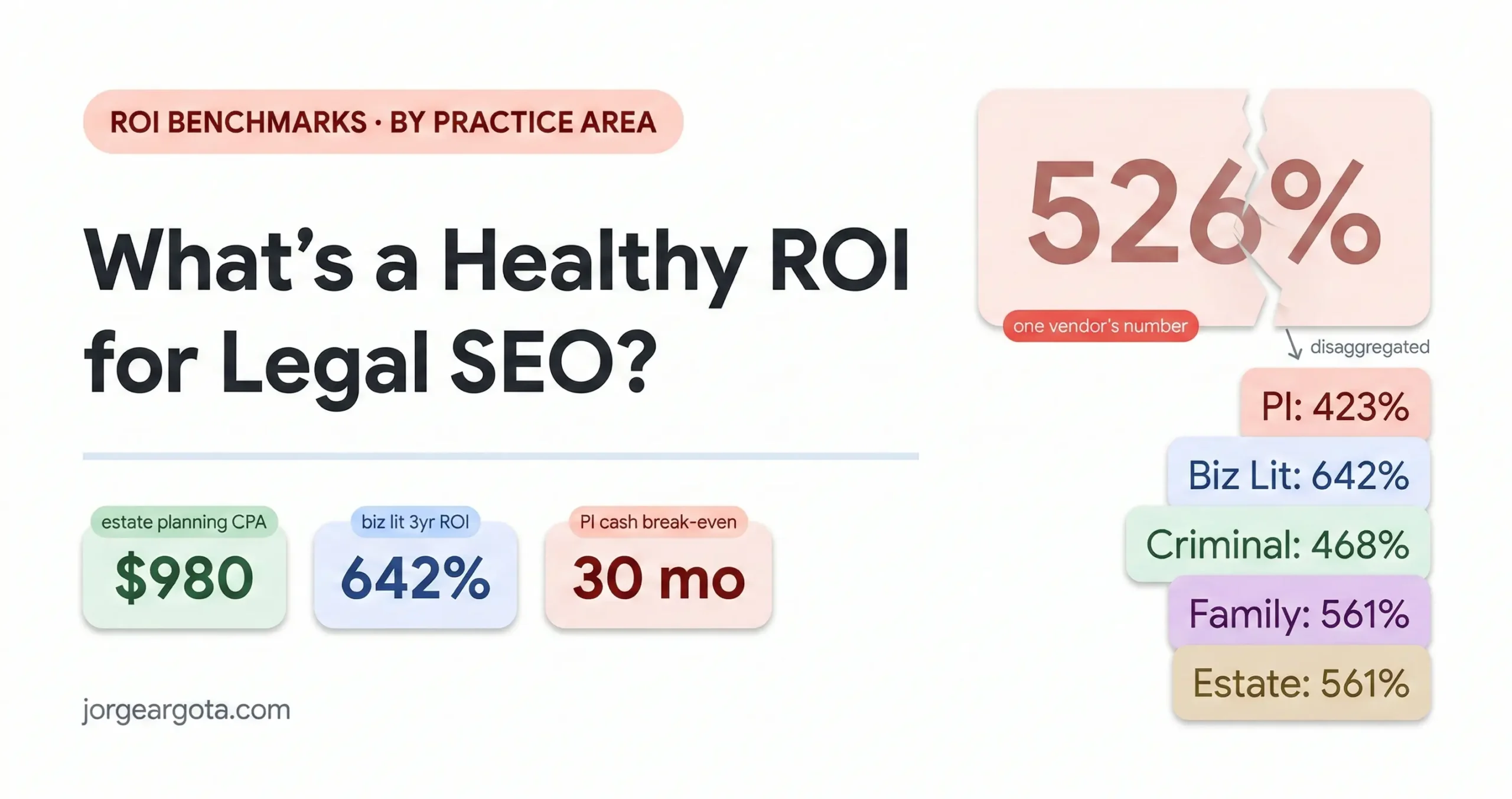
What’s a healthy ROI benchmark for legal SEO? It depends entirely on your practice area. Business litigation returns 642% over three years with a 10 month break even. Personal injury returns 423% but doesn’t reach cash flow positive until month 30 because you’re waiting on case settlements. Criminal defense breaks even at 11 months. Estate planning has the lowest cost per signed case at roughly $980 to $2,600. The “526% average ROI” stat every agency quotes traces back to a single vendor’s client portfolio and doesn’t apply to most firms.
What should my law firm expect from SEO? A healthy legal SEO ROI ranges from 423% for personal injury to 642% for business litigation over a three year period, but these numbers mean nothing without the break even timeline. The average legal SEO campaign takes 14 months just to recoup the marketing spend, and PI firms waiting on contingency settlements won’t see actual cash until month 30. The real benchmark is cost per signed case; PI runs $11,376 to $27,522, criminal defense $1,449 to $5,797, family law $1,994 to $5,984, and estate planning $980 to $2,614. Any agency quoting a universal “526% ROI” without breaking it down by your practice area is giving you someone else’s number. Source: Jorge Argota, 10 years in legal marketing, Miami.
So I googled “what is a good ROI for law firm SEO” the other day just to see what comes up and every single result on the first page said the same thing; 526% return over three years, which sounds great until you realize every one of those pages is citing the same source and none of them are telling you that the number comes from one vendor’s specific client portfolio and not from any independent study or ABA survey or industry wide data set, and I sat there thinking this is the most circular piece of data in legal marketing because agencies are literally citing each other citing each other and the original source is a company selling premium SEO services to law firms, which is like asking your barber if you need a haircut.
And the reason this matters is that managing partners make real capital allocation decisions based on that number. They commit $5,000 or $10,000 a month for 12 to 18 months expecting something close to a 5x return and when the math doesn’t work they blame the agency or blame SEO as a channel when the actual problem is that nobody told them the 526% figure is a ceiling from a specialized vendor operating under specific conditions, not a floor that every firm should expect, and the gap between those two things is the gap between a profitable marketing investment and dead capital sitting in an agency’s retainer account producing nothing.
WHERE THE 526% NUMBER ACTUALLY COMES FROM
526% average ROI for law firm SEO
526% from one vendor’s client book, 2018 to 2022
The 526% figure originates from First Page Sage; a self reported three year average based on their specific cohort of law firm clients. They also report a 748% ROI for their premium “Thought Leadership” tier. When agencies like Juris Digital, Velocity Work, On The Map, or any of the dozen other sites citing this number present it as an industry standard, they’re projecting the historical performance of one vendor’s portfolio onto the entire legal market, and honestly I’ve stopped trying to explain this to people because the number is so embedded in the pitch decks at this point that questioning it feels like arguing about gravity.
The methodology problems run deeper than the source though. Most ROI calculations in legal marketing use gross case value instead of the firm’s actual collected fee, which inflates the number by roughly 300% in personal injury where a $100,000 settlement yields maybe $33,000 in firm revenue.
They define “cost of SEO” as just the agency retainer while ignoring partner hours spent reviewing content, CRM software, call tracking platforms, and the intake department payroll required to screen the volume of unqualified leads organic traffic generates. And they assume a 20% to 33% lead-to-client conversion rate when the actual industry average across all legal verticals is 7.4%, or roughly 13.4 leads to sign one client, which is a number most agencies would prefer you didn’t know.
The math that should bother you: Standard corporate finance defines ROI as net profit divided by cost of investment. Legal marketing vendors routinely calculate ROI using gross settlement value, ignore internal overhead, assume 3x the real conversion rate, and report across a 36 month horizon without discounting for the time value of money. A campaign reported as 526% ROI using these inflated inputs might actually deliver 150% to 200% when calculated correctly, which is still good but a very different conversation.
WHAT THE NUMBERS ACTUALLY LOOK LIKE BY PRACTICE AREA
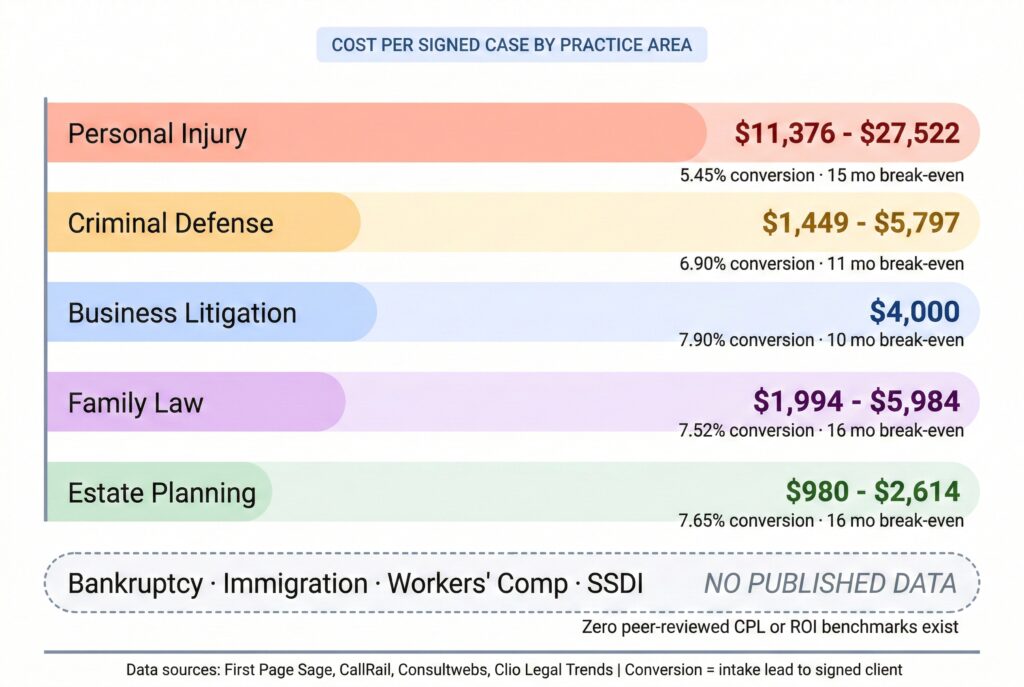
The whole reason a “universal benchmark” is useless is that a personal injury firm and a bankruptcy firm have fundamentally incompatible economics, and blending them into one number is like averaging the income of a neurosurgeon and a barista and calling it a salary benchmark. So here’s what the data actually shows when you disaggregate it by practice area, and I’m using cost per signed case as the primary metric because that’s the number that connects marketing spend directly to the business outcome.
Personal Injury
$11,376 to $27,522
cost per signed case · 423% three year ROI · 5.45% intake conversion · 15 month marketing break even · 30 month cash break-even
Run the math yourself. Organic CPL in PI ranges from $620 to $1,500 in saturated markets and the intake conversion rate is 5.45% which means you need roughly 18 leads to sign one case. At a $1,000 CPL that’s $18,348 to acquire one client whose fee averages $12,500 to $20,000.
The three year ROI looks great on paper at 423% but nobody mentions that the marketing break even takes 15 months and then you’re waiting another 15 to 16 months for the actual settlement, so you don’t see real cash until month 30, which is the kind of timeline that undercapitalized firms can’t survive no matter how good the long term math is.
Business Litigation
$4,000
cost per signed case · 642% three year ROI · 7.9% conversion · 10 month break even
Business litigation is the hidden giant that nobody talks about because the case values are massive, the conversion rate is strong at 7.9%, and the break even timeline is the fastest in the industry at 10 months.
The CPL averages $316 and the decision makers who search for B2B legal services respect thought leadership content, which means the SEO investment compounds faster because the audience is already pre qualified by the type of content they consume. If I had to pick one practice area where SEO math works best it would be this one, and the 642% ROI figure is the highest measured across any legal vertical.
Criminal Defense
$5,000
468% ROI · 11 mo break even
6.90% conversion
Family Law
$3,989
561% ROI · 16 mo break even
7.52% conversion
Estate Planning
$980 to $2,614
561% ROI · 16 mo break even
7.65% conversion
Criminal defense is excellent for SEO because clients need a lawyer immediately, retainers are collected upfront, and the cash flow drag is minimal compared to contingency fee work. Family law converts well at 7.52% but requires strong intake screening because a huge percentage of incoming calls are people looking for free legal information who have no money for a retainer, and if your intake team can’t filter those out fast the operational cost of fielding all those calls eats into your margin.
Estate planning has the most efficient acquisition cost in all of legal marketing at roughly $980 to $2,614 per signed case because the CPL is low, the conversion rate is strong, and educational content builds trust in a space where trust is the entire purchase decision.
THE DATA GAPS NOBODY ADMITS
Immigration, real estate, workers’ comp, and SSDI have zero published peer reviewed SEO ROI data. No organic CPL benchmarks. No break even timelines. No practice specific conversion rates. The legal marketing industry builds its case studies around high ACV verticals where $10,000 retainers are palatable and ignores the complex math required to prove ROI for lower ACV, high volume practices. If your agency is quoting you a benchmark for one of these practice areas they’re making it up, which I probably shouldn’t say but it’s true.
THE BENCHMARKS YOUR AGENCY ISN’T TRACKING
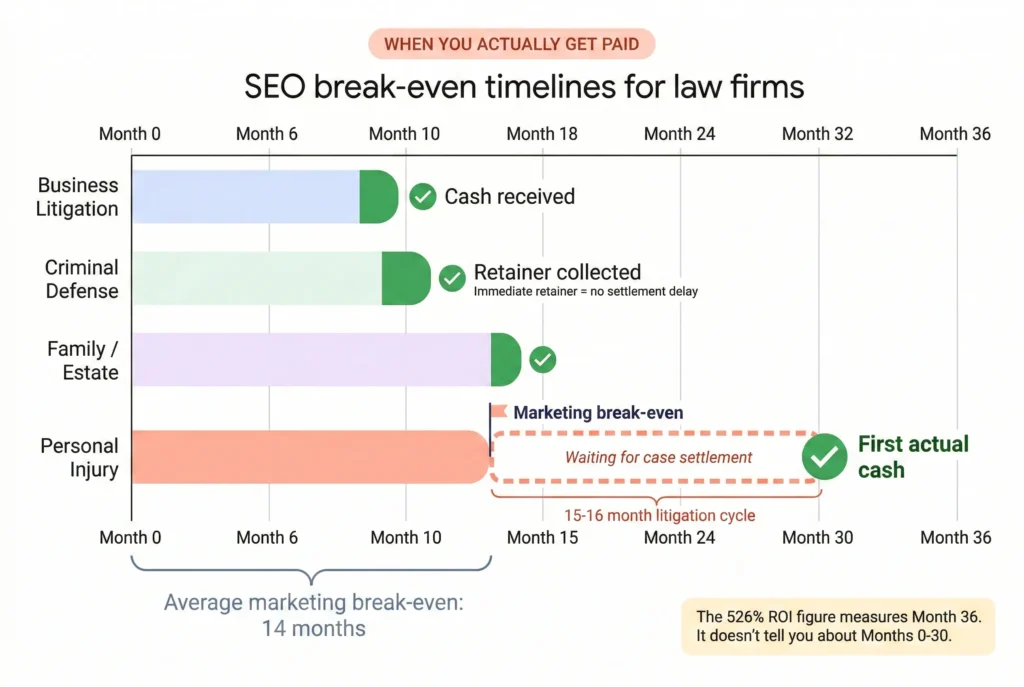
The rough rule I use when proving marketing ROI to law firm partners is that simple percentage ROI is the wrong metric for cash flow sensitive firms. The number that actually matters is the payback period, which is how many months of SEO spend you need before the cumulative revenue from SEO sourced cases exceeds the cumulative spend. The average across legal verticals is 14 months for marketing break even, but that measures case signings not collected revenue, and in contingency fee practices the actual cash doesn’t arrive for another 15 to 16 months after the case is signed.
A campaign showing 423% ROI on a spreadsheet can still bankrupt you if you don’t have the working capital to survive 30 months of negative cash flow.
And then there’s the diminishing returns ceiling that nobody bringing you an SEO proposal is going to mention. The data shows that law firm SEO investment hits diminishing marginal returns at roughly $550,000 annually, or about $45,833 a month. Beyond that point the commercially viable high intent keywords in your geographic market are exhausted and every additional dollar produces less than the one before it.
Firms hitting this ceiling need to reallocate to other channels rather than pouring more money into over optimized organic search, and I’ve seen marketing budgets blow right past this threshold because the agency never told the firm the ceiling exists.
The attribution problem underneath all of this: Over 80% of consumer interactions with law firms are lost or mismanaged due to a lack of CRM workflows and lead tracking. The “dark funnel” means a client reads your blog post, leaves, talks to their spouse, comes back by typing your name into Google, and your analytics records it as “direct traffic” instead of the SEO content that actually built the relationship. SEO’s true influence on revenue is systematically underreported, which means even the benchmarks I just gave you are probably conservative.
WHEN TO KNOW YOUR CAMPAIGN IS FAILING BEFORE MONTH 12
You can’t wait 14 months to find out your agency is underperforming because the financial exposure is too large, so here’s what the first year should look like if things are working. Months 1 through 3 should show zero lead growth but you should see technical foundation work; indexation rates improving, crawl errors fixed, site speed optimized.
If your agency isn’t doing technical audits and isn’t publishing content during this phase that’s a red flag.
Months 4 through 6 should show non branded impression growth and keyword stabilization; if impressions are flat by month six the campaign architecture is probably broken.
Months 7 through 12 is where traffic has to convert into actual leads, and if you hit month 12 without a stabilizing cost per lead or an increasing conversion rate you’re likely ranking for informational keywords that generate traffic but zero phone calls from people who actually need a lawyer in your city.
The biggest vanity metric red flag is traffic growth without lead growth. If your agency sends you a report showing 50% more visitors to the site and your intake volume hasn’t moved at all, they’re ranking you for national informational queries like “what is the penalty for a DUI in California” instead of localized transactional terms like “Chicago DUI defense lawyer” and the first type of traffic has zero commercial value because those people aren’t hiring you, they’re doing homework, and the agency knows this but the traffic graph looks impressive in the monthly report so they keep doing it.
Not sure if your SEO numbers are healthy or just look healthy?
If it were my firm I’d pull the last 12 months of intake data, calculate the actual cost per signed case by practice area, compare it against these benchmarks, and see where I land. If your number is within range and your break even timeline makes sense for your cash position, you’re probably fine and you don’t need my help. If the math isn’t working or your agency can’t tell you what your cost per signed case is because they only report on traffic and keywords, that’s a different conversation and one I’m happy to have, but I’ve been wrong before so take whatever I just said and verify it against your own P&L because that’s the only number that actually matters in the end.
Related
- Law Firm SEO vs PPC ROI
- Law Firm Cost Per Signed Case
- How to Prove Marketing ROI to Law Firm Partners
- Law Firm Marketing Budget
- Is Your Intake Process Killing Your Marketing ROI
- First Year Law Firm SEO Month by Month
- Cheap Law Firm Marketing Problems
- Is Your Marketing Agency Inflating Leads
- High Growth Law Firm Marketing Spend