

Written by Jorge Argota · Legal Marketing · United States
I had two PI firms come to me within the same month last year, both spending about $10,000 a month on Google Ads, both in competitive Florida markets. Firm A was signing roughly 2 cases a month from that spend. Firm B was signing 8. Same budget, same keywords, same market size. The difference wasn’t the campaigns; the campaigns were almost identical. The difference was that Firm A took an average of two hours to return a call and Firm B had an intake specialist picking up within 90 seconds. Firm A’s cost per signed case was $5,000. Firm B’s was $1,250. Both firms had the same cost per lead and one of them was profitable and the other was bleeding.
TL;DR
Cost Per Signed Case is the only metric that matters. Cost Per Lead is a vanity number that hides whether you’re making money or losing it. The “Golden Ratio” for a profitable firm is a CPSC that never exceeds 15 to 20% of the projected case fee. For PI that means a healthy CPSC of $1,500 to $3,000 against a $15,000 fee. For family law it means $800 to $1,200 against a $5,000 retainer. This page covers the CPSC benchmarks by practice area, the Intake Tax that inflates your CPSC when response times are slow, and the LSA arbitrage that produces the lowest cost per signed case in legal PPC.
YOUR CPSC SHOULD NEVER EXCEED 15 TO 20% OF THE CASE FEE
85% of inbound legal inquiries are fundamentally unqualified. That means for every 100 leads your campaigns produce, 85 of them were never going to hire you. The cost per lead number your agency reports includes all 100. The cost per signed case only counts the ones that actually signed a retainer. The gap between those two numbers is where most firms lose money without realizing it, and the CPC benchmarks page covers what the clicks cost by practice area. This page is about what happens after the click.
Green = healthy ratio. Amber = margin pressure. Below 10% means you’re probably underinvesting. Above 20% means the overhead eats the profit.
The thing that surprises most partners when I run these numbers is that a $300 cost per lead in PI isn’t a problem at all if you’re converting 1 in 8 leads to a signed case, because your CPSC is $2,400 against a $15,000 fee and that’s a 6x return. But a $100 cost per lead in family law can be a disaster if your intake is slow and you’re only converting 1 in 15, because your CPSC is $1,500 against a $5,000 retainer and that’s 30% acquisition cost that eats most of the profit. The cost per lead doesn’t tell you anything useful by itself. The CPSC tells you everything.
HOW SLOW RESPONSE TIMES DOUBLE YOUR COST PER SIGNED CASE OVERNIGHT
The industry average response time to a digital legal inquiry is 42 hours. And 63.5% of firms never respond to certain inquiries at all. A five-hour delay in responding to a single inquiry costs a firm up to 46 clients per year, which works out to roughly $200,000 in lost revenue. And 79% of legal consumers hire the first attorney who responds, which means the firm that picks up fastest doesn’t just convert better; it captures the client before the other four firms the person contacted even call back.
The 5-Minute Cliff: Lead qualification rate by response time
Source: Harvard Business Review speed-to-lead research. The drop from 21% to 1% happens in 25 minutes.
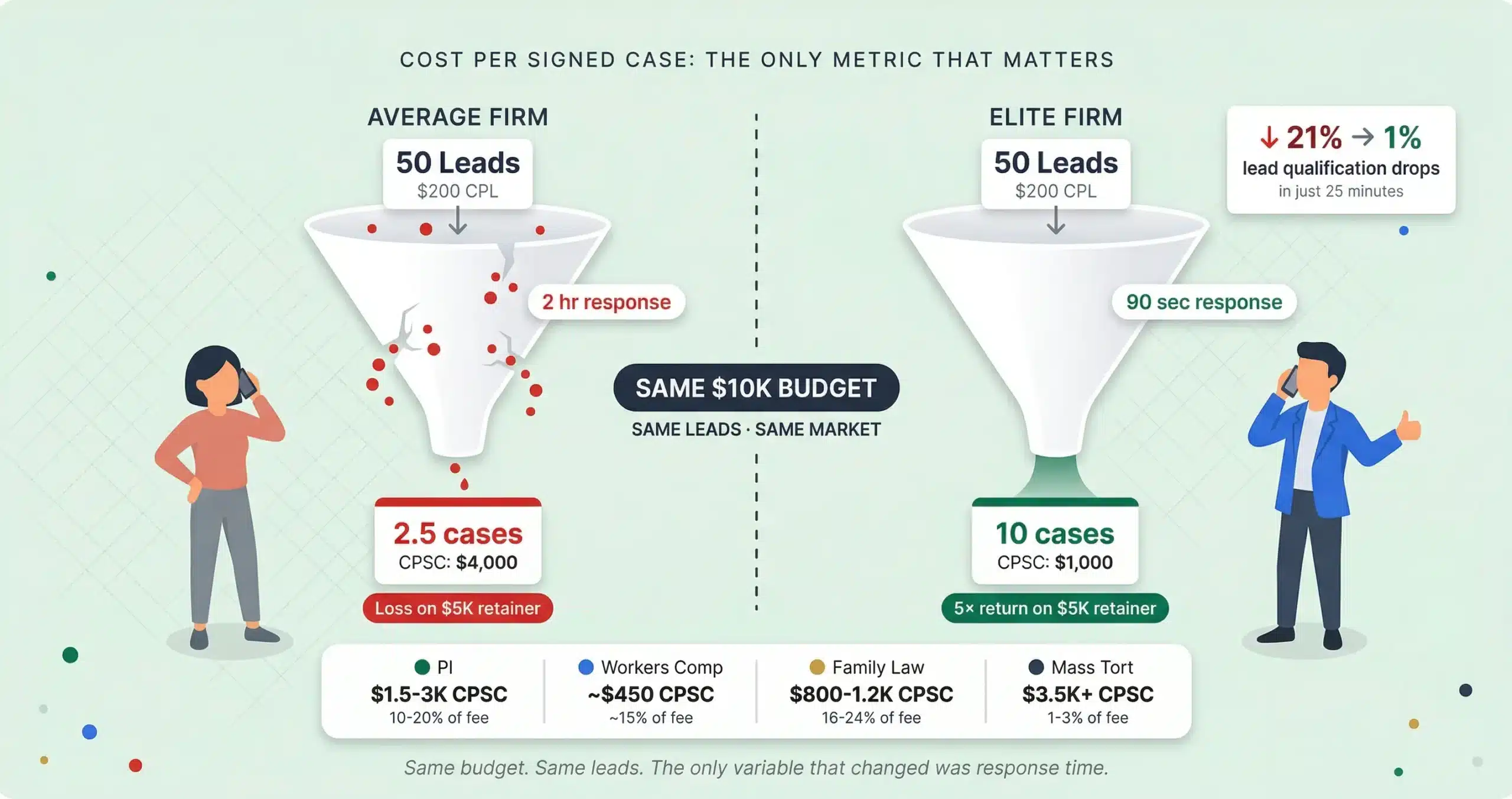
Average Firm
$10,000 spend. 50 leads at $200 CPL. Responds in 2 hours. 5% conversion. 2.5 signed cases. CPSC: $4,000. Loss on a $5,000 retainer.
Elite Firm
$10,000 spend. 50 leads at $200 CPL. Responds in under 2 minutes. 20% conversion. 10 signed cases. CPSC: $1,000. 5x return on a $5,000 retainer.
Same budget. Same leads. Same cost per lead.
The only variable that changed was response time.
It produced a 4x difference in cost per signed case.
The biggest technical mistake firms make is tracking CPSC on a spreadsheet but never telling Google about it. If you aren’t using Offline Conversion Tracking to feed your signed retainer data from your CRM back into Google Ads, the algorithm keeps optimizing for the cheap leads that fill your inbox but never sign. It doesn’t know the difference between a $200 lead that became a $15,000 case and a $200 lead that ghosted after the first call. To get your CPSC down, Google’s machine learning needs to know exactly which clicks turned into paying clients, and the Google Ads cost page covers the full CRM-to-Google feedback loop setup.
WHY LOCAL SERVICE ADS PRODUCE THE LOWEST COST PER SIGNED CASE IN LEGAL PPC
Local Service Ads bypass the biggest variable that inflates CPSC in standard PPC, which is bad clicks. In PPC you pay for every click whether the person was qualified or not. In LSA you pay per connected lead; Google only charges for calls that last longer than 30 seconds, which means the “bad click” waste that accounts for most of the gap between CPL and CPSC in standard campaigns gets removed entirely.
LSA produces roughly 1/3 the CPSC of standard PPC for personal injury because you only pay for connected leads.
The catch is that LSA inventory is capped. Google limits how many leads you get per week based on your budget and market, so you can’t scale LSA the way you can scale PPC. The strategy is to maximize your LSA budget first because it produces the lowest CPSC, and then layer PPC on top for the volume LSA can’t provide. The Local Pack page covers how LSA and PPC interact on the same results page and the Near Me page covers the full LSA mechanics.
Want to know your actual cost per signed case?
Send me your last 90 days of ad spend and how many cases you signed from it. I’ll calculate your CPSC by practice area, compare it against the Golden Ratio, and tell you whether the gap is in your campaigns or your intake. If the numbers already work I’ll tell you that too and you can stop thinking about it.
Related: CPC Benchmarks by Practice Area · Google Ads Cost and ROI · Local Pack vs Paid Ads · Near Me Revenue Engine · Portfolio Theory PPC