
Written by Jorge Argota · Legal Marketing · United States
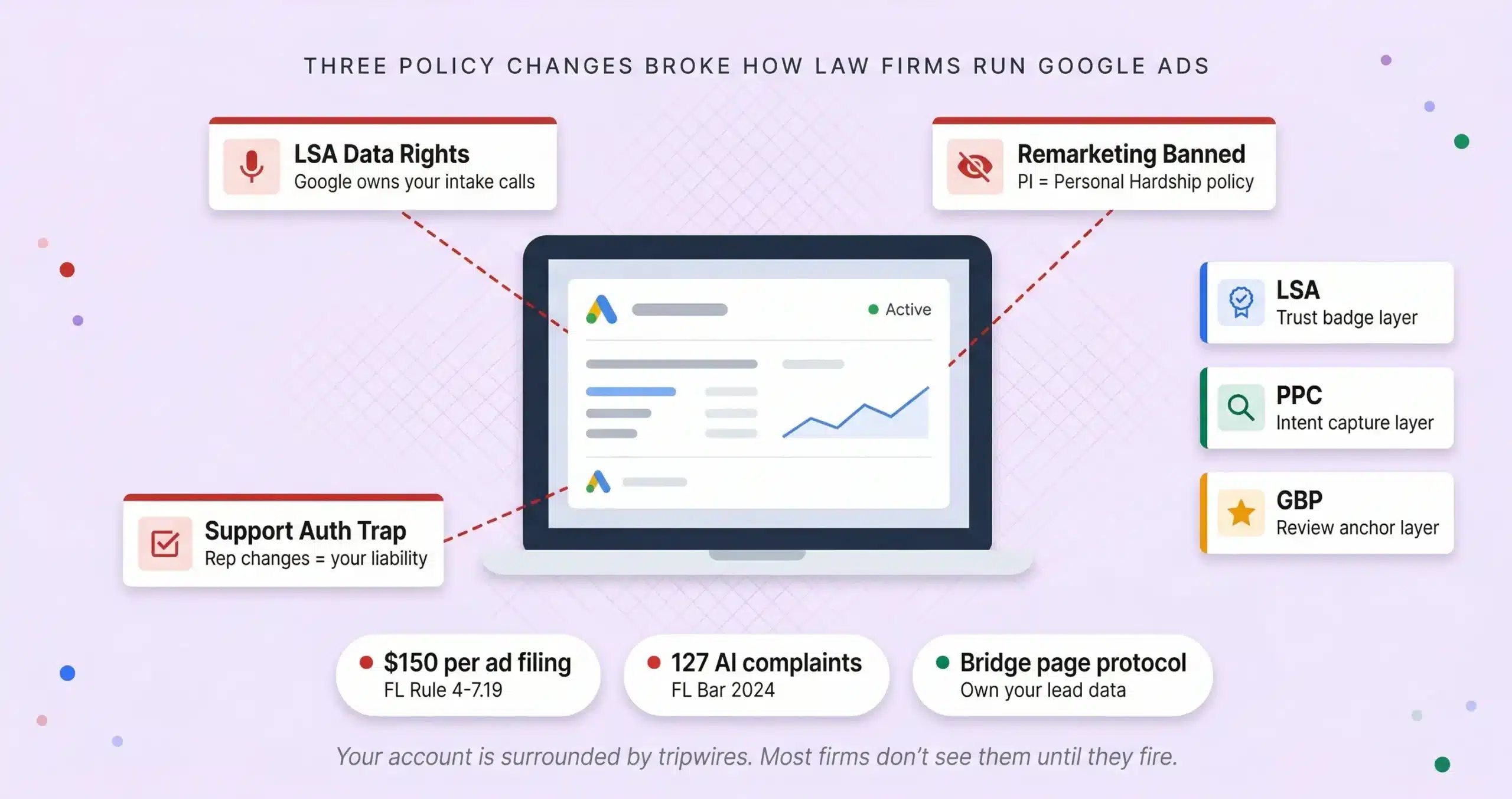
Three policy changes in 2025 and 2026 broke the way most law firms run Google Ads. LSA data rights shifted intake recordings to Google’s ownership, the “Personal Hardship” classification killed remarketing for PI firms, and the Support Authorization clause made you liable for any changes a Google rep makes to your account.
⚠ Silent Killer 1
LSA Data Ownership
Google records, monitors, and owns your intake calls. Initial conversations through LSA are not privileged.
⚠ Silent Killer 2
Support Authorization
Checking the support checkbox transfers full liability to you for any changes a Google rep makes to your live account.
⚠ Silent Killer 3
The $150 Silent Tax
Every ad text variation in Florida triggers a new Rule 4-7.19 filing at $150 per submission. A font change counts.
TL;DR
Google Ads policy for legal services in 2026 requires identity verification matching your bar license to your LSA profile, prohibits remarketing for “Personal Hardship” practice areas including PI, and transfers full liability to the advertiser when a Google rep modifies your account through the Support Authorization clause. LSA intake calls are recorded and owned by Google, not you. Every ad revision requires a new Florida Bar Rule 4-7 filing at $150 per submission. Source: Jorge Argota, 10 years legal PPC.
LSA DATA RIGHTS AND THE SUPPORT AUTHORIZATION TRAP
The LSA terms update gave Google explicit permission to record, monitor, and temporarily store phone calls and texts initiated through the platform. Those initial intake conversations are not privileged. Your receptionist has to acknowledge the unsecure line and move the prospect to an internal firm channel before any case specifics are discussed or you’re creating a discoverable record that Google owns and can share as aggregated performance data with third parties.
🛑 CRITICAL: The Support Authorization Liability Transfer
When you contact Google Ads support, the intake form now includes a mandatory checkbox granting the rep permission to make changes directly inside your live account. If that rep adjusts your ad copy to include an implied guarantee or expands your geo-targeting into a state where you’re not licensed, the terms explicitly say it’s “solely of your own accord and at your own risk.” You’re liable for the bar complaint, not Google. Exhaust every self-service option, Help Center article, and community forum before checking that box.
⚠ The identity verification purge
Google’s automated review now suspends accounts that submit documentation deemed modified or redacted. Even innocent edits to a photo ID trigger false-positive flags and immediate suspension. Your legal business name, physical address, and licensing numbers on your landing page must exactly match the raw, unedited documentation in the verification portal. No exceptions.
PERSONAL HARDSHIP BAN AND REMARKETING RESTRICTIONS
If you’re running a PI firm and wondering why your remarketing lists stopped producing results sometime in 2025, this is why. Google classified personal injury, criminal defense, and several other practice areas under “Sensitive Events” and “Personal Hardship” policies that prohibit personalized advertising. You cannot retarget someone who visited your car accident page. The pixel fires, the audience builds, but Google won’t serve the ads to that list because the platform considers it exploitative to follow someone around the internet after they indicated they’re in physical or legal distress.
⛔ Banned under Personal Hardship
Remarketing lists: visitors to PI, criminal defense, bankruptcy, or domestic violence pages are tagged as “Sensitive Health” or “Trauma.” Following them violates the exploitation clause.
Ad copy like “You Have Rights”: implies the user is a victim in a negative state. Often flagged as “Emotional Distress” by the automated review.
✅ Safe alternatives
In-market audience segments: Google’s pre-built “Legal Services” audiences are scrubbed of sensitive signals. You target the intent, not the user’s browsing history.
Ad copy like “Free Case Evaluation”: focuses on the professional service being offered, not the injury or personal struggle. Passes automated review consistently.
FLORIDA BAR AD FILING RULES AND AI ETHICS VIOLATIONS
Under Florida Bar Rule 4-7.19, all non-exempt digital ads have to be submitted for compliance review at least 20 days before they go live. That includes targeted email campaigns, sponsored social media posts, and banner ads. The critical distinction: an organic social post on your firm’s feed doesn’t require filing, but the instant you boost it with paid dollars to reach people who don’t follow you, it triggers the full direct solicitation rules and needs a filing.
Any change to a previously approved ad, including a font swap, a color shift, or a layout adjustment, legally transforms it into a new advertisement. New filing required. $150 fee, or $250 if you file late. The only exception is when the revision is made to comply with a direct bar opinion.
⚠ AI-generated ad violations (127 complaints in Florida, 2024)
The Florida Bar processed 127 ethics complaints involving AI-generated advertisements in 2024. Violations included hallucinated case outcomes, fabricated client testimonials, and missing jurisdictional disclaimers. Under Rules 4-1.1 and 4-5.3, the attorney is 100% personally liable for AI-generated marketing content.
The chatbot UPL trap
AI chatbots on landing pages that cross from gathering intake data into offering legal guidance (like “You likely have a case”) violate Rule 5.5 (unauthorized practice of law). Hard-code your chatbot to be a data collector only. The opening message must state: “I am an automated intake assistant, not a lawyer. I cannot provide legal advice.” If the chatbot can’t say it, it shouldn’t be on your site.
THE TRUST TRIANGLE: LSA + PPC + GOOGLE BUSINESS PROFILE
LSA, PPC, and your Google Business Profile aren’t three separate channels. In 2026 they’re a single verification ecosystem and running one without the others creates gaps that cost you Quality Score, ad placement, and client trust. If Google can’t match your bar license to your LSA profile, your PPC Quality Score is capped. If your GBP reviews don’t validate the claims in your ads, the algorithm deprioritizes your placement.
LSA: The trust badge
Google Screened badge requires bar verification for every attorney in the profile via Evident. Delays in identity checks remove that attorney from the ad rotation immediately.
PPC: The intent capture
High-intent keywords for specific case types. “T-bone accident lawyer” converts better than “lawyer” because the specificity signals Quality Score and matches the landing page.
GBP: The organic anchor
Reviews validate the paid clicks. Response velocity and review sentiment are now quantifiable data points Google uses in the ad auction. A weak GBP undermines both LSA and PPC performance.
⚡ Double Serving is not what you think
Running LSA and PPC simultaneously is safe and recommended for SERP dominance. The real violation is creating multiple LSA profiles for the same physical office to manipulate proximity radius, or running two separate PPC text ads in the same auction from different accounts. One LSA plus one PPC campaign for the same keyword is the standard 2026 strategy. One unverified attorney in your Evident roster kills the entire firm’s LSA rotation, so audit your roster quarterly.
💡 The “Bridge Page” protocol for LSA data sovereignty
Don’t send PPC traffic to your homepage. Send it to a dedicated qualifying landing page that you fully own, with disclaimers visible, fees explained, and HTTPS secured. This gives you first-party data ownership on the leads that come through paid search, separate from the LSA intake data that Google controls.
Is your account bleeding budget to policy violations?
Send me your account ID and I’ll run a 3 point liability check: the Evident verification status for every attorney on your roster, a Personal Hardship scan on your remarketing lists, and a Double Serving audit between your LSA and PPC campaigns.
About Jorge Argota · 10 years navigating Google Ads policy for law firms. Every campaign I launch passes Florida Bar Rule 4-7 review before the first impression is served. Full bio.
Related: TCPA Compliance · Campaign Structure · White Label PPC · Performance Max