
Written by Jorge Argota · Legal Marketing · United States
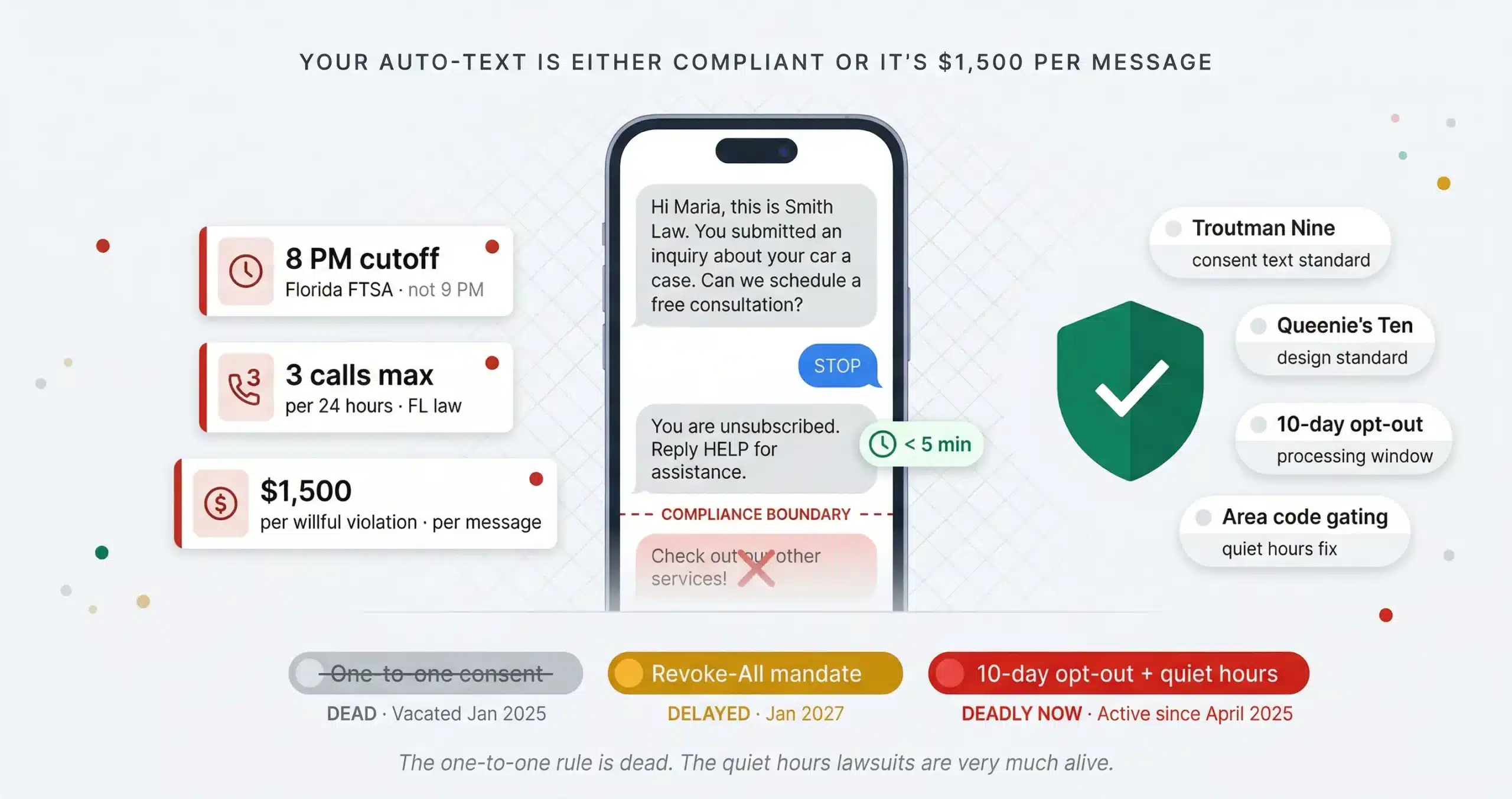
Half the TCPA articles on the internet are still warning you about the “one to one consent rule” that was vacated by the 11th Circuit in January 2025. That rule is dead. Even the “Universal Revocation” mandate was delayed from April 2026 to January 2027. So why are law firms still getting hit with $1,500 fines? Because two rules are alive and hunting right now: the 10 day opt-out processing window that’s been active since April 2025, and the 480+ quiet hours lawsuits targeting anyone who texts a Florida area code after 8 PM.
TL;DR
The FCC’s one to one consent rule was vacated in January 2025 by the 11th Circuit (Insurance Marketing Coalition v. FCC). Bundled consent survives but the evidentiary standard is higher than ever. The full “Revoke-All” cross channel mandate was delayed to January 31, 2027, but the 10 business day opt-out processing window has been active since April 2025. Florida’s FTSA applies to any phone number with a Florida area code and has an 8 PM quiet hour cutoff, a 3 call per 24 hour limit, and its own ATDS definition that captures standard CRM workflows. Source: Jorge Argota, 10 years legal marketing.
💡 Dead vs delayed vs deadly
Dead: FCC’s one to one consent mandate (vacated Jan 24, 2025; formally expunged July 2025 via order DA-25-621). Delayed: The full “Revoke-All” cross department mandate was pushed to January 31, 2027 by the FCC on January 6, 2026. Deadly right now: The 10 business day opt-out processing rule (active since April 2025) and the 480+ quiet hours lawsuits hitting firms that text outside permitted windows.
TCPA CONSENT REQUIREMENTS FOR LAW FIRM LEAD FORMS 2026
Your PPC landing page intake form needs all nine elements of what the compliance bar calls “The Troutman Nine” or the consent is unenforceable. Written verification, clear and conspicuous notice, specific authorization for telemarketing, explicit tech disclosure (including AI-generated voice if you use it), precise seller identification with your firm’s name visible on the form, phone number tied to consent, no-condition-of-purchase statement, revocation rights notification, and consent captured before the first automated contact. Miss any one and a plaintiff’s attorney voids the entire disclosure. One note: the 5th Circuit ruled in Bradford (February 2026) that written consent is not strictly required by the TCPA statute and oral consent can serve as a defense in Texas, Louisiana, and Mississippi. Written remains the safe harbor standard everywhere else and I wouldn’t rely on oral consent as a primary strategy but it’s worth knowing the precedent exists.
Getting the text right is only half the problem. Federal judges are now invalidating consent based on how it looks on screen. The industry response is “Queenie’s Ten,” the 2026 design compliance framework that complements the Troutman Nine. After the McMillan v. Westgate decision in February 2026 threw out an arbitration provision because the font was smaller than the rest of the page, these rules are no longer optional.
The Text: Troutman Nine
Clear and conspicuous notice. Specific seller ID (your firm’s name, not “partners”). Marketing purpose stated. Technology disclosure (ATDS and/or AI voice). No condition of purchase. Revocation rights. Executed before first contact.
The Design: Queenie’s Ten
Disclosure immediately above the CTA button (no separation). Font size matches body text (no squishing). WCAG AA contrast ratio (4.5:1 minimum). No scroll boxes hiding terms. No dark patterns or prechecked boxes. Renders on mobile without pinching.
⚠ The quiet hours trap (480+ lawsuits since late 2024)
Federal law prohibits automated calls and texts before 8 AM and after 9 PM in the called party’s time zone. One South Florida firm filed over 100 class actions in a single month targeting companies that sent promotional texts outside these windows. A prospect fills out your form at 11:30 PM and your CRM auto-texts them a confirmation; that’s a $500 to $1,500 per message violation. The fix: don’t rely on contractual waivers; courts in the 11th Circuit are increasingly ruling you can’t waive statutory quiet hours protections. Instead, implement area code gating in your dialer: IF area code is in Florida list AND time is past 7:45 PM EST, suppress the send. Set the cutoff 15 minutes early to account for carrier latency.
FLORIDA FTSA RULES FOR LAW FIRM MARKETING
The FTSA is the most dangerous state-level telemarketing law in the country and it applies to any phone number with a Florida area code whether the person lives in Florida or not. Someone who moved to New York five years ago but kept their 305 number is presumptively protected by the FTSA and your dialer has to treat them like a Florida resident unless you can prove otherwise, which you can’t do during real-time automated follow-up.
💡 The FTSA 15 day cure period (text messages only)
Before a plaintiff can file an FTSA text message lawsuit (not voice calls), they must reply “STOP” and wait 15 days. If your system reliably processes every STOP request within that window and sends one confirmation text, you’re shielded from text based class actions. The failure point: if your CRM reads “STOP” but your separate marketing automation platform doesn’t sync the opt-out, you send a text on day 16 and trigger the lawsuit. Your suppression list needs to update across all platforms every 12 hours minimum.
OPT-OUT PROCESSING RULES AND AI VOICE COMPLIANCE 2026
The full “Revoke-All” mandate that would require a single opt-out to kill all automated contact across every channel and every department was originally set for April 11, 2026 but the FCC pushed it to January 31, 2027. What is active right now since April 2025 is the “Reasonable Method” standard: a lead can say “stop calling me” in an email reply, a text, a voicemail, or any reasonable channel and you have to honor it within 10 business days on that specific communication channel. Your CRM, intake dialer, and SMS platform need to be connected enough that a revocation flag in one system prevents continued contact from the others within that 10 day window.
You get one narrow exemption: within five minutes of receiving a revocation text, you can send one automated clarification message. Compliant: “You are unsubscribed. Reply HELP for help.” Non-compliant: “Unsubscribed. Check out our other services here.” Any marketing content in the confirmation message voids the exemption. If they don’t respond to the clarification, assume a full opt-out.
And if you’re using AI voice agents for intake or follow-up, the FCC classified AI-generated voices under the TCPA’s artificial and prerecorded voice rules in February 2024. The compliant greeting sounds like this: “Hello, this is [Name], an artificial intelligence assistant calling on behalf of [Firm Name]. This call is being recorded.” That last part matters because in two-party consent states like California and Florida, recording a call without disclosure is a CIPA wiretapping violation that’s often more expensive than the TCPA violation itself; $5,000 per call in California. Your consent disclosure also has to specifically authorize “artificial or prerecorded voice” and running an AI intake agent without any of this is $500 to $1,500 per call in statutory damages.
HOW TO PROTECT YOUR LAW FIRM FROM TCPA LIABILITY
Shift to inbound channels
LSAs and Call-Only campaigns bypass ATDS restrictions because the consumer initiates the call. But “safer” is not “safe”; if you record inbound calls for quality assurance without a whisper disclosure (“This call may be recorded”) before the agent picks up, you’re exposed to CIPA wiretapping liability at $5,000 per violation in California and similar statutes in Pennsylvania and Florida.
Session replay on every form
TrustedForm or Jornaya captures mouse movements, keystrokes, and a visual rendering of the screen at the millisecond of submission. Powerful consent evidence, but also a litigation target; plaintiffs argue real-time keystroke capture is “wiretapping” under CIPA. Your Privacy Policy must explicitly disclose session replay software or the consent tool itself becomes a liability.
Vendor indemnification clauses
You’re vicariously liable for your lead vendor’s autodialer violations. Every vendor contract needs TCPA-specific indemnification, mandatory TrustedForm certificates per lead, and a prohibition on unapproved AI voice technology.
Unified suppression architecture
Connect your CRM, SMS platform, and intake dialer to a single suppression database. An opt-out in one channel locks all channels within 10 days. Scrub incoming leads against the Reassigned Numbers Database; 100,000+ numbers change hands daily and texting the new owner is a violation.
Need a compliance audit on your intake forms?
Send me your landing page URL and I’ll check the consent disclosure against the Troutman Nine and the current UI/UX standards. If the form is compliant I’ll tell you that too.
About Jorge Argota · 10 years in legal marketing. Every intake form and CRM workflow I build passes the Troutman Nine consent standard. Full bio.
Related: Campaign Structure · White Label PPC · Cost Per Signed Case · Click Fraud Protection