
Written by Jorge Argota · Legal Marketing · United States
Every “SpyFu vs Semrush” article on the internet compares pricing tiers and feature lists like you’re buying project management software. None of them address what happens when a single click costs $300 and one bad keyword match drains your daily budget before lunch.
Legal PPC is a different animal. Saving $80 a month on your intelligence tool is meaningless when the data quality determines whether you’re bidding against a firm that’s profitable or one that’s hemorrhaging money and about to quit the auction entirely.
SpyFu: The Forensic Historian
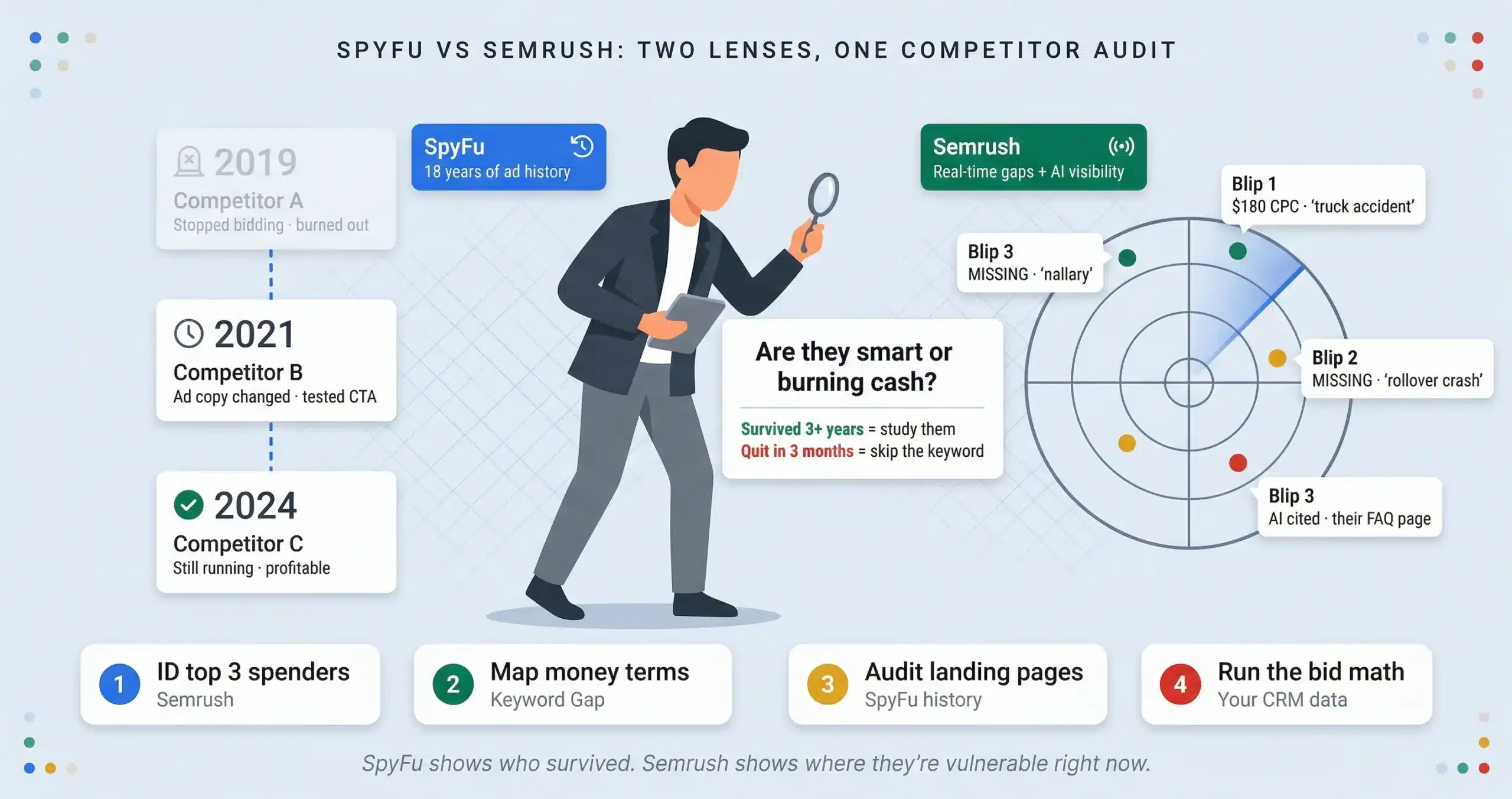
18 years of ad history. Use it to see which competitors survived high CPCs and which ones burned out. If they ran an ad for 5 years, it made money. Stopped after 3 months? It burned cash.
Semrush: The Real-Time Radar
Live keyword gaps and AI visibility tracking. Use it to find the specific terms your competitor bids on that you don’t and to track whether your firm gets cited in ChatGPT and Perplexity responses.
I use both on every legal account I manage but for completely different reasons and at completely different stages. Together they answer the only question that matters: is your competitor winning because they’re smart or because they’re burning money they’re about to run out of.
TL;DR
Use SpyFu for the 18 year ad history to see which competitors survived high CPCs and which ones burned out. Use Semrush for real-time keyword gaps and AI visibility tracking across ChatGPT and Perplexity. Together they answer the only question that matters in legal PPC: is your competitor winning because they’re smart or because they’re burning money they’re about to run out of.
SPYFU FOR LEGAL PPC: THE GRAVEYARD ANALYSIS
SpyFu maintains an unbroken record of Google Ads going back 18 years to 2007 and their latest infrastructure update exposed up to 10x more ad records per domain. In legal PPC, the value isn’t seeing who’s bidding now; it’s seeing who stopped. A firm that bid on “mesothelioma lawyer” from 2019 to 2022 and then disappeared couldn’t make the unit economics work at $500 to $1,000 per click and that’s a keyword you skip unless your back-end conversion rate is structurally better than theirs was.
1 · The Survivor Test
Filter competitor ad history for campaigns running longer than 3 years. In a $200 per click auction, longevity is the only proxy for profitability. If it survived 36 months of billing, it’s making money and worth studying.
2 · Ad Copy Forensics
Track how a competitor’s CTA evolved. Moved from “Free Consultation” (2022) to “No Win No Fee” (2024)? Their data proved the second phrasing had higher intent. Steal the winner and skip the test.
3 · Landing Page Audit
Every historical ad links to its destination URL. Competitor sent $300 clicks to a generic homepage? They’re burning cash. Dedicated practice area page with form above the fold? That’s the one to study.
💡 The “Top Ads” shortcut (most actionable tip on this page)
SpyFu’s Top Ads panel shows what percentage of total impressions each ad variant commands. One headline at 13% impression share for six months while others sit at 2%? That ad is a verified statistical winner. Adopt the psychological framework without spending a dollar on A/B testing; your competitor already did it for you.
SEMRUSH FOR LEGAL PPC: KEYWORD GAPS AND AI VISIBILITY
Semrush does something SpyFu can’t; it shows you the keywords your competitors rank for that you don’t even bid on yet. Their Keyword Gap tool lets you cross-reference your domain against up to four competitors simultaneously and the output categorizes everything as “Missing,” “Weak,” or “Shared.”
The “Money Term” Filter
Ignore the “Shared” column. Focus on “Missing” (they rank, you don’t) and filter for CPC above $50. In legal, anything below $50 is usually informational. Above $50 is commercial intent where a single conversion justifies the spend.
AI Visibility Toolkit (2026)
First platform tracking which law firm URLs get cited inside ChatGPT, Perplexity, and Gemini. “Cited Pages” filter shows which content formats are pulled; tables get cited 2.5x more than prose. FAQ schema nearly doubles ChatGPT citation rate.
With 60% of Google searches ending without a click and paid CTR dropping 68% on queries with AI Overviews, knowing whether your firm shows up in the AI answer is probably more important than knowing your search ranking position at this point and that’s a sentence I wouldn’t have written two years ago but the data doesn’t leave much room for debate.
⚠ The visibility gap most firms don’t know about
Paid CTR dropped from 19.7% to 6.3% on queries where AI Overviews appear. But firms cited inside the AI Overview see 91% higher paid CTR and 35% more organic clicks. If your competitor is in the AI answer and you’re not, they’re capturing the intent before your ad is even visible.
THE 4 STEP COMPETITOR AUDIT FOR LEGAL PPC ACCOUNTS
Generic tool comparisons tell you what buttons to click. Here’s how I actually use both platforms together on a legal PPC account where the CPC is $150 or more and the margin for error is basically zero.
1 · Identify the top 3 spenders
Tool: Semrush
Pull the top 3 spenders in your specific geo-market from Semrush’s Advertising Research tab. Ignore national aggregators; focus on the firms actually bidding in your DMA.
2 · Map the money terms
Tool: Semrush Keyword Gap
Export “Shared Keywords” and filter for CPC above $50. These are the terms where a single conversion justifies the cost and everything below $50 in legal is usually informational traffic.
3 · Audit their landing pages
Tool: SpyFu Ad History
Pull the landing page URLs tied to each competitor’s ads. Homepage means amateur. Dedicated practice area page with click-to-call above the fold means someone who knows what they’re doing.
4 · Run the bid math
Tool: Your CRM data
Formula: (Avg case fee × close rate × lead-to-case rate) ÷ 3 = your max CPC. Competitor bids $200 but your max comes out to $140? Don’t match them. They’re converting at a structurally higher rate or they’re about to go broke.
WHERE THE HIDDEN KEYWORDS ACTUALLY COME FROM
The expensive head terms like “personal injury lawyer [city]” are where all the money goes and where most of it gets wasted. Firms generating real ROI in 2026 target the long-tail conversational queries that prospects actually type when they’re in distress, not the formal legal terminology that every agency defaults to.
Someone going through a bad divorce doesn’t search “corporate asset division in contested divorce proceedings.” They search “how to protect my small business from my ex-wife.” That second query costs a fraction of the formal one and converts at a higher rate because the person is further along emotionally; they have a specific problem and they want a specific answer. Reddit forums, intake call transcripts, and consultation notes are where you find these phrases and Reddit alone saw a 1,300% visibility surge in search results after Google’s late 2025 algorithm updates.
I mine our own intake call transcripts for keyword ideas more than I use any third-party tool because the questions a prospect asks right before they sign a retainer are the exact queries you should be bidding on. Three clients in a row asking “how long does a truck accident settlement take in Tampa” during the consultation means that’s a keyword with a landing page behind it by the end of the week. The expensive keywords page covers the CPC data by practice area and the negative keywords page has the full exclusion list for protecting the budget from informational queries.
Want the competitor audit for your market?
Send me your top competitor’s domain and your practice area and I’ll run the SpyFu graveyard analysis and the Semrush keyword gap for your market and tell you where the openings are before you spend anything.
About Jorge Argota · 10 years in legal PPC. I run SpyFu and Semrush audits on every account before a campaign launches. Google Ads certified. Full bio.
Related: Most Expensive Keywords · CPC Benchmarks · Negative Keywords · Top PPC Spenders