
Written by Jorge Argota · Legal Marketing · United States
Most agencies lose their law firm clients at 90 days and you report 30 leads and the managing partner says “I signed zero cases and your ads don’t work and I’m canceling.”
I’ve been the white label fulfillment behind agencies running legal accounts for about 10 years now and every single time the problem is the same; it’s never the ads.
⚠ The compliance risk most providers miss entirely
If your ad says “Best Personal Injury Lawyer in Miami” and the attorney isn’t board-certified by the Florida Bar, that’s a Rule 7.1 violation. The attorney faces disciplinary sanctions, not the agency, and that means you lose the client, the referral network, and probably every other firm that attorney talks to. This is the number one way agencies blow up law firm relationships and most white-label providers don’t even know the rules exist.
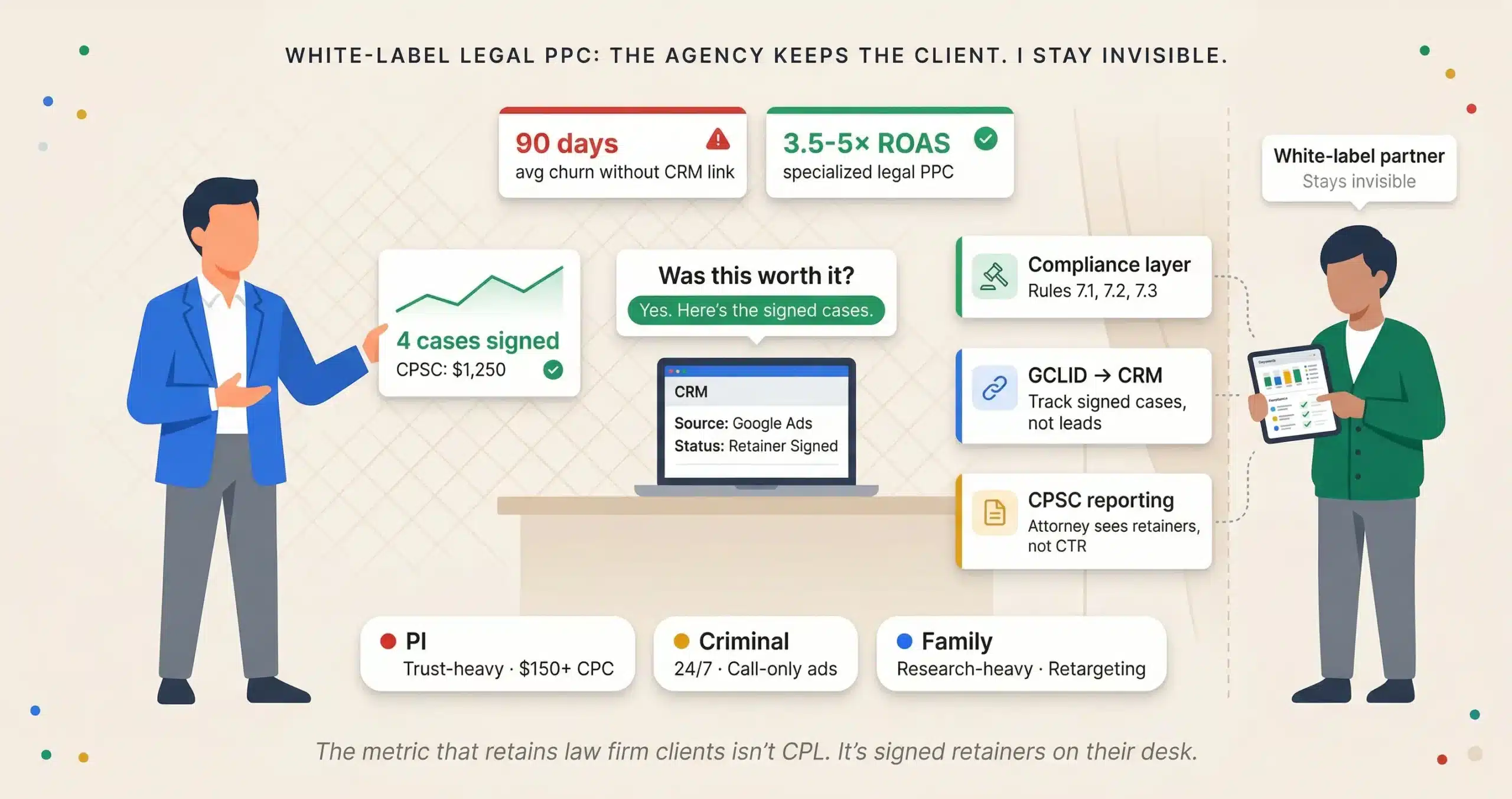
White label legal PPC isn’t lead generation. It’s case acquisition infrastructure. The metric that retains the client isn’t CPL; it’s the cost to put a signed retainer on their desk.
White label legal PPC management for agencies requires three things generalist providers miss: ABA Rule 7.1/7.2/7.3 compliance baked into every ad, GCLID to CRM integration that tracks signed cases instead of form fills, and a 30 day intake audit before campaigns launch. Specialized legal campaigns run 3.5 to 4.5% CTR with 3.5x to 5.0x ROAS vs 2.5% CTR and 2x ROAS from generalist teams. The execution gap costs agencies their law firm clients at 90 days. Source: Jorge Argota, 10 years white-label legal PPC fulfillment.
ABA advertising rules that get law firm clients sanctioned
Most white label providers skip the bar rules because they don’t know they exist. Every state has advertising regulations and they’re not suggestions. Rule 7.1 I covered above. Rule 7.2 says the contract has to be flat fee or retainer-based media management; if the compensation looks like a per case bounty or a commission tied to signed retainers, that’s fee splitting and the attorney is exposed. I’ve seen agencies lose entire books of business over that one clause because the agency never checked the rules before drafting the MSA. And Rule 7.3 covers solicitation; your retargeting campaigns and automated SMS sequences and chatbot interactions have to stay classified as passive advertising and if the chatbot initiates contact and offers legal services to someone who hasn’t reached out first, you’ve crossed into prohibited real-time solicitation and the consequences aren’t theoretical.
⚠ Rule 7.3: The chatbot solicitation risk
If your chatbot says “Hi, do you need a lawyer?” before the user clicks anything, that’s real-time solicitation under Rule 7.3 and the attorney is liable. The chatbot has to wait for the user to initiate. It can respond to inquiries all day long but it cannot start the conversation or you’ve crossed from advertising into prohibited solicitation.
I auto insert “Attorney Advertising” and “Prior results do not guarantee a similar outcome” as sitelink extensions based on the geo target state so the agency never has to remember. It takes maybe five minutes to set up and it eliminates the single biggest compliance risk in the relationship, which is kind of wild that more people don’t do it but here we are.
💡 The five minute fix
Add “Attorney Advertising” and “Prior results do not guarantee a similar outcome” as automated sitelink extensions triggered by geo-target state. It takes five minutes per account, it’s invisible to the end user, and it removes the compliance risk that destroys more agency-firm relationships than bad CPL numbers ever will.
Why law firm leads don’t convert to signed cases
So a lead comes in at 2 PM and the receptionist is at lunch and the attorney is in deposition and by 2:15 that person already called the next firm on Google and your dashboard shows a conversion but the firm’s CRM shows nothing and both sides think the other one is the problem. I see this constantly and the fix every time is the same; you pass the GCLID from Google Ads into a hidden field on the intake form and when that lead eventually signs a retainer in Clio or Filevine the signed case value gets pushed back into Google so the algorithm stops chasing form fills and starts finding people who actually hire lawyers. The CPSC page walks through the Zapier workflow for setting that up.
💡 The metric shift that retains clients
The report the attorney sees should show cost per signed case, not cost per lead. Pull from Google Ads, GA4, and the firm’s CRM so it traces which campaigns produced retained clients. The agency gets the full version with CTR and quality scores. The attorney gets the version that answers one question: “was this worth it.”
Thirty or 40 legal accounts at any given time; that’s what I’m managing and within a week of taking one over I can tell whether the previous agency was a generalist because the numbers never lie. Generalist accounts sit at 2.5 to 3% CTR and maybe 2x ROAS. The negative keyword list has 50 terms when it needs 500. Cheap clicks everywhere, no case signal anywhere, and the algorithm just buying whatever Google wants to sell it. After the rebuild with exact match targeting and portfolio bidding across practice areas the CTR goes to 3.5 to 4.5% and ROAS hits 3.5x to 5x because the algorithm is sharing conversion data across car accident and truck accident and slip-and-fall campaigns instead of each one trying to learn from scratch on a tiny budget, which is the difference between a campaign that produces retainers and one that produces a cancellation email.
How to structure legal PPC campaigns by practice area
Before any search campaign goes live, LSAs go first. They sit above the paid search results, charge per lead instead of per click, and filter out the bot traffic that bleeds traditional PPC accounts dry. Spam lead or a call outside the practice area? Dispute it within 48 hours for a direct credit from Google; I track every recovered dollar on the monthly report.
And you have to segment by practice area because the campaign architecture is completely different for each one and running the same ad copy and the same bid strategy across all three is how generalist agencies burn $50,000 a month and sign zero cases.
Personal Injury
$150+ CPC · Long cycle
Trust-heavy landing pages. Settlement figures and case results above the fold. Filter for “retainer intent” not “accident research.”
Criminal Defense
Urgent · 24/7 bidding
Call-only ads and mobile-first. Someone just got arrested; if they can’t click-to-call in two seconds you lose the case to the next firm.
Family Law
Research-heavy · Days to decide
High-empathy copy and retargeting. The prospect spends days comparing firms; you stay top of mind until they’re ready to file.
⚠ The “one size fits all” mistake
A criminal defense prospect searching “lawyer after arrest” at 2 AM needs a click-to-call button and a live intake line. A family law prospect researching “child custody attorney” at 10 PM needs a detailed FAQ page and a retargeting sequence. If the campaign architecture treats these the same, the agency burns budget on both and converts neither.
First thing on every new account: 24 months of auction insights. Where was the previous agency bleeding money? Usually on research keywords like “lawyer salary” and “how to become an attorney” that have zero chance of producing a retainer. By week two the compliance firewall is configured and CallRail is passing GCLID data on every call. Six weeks in, the dashboard reports cost per signed case from the CRM integration; if leads are coming in but the firm isn’t signing them, I pause the spend and figure out whether it’s a targeting problem or an intake problem before burning another dollar.
How to stop law firm client churn at 90 days
If the attorney can’t see which campaigns produced signed retainers in their own CRM, the monthly report is just a PDF they ignore before calling to cancel.
Before any ads launch, three calls to the firm’s main number at random hours during the first week. Pick up within two minutes during business hours or the campaign doesn’t go live. Sending $150 clicks to a voicemail box burns the budget and kills the relationship before it even had a chance, and that’s exactly what we’re trying to prevent.
And the MSA needs a clean transfer clause. The law firm owns all data, ad accounts, and CRM records. If the relationship ends, everything transfers. I’ve watched firms lose months of campaign history because the previous vendor refused to share Google Ads access and the firm started from zero, which keeps happening more than it should.
🔒 Data ownership bill of rights
The law firm owns the Google Ads account, the conversion history, the CRM records, and the CallRail numbers. If the relationship ends, everything transfers with no hostage accounts and no proprietary data walls. This is the single biggest trust signal you can offer an agency evaluating white-label partners and I’ve watched firms lose months of campaign data because a previous vendor refused to hand over access, which keeps happening more than it should.
If you’re an agency running legal accounts and you need a white-label partner who handles the compliance layer and the CRM integration and reports on signed cases instead of form fills, that’s what I do. The agency keeps the client relationship and I stay invisible. Start a conversation.
Jorge Argota · 10 years as white-label PPC fulfillment for agencies with legal clients. Google Ads certified, Full bio.
Related: Cost Per Signed Case · CPC Benchmarks · Click Fraud Protection · 350+ Negative Keywords