

Written by Jorge Argota · Legal Marketing · United States
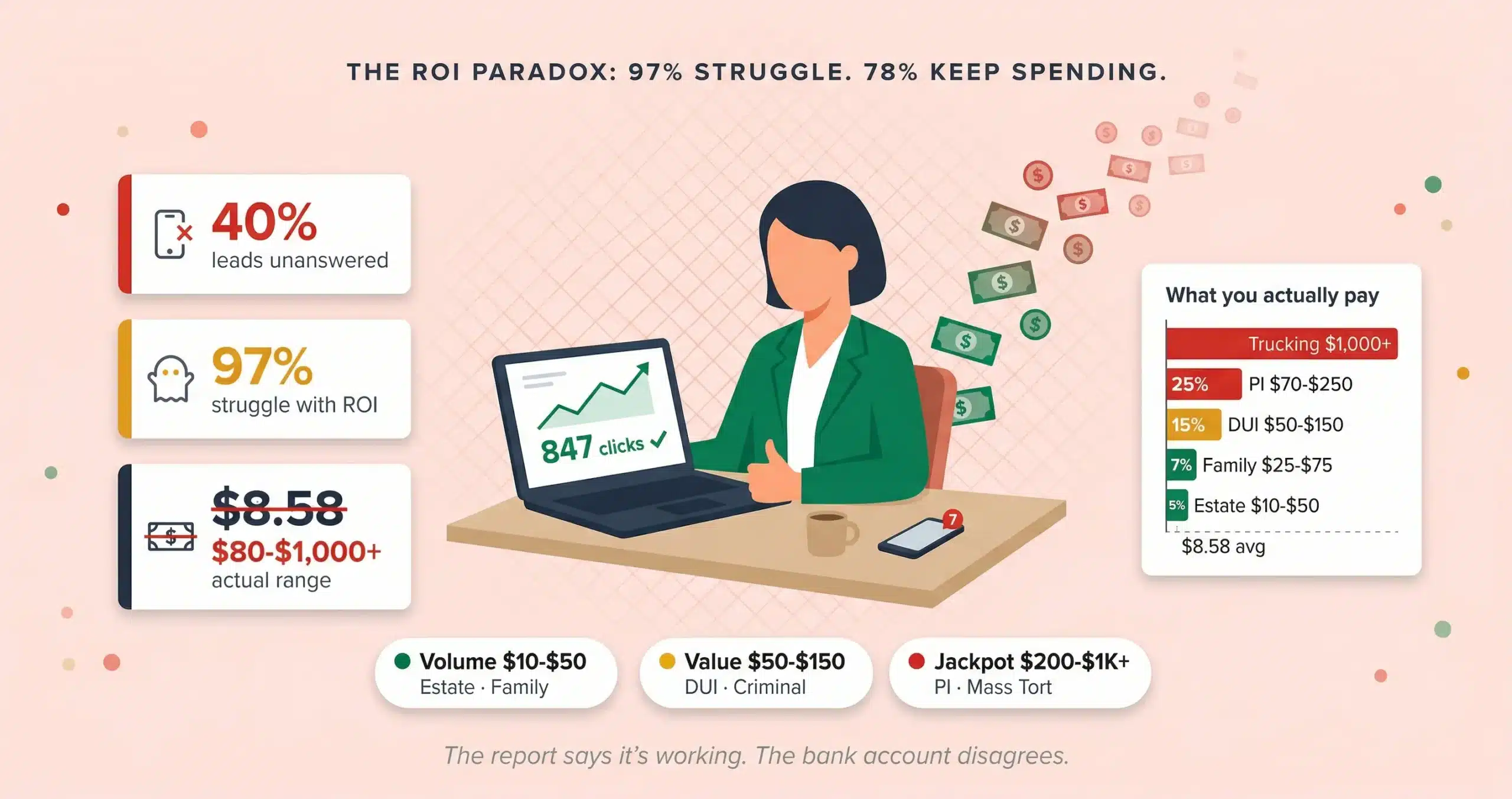
I run Google Ads for law firms and the number I keep seeing quoted in every benchmark article is $8.58 average CPC for legal. That number is a lie. It blends $0.63 display network clicks with $250 personal injury clicks and produces an average that describes neither. If you budget based on $8.58 you will run out of money before lunch.
$426.7B
US Legal Market (2025)
463,600
Law Firms Competing
$3B
Annual Legal Ad Spend
97%
Report Difficulty With ROI
The real picture is that 463,600 law firms compete across 210 designated market areas in a $426.7 billion industry and 78% of them use paid search. 97% report difficulty achieving positive ROI. Not because the platform is broken but because they’re budgeting for a market that doesn’t exist. Legal PPC is not one market; it’s three completely different economies with different entry prices, different conversion mechanics, and different minimum budgets to even generate enough data for the algorithm to learn.
TL;DR
Every benchmark article says legal CPC averages $8.58. That number will bankrupt your campaign. I manage accounts across PI, criminal, family, and estate and the actual cost ranges from $10 per click for estate planning to $1,000 for commercial trucking depending on which of the three PPC economies you compete in. This page breaks down the real market size, the three economies (Volume, Value, and Jackpot), the performance benchmarks that separate average firms from top performers, and the reason 40% of the leads you’re paying for never get a callback.
THE $426 BILLION REALITY: WHY THE “AVERAGE” IS WRONG
Estimated Cost Per Case
$14,286
Clicks
66.7
Leads
4.7
Cases
0.7
$/Case
$14,286
PI: CPC $150+, Conv 5-7%. Family: CPC $30, Conv 8-10%. DUI: CPC $80, Conv 9-12%.
THE 3 DISTINCT ECONOMIES OF LEGAL PPC
I stopped calling it “the legal PPC market” about three years ago because it’s not one market. A family law firm competing at $30 per click has nothing in common with a PI firm competing at $250 and they share a category label and nothing else. When I onboard a new firm the first thing I figure out is which economy they’re competing in because the budget math, the bid strategy, and the intake requirements are completely different for each one.
PERFORMANCE BENCHMARKS: AVERAGE FIRM VS TOP PERFORMER
1.37 million active lawyers in the US as of 2025 and the number is climbing. 93% of new graduates are employed and law school applications jumped 21% for the 2025 to 2026 cycle, which means more firms entering the auction every quarter. A quarter of all US lawyers practice in New York and California alone, so the CPC in Manhattan looks nothing like the CPC in Boise and using a national average for either one will wreck your budget. The budget page covers the full channel allocation breakdown by firm size.
THE ROI PARADOX: WHY 97% OF CAMPAIGNS FAIL
82% of firms say paid search ROI doesn’t justify the spend. But 78% keep spending anyway. I see this constantly and the disconnect almost never lives in the campaign. The ads are generating clicks, the clicks are producing leads, and then the leads sit in a voicemail box for two days because the intake process is broken and by the time someone calls back the prospect already hired the firm that picked up first.
The Ghost Metric: 40% Lead Leakage
40%
of all inbound web leads go entirely unanswered
Attorneys and their staff are too consumed by casework to handle real-time intake. A $1,500 PI lead sent to voicemail is incinerated capital.
17.6%
form conversion rate vs 2.6% phone conversion rate
People who fill out an intake form convert at nearly 7x the rate of exploratory phone calls because they’ve already committed time to describing their case.
The firms solving this are smaller than you’d expect. Growing solo firms now handle 37% more cases than their traditional peers and growing small firms handle 25% more. They’re not outspending anyone; they’re converting more of what they already generate through AI intake that picks up in under 60 seconds and flat-fee billing that rewards efficiency instead of penalizing it. The CPSC page covers the intake speed mechanics and the CPC benchmarks page covers what each practice area actually pays per click.
THE “CPC CLIFF”: VISUALIZING REAL COSTS
The CPC Cliff: Industry Average ($8.58) vs What You Actually Pay
If you budget based on $8.58, you cannot compete in any practice area above Family Law.
I broke down the practice-area detail on the CPC benchmarks page including why crisis keywords carry a premium I call the Panic Premium and how Quality Score mechanics can cut what you actually pay by 30 to 40%. The industry benchmarks page covers how legal compares to finance, insurance, and education and why Google’s own auction mechanics artificially inflated these prices for nine years.
BUDGET VIABILITY MATRIX
If you spend below these numbers you won’t generate enough clicks for the algorithm to learn what converts and what doesn’t. Every dollar is exploratory waste because the campaign never exits the learning phase. I’ve seen firms spend $3,000 a month on PI and wonder why it doesn’t work; at $150 per click that’s 20 clicks, maybe one lead, and zero statistical signal for Google to optimize against.
THE NEGATIVE KEYWORD VAULT (BUDGET PROTECTION)
Add These to Your Negative Keyword List Today
Employment Queries
“internship”
“salary”
“jobs”
“resume”
“training”
“course”
Free Services
“pro bono”
“legal aid”
“free”
“volunteer”
“clinic”
Education Queries
“law school”
“exam”
“bar association”
“degree”
“LSAT”
The full 350+ negative keyword list covers every practice area with copy-paste Google Ads formatting.
Which Economy Are You Competing In?
Your practice area determines whether you need $2,000 or $20,000 a month to compete. We run the budget math against your market, your practice mix, and your current conversion rate to tell you whether the numbers work before you spend anything.
Related: CPC Benchmarks by Practice · Cost Per Signed Case · Industry Benchmarks · Most Expensive Keywords