
Written by Jorge Argota · Legal Marketing · United States
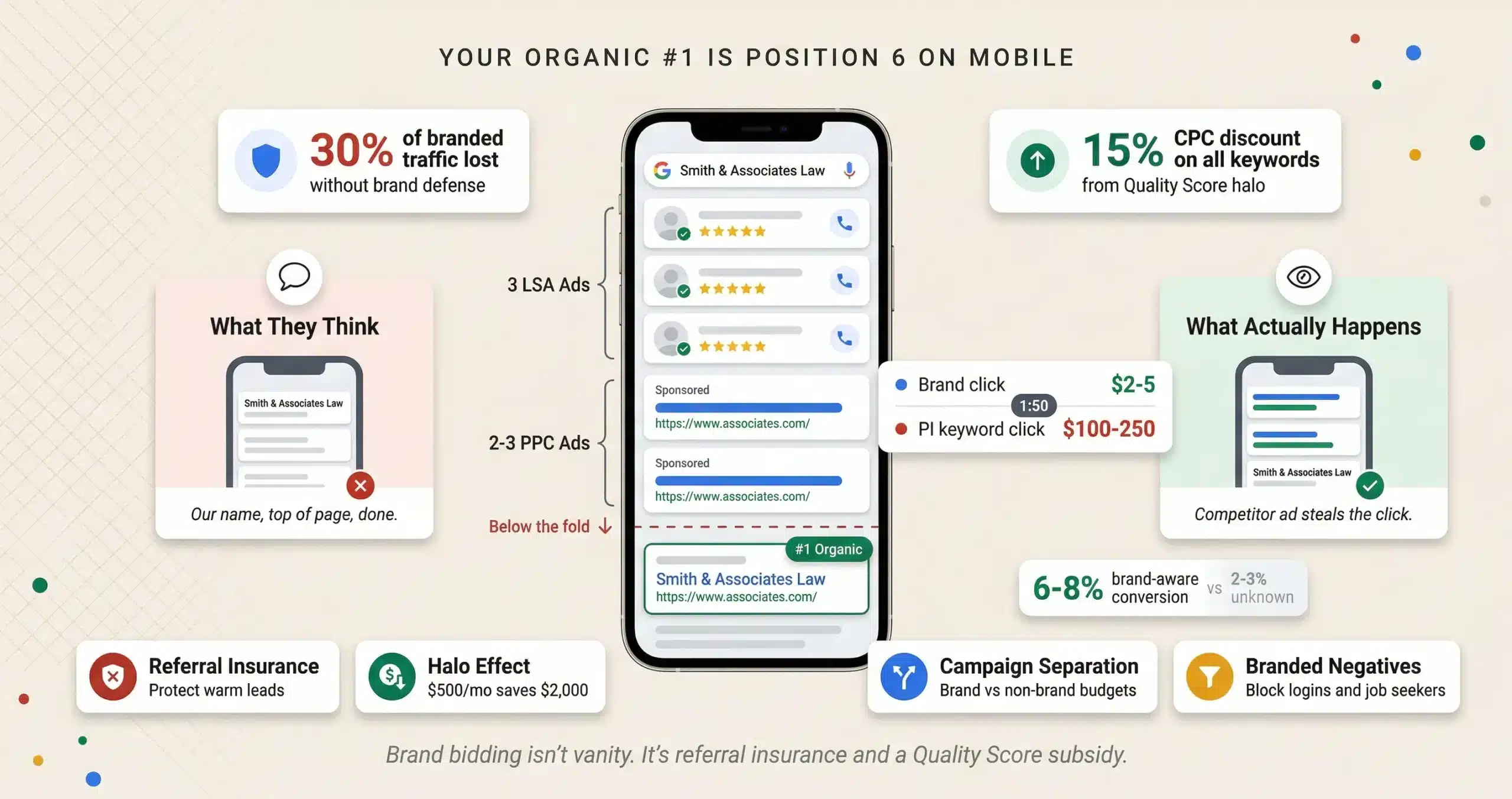
So every managing partner I talk to says the same thing: “We rank number one for our own name, why would I pay for that click?” And the answer is that on a mobile phone, your organic number one result is actually the sixth thing on the screen. It sits below three Local Service Ads and two or three paid search ads. If a competitor is bidding on your name and you’re not, the first thing a referral sees when they Google you is someone else’s ad with a “No Fee Unless We Win” hook, and you just lost a $50,000 case to save $3 on a click.
TL;DR
Bidding on your own firm name isn’t vanity; it’s referral insurance and a Quality Score subsidy. Firms that bid on branded terms see a 31% increase in total conversions compared to relying on organic alone. Brand-aware searchers convert at 6% to 8% versus 2% to 3% for people who don’t recognize the firm. And the branded clicks cost $2 to $5 while your injury keywords cost $100 to $250, which means the high CTR from branded traffic lifts your account-level Quality Score and lowers the CPC on your expensive keywords by up to 15%. This page covers why brand bidding is a defense mechanism, not a marketing expense.
30%
of branded traffic diverted to competitors without defense
15%
average CPC discount on non-brand from Halo Effect
1:50
$2 brand click vs $100 generic click cost ratio
WHY ORGANIC #1 IS INVISIBLE ON MOBILE: THE REFERRAL PROTECTION CASE
On a desktop screen, ranking first organically for your own name puts you near the top of the page. On a mobile phone, which is where most legal searches happen, organic position one sits below three Google Screened LSA results and two to three paid search ads. That means the top 40% of the mobile screen is controlled by whoever’s paying for it, and if you’re not paying, your competitors are.
What the Partner Thinks Happens
“Someone Googles our name, sees our listing first, clicks it, calls us.”
What Actually Happens on Mobile
“Someone Googles your name, sees a Morgan and Morgan ad at the top with ‘No Fee Unless We Win,’ clicks it, and calls them instead. Your organic listing is below the fold.”
The people searching your firm by name are your warmest leads. They’re past clients looking to refer friends, people who heard about you from a colleague, or prospects who saw your name somewhere and are verifying you before calling. Research shows that not defending these branded searches can divert up to 30% of this high-intent traffic directly to competitors who are bidding on your name. And the conquesting compliance page confirms that bidding on a competitor’s name is legal in most states, which means if you’re not defending, someone is attacking. Branded bidding isn’t customer acquisition; it’s referral insurance.
THE HALO EFFECT: HOW $500 IN BRAND ADS SAVES $2,000 ON INJURY KEYWORDS
This is the part that changes the math on branded bidding from “defensive expense” to “financial engineering.” Google assigns quality scores based partly on your account’s aggregate click-through rate. Your “car accident lawyer” keywords have a CTR around 2% and a Quality Score of maybe 5 out of 10. Your branded keywords have a CTR of 40% or higher and a Quality Score of 10 out of 10. When you flood your account with high-quality branded data, it lifts the average trust signal of the entire account.
The math: Spending $500 a month on branded ads generates high-volume, 10/10 Quality Score traffic that acts as a lever lowering the CPC on your expensive non-branded keywords by up to 15%. At legal CPCs that 15% discount can save $2,000 a month or more on your PI and criminal defense campaigns. The branded clicks themselves cost $2 to $5 each, which means the entire branded campaign pays for itself multiple times over through the CPC reduction on every other keyword in the account.
And the conversion data reinforces the economics. Firms with established brand recognition convert paid search traffic at 6% to 8%, compared to 2% to 3% for unknown firms. The click costs the same in the auction regardless of whether the person knows you, but the person who searched your name and landed on your ad converts at triple the rate. Studies show that businesses using brand bidding see a 31% increase in total conversions compared to relying on organic results alone, and for law firms where a single additional signed case can be worth $30,000 to $300,000, that 31% increase is transformative.
BRAND CAMPAIGN SEPARATION: WHY MIXING BRANDED AND NON-BRANDED KEYWORDS KILLS YOUR BUDGET
If you run branded and non-branded keywords in the same campaign, Google’s algorithm will eat your budget on the branded terms first because they have the highest CTR and the cheapest clicks, which makes the algorithm think they’re your best performing keywords. Your daily budget gets consumed by $3 branded clicks before noon and your $200 injury keywords never get enough impressions to learn or convert. The campaign report looks great because the branded clicks inflate the numbers, but you’re not acquiring any new clients; you’re just paying for people who already knew your name.
The fix is absolute separation. Brand campaigns target searches containing your firm name and individual attorney names. Non-brand campaigns target practice area keywords and run on their own budget. Once you separate the brand campaign, change the bid strategy to Target Impression Share and set it to 100% for Absolute Top of the Page. You’re not trying to maximize conversions here; you’re building a wall around your name so no competitor can ever show above you. Your non-brand campaigns keep running on Target CPA or Maximize Conversions where the algorithm needs flexibility, but the brand campaign’s job is pure defense and it should never lose the top slot. If you’re seeing your non-branded campaigns underperform while your blended reports look strong, this separation is almost always the reason.
BRANDED NEGATIVE KEYWORDS: STOP PAYING FOR EXISTING CLIENTS AND NAVIGATIONAL SEARCHES
Even within your brand campaign, there are searches you don’t want to pay for. An existing client searching “Smith Law login” or “Smith Law bill pay” is looking for your client portal, not hiring you. A vendor searching “Smith Law address” or “Smith Law fax number” is navigating, not converting. Let organic handle those and save the branded budget for the searches that produce new cases.
Branded Negative Keyword Lists for Law Firms
The existing client block
The vendor and navigational block
The job seeker block
The 350+ negative keywords list has the full universal negatives for non-branded campaigns. These branded-specific lists are the additional layer you apply to the brand campaign only.
Want to know if competitors are bidding on your name right now?
Search your firm name on Google from a phone right now and look at what shows above your organic listing. If you see a competitor’s ad, you’re leaking referrals. Send me your firm name and I’ll pull the auction insights, tell you who’s bidding on you, and build the branded defense campaign with the right negatives already loaded. If no one’s conquesting you, I’ll tell you that too and you can skip the brand spend entirely.
Related: Competitor Bidding Compliance · 350+ Negative Keywords List · PPC Campaign Management · Keyword Intent Taxonomy · Google Ads Cost and ROI