

Written by Jorge Argota · Legal Marketing · United States
Originally published from conversion audits and intake data. Refreshed as benchmarks change.
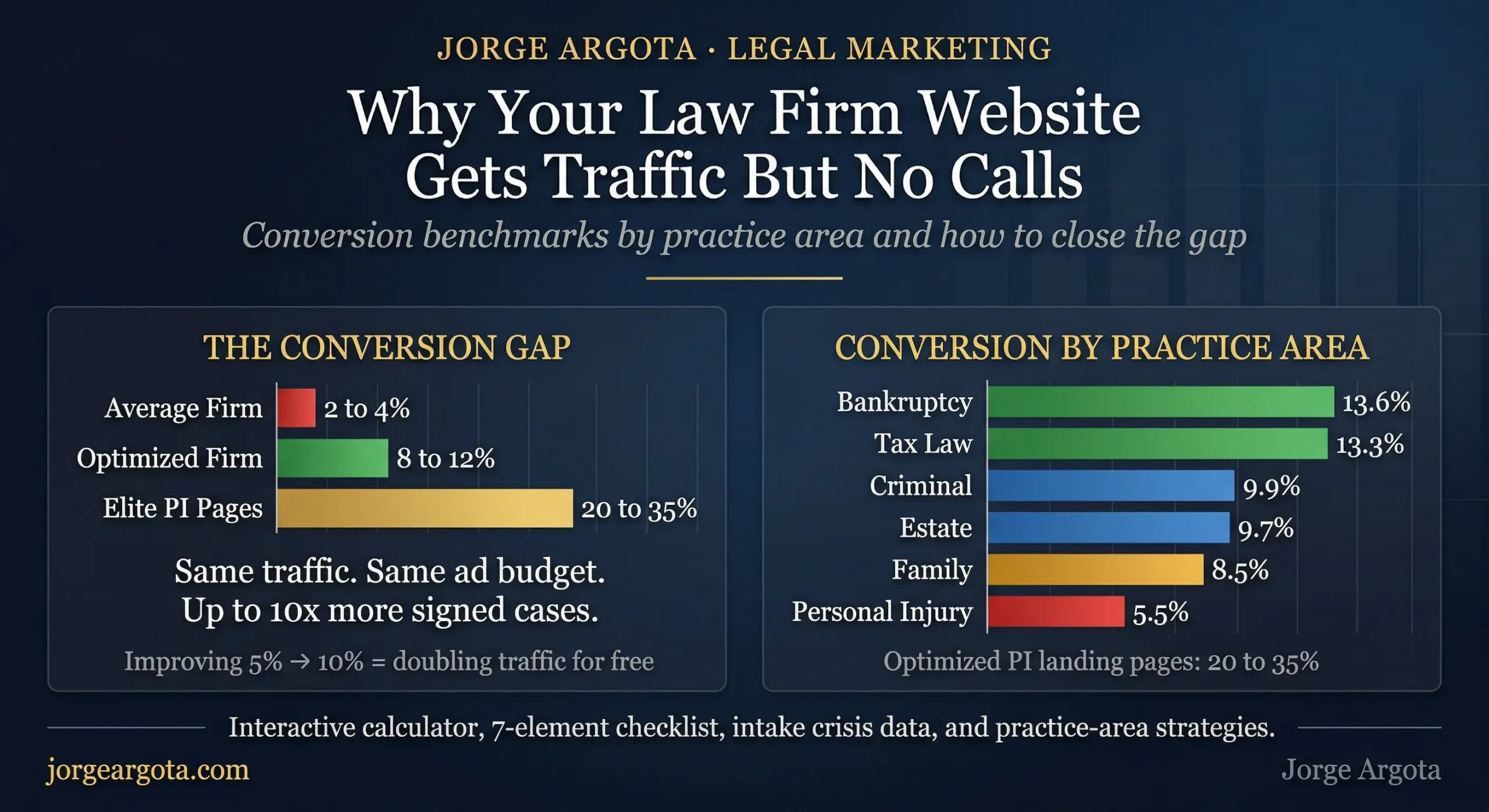
You’re spending money on marketing and the monthly report says traffic is up. More people are visiting your website than ever. But the phone isn’t ringing any more than it was six months ago and the intake team says the leads coming in aren’t great. The problem almost never is the traffic. The problem is what happens after someone lands on your site. The average law firm website converts somewhere between 2 and 4% of visitors into leads. The firms doing it right convert 8 to 12%. And the best personal injury landing pages I’ve audited hit 20 to 35%. The gap between those numbers is worth more than any traffic source you could buy.
Improving your conversion rate from 5% to 10% is mathematically the same as doubling your traffic without spending another dollar on ads. This page covers the practice-area conversion benchmarks nobody else publishes, the seven elements that separate the best landing pages from average ones, why most firms lose more money from slow intake than from bad marketing, and what to do about all of it.
RUN THE MATH: THE COST OF A LEAKY FUNNEL
Assumes blended traffic cost of $10/visitor, 25% intake close rate, and $5,000 average case value. Adjust sliders to view impact.
WHERE THE LEADS ACTUALLY DISAPPEAR
Most firms think they have a lead generation problem when they actually have a conversion and intake problem. I’ve audited firms spending $20,000 a month on Google Ads where less than half the leads ever got a callback. The marketing was working. The funnel underneath was broken.
WHERE LEADS DROP OFF (INDUSTRY AVERAGE VS OPTIMIZED)
Visitor to Lead
Lead Contacted
Consult Scheduled
Case Signed
The compounding effect: an average firm converts roughly 0.3 to 0.5% of website visitors into signed cases. An optimized firm converts 3 to 5%. That’s a 10x gap from the same traffic.
When you multiply the losses at each stage, the average firm turns roughly 1 out of every 200 to 300 website visitors into a signed case. An optimized firm turns 1 out of every 20 to 30. Same traffic, same ad budget, 10x more cases. That’s why I always tell firms to fix the funnel before spending more money at the top of it.
YOUR CONVERSION RATE DEPENDS ON WHAT KIND OF LAW YOU PRACTICE
This is the data that nobody else publishes and it explains a lot of confusion in legal marketing. A PI firm converting at 5% is actually performing at the top of its category, while a bankruptcy firm converting at 5% is dramatically underperforming. The benchmarks are different for every practice area and if you’re comparing yourself to a generic “industry average” you’re measuring against the wrong number.
CONVERSION RATE BY PRACTICE AREA (HOVER FOR DETAILS)
Bankruptcy
Tax Law
Criminal
Estate
Family
Legal Average
General Practice
Personal Injury
Bankruptcy and tax law convert highest because the searcher has already decided to act. Personal injury converts lowest at the average level but optimized PI landing pages reach 20 to 35% because they match specific accident types to dedicated pages.
The PI number deserves its own explanation. The 5.5% average includes every PI firm in the country, including ones sending all their paid traffic to a generic homepage. The firms with dedicated landing pages built for specific accident types; truck accidents getting their own page, motorcycle getting its own page, slip and fall getting its own page; those firms convert at 20 to 35%. The gap between sending paid traffic to your homepage versus a dedicated landing page is roughly 3 to 4 times. That single change; building a specific page for each case type and sending ad traffic only to that page; is the single most impactful conversion fix in legal marketing.
SEVEN THINGS THAT SEPARATE 20% PAGES FROM 5% PAGES
1. The headline tells the visitor they’re in the right place within 2 seconds
“Injured in a Car Accident?” converts dramatically better than “Premier Personal Injury Representation” because the first one matches what the person just typed into Google. If your headline sounds like a tagline from a billboard, it’s costing you leads.
2. The phone number and contact form are visible before any scrolling
On mobile; which drives roughly 7 times more traffic than desktop in legal; the call button needs to be tappable the instant the page loads. Every scroll required to find the phone number loses people. In legal, mobile visitors actually convert higher than desktop visitors because people facing emergencies (accidents, arrests, custody disputes) tap “call now” immediately when they see it.
3. The form has three fields, not seven
Every additional form field drops completions by about 11%. Reducing from 7 fields to 3 increases submissions by roughly 86%. Name, phone number, brief description of what happened. That’s it. If you need more information for qualification, use a two-step form where the first step is dead simple and the second step asks for details after they’ve already committed.
4. There’s no navigation menu on the landing page
A regular website has a menu bar with 5 to 7 links at the top; Home, About, Practice Areas, Blog, Contact. Each of those is an exit. Removing the navigation from a landing page can double conversions because every element now points to one action: call or fill the form. The marketing playbook has the side-by-side comparison showing exactly what this looks like.
5. Social proof is next to the form, not buried on a separate page
Testimonials placed adjacent to the contact form increase conversions by about 34%. Case results near the call-to-action increase them by 20 to 30%. Star ratings in the header establish trust before the visitor reads a single word. Most firms put all their reviews on a separate “Testimonials” page that nobody visits. Put them where the decision is happening.
6. Video on the page
Landing pages with video increase conversions by 80 to 86% and visitors stay on the page roughly 88% longer. A 60-second video of the attorney explaining the process and what to expect does more for trust than 2,000 words of text. Despite this, only about a third of law firms create any video content at all.
7. The page loads in under 3 seconds
Each additional second of load time drops conversions by about 4.4%. Over half of mobile visitors abandon sites that take longer than 3 seconds. In an industry where 88% of traffic arrives on phones, a slow site isn’t just annoying; it’s the equivalent of locking the front door during business hours.
WHAT WORKS FOR YOUR PRACTICE AREA SPECIFICALLY
The conversion tactics that work for a PI firm are different from what works for a family law practice or a criminal defense firm. The urgency, the emotions, and the way people search are all different, which means the pages need to be different too.
Personal injury needs urgency-driven design that matches the crisis the person is living through.
- Benefit-focused headlines: “Injured in a Car Accident? Get the Compensation You Deserve” outperforms “Premier Personal Injury Representation” by a wide margin
- One landing page per accident type (truck, motorcycle, slip and fall each get their own page)
- Case value calculators work well because the first question every injured person asks is “how much is my case worth”
- Google blocks follow-up ads for PI because injuries are classified as sensitive health conditions; your site has to convert on the first visit because you can’t follow that visitor with ads afterward
Family law requires empathy-first messaging with heavy privacy assurances.
- Confidentiality language matters because many clients are researching divorce without their spouse knowing
- Google also blocks follow-up ads for family law (divorce classified as “relationship hardship”)
- 3x more phone calls than form fills because the decision is emotional and people want to talk to a human
- Paid initial consultations ($150 to $300) actually close at higher rates because the fee filters for serious prospects
Criminal defense operates on a 24-hour conversion window.
- People search within 48 hours of arrest, often at 2 or 3 in the morning; DUI searches spike on holiday weekends
- Google Business Profile must show “Open 24 Hours” or emergency availability; firms showing “Closed” at 11 PM lose prospects
- Call button matters more than the form because these clients overwhelmingly want to talk to someone immediately
- Stage your content by timeline: panic questions (first 24 hours after arrest), process questions (24 to 72 hours), attorney selection (72 hours and beyond)
DESIGNING FOR THE PERSON ON THEIR PHONE AFTER AN ACCIDENT
In legal, mobile devices drive roughly 7 times more traffic than desktop. That’s the largest gap of any industry. And unlike most industries where desktop visitors convert higher, legal bucks the trend; mobile visitors actually convert better because people facing emergencies tap “call now” immediately. Your entire site needs to be built for the person holding their phone at the scene of an accident or sitting in a police station at midnight.
What that means practically: the phone number is a tappable button, not just text. It’s visible on every page without scrolling. The contact form works on a small screen without pinching or zooming. Pages load in under 3 seconds (over half of mobile visitors leave if it takes longer). Images are compressed. Videos are embedded, not auto-playing (auto-play on mobile kills data plans and makes people close the tab). And the navigation is simplified because thumbs can’t hit small menu items the way a mouse cursor can.
If your website was built more than 3 years ago and hasn’t been redesigned for mobile-first, the fastest conversion improvement you can make is probably not a content change or an SEO change. It’s a design change. Get the phone number out of the hamburger menu and onto the screen. Get the form fields down to 3. Get the page to load in under 3 seconds. Those three things alone can double your conversion rate on the same traffic you’re already paying for. The strategy guide covers the full technical checklist.
MOST FIRMS GIVE UP AFTER ONE ATTEMPT. THE DATA SAYS TRY TEN.
The research on follow-up in legal is brutal. Roughly 80% of signed cases require at least 5 follow-up contacts. But 44% of firms give up after just one attempt and only 2% reach out 7 or more times. That means almost half the industry quits after one try on leads they already paid to acquire.
Text first, then call, then email. Text messages have a 98% open rate versus 20 to 28% for email. The response rate on texts runs about 45% versus under 5% for voicemail. The approach that works: send a text first to identify who’s calling back, then call, then start an email sequence for anyone who still hasn’t responded. Six to ten touchpoints across all three channels. The firms doing this consistently convert at 2 to 3 times the rate of firms that call once and move on.
Improving conversion from 5% to 10% is worth more than doubling your ad budget. The firms winning in legal marketing aren’t the ones spending the most. They’re the ones answering every call, following up ten times, and building pages that match what the searcher just typed into Google.
WHAT YOUR MARKETING AGENCY SHOULD BE DOING ABOUT ALL OF THIS
If your agency sends you a monthly report that shows traffic going up but never mentions your conversion rate, your cost per lead, or your intake response time, they’re measuring the wrong things. Traffic without conversion is a vanity metric. A good legal marketing agency should be monitoring three things every single month: how many of your website visitors turn into leads, how fast your team responds to those leads, and how many leads turn into signed cases.
Specifically, they should be building dedicated landing pages for every case type you advertise for instead of sending all your paid traffic to one generic page. They should be running tests on your headlines and form layouts to find what converts best. They should be reviewing your call recordings (with your permission) to identify where leads drop off during the intake conversation. And they should be tracking every lead from the first click through to the signed retainer so you can see which keywords and which channels actually produce cases, not just phone calls.
If they’re only optimizing the top of the funnel; getting more people to your site; and ignoring what happens after that, they’re solving the wrong problem. The agency evaluation guide has the 15 questions that separate agencies who understand this from ones who just report traffic numbers.
If you want me to look at your website conversion rate, your landing pages, and your intake response time, I can usually tell you in 15 minutes where the biggest leak is and what to fix first. Send your site through the contact page and tell me what you’re spending on ads and how many calls you’re getting. The gap between those two numbers tells the whole story.
Related: The 5-Channel Growth Engine · Google Ads Cost and ROI · Predictable Lead Pipeline · SEO for Lawyers · PI Marketing Guide · How to Choose an Agency