

Written by Jorge Argota · Legal Marketing · United States
Originally published from campaign data through early 2026. Updated as benchmarks change.
The Number Everyone Cites
“The average cost per click for lawyers is $8.58.”
What You Actually Pay
The keywords that produce signed cases cost $150 to $500 for personal injury and past $1,000 for trucking. The $8.58 average includes every junk keyword nobody should be bidding on.
The question isn’t whether Google Ads is expensive because it obviously is. The question is whether what comes out the other end is worth what you put in, and the answer depends on your practice area, your market, your intake speed, and whether your campaigns are set up to learn from the cases that actually sign or just blindly buying clicks and hoping.
TL;DR
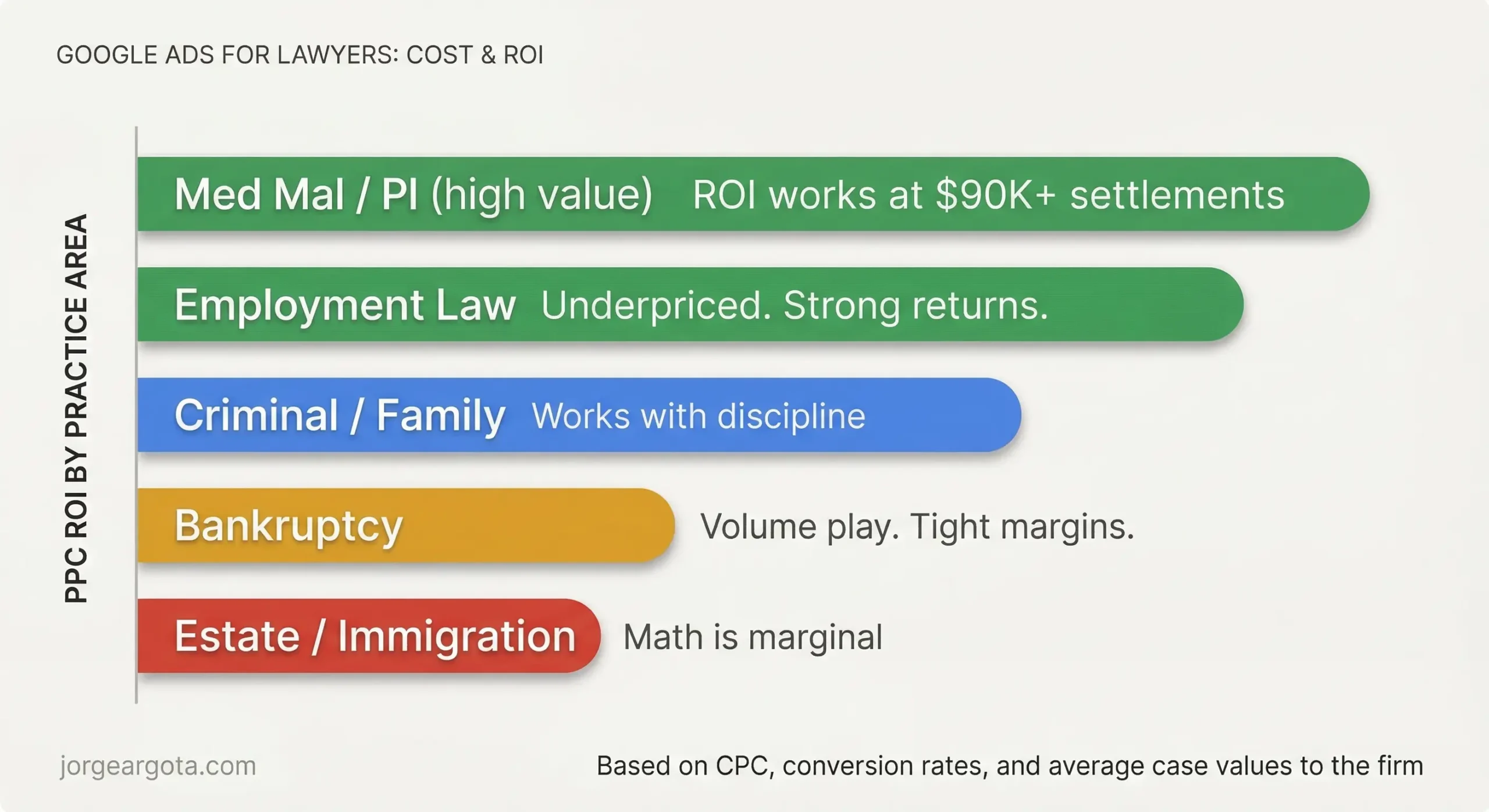
What does Google Ads actually cost for lawyers and does the ROI make sense? It takes roughly 13 leads to sign one case. The math works for PI when settlements average over $90,000, for med mal, and for employment law. It works with discipline for criminal defense and family law. It’s marginal for estate planning and bankruptcy. The difference between profitable and unprofitable comes down to infrastructure; dedicated landing pages, call tracking, negative keywords, and feeding signed case data back to the algorithm.
WHAT A CLICK ACTUALLY COSTS BY PRACTICE AREA
Here’s what the account level averages look like, and the thing to understand is that these are averages across every keyword in the account; the cheap ones and the expensive ones mixed together. That’s why the PI number looks low. The keywords that actually produce signed cases cost way more than what shows up at the account level.
COST PER LEAD BY PRACTICE AREA (HOVER FOR FULL BREAKDOWN)
Personal Injury
Tax Law
Family Law
Criminal Law
General Practice
Bankruptcy
Estate & Probate
Sorted by cost per lead, highest to lowest. PI has the lowest conversion rate and the highest cost per lead. Bankruptcy has the highest conversion rate and the cheapest leads. Hover any row for the full breakdown.
Now look at what the actual high intent keywords cost. These are the terms where someone is trying to hire a lawyer right now.
MOST EXPENSIVE LEGAL KEYWORDS (HOVER FOR DETAILS)
Truck Collision
Offshore Accident
Mesothelioma
Oil Rig Injury
Construction
Truck Accident
Motorcycle
Car Accident
Birth Injury
DUI Defense
These are keyword planner estimates and top of page bids. Well managed accounts with tight targeting and good quality scores often pay a fraction of these numbers.
And here’s the thing a lot of firms miss. The numbers in that table are the ceiling, not the floor.
What you actually pay in a well managed account with tight targeting and good quality scores is often a fraction of what the planner says. One agency reports their managed PI campaigns average roughly $27 per click on terms where the planner shows hundreds. So the table tells you the worst case and the actual case depends entirely on the quality of your ppc services for attorneys, which is one of the reasons this space is so sensitive to who’s running it.
Where You Practice Changes What You Pay
The most expensive cities aren’t New York or LA. They’re Lafayette and Baton Rouge, Louisiana, because of offshore and maritime keyword concentration. Most major metros people assume are expensive don’t even crack the top 20. And the underpriced markets; Phoenix, Philadelphia, Atlanta; represent large populations without the extreme competition of the Gulf Coast, which matters if you’re deciding where to allocate a ppc law firm budget across multiple markets.
WHAT PERCENTAGE OF THOSE CLICKS ACTUALLY BECOME SIGNED CASES
The click is just the beginning and this is where most firms get lost. They look at ppc advertising for lawyers as a lead generation tool and report on cost per lead like that’s the finish line when it’s really the first third of the funnel.
THE FULL FUNNEL DROP-OFF (HOVER FOR DETAILS)
Impressions
Clicks
Leads
Consultations
Signed Cases
That tiny green bar at the bottom is what you’re actually paying for. Everything above it is the cost of finding it.
And the piece that amplifies or destroys those numbers is how fast you respond.
Firms that pick up or call back within a few minutes convert at dramatically higher rates than firms that wait hours. And yet most firms take hours. Some take days. Which means they’re paying hundreds per click and then letting the lead go to voicemail. The full speed to lead data and intake system architecture is on a separate page, but the short version is that your intake speed is the single biggest multiplier on whether your law firm ppc management produces cases or just produces expensive reports.
The Landing Page Gap That Doubles Your Numbers
Sending your pay per click advertising traffic to the homepage instead of a dedicated landing page is probably the single most expensive structural mistake I see. The homepage converts at roughly a quarter of the rate a dedicated page does, which means you’re paying three to four times more per lead on the same clicks. What the landing page needs:
- Phone number above the fold
- Short form (name, phone, one sentence about the case)
- No navigation that lets people wander off the page
- Fast load time because more than half of mobile visitors leave if the page takes longer than three seconds
WHICH KEYWORDS ACTUALLY PRODUCE CASES AND WHAT TO SAY IN THE AD
The keywords that convert best for Google Ads for lawyers share a specific pattern. They signal that the person is ready to hire, not just reading about the topic.
Bottom of Funnel (Best Converters)
“Near me” + city + practice area + lawyer. “Divorce lawyer Chicago.” “Car accident attorney Tampa.” These signal both geographic and practice area intent at the same time. Most people who search “near me” visit a business within 24 hours.
Middle of Funnel (Decent Intent)
Generic practice area terms without location. “Personal injury attorney.” Still decent intent but much more competition and lower conversion.
Top of Funnel (Avoid Bidding)
“How to file for divorce.” “What to do after a car accident.” Converts worst and costs the most per signed case because the person is researching, not hiring. Most firms should not be bidding on these terms at all.
Match Types: Start Tight, Open Up Later
Start with exact match and phrase match only. Build clean conversion data over the first month or two, get to maybe 30 to 50 conversions a month, and only then introduce broad match paired with Smart Bidding.
Broad match is the only type that uses all of Google’s signals; search history, browser behavior, all of it. Powerful once the algorithm has enough data, but dangerous without it because Google will expand aggressively into junk queries at full price. The firms that skip straight to broad match on day one are the ones spending $50,000 a quarter on leads that never sign.
On ad copy, the thing that works best for pay per click advertising for lawyers is being specific instead of generic:
- “Free Consultation” is still the highest performing call to action
- “No Fee Unless We Win” works for PI because it removes the risk
- “24/7 Available” works for criminal attorney marketing because DUI clients are calling at 2 AM on a Saturday
- Specific proof points like “Recovered $50M for Injury Victims” or “500 Five Star Reviews” beat “experienced attorneys” every time
And because most legal leads come by phone not forms, the call extension on your ad isn’t optional. It’s the primary conversion mechanism.
How to Actually Track What’s Working
The tracking setup in plain terms:
- Call tracking assigns a different phone number to every traffic source (CallRail or WhatConverts)
- Hidden UTM fields on every web form capture the campaign and keyword
- CRM integration carries source data from first click through signed retainer
- Outcome pushback: when a lead signs or gets disqualified, that result pushes back to Google so the algorithm learns
The pipeline guide has the full technical setup including the CRM to Google Ads feedback loop that makes everything on this page work better over time.
THE SETUP SEQUENCE: HOW TO LAUNCH A CAMPAIGN THAT PRODUCES CASES FROM WEEK ONE
So a lot of what’s above covers what to do and what not to do, but I keep getting asked “what’s the actual order” by firms setting up Google Ads for lawyers for the first time or rebuilding after a bad agency experience. Here’s how to set up PPC for law firms to generate qualified case leads without wasting budget, step by step.
Week 1: Infrastructure Before Ads
Install call tracking and form tracking before you spend a dollar on clicks. Set up CallRail or WhatConverts, create a dedicated landing page per practice area, add hidden UTM fields to every form, and connect your CRM so source data follows the lead from click to retainer. If you skip this, you’re flying blind from day one.
Weeks 2 to 4: Exact Match, Tight Budget, Learn
Start with exact match keywords only on your highest value practice area. City plus practice area plus lawyer patterns. Separate branded from non-branded campaigns immediately. Set a modest daily budget and let the data come in clean. Your goal for the first month is 30 to 50 conversions, not 300 leads.
Month 2: Negative Keywords and Intake Sync
Pull your Search Terms report every Monday morning and block junk. Start the 15 minute negative keyword ritual. At the same time, make sure your intake team is tagging every lead as qualified or not qualified in the CRM, because that data is what teaches the algorithm in the next step.
Month 3: Turn On the Feedback Loop
Push your CRM disposition data back to Google Ads through offline conversion imports. Now the algorithm knows which clicks produced signed retainers and which produced junk. Enable Smart Bidding with Target CPA or Maximize Conversions. This is where the cost per signed case starts dropping without changing the budget.
Month 4+: Expand With Data, Not Guesswork
Now you can introduce phrase match and eventually broad match because the algorithm has real conversion data to work with. Add your second practice area. Increase budget on what’s producing signed cases. Kill what isn’t. The keywords converting in PPC become your SEO content targets so you eventually stop paying for traffic you could get organically.
THE BREAK-EVEN MATH THAT TELLS YOU WHETHER IT’S WORTH IT
Instead of just listing what things cost, I want to walk through the math for each practice area so you can see whether the numbers work for your firm specifically. Because the answer is different for a PI firm in Houston versus an estate planning firm in Phoenix.
Personal Injury: Math Works Above $90K Settlements
For firms handling moderate fender benders the numbers are usually negative. For firms handling trucking cases or catastrophic injuries where settlements hit six figures regularly, the math works well because one case pays for several months of ad spend.
Criminal Defense: Profitable Above $4K Case Fees
DUI clients need help immediately, which means they close at a much higher rate. CPCs are more moderate and the close rate is strong enough that most well run campaigns come close to break even or better when case fees average above $4,000 or the CPC stays below $60.
Family Law: Best PPC Economics, Most Underrated
Moderate CPCs, decent case values, and conversion rates in the middle of the range. The return can be two to three times the spend, which is better than a lot of PI campaigns I’ve audited where the case values weren’t high enough to justify the click costs. I don’t think enough family law firms realize this.
Estate Planning: Marginal at Best
Case values are low enough that there’s almost no room for error. For estate planning I’d usually put the money into SEO and referral networks before pay per click advertising for attorneys because the math just doesn’t give you enough cushion on the paid search side.
The Hidden Costs Nobody Mentions
The click cost is just the ad spend. On top of that you’re paying management fees, call tracking, click fraud protection, landing page development, CRM costs, and intake staff. For a small firm the hidden costs can add 30 to 60% on top of the ad budget. Most firms underestimate their true all in cost by a lot.
THE MISTAKES THAT BURN THROUGH BUDGETS
I’ve audited enough accounts to see the same problems over and over. And the reason they’re so common is that most ppc agency for law firms setups follow a template built for e-commerce that breaks badly for legal because legal has the highest click costs of any industry and the smallest margin for error.
The Seven Budget Killers
- Running broad match without controls. Google expands into salary searches, TV show queries, and “how to become” questions at full price. Start with exact match first.
- Not running negative keywords. Job searches, education queries, and DIY legal templates all trigger your ads. The Monday morning negative keyword ritual takes 15 minutes a week.
- Sending traffic to the homepage. Roughly doubles your cost per lead on every click. Use dedicated landing pages.
- Not tracking phone calls. Most legal leads come by phone. Without call tracking your agency is optimizing with maybe a quarter of the data visible.
- Not separating branded from non-branded. Someone searching your firm by name should cost almost nothing. If those searches eat your daily budget, the expensive terms never get a chance.
- Not enough budget to learn. For PI the minimum is roughly $6,500 a month. Below that Smart Bidding can’t optimize. For small firms on a tight budget, the sequencing matters more than the spend.
- Judging by cost per click instead of cost per signed case. An expensive click that produces a case is a bargain. A cheap click that never converts is waste.
The firms making money on Google Ads and the firms losing money are often spending the same amount. The difference is almost always what’s underneath the ads.
The Fix That Solves Multiple Problems at Once
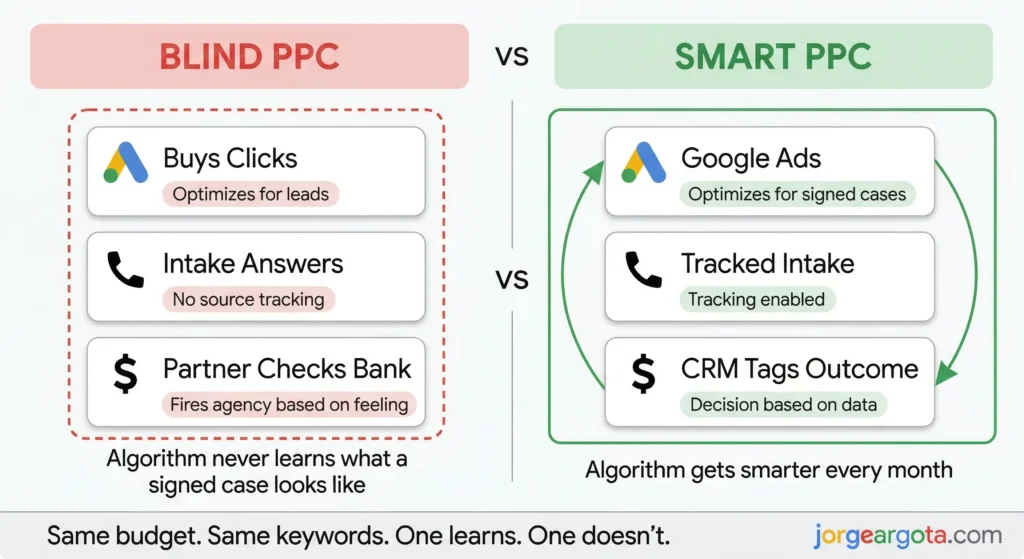
Feed your signed case data back into Google Ads through offline conversion tracking. When your CRM tells Google “this click produced a signed retainer, bid for more people like this” and “this click produced junk, stop buying that intent,” the algorithm learns what a good lead looks like.
Almost nobody does this. The firms that do see their cost per lead drop significantly without changing the budget. And when that feedback loop is running, the PPC and SEO start compounding each other because both channels showing up on the same results page produces more clicks than either one alone.
HOW TO KNOW IF YOUR PPC AGENCY IS ACTUALLY GOOD
Most law firms don’t manage Google Ads themselves. They hire a ppc agency for law firms and then have no way to tell if the law firm ppc management they’re paying for is good because the agency controls the data and writes the report.
That’s a setup where a bad agency can coast for a long time.
Five things to require:
- You own the Google Ads account. Some agencies run campaigns under their own account and if you leave, you lose everything; the historical data, the conversion learning, months of relearning you already paid for.
- Full transparency on what goes to ads versus management. Target the 80/20 rule; 80% to ads, 20% to management. Anything above 25% to management and you should be asking what you’re getting.
- Reporting tracks to cost per signed case. If your agency sends you a PDF with impressions and clicks, that’s a screenshot, not management. The metric that matters is what you paid per retainer by practice area.
- Legal specialization. If they don’t understand bar compliance rules, case value differences across practice areas, and how legal intake works, they’re managing your account like an e-commerce store.
- Geographic exclusivity. If the agency also manages your top competitor in the same market, they’re making decisions that are bad for one of you no matter what they tell either of you.
And one note on alternatives; Microsoft Ads (Bing) runs dramatically cheaper than Google on the same legal keywords and the audience skews older, wealthier, and desktop heavy, which works well for high value practice areas. A firm already spending on Google can add a fraction of that budget on Bing and pick up meaningful additional volume. That’s a whole separate topic but worth knowing about when you’re evaluating your total paid search spend.
And one more thing on click fraud. The best data puts it at somewhere around 10 to 20% of clicks, which at legal click costs adds up over a year. Click protection tools exist and at legal CPCs even modest fraud reduction more than pays for the tool cost.
If you want me to run the math on your specific account, send me what you’ve got
Your last 90 days of Google Ads data and your intake numbers. I’ll calculate your actual cost per signed case by practice area and tell you whether the math works or doesn’t. And if the math doesn’t work I’ll tell you why; it’s usually one or two of the mistakes above and not a complete rebuild.
P.S. The firms making money on Google Ads and the firms losing money are often spending the same amount. The difference is almost always what’s underneath the ads; the landing pages, the call tracking, the negative keywords, and whether anyone taught the algorithm what a signed case looks like. The pipeline guide covers the full system. The tactics page covers the Google Ads moves. The channel economics page shows how it compares to every other channel. And if you’re a small firm figuring out where ads fit in a tight budget, that covers the sequencing.
Related: Predictable PI Lead Pipeline · Google Ads and GBP Tactics · Channel Economics by Signed Cases · Cross-Channel Synergy · Complete 2026 Strategy Guide · Small Firm Marketing