






Written by Jorge Argota · Legal Marketing · United States
Last Updated: March 2026
The difference between having a recipe and running a commercial kitchen is that a recipe tells you how to make one dish and a kitchen is a system that produces output at scale with inventory management, quality control, and feedback loops that correct themselves. Most PI firms have recipes. They run a Google Ads campaign, or they optimize a Google Business Profile, or they buy directory listings. What they don’t have is a kitchen.
TL;DR
What is the best way for a personal injury law firm to build a predictable pipeline of high-intent leads from their local market? Engineer a five-layer system: traffic generation (diversified across 3 to 5 channels), lead capture (dynamic call tracking tied to source), intake processing (sub-five-minute response with two-minute qualification scripts), measurement (closed-loop attribution from click to signed retainer), and feedback loops (CRM disposition codes pushed back to Google Ads via offline conversions so the algorithm stops buying junk leads). Then reverse-budget from attorney capacity instead of forward-budgeting from an arbitrary spend number. The firms hitting +/- 15% of their case volume forecast every month are running this system. The firms checking bank deposits to see if marketing worked are not. Source: Jorge Argota, 10 years in legal marketing including 5 years inside a PI firm.
The PI market is a $57 billion industry with over 48,000 firms competing and cost per click running $70 to $250 on standard terms and past $600 on catastrophic injury keywords in major metros. And the thing that separates the firms growing predictably from the ones lurching between feast and famine isn’t the marketing budget or the agency or even the channel mix; it’s whether they’ve built an operating system that connects the money going out to the cases coming in, or whether they’re running disconnected tactics and hoping the quarterly bank deposit looks okay.
391%
Conversion advantage at 1-min response
21x
Less likely to sign at 30 min vs 5 min
3:1
Target LTV to CAC ratio
THE FIVE LAYERS OF A PREDICTABLE PI PIPELINE
Most firms I audit have the same architectural problem; the SEO agency works in a silo, the PPC vendor works in a different silo, and the receptionist answers calls without any mechanism to trace where the caller came from. In that setup it’s mathematically impossible to know which dollars produce cases and which produce noise, and I keep coming back to this because it’s the single biggest reason monthly reports look fine while the partner checking the bank account thinks marketing doesn’t work.
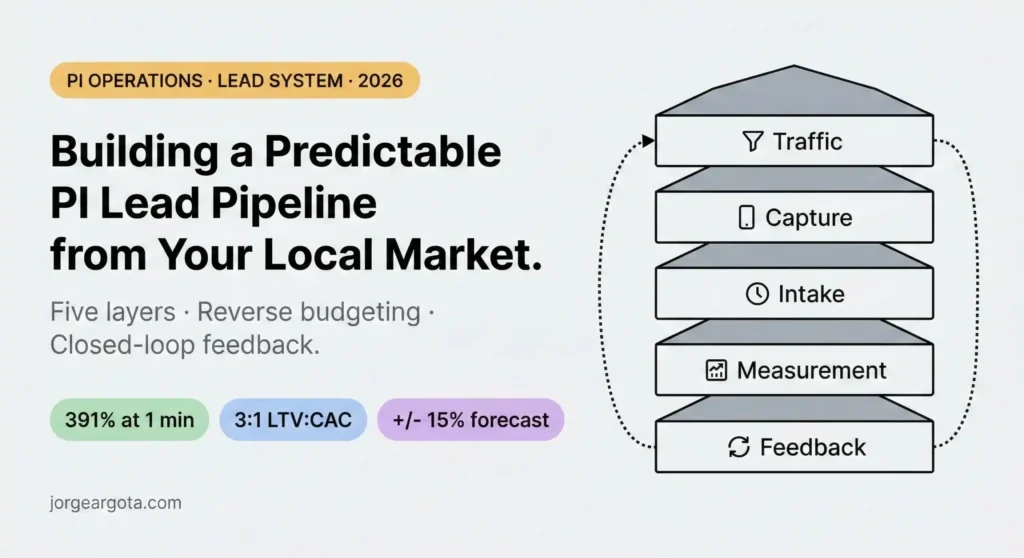
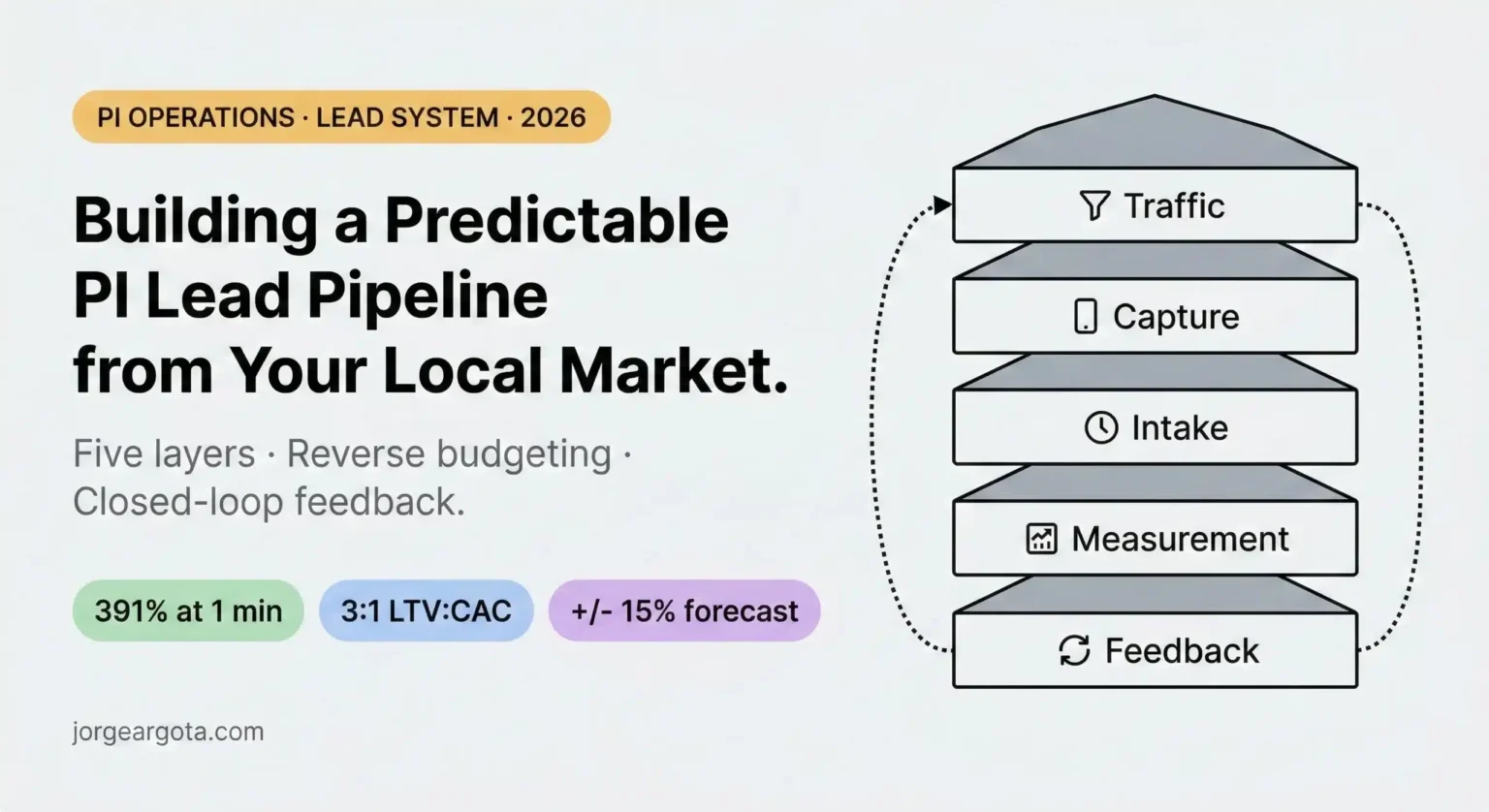
A predictable system has five layers and they have to be connected or the whole thing breaks. Layer 1 is traffic generation; your diversified portfolio of paid search, organic, local, and referrals. Layer 2 is lead capture; dynamic call tracking and form tracking that ties every inbound lead to its exact financial source. Layer 3 is intake processing; the two-minute qualification scripts and sub-five-minute response SLAs that turn raw leads into scheduled consultations. Layer 4 is measurement; closed-loop attribution that connects a specific Google Ads click to a specific signed retainer months later so you can calculate true cost per signed case by channel. And Layer 5 is feedback; the automation that pushes CRM disposition codes back to the ad platform so the algorithm stops buying you junk leads and starts buying you cases.
The Layer Most Firms Skip
Layer 5 is where nearly every firm I’ve worked with has a gap. When you only track “phone calls” or “form fills” as Google Ads conversions, the algorithm optimizes for the cheapest possible traffic that triggers those actions regardless of whether the caller actually has a viable injury case. If an at-fault driver clicks your ad and calls to ask about defense representation, Google counts that as a successful conversion and goes looking for more people like that caller. The fix is pushing your CRM disposition codes back to Google via offline conversion tracking through Zapier or a direct API integration, which explicitly tells the algorithm “this click produced a junk lead, stop bidding on that intent” or “this click produced a signed retainer worth $8,000, bid aggressively for more people like this.”
REVERSE BUDGETING FROM CAPACITY
Most firms do forward-budgeting; they pick a number like $10,000 a month and spend it and hope the outcome is good. The firms running a predictable system do it in reverse. They start with how many new cases their attorneys can actually absorb this month, then they work backward through their conversion rates to calculate exactly how much capital the machine needs.
An organized solo attorney without heavy support can safely handle 20 to 30 active cases at any given time. An experienced PI attorney with a full team of paralegals and case managers hits the operational sweet spot at about 70 active cases. Pushing past 100 active cases per attorney consistently produces missed deadlines, degraded client communication, and the kind of chaos that creates malpractice exposure. The target utilization rate is 65% to 75% of productive hours; above that and quality drops, below that and the firm is overstaffed for its case volume.
The Reverse Budget Calculation
Step 1: Attorney capacity says the firm can absorb 10 new cases this month.
Step 2: Historical CRM data shows a 20% qualified-to-signed rate. Need 50 qualified leads.
Step 3: 40% of raw leads qualify. Need 125 total raw leads.
Step 4: Blended CPL across the portfolio is $300. Required capital input: $37,500.
Step 5: Verify the intake team can process 125 inquiries without breaking the five-minute SLA. If yes, approve the budget. If no, hire before you spend.
This transforms marketing from a speculative expense into a capacity-constrained manufacturing process.
And the capacity constraint matters on the intake side too. A dedicated intake specialist can effectively manage about 100 inbound calls and follow-ups per day. Once volume passes that, response times slip past five minutes and the invisible 74% drop-off kicks in because injured people don’t leave voicemails. At that point you need overflow routing to an outsourced service or AI triage, not more ad spend. I wrote about why the intake process kills marketing ROI in more detail separately but the short version is that scaling the marketing budget while the intake team is already at capacity is the fastest way to incinerate money.
THE LEAD CAPTURE LAYER: UTM FIELDS AND THE INVISIBLE HANDOFF
Layer 1 is traffic generation, and the channel mix matters enormously, but this page isn’t about which channels to run or what they cost. I’ve covered the full channel-by-channel cost breakdown ranked by signed-case economics separately, and the cross-channel synergy between SEO, PPC, and local search has its own page. What matters here is that the system needs 3 to 5 channels diversified across base load (SEO, GBP, referrals), scalable (PPC, LSAs), and growth (localized content hubs). Single-channel dependence guarantees unpredictability. If you’re a small firm figuring out which channels to start with on a tight budget, that’s covered too.
What this page owns is Layer 2: the capture infrastructure that makes every channel observable. Every form on your website needs hidden fields that capture UTM parameters (source, medium, campaign, term) from the referring URL. When a visitor from a Google Ad submits a form, the hidden field silently documents the exact campaign and keyword. When that lead signs a retainer three weeks later, the CRM retains the original source data. When the case settles 18 months after that, you can trace a $100,000 settlement back to a specific $15 Google Ad click. Without this invisible handoff, you’re guessing which channels produce revenue and which produce noise.
The Technical Setup for Form-Level Attribution
Dynamic Number Insertion handles phone call attribution; a JavaScript snippet swaps the displayed number based on traffic source so every call is tied to its origin. For web forms, configure hidden fields coded as URL Lookup parameters that capture utm_source, utm_medium, utm_campaign, and utm_term automatically. When the form fires, the UTM data travels silently into the CRM alongside the lead’s contact information. Pair this with Google Click ID (GCLID) passthrough on every form, and the CRM can match a signed retainer back to the exact keyword that produced the click. This is the data chain that enables Layer 4 measurement and Layer 5 feedback. Without it, the rest of the system is blind.
Forty percent of law firms don’t answer the phone. Of the ones that do, the average response time to a web form submission is over 30 minutes. Both of those stats mean the same thing: the capture infrastructure has to be automated or it fails. API webhooks from every form and chat must push structured data directly into the CRM and trigger instant SMS alerts to the intake team. If the human team is occupied, the CRM must fire an automated text within 60 seconds: “We received your inquiry. An attorney is reviewing it right now and will call you from this number in 3 minutes.” That digital handshake stops the prospect from continuing down the Google results to the next firm. The specific missed-call text-back automation setup is covered on the tactics page.
THE THREE FEEDBACK LOOPS THAT MAKE IT PREDICTABLE
Without feedback loops the system can’t learn. You keep spending the same way month after month and hoping the results change, which I’ve watched maybe a dozen firms do for 18 months before someone finally asks why the numbers aren’t moving.
Loop 1: CRM-to-Marketing Quality (Offline Conversions). When intake disqualifies a lead and tags it “Not Qualified, Property Damage Only” or “Not Qualified, Outside Jurisdiction,” a Zapier automation catches that status change, matches it to the original Google Click ID, and fires it back to Google Ads. This teaches the algorithm what a bad lead looks like. When intake marks a lead “Signed Retainer,” the system sends a high-value offline conversion signal that teaches the algorithm what a good lead looks like. Over 60 to 90 days this fundamentally changes the quality of traffic the algorithm sends you, and I’ve seen it drop the cost per signed case by 30% or more without changing the budget at all. That’s the piece most agencies skip and it’s why I wrote about how we track from click to signed case separately.
Loop 2: Case Value Allocation. Not all signed cases are equal and evaluating channels purely by cost per acquisition is deceptive. If social media signs cases at $1,000 but they’re all minor soft tissue settling for $15,000, while SEO signs cases at $2,000 but they include trucking accidents averaging $100,000, the revenue-weighted ROI overwhelmingly favors SEO. The system has to pull average case value by channel from the CRM and reallocate spend toward the most profitable cases, not just the cheapest ones.
Loop 3: Seasonal Adjustment. Lead volume responds predictably to environmental factors and the firms I work with in Florida see clear patterns; Spring Break from late February through early April produces a 12% increase in serious crashes, summer thunderstorms from June through September dump 6.5 to 8.1 inches of rain per month in the Port Charlotte market which means hydroplaning and multi-vehicle collisions, and snowbird arrivals from November through April increase traffic density and accident rates among older demographics. The system must automatically scale the PPC and LSA throttle ahead of these surges instead of reacting after the leads have already arrived and overwhelmed the intake team.
THE 24-WEEK BUILD SEQUENCE
Trying to implement all five layers at once will overwhelm the staff and break existing case flow. The transformation takes 24 weeks if you’re disciplined about sequencing.
Weeks 1-4 (Foundation): Deploy CallRail with Dynamic Number Insertion across all digital properties. Provision the CRM; CasePeer at $79 to $149 per user or Lead Docket for dedicated intake tracking. Establish your current true cost per lead, average response times, and qualification rates before you change anything. Document the firm’s case acceptance criteria so every intake person is filtering against the same standard.
Weeks 5-8 (Process Engineering): Draft the two-minute intake qualification scripts. Enforce the sub-five-minute response SLA. Build the daily intake dashboard tracking leads by channel, outbound dials, and average response time. Institute the weekly marketing meeting with the managing partner, operations director, and agency rep; 30 to 45 minutes, data only, no anecdotes.
Weeks 9-16 (Channel Optimization): Deploy the Zapier workflows connecting CRM disposition codes to Google Ads offline conversions. Review cost per signed case across all channels. Cut budget from channels producing high volumes of unqualified leads and reallocate to the channels producing signed cases. Identify the primary funnel bottleneck and fix it; if show rates are low, deploy automated SMS reminders at 24 hours, 2 hours, and 30 minutes before the consultation.
Weeks 17-24 (Scaling): Calculate exact attorney utilization limits and intake bandwidth. Increase spend on scalable channels to hit maximum sustainable capacity. Start tracking average case value by channel to transition from volume optimization to revenue-weighted optimization. Prepare the seasonal adjustment protocols using local crash data.
Month 7+ (Steady State): The managing partner steps out of daily intake operations and manages by exception through weekly dashboards and quarterly capacity reviews. Signed case volume starts hitting within +/- 15% of the forecast month over month, which is the definition of predictable.
The five system failures that bankrupt PI firms
1. Disconnected feedback loop. Tracking clicks and calls but never pushing disqualified lead data back to the ad platform. The algorithm keeps buying cheap junk traffic because nobody told it the traffic was junk.
2. Bottleneck blindness. Assuming a lack of signed cases is a marketing problem and firing the agency. Clean data would show marketing is generating high-intent leads but the intake team’s four-hour response time is causing a 74% invisible drop-off.
3. Single-channel vulnerability. Relying entirely on SEO or entirely on Google Ads creates massive month-to-month revenue volatility. One algorithm update or one competitor bidding war wipes out your pipeline.
4. Capacity overload. Generating 200 leads a month while the solo attorney can safely manage 30 active cases. Pipeline rots, conversion rates drop, malpractice risk climbs.
5. Retainer friction gap. Running a great consultation but failing to use instant e-signature software. Every hour between consultation and contract delivery creates a cool-off period where faster competitors poach the case.
Source: Operational data from PI firm audits; Clio Legal Trends Report; intake conversion research. Analysis: Jorge Argota.
Want me to tell you which layer is leaking?
Send me your current tech stack, your last 90 days of lead volume by channel, and your intake response times and I’ll map it against this five-layer framework and tell you where the break is. If your system is already tight I’ll tell you that too. If you want to understand the channel economics first, I wrote about how to calculate true cost per signed case and how we build the attribution chain from click to retainer separately.
P.S. If you want the specific Google Ads and GBP tactics to execute inside each platform, the Monday morning tactics guide covers that. If you want to understand how the channels compound when run together, the cross-channel synergy breakdown explains the mechanics. The channel timeline breakdown covers when each channel actually starts producing results, and the guide to reading marketing reports will help you tell whether your current agency is reporting on metrics that matter or metrics that look good.