
The Old Playbook Broke in April 2025 and Most Georgia Firms Are Still Running It
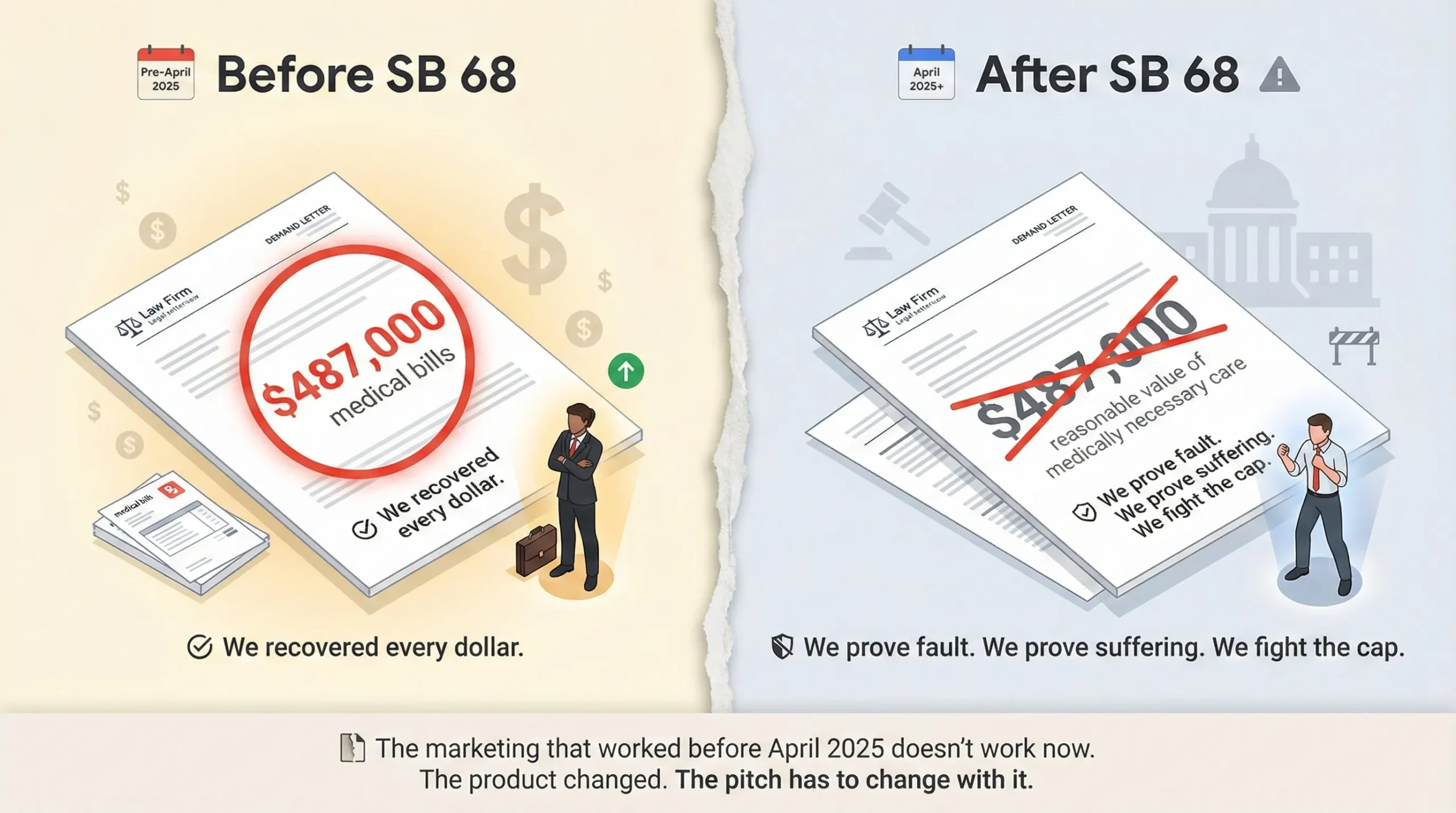
So there was a version of legal marketing in Georgia that worked for maybe 15 years and it went like this; you’d take a PI case, present the full billed amount of the medical expenses to a jury even though insurance paid a fraction of it, and the gap between billed and paid was the whole negotiating advantage. Firms marketed around those numbers because the numbers were huge and impressive and clients saw “$500,000 recovery” on a billboard and called the firm that posted it. And honestly it worked, I’m not going to pretend it didn’t, but then Senate Bills 68 and 69 passed in April 2025 and killed the whole model in one session.
But here’s what most agencies haven’t figured out yet; it’s not just the damages that changed, it’s three things at once and they all hit the marketing. Phantom damages are gone, so you can’t present inflated medical bills anymore; recoverable expenses are now limited to the “reasonable value of medically necessary care” which basically means what was actually paid. Apportionment in negligent security cases changed, so if someone gets shot at an apartment complex and the jury says the shooter is 90% at fault, the complex only pays its 10% instead of the full amount. And trials can now be bifurcated into liability and damages phases, meaning the jury decides if the defendant was at fault before they ever hear how badly the plaintiff was hurt. That last one is maybe the biggest shift because it means marketing “we tell your story” doesn’t land if the firm can’t prove fault first, which is a technical skill not an emotional one and most firms have been marketing the emotional version for years.
34,000+ active attorneys in Georgia. Over 70% practice in metro Atlanta. The 2025 tort reform didn’t reduce the number of cases but it changed what the average case is worth and how it gets won, which means the marketing has to change too.
What the Reform Actually Broke
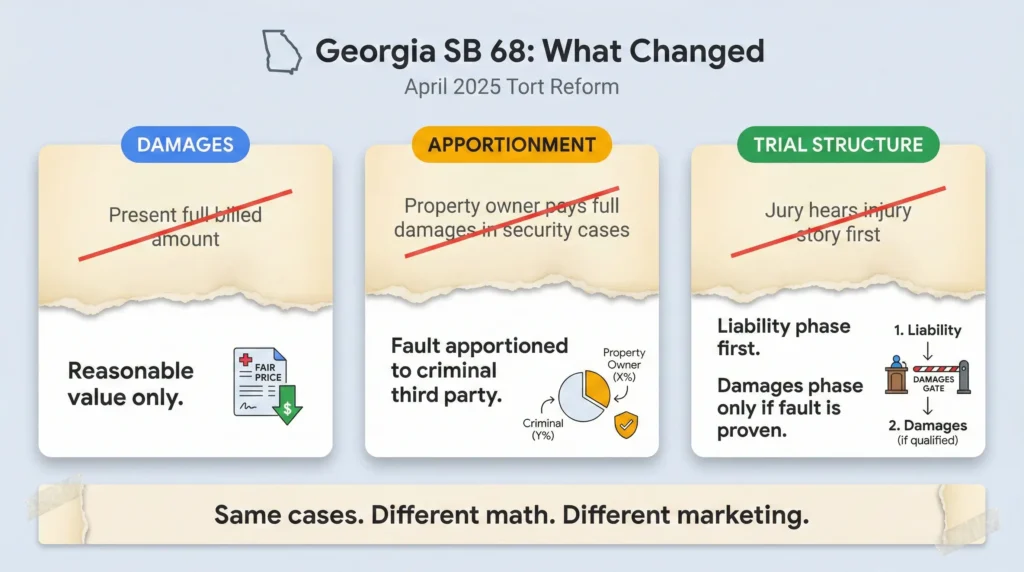
The phantom damages change hits personal injury marketing hardest because the big numbers were the whole pitch. A firm that used to post “$1.2 million settlement” on the homepage was probably presenting $800K in billed medical expenses that insurance paid $200K on, and the gap was the whole play. That play is gone now. The marketing has to shift from “look what we recovered” to “we prove fault and we prove suffering” which is harder to say in a headline but it’s the truth and I think the firms that figure out how to say it clearly are going to pull ahead of the ones still running 2024 creative, which is probably most of them right now.
The apportionment change makes negligent security cases worth less unless the property owner’s failure is egregious. Broken gates, burnt-out lights, prior police reports of crime on the property; those are the facts that keep the property owner’s share high enough to justify the case. Marketing content now needs to pre-qualify these leads by asking about specific security failures before intake, because a generic “were you attacked on someone’s property” campaign is going to generate calls that don’t convert under the new math.
And the bifurcation change is the one I think matters most for how firms actually position themselves going forward. If the jury decides fault before they hear about the injury, then the firm’s ability to prove liability is the product being sold. “We tell your story” worked when the story came first. Now the technical proof comes first. Firms that market trial readiness and technical skill are positioning for the new reality; firms still marketing empathy alone are selling a Phase 2 pitch before Phase 1 is won, which maybe sounds like a small distinction but it changes everything about what the website says and how the ads are written.
Atlanta Is a Logistics Case Generator and the Rest of the State Is Wide Open
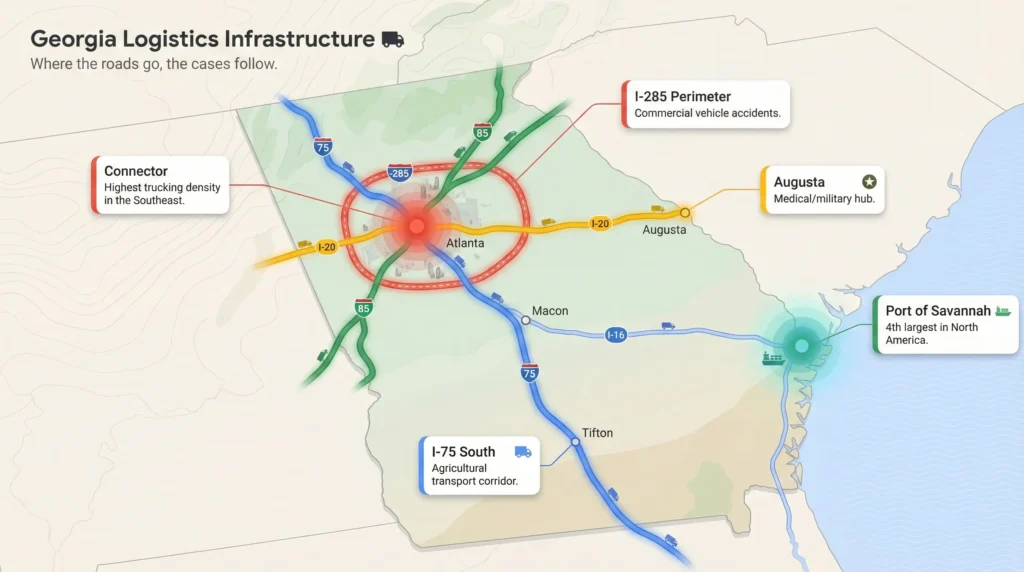
A click on “car accident lawyer Atlanta” costs $150 to $500 and you’re bidding against Morgan & Morgan and John Foy and every firm running TV in the metro, which is not a fight you win on budget. But “commercial truck accident I-75 Georgia” or “18-wheeler wreck I-285” targets cases worth ten times a standard auto claim and the firms at the top of those results understand federal trucking regulations and multi-defendant liability which most general PI firms don’t build content around. Georgia is a logistics state; the Port of Savannah is the fourth largest in North America and the warehouse districts near Hartsfield-Jackson generate industrial injury cases constantly. The paid ad strategy in Atlanta has to target the corridor and the case type together, not the city and the practice area, because “Atlanta personal injury” is a money pit and “I-285 trucking accident attorney” is a viable campaign, or at least it has been for the firms I’ve worked with.
And then there’s everything outside Atlanta, which is where the math gets honestly kind of fun. Savannah is port cases and tourist premises liability; “hotel slip and fall Savannah” and “rental car accident Savannah” are high-value niches with maybe a quarter of Atlanta’s ad costs. Augusta is medical malpractice tied to Augusta University Health and military cases at Fort Eisenhower where the Federal Tort Claims Act applies. Macon sits at the crossroads of I-16 and I-75 and Columbus is a corporate hub with family law and business litigation. CPCs in Macon and Columbus run maybe 50% of what Atlanta costs and a moderate budget can dominate those markets in a way that’s impossible in Atlanta, which I’ve told firms before and the ones who listened are the ones calling me back.
Georgia Practice Areas After the Reform
Medical malpractice in Georgia has a “gross negligence” standard for emergency care which makes ER cases almost impossible to market and win. The viable cases are surgical errors, misdiagnosis, and birth injuries in non-emergency settings where ordinary negligence applies and the content that explains this filter saves the firm’s intake team from fielding ER calls that can’t clear the standard. AI search tools answering “can I sue for an ER mistake in Georgia” need to cite a firm that actually explains the gross negligence bar honestly, which most sites don’t.
The affluent northern suburbs are driving family law volume and it’s not slowing down. Alpharetta, Roswell, Johns Creek, Milton; tech relocations brought high-asset divorces involving RSU division, business valuation, and executive compensation splits. Georgia is equitable distribution not community property and the content targeting “Alpharetta divorce lawyer” needs to speak to someone with a seven-figure portfolio who’s comparing three firms. Estate planning overlaps in this market and probably always will.
Workers’ comp targets the logistics workforce and the design has to be mobile-first because these workers search on phones. Warehouse injuries near Hartsfield-Jackson, longshoreman claims at Savannah, forklift accidents in the distribution corridors. Rural south Georgia broadband is still unreliable and a site that loads in five seconds loses the lead. Criminal defense and immigration fill out the Atlanta metro, with Spanish-language content becoming baseline in Gwinnett, Hall, and Whitfield counties where the Hispanic population grew faster than the legal market adapted, which is an opportunity that I think a lot of Atlanta firms still haven’t noticed. Employment law, bankruptcy, and mass tort complete the Georgia landscape.
How I Build This
Every Georgia campaign I build now starts with the reform. Does the firm’s current marketing lean on big settlement numbers that were inflated by phantom damages? Does the website talk about “telling your story” without explaining how they prove fault? Is the intake filtering for the new apportionment math in security cases? If any of those are yes the marketing needs to be rebuilt from the reform outward, not patched.
For Atlanta firms the content targets the interstate corridors and the specific case types that survive the reform at high value; trucking, catastrophic injury, surgical malpractice. Paid ads target those corridors with geofencing around the medical districts and logistics hubs. Local Services Ads by neighborhood because “Buckhead divorce attorney” and “Decatur criminal defense” are different markets within the same metro.
For secondary markets the play is efficiency and honestly it’s where I’d put money first if I were starting fresh. A Macon or Columbus firm can own its local market with a budget that wouldn’t buy ten clicks in Atlanta. Savannah targets the port and the tourists. Augusta targets the medical complex and the military base. GEO-structured content and AI optimization so the firm is what gets cited when someone asks “can I sue if I was partly at fault in Georgia” and the answer involves OCGA § 51-12-33 and the 50% bar.
Georgia doesn’t allow “specialist” claims without Bar-approved certification and the certifying body named in the ad. Contingency fee ads must disclose that the client may still owe litigation costs even if there’s no attorney fee. AI chatbots on law firm sites must disclaim they’re automated and not attorneys. We build every website and every ad with these rules in. Ethics rules → Review management → Review ethics →
Tracking from click to signed retainer by practice area, market, and case type. Full data ownership. Everything is yours. Reports → ROI →
Georgia Markets We Serve
Atlanta, Sandy Springs, Marietta, Buckhead, Midtown, Decatur, Alpharetta, Roswell, Johns Creek, Savannah, Augusta, Macon, Columbus, Athens, and throughout south Georgia. We work with firms nationwide too. Tell us about your market →
Is Your Marketing Built for Pre-Reform or Post-Reform Georgia?
Send me your setup and I’ll tell you whether your campaigns still lean on phantom damage math, whether your content proves fault or just tells stories, and whether your site clears the contingency fee and specialist disclosure rules. If it’s already rebuilt for the new reality I’ll tell you that and we can skip the call, or don’t send anything, honestly either way.
Talk to Jorge → Phone or text: 941 626 9198