
Why Med Mal Marketing Is Different
Medical malpractice is the most expensive practice area to market in all of legal. A single click on a Google ad costs $50 to $300 depending on your city, and the average cost just to get someone to fill out a contact form is $512. That’s higher than car accidents, truck accidents, or any other case type.
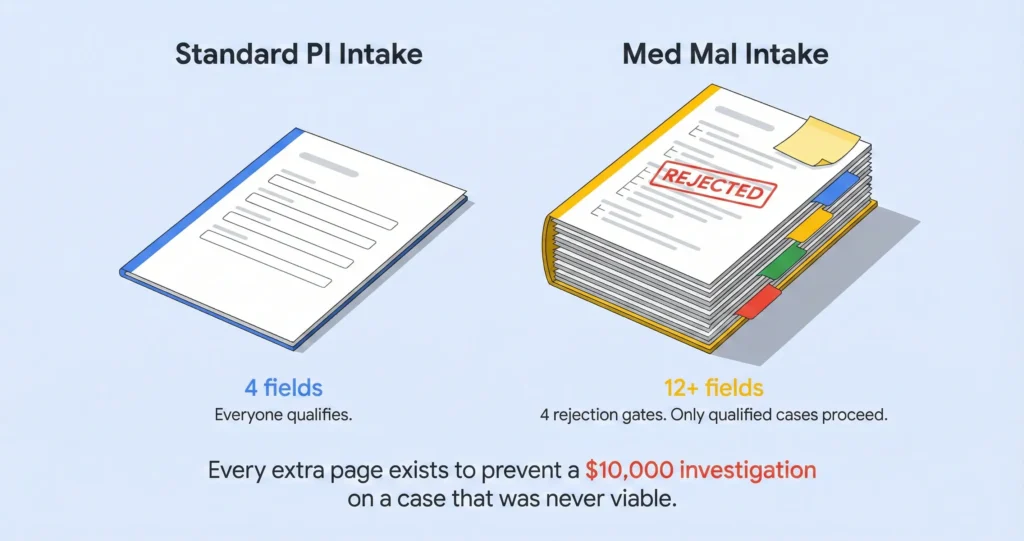
But the ad spend isn’t where the real money goes. In personal injury, a bad lead costs you a phone call. In med mal, a bad lead costs you $10,000 to $50,000 before anyone realizes it wasn’t viable. Medical records, nurse review, expert opinion, and then someone says “this isn’t a case.” That investigation cost is why med mal marketing has to work differently than everything else in legal.
The numbers behind everything we build:
- $512 average cost per lead, highest in legal
- $10,000 to $50,000 to investigate each lead
- 2 to 4 years from signed retainer to payment
- $250,000 to $500,000+ median settlements
- Doctors fight harder than any other defendant because settling gets reported to a national database that follows them for life
We wrote a full breakdown of why standard agencies fail at med mal if you want the longer version. This page covers what a campaign built for these economics actually looks like.
What We Do for Med Mal Firms
We handle five things: getting you found on Google, getting you cited by AI tools, running your paid ads, building your website, and managing your reviews. Same services we’d provide any law firm. The difference is that in med mal, every one of them operates under constraints that don’t exist elsewhere.
Getting found on Google requires clinical accuracy, not just good writing. Med mal content sits at the intersection of legal and medical, which means Google holds it to the highest quality standard it has. A page about birth injuries needs to accurately explain fetal heart monitoring, what decelerations indicate, and when a C-section should have been performed. If the medical information is wrong, Google buries the page no matter how good the SEO is. We build SEO campaigns around how patients actually describe their injuries, then bridge that language to the clinical terms and the legal theory.
Getting cited by AI is a different problem than ranking on Google. More people are asking ChatGPT and Google’s AI Overview questions like “can I sue for a missed cancer diagnosis” before they ever search for a lawyer. If your firm’s content is what the AI pulls from, your name appears in that answer. We structure your site so AI tools can find your content, understand what your firm covers, and cite you as a source. More on how this works →
Paid ads in med mal require a verified trust badge and serious budget. Google combined their old “Screened” and “Guaranteed” lawyer badges into a single “Google Verified” badge in October 2025. We manage the verification process and optimize for the three things that determine which firm shows up first: how close you are to the searcher, how fast you answer the phone (Google tracks this and penalizes missed calls), and how recently you’ve gotten reviews (20 from last month beats 100 from two years ago). Budget reality: you generally need $10,000 to $50,000 per month before Google’s system has enough data to learn what works.
Your website needs to work for people in crisis. Someone whose child was just diagnosed with cerebral palsy from a birth injury is not going to tolerate pop-ups and flashing banners. We build sites with calm layouts, simple intake forms with clinical screening questions, and one-tap phone access on mobile. We also build them to meet federal accessibility requirements, because law firms are now being sued for non-compliant websites, which is exactly the kind of irony you don’t want.
Review management in med mal is a legal minefield. Ethics rules prevent you from revealing anything about the attorney-client relationship in a public response, even when the review is unfair. We manage your review profile with bar-compliant protocols and set up automated review request systems that keep fresh reviews flowing in, which is what actually drives your ad ranking.
Case Types We Market
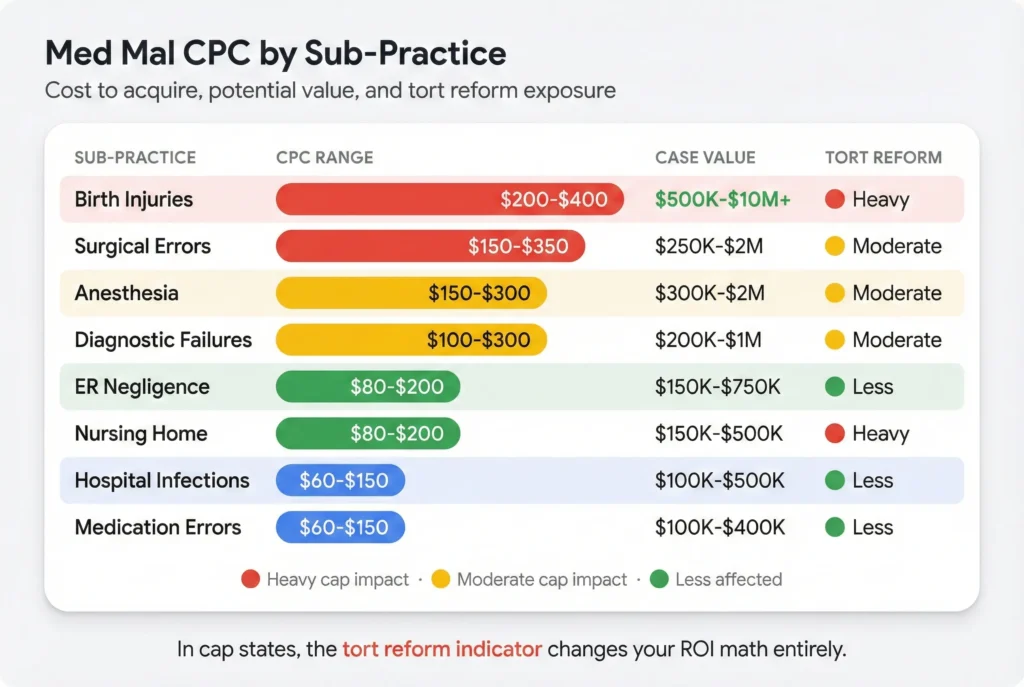
Medical malpractice isn’t one case type. Birth injuries, surgical errors, diagnostic failures, anesthesia errors, ER negligence, hospital infections, medication errors, nursing home neglect, radiology errors, and obstetric injuries all have different advertising costs, different case values, and different ways potential clients search for help. A parent whose baby has Erb’s palsy searches completely differently than an adult who woke up during surgery.
We build separate keyword strategies, content, and intake screening for each case type your firm handles. In states with damage caps, we shift budget toward case types where economic damages (future medical care, lost income) aren’t subject to the cap, like birth injuries with lifetime care needs. In uncapped states, the targeting spreads more broadly based on where ad costs and case values create the best return.
How We Measure Results
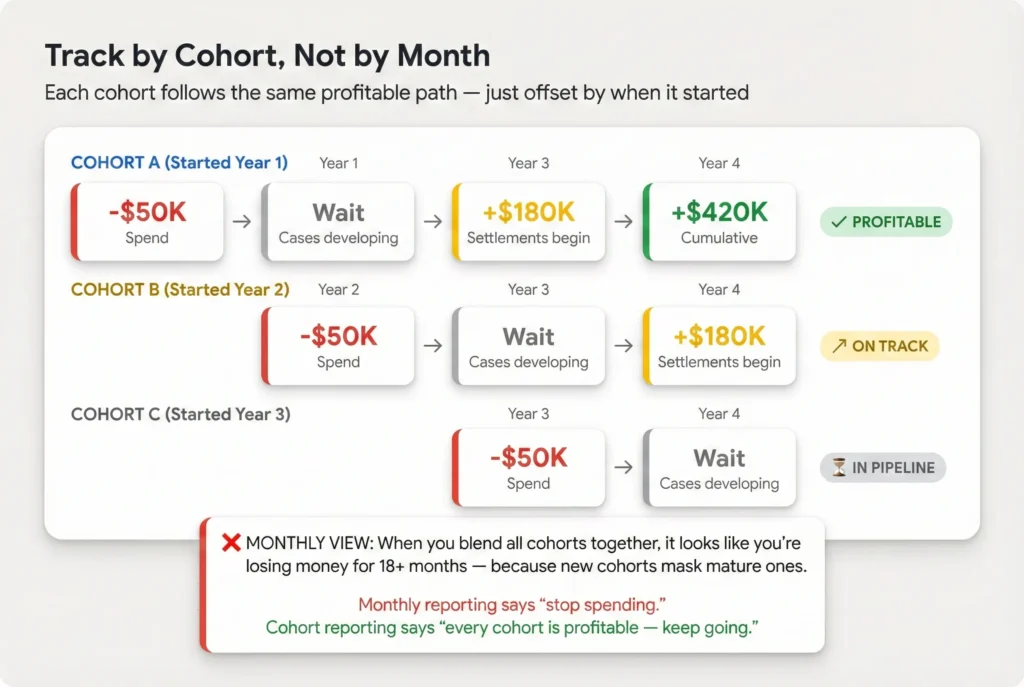
If you measure med mal marketing the way you’d measure a car accident campaign, the numbers will always look terrible. In PI, spend in January, revenue by June. In med mal, revenue might not appear until 2029. Most agencies panic at month six and recommend cutting the budget, which kills the pipeline right when it’s starting to fill.
We track each group of leads over their entire lifecycle instead of judging this month’s spend against this month’s revenue. We report on what your current investigations are projected to be worth, how fast cases are moving through the pipeline, and what your actual cost per signed case looks like measured against the leads that generated them. You get full data ownership: the website, the hosting, the analytics, the ad accounts. If you leave, you keep everything.
What to look for in a marketing agency’s reports →
Med Mal Marketing by State
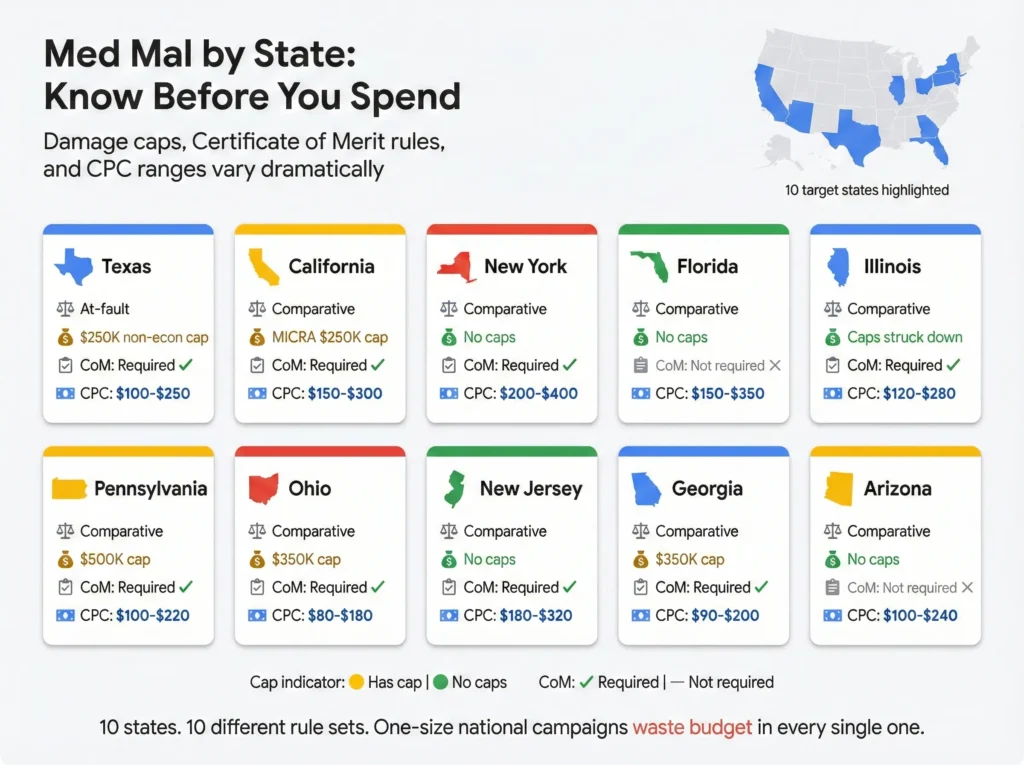
The strategy changes state by state. Some states cap pain-and-suffering awards. Some require an expert report before filing. Statutes of limitations vary. Ad costs in New York are double Ohio. A campaign that targets every case type in New York would waste money in Texas where damage caps make certain cases not worth investigating. Each state page below covers the specific rules, costs, and strategy for your market.
California · Texas · Florida · New York · Pennsylvania · Illinois · Ohio · Georgia · North Carolina · New Jersey
Don’t see your state? We work with med mal firms nationwide. Tell us about your market and we’ll build the strategy around your state’s rules.
Want to see what your med mal marketing should actually look like?
Headline: Want to see what your med mal marketing should actually look like?
Send me your current campaign and I’ll show you where it’s built for med mal and where it’s still running a general playbook. If everything checks out, I’ll tell you that too. Most don’t.
Talk to Jorge → Phone or text: 941 626 9198