

Nobody in legal marketing talks about immigration and I’ve never understood why. It’s the fastest-growing practice area, the client base is enormous and underserved, the PPC economics are better than any other area of law, and somehow Consultwebs and Scorpion and FindLaw have basically zero content about how to market an immigration firm. Rankings.io put out one post recently which tells me they’ve noticed the gap, but that’s about it.
And the reason I think most agencies avoid it is because immigration marketing is genuinely harder than marketing a PI firm or a criminal defense practice. Your clients speak multiple languages and search in multiple languages and the website has to work in both. The regulations change with every administration and sometimes with a single executive order. The people you’re trying to reach have often been burned by notario fraud and don’t trust legal advertising. And the ethical lines around advertising to undocumented populations are complicated in ways that most agencies have never thought about.
But if you figure it out, the economics are incredible. PPC clicks cost $3 to $15 when PI firms are paying $200 to $1,000, which means you can run a real campaign on a fraction of the budget. And the demand keeps growing regardless of who’s in the White House because immigration is structural, not cyclical, and I don’t think that changes anytime soon.
Your Clients Are Not One Person and You Can’t Market to Them Like They Are
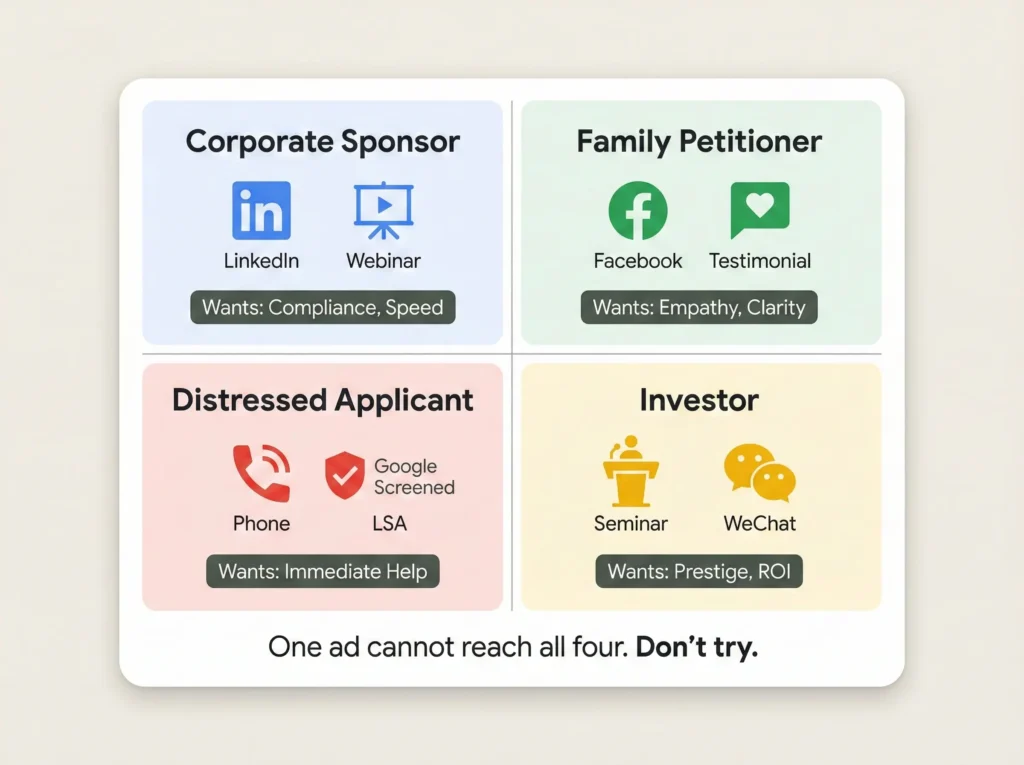
Who are the different client personas for immigration lawyers? Immigration clients segment into at least four distinct groups with different psychological drivers and marketing channels. Corporate sponsors (HR directors, startup founders) care about compliance and workforce continuity; they respond to technical white papers and LinkedIn content. Family-based petitioners (US citizens sponsoring spouses or parents) are driven by separation anxiety; they respond to emotional testimonials and Facebook. Distressed applicants (people in removal proceedings or detention) need immediate help; they respond to LSA and mobile-optimized click-to-call. Investor visa candidates (EB-5, E-2, O-1) are sophisticated buyers comparing firms globally; they respond to seminars and wealth manager partnerships.
The biggest mistake I see immigration firms make with their marketing is treating every potential client the same. An HR director trying to get an H-1B processed for a software engineer has absolutely nothing in common with a mother trying to sponsor her spouse from abroad, and a Google Ad that tries to speak to both of them will end up speaking to neither.
The HR director cares about compliance and speed. They’re worried about Department of Labor audits and PERM processing timelines and they want content that’s technical and authoritative. A webinar on I-9 compliance or a LinkedIn article breaking down the latest visa bulletin is what moves this person toward hiring you. They’re not going to click on an ad that says “We Fight for Your Family.”
The family petitioner runs on emotion. They’ve been separated from someone they love and the government paperwork feels like a wall between them. Testimonials from reunited families and success stories on Facebook and Instagram are what build trust here. This person needs to feel like you understand what they’re going through, not just that you know the law.
And the person in removal proceedings is in crisis. They’re searching on their phone, probably at night, probably scared. They need to see a phone number they can tap immediately and someone who answers. If your site takes five seconds to load or your intake form has 15 fields, this person is gone.
If Your Spanish Pages Are Just Translations You’re Losing an Entire Market
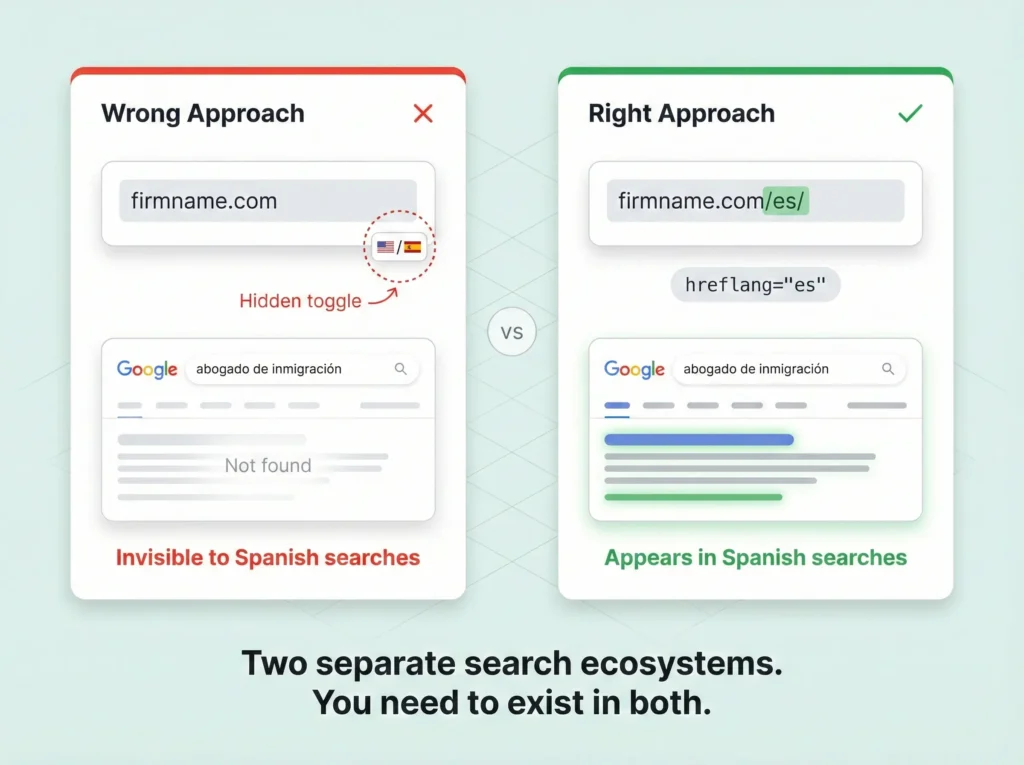
How should immigration lawyers build bilingual websites? A “Se Habla Español” banner on an English website does not capture Spanish search traffic. When someone searches “abogado de inmigración en Houston,” Google looks for Spanish-language pages to serve. If your site only has English content, you are invisible to that searcher. Build dedicated Spanish subdirectories (firmname.com/es/) rather than using translation plugins or separate domains. Use hreflang tags to tell Google which pages are language equivalents. Have content transcreated by native speakers rather than machine-translated, because legal concepts like “prosecutorial discretion” require cultural context, not dictionary substitution. Spanish immigration keywords often have lower competition than their English equivalents despite significant search volume.
This is something I’ve seen done wrong at almost every immigration firm I’ve looked at. The firm puts a little flag icon or a “Se Habla Español” link somewhere on their homepage and thinks that covers their Spanish-speaking market, but it doesn’t cover anything and here’s why.
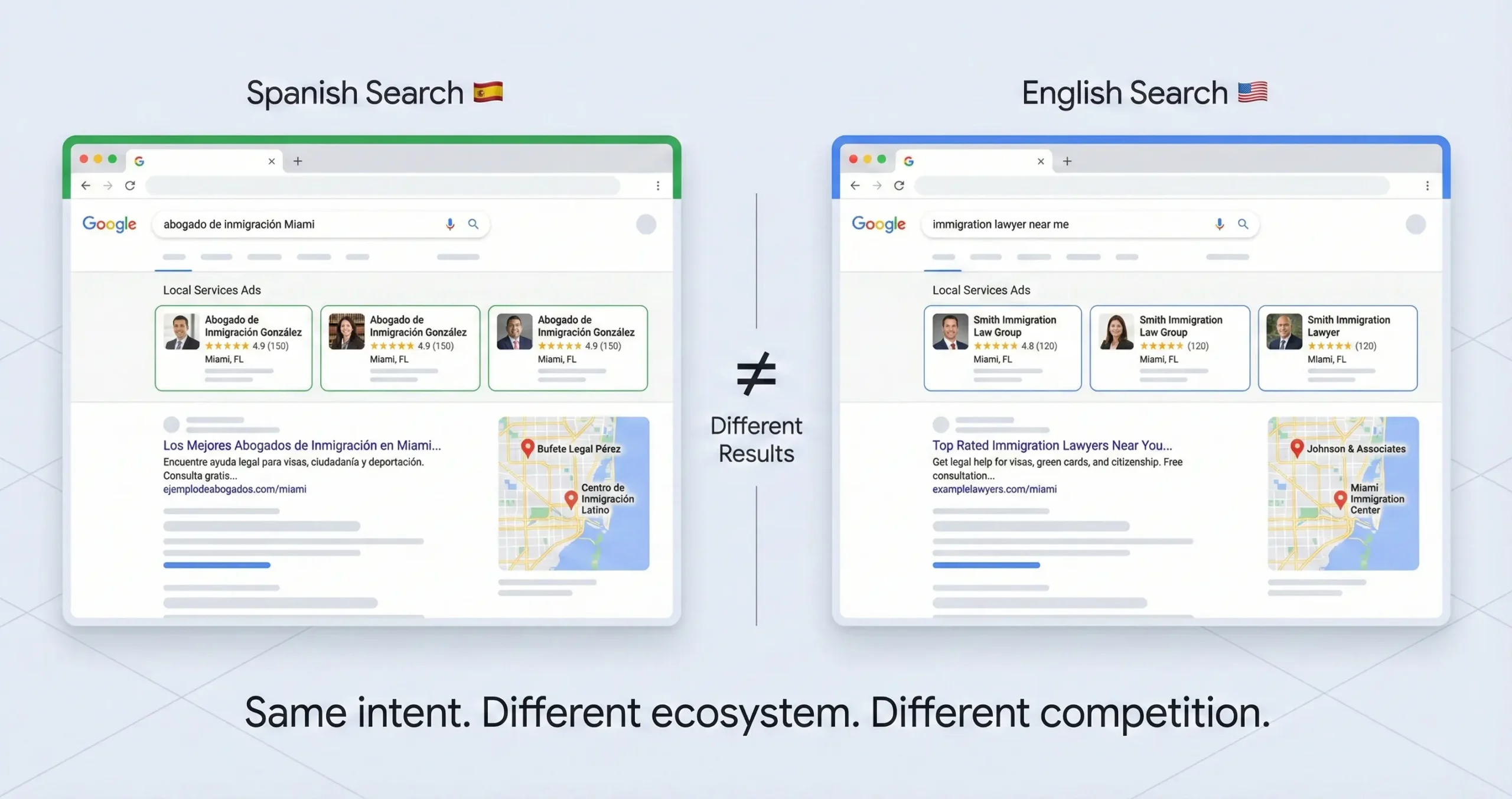
When someone types “abogado de inmigración en Miami” into Google, the search engine is looking for Spanish-language pages to show them. If your entire site is in English with a tiny link to a Google Translate version, you’re invisible to that search and you don’t exist for that person at all. They’re going to find the firm that actually has Spanish content indexed and ranking, and that firm is going to get the call.
The right way to do it is with dedicated subdirectories, like firmname.com/es/immigration-services/, where each English page has a full Spanish counterpart that a native speaker wrote from scratch, not something run through a translation tool. And you need hreflang tags in your code that tell Google “this Spanish page is the equivalent of this English page” so the search engine knows which version to serve based on the user’s language settings.
And the content has to be transcreated, not translated. Legal concepts don’t always have direct equivalents in Spanish and a literal translation of “adjustment of status” or “prosecutorial discretion” can confuse someone who needs to understand what’s actually happening with their case. A native-speaking writer who understands both the law and the cultural context produces content that ranks better and converts better than anything a plugin can generate, and that matters even more now that AI search engines are pulling answers directly from your content rather than just linking to it.
And here’s the part that should get your attention; Spanish immigration keywords often have lower competition than their English equivalents even though the search volume is significant. “Abogado de inmigración” gets thousands of searches a month and fewer firms are competing for it, which means your content can rank faster and your PPC costs are even lower than the already-cheap English immigration terms.
The Notario Problem Is Your Marketing Opportunity
How do immigration lawyers differentiate from notario fraud? In many Latin American countries, a “Notario Público” is a trained legal professional with powers similar to an attorney. In the United States, a notary public has no legal training. Unscrupulous non-lawyers exploit this linguistic confusion to deceive immigrants into paying for unauthorized legal work. Immigration firms should use this as a differentiation strategy by prominently displaying “Licensed Attorney / Abogado Licenciado” on all materials, creating educational content like “Why a Notario Can Ruin Your Immigration Case,” and positioning themselves as the legitimate alternative. This protects the community while establishing the firm’s credibility.
There’s a problem in the immigration space that most marketing agencies have never heard of and it creates a real opportunity for firms that understand it. In most Latin American countries, a “Notario Público” is basically the equivalent of a specialized attorney; they’re highly trained legal professionals with real authority. In the United States, a “notary public” is someone who witnesses signatures and has zero legal training.
And there are people all over the country exploiting that confusion to charge immigrants hundreds or thousands of dollars for legal work they’re not qualified to do. They call themselves notarios and they file paperwork incorrectly and they miss deadlines and by the time the person realizes something went wrong, the damage is done and it’s often irreversible.
For immigration firms, this is both a community problem you can help solve and a marketing angle that differentiates you from everyone else. Every piece of marketing material should prominently say “Licensed Attorney” and “Abogado Licenciado” because that distinction matters enormously to someone who’s been warned about notario fraud or who’s been burned by it before.
And there’s a content play here too. A blog post or video titled “Why a Notario Can Ruin Your Immigration Case” does two things at once; it educates and protects the community, which builds genuine trust, and it positions you as the legitimate alternative, which drives cases. I’ve seen this kind of content rank well because nobody else is making it and the demand from people searching “is my notario legit” or “notario vs abogado” is real.
Two Niches That Can Fund Your Entire Marketing Budget
What are the best marketing niches for immigration lawyers? Two high-value niches stand out. First, mandamus litigation (suing USCIS for unreasonable processing delays) targets clients who have been waiting years, have the funds to pay for federal litigation, and are searching for a specific solution. Content targeting “how to sue USCIS for delays” captures extremely high-intent traffic despite low search volume. Second, criminal-immigration (Crim-Imm) work is a B2B referral strategy targeting criminal defense attorneys who need immigration expertise for their non-citizen clients under the Padilla v. Kentucky requirement. A single criminal defense attorney can become a source of dozens of referrals per year, reducing the need for direct-to-consumer advertising.
Most immigration firms try to market everything at once; family petitions, work visas, asylum, naturalization, removal defense. And I get why, because you want to capture every possible client, but the economics of digital marketing reward specificity so heavily that going narrow usually outperforms going broad.
The mandamus niche is a good example. With USCIS backlogs creating multi-year waits for people whose applications should have been processed months ago, there’s a growing market of people who are ready to sue the government to force action.
These clients are deep in the funnel; they’ve already been waiting, they’ve already spent money on the original filing, and they’re searching for something very specific like “how to sue USCIS for delays” or “mandamus lawsuit timeline.” The search volume is low but the intent is about as high as it gets, and most general immigration firms don’t do federal litigation so the competition is thin.
And then there’s the Crim-Imm referral play which is a completely different model. Under Padilla v. Kentucky, criminal defense attorneys have to advise non-citizen clients about the immigration consequences of a guilty plea, and most criminal lawyers don’t know immigration law well enough to do that confidently.
If you position yourself as the expert they call when they need that analysis; through CLE presentations, through relationships with public defenders, through content aimed at the criminal bar rather than at immigrants directly; a single criminal defense attorney can send you dozens of cases a year without you ever running a Google Ad.
The Stuff That Actually Builds Trust Doesn’t Happen Online
How do immigration lawyers build community trust for marketing? Digital advertising alone cannot build the level of trust needed to reach many immigrant communities because these populations have experienced fraud, exploitation, and systemic distrust of authority. The most effective trust-building happens offline through legal clinics at churches, mosques, and community centers, formal referral partnerships with nonprofits through memorandums of understanding, participation in Facebook groups for specific communities (e.g., “Brazilians in Orlando”), and sponsoring community events. These create face-to-face touchpoints that digital ads cannot replicate and position the attorney as a known and trusted member of the community rather than a stranger asking for money.
And this is where immigration marketing differs from every other practice area in a way that I think matters more than the SEO or the PPC. A lot of the people you’re trying to reach have been lied to before, either by notarios or by the system itself, and they don’t trust advertising. Running a Google Ad that says “immigration lawyer, call now” doesn’t carry the same weight with someone who’s been burned as it does with someone searching for a personal injury attorney after a car accident.
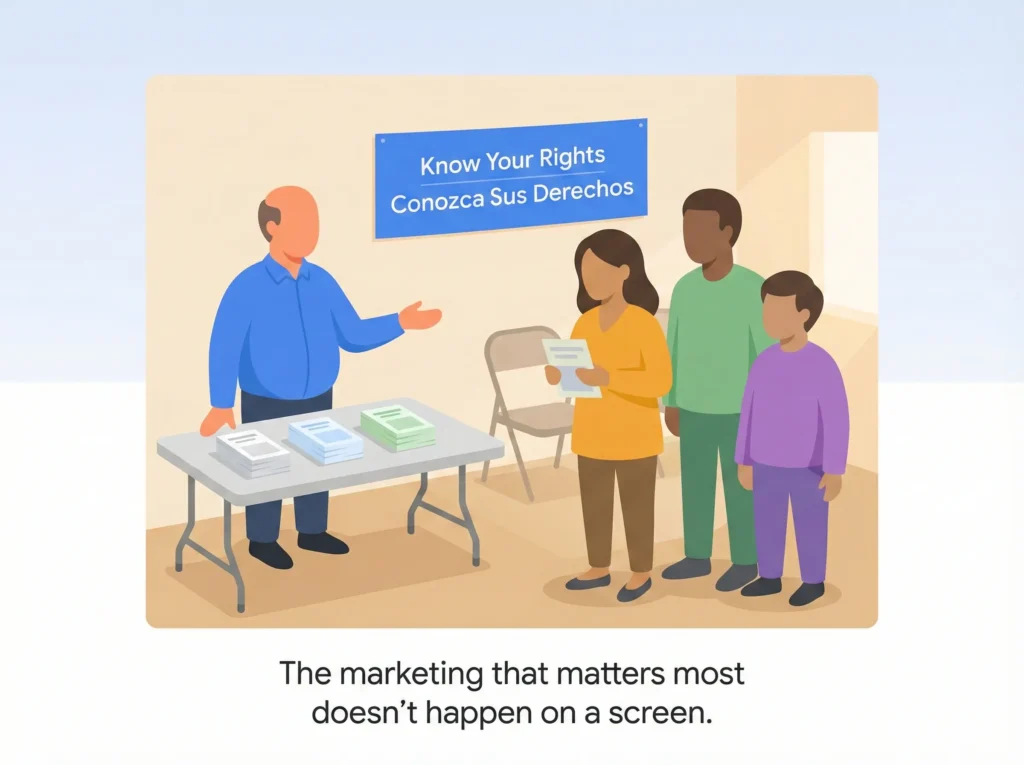
What does work is showing up in person. Hosting a “know your rights” workshop at a church in a neighborhood where your clients actually live. Partnering with a nonprofit that already has the community’s trust and establishing a formal referral relationship where they handle the simple stuff and send you the complex cases. Participating in Facebook groups where specific communities gather; not to pitch your services, which crosses into solicitation territory that state bar advertising rules take very seriously, but to answer general questions and be a known name.
These things don’t scale the way PPC scales and they don’t produce leads you can track in a dashboard, but they create a kind of trust that no amount of ad spend can buy. And in a practice area where your clients are often making the most important decision of their lives based on whether they believe you’ll actually protect them, that trust is the whole game.
The PPC Economics Are Better Than You Think
How much does PPC cost for immigration lawyers? Immigration law has the cheapest paid search costs in legal marketing, with average cost per click ranging from $3 to $15 compared to $200 to $1,000 for personal injury. This means a $2,000 monthly PPC budget can generate meaningful traffic and enough data to optimize campaigns, which is impossible in PI at the same spend level. Google Local Services Ads are particularly effective because the pay-per-lead model with the Google Verified badge (which replaced Google Screened in October 2025) builds trust with clients who are wary of fraud. The key operational requirement is 24/7 intake coverage because many immigration clients search and call outside business hours due to work schedules.
The PPC economics for immigration law are so much better than other practice areas that it changes the entire strategy conversation. When PI firms are spending $500 to $1,000 per click and need $20,000 a month just to test whether a campaign works, immigration firms can run real campaigns on $2,000 to $3,000 a month and get enough clicks to actually learn what’s converting. If you’re trying to figure out which channel makes sense at your budget level, immigration is one of the few practice areas where PPC works at almost any spend.
And Local Services Ads are particularly good for immigration because the verification badge does something unique in this space. Google replaced the old “Screened” badge with a generic “Verified” checkmark in October 2025, but the underlying verification process still matters here; for a client who’s been warned about notario fraud and who doesn’t know how to verify whether an attorney is legitimate, seeing that Google has already confirmed the firm’s license and run a background check reduces a barrier that no amount of ad copy can overcome on its own. That verification combined with a strong review profile is probably the most powerful trust combination available in immigration marketing right now.
But the operational piece matters here more than in other practice areas. Immigration clients often work jobs where they can’t make phone calls during business hours, which means your leads are coming in at 9 PM and 11 PM and on weekends. If your intake setup doesn’t include after-hours coverage, you’re paying for leads that call, get voicemail, and dial the next firm. And with clicks this cheap, the waste isn’t in the ad spend; it’s in the missed calls.
What I’d Tell an Immigration Firm That Called Me Tomorrow
If your firm is already getting cases through referrals and community relationships and the pipeline feels stable, there’s no reason to change what’s working just because you read this. Keep doing the offline stuff because that’s your foundation and it’s harder to replicate than anything digital.
But if you want to grow beyond referrals, or you’re starting to see competitors show up in searches where you used to be alone, the first move is getting your bilingual website architecture right because that unlocks an entire market most firms are invisible to.
Then test PPC at $2,000 to $3,000 a month because the economics let you learn what works without burning through your marketing budget. Build content around the specific visa types and processes your clients are searching for, especially USCIS processing times and policy changes that create immediate demand. And keep investing in the community presence because that’s what turns a lead into a client who trusts you enough to hand over their entire future.
Or don’t, honestly, the firms that figure this out will have a pretty significant head start in a market that’s only getting bigger, but that’s their problem to solve, not yours.
Want to know where your immigration firm stands?
I’ll look at your bilingual SEO, your PPC economics, your intake coverage, and your community positioning and tell you where the gaps are. If you’re already in a good spot I’ll tell you that too.
How much to spend | Which channel first? | Fix your intake | Know the advertising rules