

Key Takeaways
- 93% of legal consumers read reviews before hiring an attorney. A 3.5-star rating creates a “trust deficit” that no amount of ad spend can overcome.
- 4.2 to 4.5 stars converts better than 5.0. Per Spiegel Research Center, perfect ratings look manufactured. Below 4.0 is catastrophic; fewer than half of consumers will consider you.
- Timing is everything. Request reviews within 24 hours of case closure. A week later, conversion drops significantly. A month later, you’re ignored.
- Florida is the strictest. Rule 4-7.13(b)(8) requires “objectively verifiable” testimonials plus disclaimers. Opinion 21-1 says you can’t reveal confidential info in responses even if the review is false.
- Never pay for reviews. FTC finalized rules in 2024 banning fake reviews and review suppression. Bar rules prohibit “anything of value” in exchange for recommendations.
Table of Contents
You do this yourself and you probably don’t even think about it. You search for something, you click on a result, and before you call or fill out a form you go check the reviews. If the reviews are thin or the rating is under 4.5 you back out and click the next one, and the whole decision takes maybe 90 seconds. Your potential clients are doing the exact same thing with your firm, which means every dollar you spend on ads and SEO is filtered through your review profile before it produces a phone call, and if the reviews aren’t right then the ads are just sending people to go hire your competitor.
Why Reviews Matter More Than Your Website
Summary: Reviews function as “social proof” that reduces the perceived risk of hiring a lawyer. 93% of legal consumers read reviews before contacting a firm. Even referred leads validate the recommendation online; a weak profile causes “referral leakage” where warm leads go to competitors. Percy Martinez went from 4.7 to 5.0 stars and 98 to 118 reviews; the phone rang more without changing anything else about the marketing.
Here’s what most lawyers don’t understand: people don’t trust your website. They trust other people who’ve been in their situation.
When someone is facing divorce or criminal charges or a serious injury, they can’t evaluate your courtroom skills from a bio page. They don’t know if you’re actually good or just good at marketing. So they use reviews as a proxy for competence, empathy, and reliability.
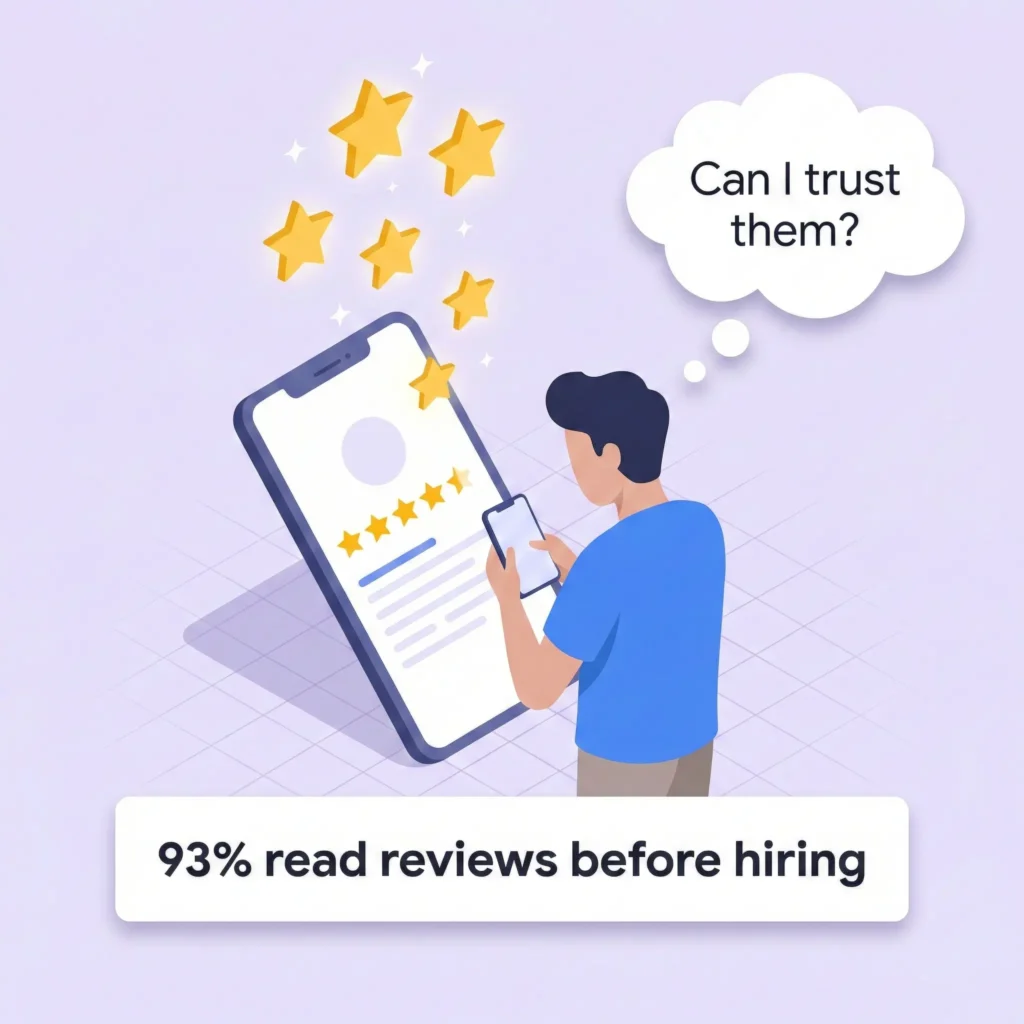
Data shows 93% of legal consumers read reviews before hiring an attorney. They’re not just looking at stars; they’re looking for narrative resonance. When someone reads a detailed review describing how you navigated a custody battle or fought an insurance company, they project themselves into that story. The conversion happens before they ever call.
The Referral Leakage Problem
Even when someone is referred to you by a friend, they still Google you to validate the recommendation. If they find a 3.0-star rating or a barren Google Business Profile, that warm referral goes cold and they call the competitor with 150 reviews instead.
This is “referral leakage.” All your networking and business development effort, leaking out because your digital presence didn’t close the deal.
The Rating Sweet Spot (It’s Not 5.0)
Summary: Per Spiegel Research Center, purchase likelihood peaks at 4.2 to 4.5 stars. A perfect 5.0 appears manufactured and triggers skepticism unless backed by volume (100+ reviews). Below 4.0 is the “trust cliff” where fewer than half of consumers will consider you. Percy hit 5.0 with 118 reviews; the volume validated the score.
This surprised me: a perfect 5.0 rating can actually hurt conversion.
Spiegel Research Center data shows that purchase likelihood peaks in the 4.2 to 4.5 range. Consumers have developed skepticism toward profiles that look too perfect. In legal work, where conflict is inherent, a profile with only glowing reviews looks censored or fake.
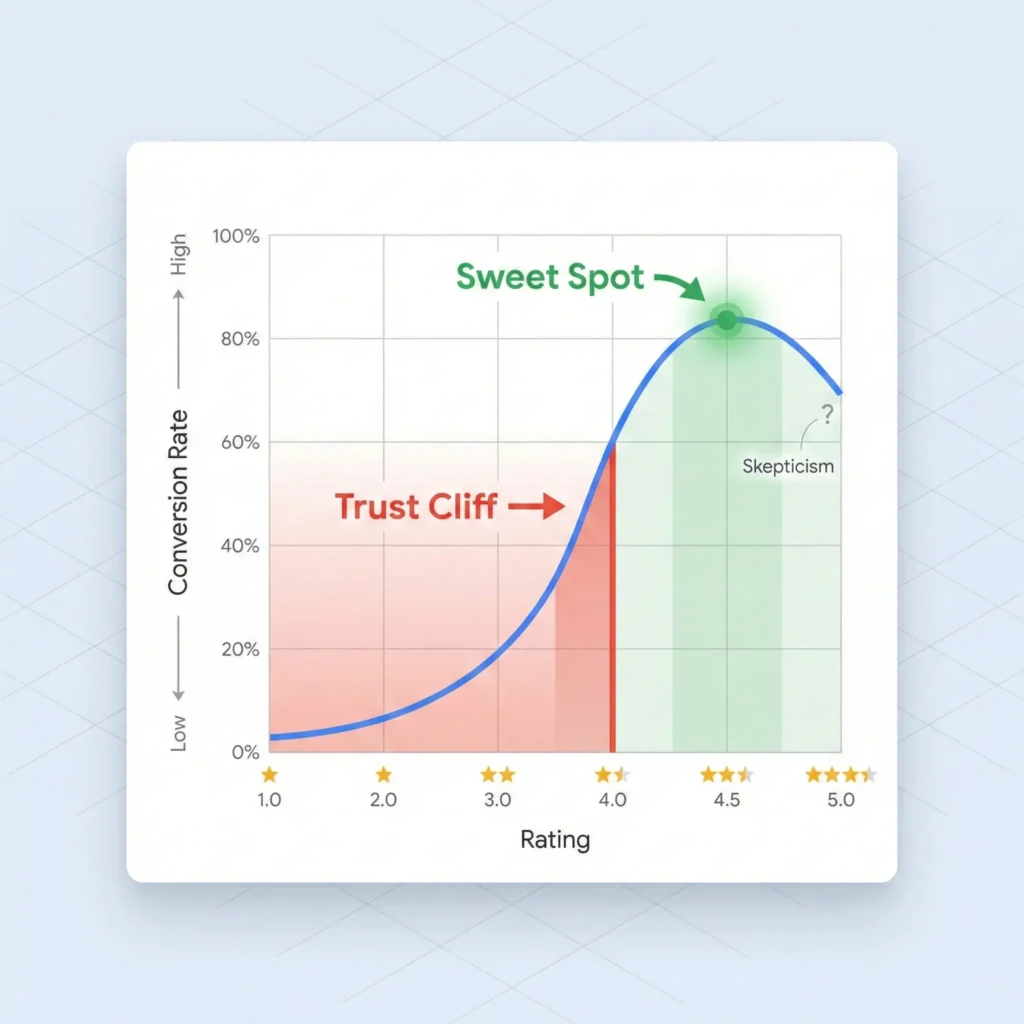
A prospective client understands that lawyers can’t win every case or please every person. A few moderate ratings handled professionally actually signal transparency and authenticity.
But drop below 4.0 and you hit the “trust cliff.” Fewer than half of consumers will even consider a business under four stars. That’s where the math breaks completely.
The Volume Exception
Here’s the nuance: while e-commerce data suggests skepticism at 5.0, in the hyper-competitive legal Map Pack, 5.0 often wins simply due to visibility algorithms; provided you have the volume (100+ reviews) to prove the score is real, not just five friends. Percy had 118 reviews at 5.0. That volume validated the perfect score. A 5.0 with 8 reviews triggers suspicion. A 5.0 with 150 reviews signals dominance.
The Goal
Not perfection for its own sake. A preponderance of positive sentiment backed by volume that overwhelms the inevitable negative feedback from the adversarial nature of legal work.
How Reviews Actually Affect Your Rankings
Summary: Google evaluates three review metrics for Local Pack rankings: (1) Review quantity signals prominence; (2) Review velocity (2-3 per month) signals freshness; sudden spikes trigger spam filters; (3) Review keywords help rank for long-tail queries. For LSAs, star rating and volume directly affect ad placement and cost-per-lead, independent of bid price. I managed budgets at Swatch Group before legal marketing; I treat star ratings as a cost-per-lead lever, not a vanity metric.
Reviews don’t just affect conversion. They directly affect whether people find you at all.
The Local 3-Pack
The map and three business listings at the top of Google search results; that’s the most valuable real estate in legal marketing. It captures the majority of clicks for “personal injury lawyer near me” type queries.
Google evaluates three review signals:
Review Quantity: Total number signals prominence and longevity. More reviews = more established practice.
Review Velocity: The frequency of new reviews matters more than the total count. A steady drip of 2-3 per month beats 50 reviews followed by months of silence. Sudden spikes trigger spam filters and signal a dormant business.
Review Keywords: When clients write “The team helped me with my car accident claim,” that signals relevance to Google for that specific search term. You can rank for keywords you never targeted on your website just because clients mentioned them in reviews.
Local Services Ads (LSAs)
This is where reviews become a direct lever for lowering your cost per lead.
Unlike traditional Google Ads where bid price determines placement, LSA ranking is heavily influenced by star rating and review volume. A firm with 4.9 stars and 100 reviews will achieve lower cost-per-lead and higher placement than a firm with 4.0 stars and 10 reviews; even if the second firm bids more.
The $14,000 “Trust Tax”
I call this difference the “Trust Tax.” I analyzed LSA auctions in competitive markets. A firm with 4.0 stars pays roughly 60% more per lead to maintain the same visibility as a 4.9-star firm.
If you buy 100 leads a year:
Firm A (4.9 Stars): Pays ~$19,500 ($195/lead).
Firm B (4.0 Stars): Pays ~$34,000 ($340/lead).
The Result: You are lighting $14,500 on fire annually just because your reputation is average. That’s not a marketing problem. That’s a financial leak.
Reviews effectively become a bidding advantage that compounds over time.
The Ethics Minefield (State-by-State)
Summary: ABA Rule 7.1 prohibits false/misleading communications; Rule 7.2 bans “anything of value” for recommendations; Rule 7.3 restricts solicitation but allows asking existing clients for reviews. Florida requires “objectively verifiable” testimonials with disclaimers. New York requires “Prior results do not guarantee similar outcome.” California prohibits republishing reviews that guarantee results. FTC bans paid reviews and review suppression. I handled intake calls for a decade; I’ve seen Bar complaints filed over review responses.
For restaurants, review strategy is just marketing. For lawyers, it’s a compliance tightrope.
The ABA Baseline
Rule 7.1: Prohibits false or misleading communications. If you solicit a review you know is false (from a non-client, family member, or paid shill), you’re in direct violation.
Rule 7.2: Prohibits giving “anything of value” for recommending your services. You can pay for advertising and review platform subscriptions, but you cannot pay clients or third parties to write reviews.
Rule 7.3: Restricts live solicitation of strangers but allows asking existing clients for reviews as part of the representation relationship.
Florida: The Strictest Standard
Florida views legal marketing with deep skepticism.
Per Rule 4-7.13(b)(8), testimonials must be “objectively verifiable” (a high bar for subjective praise like “the best lawyer”), cannot be written by the lawyer, and cannot be paid for. Any advertisement containing a testimonial must include the disclaimer “prospective clients may not obtain the same or similar results.”
Florida Ethics Opinion 21-1 explicitly states that lawyers cannot reveal confidential information in response to a negative review, even if the review is factually false. Your response must be generic.
New York
Rule 7.1(e) requires the specific disclaimer “Prior results do not guarantee a similar outcome” on any advertisement containing testimonials. This applies to websites and social media.
California
Rule 7.1 prohibits communications that guarantee results. If a client review says “He guarantees a win” and you republish it, you’ve adopted a prohibited statement.
The FTC Layer
Beyond state bars, the FTC regulates reviews under its Endorsement Guides. In late 2024, the FTC finalized rules banning: purchase of fake reviews, review suppression (hiding bad reviews while showing good ones), and fake social media indicators.
Law firms hiring “reputation management” agencies that promise to “wipe” bad reviews face federal penalties.
When to Ask (The “Peak Happiness” Moment)
Summary: Request reviews when client sentiment is highest: PI when settlement check arrives, criminal defense when charges dropped, family law when decree is final, immigration when visa approved. Client willingness degrades rapidly; 24 hours after closure converts significantly better than one week later. A month later is usually ignored. I was the one handing clients their settlement checks; I know exactly when they’re ready to say yes.
Timing is the single biggest variable in whether someone actually leaves a review.
Practice Area Timing:
Personal Injury: When the settlement check is handed over or wire confirmed.
Criminal Defense: When charges are dropped, not guilty verdict is read, or favorable plea finalized.
Family Law: When custody agreement is signed or divorce decree is final.
Immigration: When visa or green card is approved.
The Decay Curve
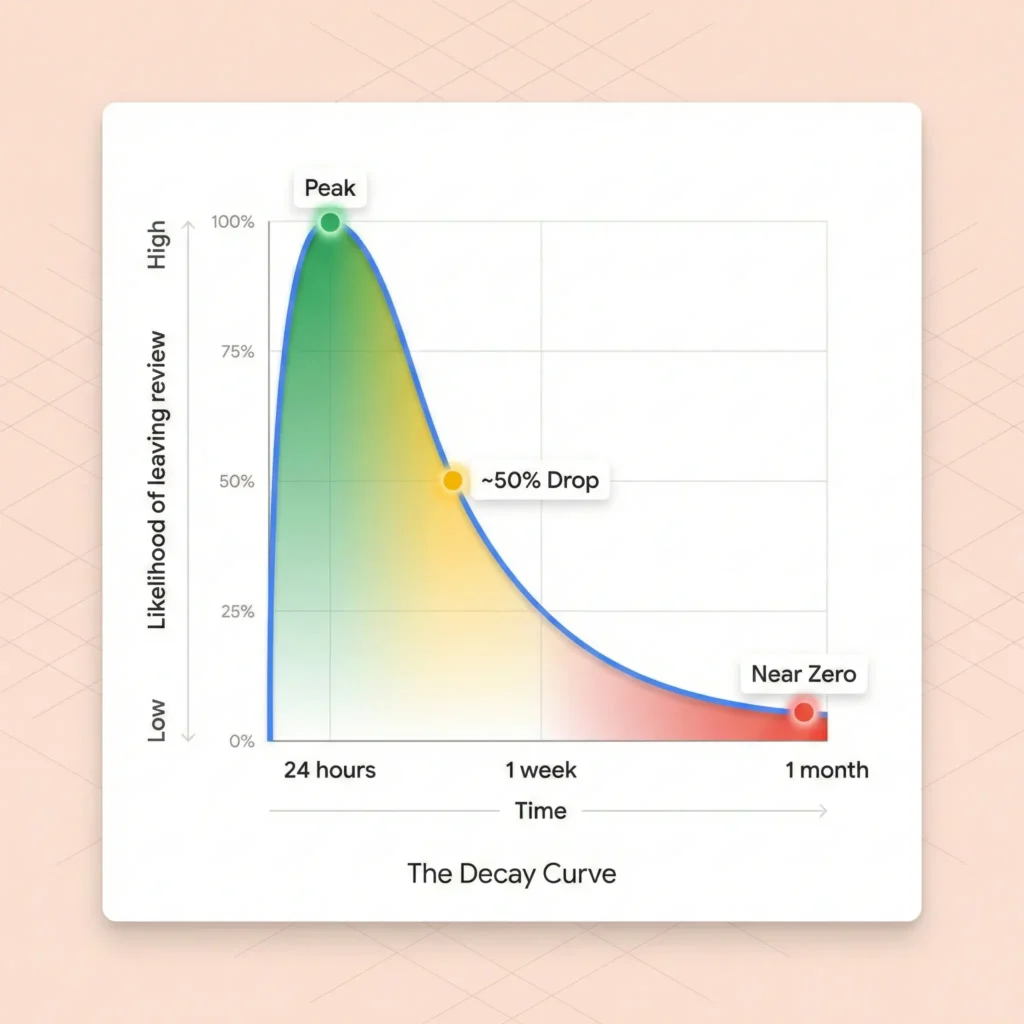
Client willingness to leave a review degrades fast. A request sent 24 hours after case closure converts at a much higher rate than one sent a week later. A request sent a month later is often ignored; the client wants to move on from the legal trauma.
The Milestone Strategy (Long Cases)
For cases that take 18 months (divorce, probate), waiting until the end is risky. The client might be exhausted or the final result might feel like a compromise.
Request reviews at successful milestones during the case: “We just won the temporary hearing!” or “Motion to dismiss granted!” This captures the emotion of the micro-win when the client is most grateful.
Email vs. Text (And the TCPA Trap)
Summary: Email has 20-30% open rates; best for B2B or complex matters. SMS has 98% open rates; best for high-volume B2C practices. TCPA requires Prior Express Written Consent for marketing texts; intake forms must include explicit checkbox. Violations carry $500-$1,500 statutory damages per text. We audit intake forms for TCPA compliance before launching any review campaign; one missing checkbox across 200 clients is a $300,000 exposure.
Traditional and professional but low open rates (20-30%). Best for corporate law, IP, or complex matters where you want a thoughtful, detailed review.
Text (SMS)
98% open rates and immediate action. Best for high-volume practices: traffic tickets, simple injury, consumer bankruptcy. Keep it short with a direct link to the review platform.
The TCPA Trap
This is where firms get sued.
Sending marketing texts (and a review request is technically marketing) requires Prior Express Written Consent under the Telephone Consumer Protection Act. Your engagement letters or intake forms must include a checkbox explicitly consenting to text messages for feedback purposes.
Failure to get consent exposes you to class-action lawsuits with statutory damages of $500-$1,500 per violation. One missing checkbox, multiplied by hundreds of clients, becomes catastrophic.
The Automated Workflow
Manual requests fail because lawyers get busy. Set up automation in your practice management software (Clio, MyCase) or reputation tools (Birdeye, Podium):
- Trigger: Case status changes to “Closed”
- Filter: Staff marks client as “Satisfied” (internal check)
- Action: Automated SMS with direct link
- Follow-up: Email reminder if no click in 3-5 days
Note: “Review gating” (screening for satisfaction before sending the public link) is prohibited by Google’s terms of service. But internal discretion on who to ask is generally permissible.
Steal These Scripts (Copy and Paste)
Summary: Don’t ask for a “review.” Ask for specific feedback using psychological priming. This triggers the client to write the keywords Google needs to rank you for practice-area queries. The scripts below are compliant and tested.
Lawyers are busy. Here are the exact words so you don’t have to think.
The “NLP” Email (To Rank for “Car Accident”):
“Hi [Name], it was a privilege to fight for you. Now that your case is settled, could you share one sentence about your experience? Specifically, mentioning your car accident case and the settlement helps other families in your situation find us. [Link]”
Why it works: You’re not asking for generic praise. You’re priming the client to write the exact keywords (“car accident,” “settlement”) that Google’s algorithm uses to associate your profile with that practice area.
The “Settlement Check” Script (In-Person):
“Mr. Smith, while I’m printing your settlement breakdown, would you mind doing me a huge personal favor? Google looks at how many happy clients we have. If you scan this QR code, it takes 10 seconds to tap the stars. It helps me out personally.”
Why it works: You’re asking at peak happiness (money in hand), making it personal (“helps me out”), and reducing friction (QR code, 10 seconds). The “personal favor” framing triggers reciprocity; they just received a settlement, they want to give something back.
The “Milestone” Text (Long Cases):
“Hi [Name], great news on the temporary hearing today. If you have 30 seconds, would you mind sharing how it’s been working with us so far? [Link]”
Why it works: Captures the micro-win emotion before the case drags on another 12 months and the client forgets how relieved they felt today.
How to Respond to Negative Reviews (Without Breaching Privilege)
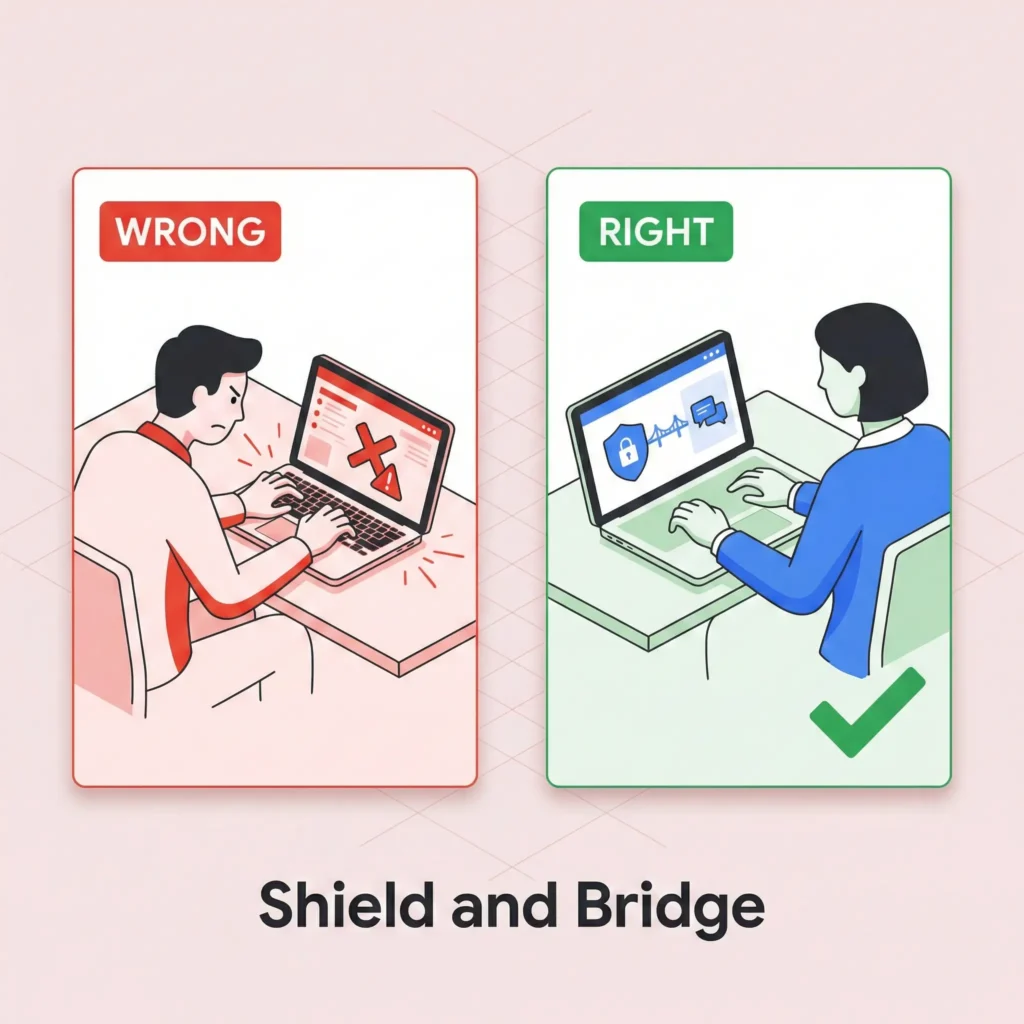
Summary: The most common ethical violation is revealing confidential information to defend yourself. Rule 1.6 privilege doesn’t have a “Yelp exception”; state bars have sanctioned lawyers for “setting the record straight.” The “Shield and Bridge” protocol below keeps you compliant while neutralizing the damage: generic acknowledgment, pivot to private channel, no case details. Florida Ethics Opinion 21-1 is explicit on this; I watched firms learn it the hard way.
This is where lawyers get disbarred.
The Privilege Trap
A client writes: “This lawyer is incompetent and lost my case.”
The violation: You reply, “We lost because you refused the settlement offer against my advice and lied about your criminal record.”
That response violates the duty of confidentiality (Rule 1.6). The “self-defense” exception to privilege applies only to formal proceedings like malpractice suits or bar complaints; not online Yelp battles. State bars have sanctioned lawyers for “setting the record straight” online.
The client’s public criticism does not constitute a waiver of privilege.
The “Shield and Bridge” Protocol
Shield (Generic Acknowledgment): Acknowledge feedback without confirming the attorney-client relationship. “We take all feedback seriously.”
Bridge (Take it Offline): Pivot to a private channel. “Please contact our office manager directly so we can discuss this matter.”
Template for Negative Reviews (Ethically Safe):
“Professional obligations do not allow us to respond to the specifics of this post or to confirm representation. However, our firm is dedicated to client service and we take all feedback seriously. We invite you to contact our office directly to discuss your concerns.”
The “Nuclear Option” for Fake Reviews
Most lawyers just click “Flag as Inappropriate” and wait. That rarely works. Google ignores 90% of flags.
If a fake review violates Google’s “Conflict of Interest” or “Fake Engagement” policy, don’t just flag it. Use the Google Business Profile Help Tool for a manual escalation.
The Paralegal Move:
Attach a redacted affidavit on firm letterhead stating:
“I, [Name], declare under penalty of perjury that I have audited our client database for the last 10 years and have no record of a client matching this identity. This review violates the ‘Fake Engagement’ policy.”
Google support reps are bureaucrats. Give them a document that looks like a court filing, and they are statistically more likely to hit delete. I’ve seen this work when the standard flag sat ignored for months.
While Waiting (Neutralize for Future Readers):
Post a response: “We have checked our records and cannot find a client matching the details provided here. We pride ourselves on our service. If you are a client, please contact us directly so we can address this.”
This signals to future readers that the review is likely fake without revealing anything about actual clients.
Legal Action (True Nuclear):
For persistent defamation with provably false factual allegations, firms can file “John Doe” lawsuits to subpoena the reviewer’s IP address. This is expensive and can trigger the “Streisand Effect” (drawing more attention to the negativity). Reserve it for damaging, demonstrably false statements that are costing you real money.
HIPAA Layer (PI/Medical Malpractice)
For firms dealing with medical issues, acknowledging someone was a client can be an acknowledgment of their medical status. Even “Glad you’re feeling better!” can be a HIPAA violation if it implies medical knowledge.
Responses must be completely devoid of any reference to case type or health condition.
Platform by Platform Strategy
Summary: Google Business Profile is critical; drives Map Pack, LSAs, and CTR. Allows asking for reviews. Yelp strictly prohibits asking; only passive presence with badge on website. Avvo allows soliciting; peer endorsements boost numerical rating, client reviews drive trust. Facebook useful for community practices but less critical for search. Each platform has different rules; what gets you featured on Google gets you banned on Yelp.
Google Business Profile (The King)
Critical. Drives the Map Pack, LSAs, and organic click-through rates. It’s the primary source of truth for consumers.
Google allows and encourages asking for reviews. But their spam filter is aggressive; it may filter reviews if many come from the same IP address (office kiosk) or if clients lack GPS history at your location.
Yelp (The Adversary)
High importance for visibility in major metros, especially for family law and criminal defense.
But Yelp strictly prohibits asking for reviews. Their algorithm filters reviews it suspects were solicited. If caught, they slap a “Consumer Alert” banner on your profile; reputation death sentence.
Strategy: Passive only. Put the “Find us on Yelp” badge on your website and email footer. Never send a “Review us on Yelp” email.
Avvo
High for legal-specific searches. The 1-10 numerical rating is calculated from profile data (experience, awards), not client reviews. But client reviews appear on the profile and drive conversion.
Allows soliciting reviews. Peer endorsements from other lawyers can boost the numerical rating. Dual strategy: happy clients for reviews, colleagues for endorsements.
Moderate importance. Useful for community-based practices and humanizing the firm. Less critical for “near me” search intent.
Uses “Recommendations” (Yes/No) rather than star ratings in many regions. Enable recommendations but monitor for spam.
Using Reviews in Your Marketing
Summary: Embed aggregate rating (“4.9 Stars on Google”) in website header/footer. Place practice-area-specific reviews on corresponding service pages. Implement Review Schema for rich snippets (up to 30% CTR increase). Use review snippets in Facebook/Instagram ad creative with required disclaimers. Strong reviews allow premium pricing by de-commoditizing the service. You own everything we build; trust badges and schema markup are standard, not upsells.
Reviews shouldn’t sit static on Google. Deploy them across your marketing.
Website Integration
Trust Badge: Place aggregate rating in header and footer. “4.9 Stars on Google” provides immediate validation on every page.
Contextual Testimonials: On your car accident page, feature car accident reviews. On divorce page, feature divorce reviews. Semantic matching increases relevance and conversion.
Schema Markup: Implement Review Schema (JSON-LD) so star ratings appear in organic search results. Can increase CTR by up to 30%.
Ad Creative
Reviews make excellent ad copy because they’re voice-of-customer data.
A carousel ad featuring snippets of 5-star reviews often outperforms generic “We Fight For You” copy. It provides social proof within the feed.
Compliance check: Using a review in an ad may require disclaimers (“Prior results do not guarantee similar outcome”) depending on your state. Some states require filing with the bar.
Fee Justification
Strong reviews let you charge more. A potential client will pay a premium for a lawyer with 200 five-star reviews over a cheaper option with 3 stars.
Reviews serve as a proxy for value, security, and peace of mind. They de-commoditize the legal service.
The Bottom Line
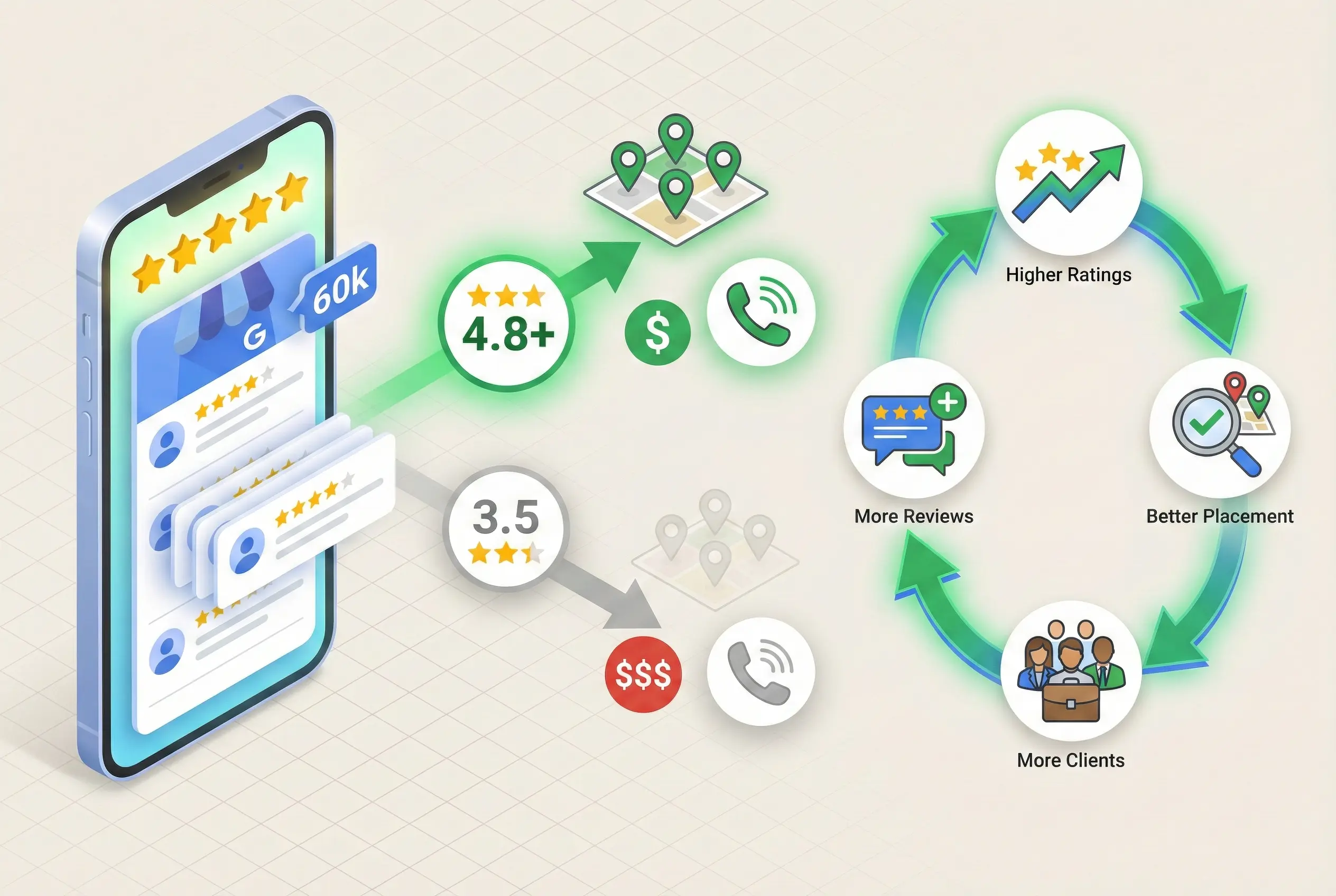
Summary: A 3.5-star firm operates a “leaky bucket” where leads pour in but leak out at validation. A 4.8-star firm with systematic review acquisition creates a “Reputation-Revenue Cycle”: higher ratings → better LSA placement → lower ad costs → more clients → more reviews → flywheel accelerates. We track reviews to cost-per-signed-case, not just star count; if the rating goes up but intake stays flat, something else is broken.
A firm with a 3.5-star rating operates with a “leaky bucket.” PPC and SEO pour leads into the top, but they leak out when consumers encounter the trust deficit.
A firm with a 4.8-star rating creates a “Reputation-Revenue Cycle”:
Higher ratings → Better LSA placement and lower ad costs → Better visibility → More clients → Systematic ask process → More reviews → Ratings stay high → Cycle accelerates
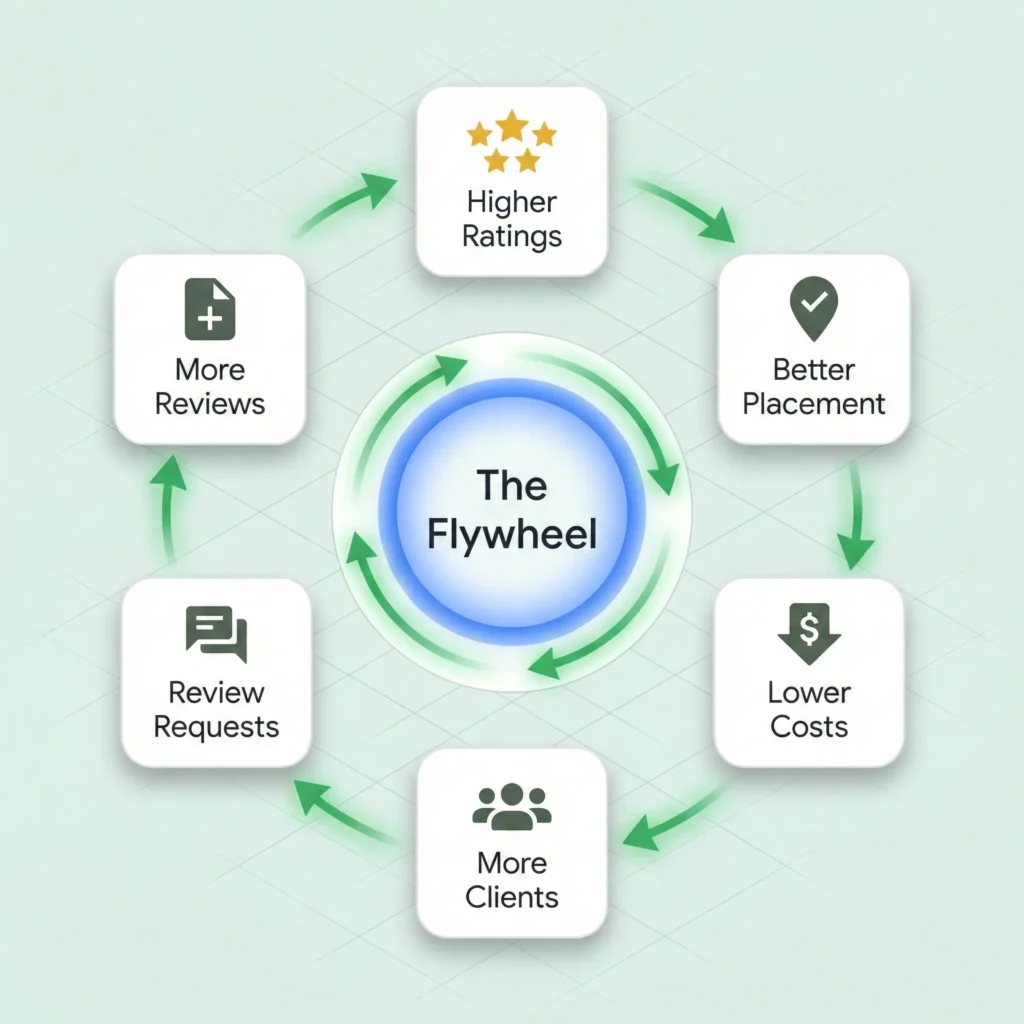
The path forward: operationalize review acquisition within ethical bounds, respond to criticism with strategic empathy, and leverage that social proof to dominate the digital marketplace.
Source
Ethics rules and compliance guidance cited in this article are drawn from the Florida Bar Advertising Rules, ABA Model Rules of Professional Conduct, and FTC Endorsement Guides.
Disclaimer
This article provides general information about review management and Bar advertising rules. It is not legal advice and does not create an attorney-client relationship. State bar rules vary significantly; consult your jurisdiction’s ethics hotline or a legal ethics attorney before implementing any review strategy. TCPA compliance should be reviewed with qualified legal counsel.