

There’s a thread on Reddit that comes back around every few months where an attorney posts something like “I spent $10,000 on Google Ads and got zero clients, is this normal” and then fifty other attorneys pile on saying they had the same experience and Google Ads is a scam. And then an agency person shows up and says “well you probably weren’t doing it right” and everyone downvotes them because that’s what every agency says when the ads don’t work.
And the thing is, both sides are telling the truth, which is what makes this so frustrating. Google Ads is genuinely the most effective channel for capturing people who need a lawyer right now, and it also genuinely burns through money at a rate that will bankrupt a small firm if the math isn’t right. The difference between those two outcomes isn’t luck and it isn’t even which agency you hire; it’s whether the unit economics of your specific practice area and budget level can sustain the cost of learning what works.
I’m going to walk through the actual math from click to signed case, including the practice areas and budget levels where the numbers don’t work no matter how good your campaign is, because nobody selling PPC management is going to tell you that.
Why Legal Clicks Cost More Than Anything Else on Google
Why are Google Ads so expensive for lawyers? Legal keywords are the most expensive on Google because the auction prices reflect the potential value of a case. Personal injury clicks cost $150-$500 because a single case can generate $100,000+ in fees on a contingency basis. This creates a “casino effect” where large firms bid aggressively on keywords hoping for catastrophic injury cases worth millions, which drives up the price for smaller firms who just want standard auto accident cases. Mesothelioma and trucking accident terms exceed $1,000/click because settlement values can reach eight figures. Quality Score compounds this; firms with poor landing pages pay up to 400% more per click than firms with optimized pages for the same keyword.
The reason a click on “personal injury lawyer” costs $150 to $500 while a click on “plumber near me” costs $6 is that Google’s auction efficiently prices the intent behind the search. A person searching for a lawyer might become a client worth $50,000 or $500,000 in fees, and every firm bidding on that keyword knows it, so the click price reflects the potential outcome rather than the actual outcome.
And this creates a distortion that hurts small firms more than anyone. The big PI shops are running what amounts to a whale hunt; they’ll pay $500 a click on “truck accident lawyer” because one trucking case with a commercial insurance policy can settle for seven figures, which means a $3.3 million contingency fee on a single case. They don’t care that most of those clicks turn into fender-bender inquiries because the economics work on the whales alone.
But that whale-hunting bid of $500 becomes the market price that everyone has to pay, including the solo practitioner who just wants basic car accident cases and whose average case value might be $15,000. That solo is competing in an auction priced for outcomes they’ll never see, which is why so many attorneys describe the experience as “burning money.”
And there’s a second layer that makes it worse. Google uses something called Quality Score which is basically a grade from 1 to 10 on how relevant your ad and landing page are to what the person searched for. If your Quality Score is high, say 8 to 10, Google discounts your actual cost per click by up to 50%. If it’s low, 3 to 5, they mark it up by as much as 400%.
So two firms bidding on the exact same keyword can pay wildly different amounts per click, and the difference comes down to whether you’re sending people to a dedicated landing page with a clear call to action or dumping them on your homepage where they have to figure out what to do next.
The Math From Click to Signed Case That Nobody Shows You
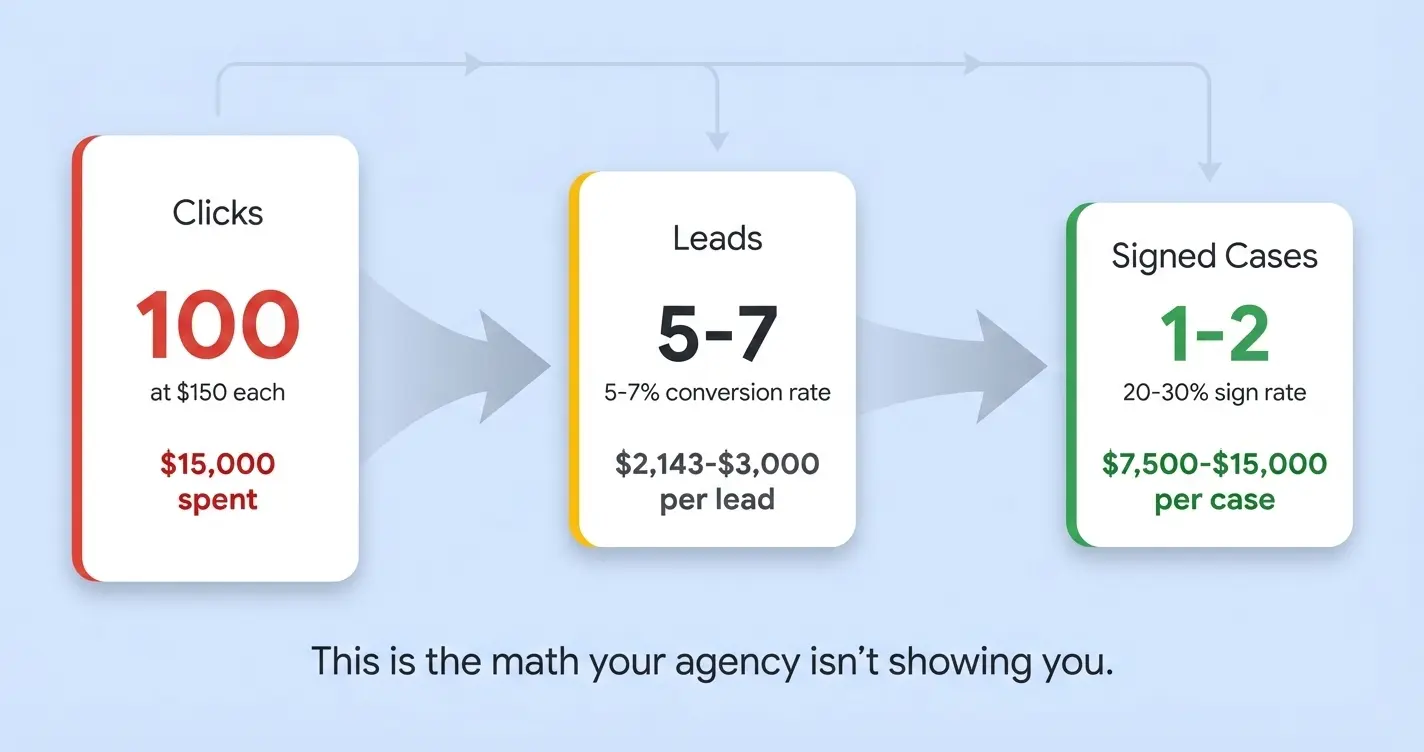
How do you calculate cost per signed case from Google Ads? The calculation has three steps. Step 1: Cost Per Lead (CPL) = CPC divided by click-to-lead conversion rate (industry average 5-7%). A $150 click with 5% conversion = $3,000 CPL. Step 2: Cost Per Acquisition (CPA) = CPL divided by lead-to-client sign rate (average 20-30% for firms with strong intake). $3,000 CPL with 25% sign rate = $12,000 CPA. Step 3: ROI = average case value minus CPA. If average PI case yields $30,000 in fees and CPA is $12,000, ROI is $18,000 per case (150% return). If average case yields $8,000 and CPA is $12,000, ROI is negative $4,000 per case. The sign rate is the single biggest variable; improving intake from 10% to 25% cuts CPA by 60%.
This is the part every agency skips because it reveals whether the economics actually work for your firm. Every agency will tell you they generated 50 leads last month, and that sounds impressive until you find out what those leads actually cost and how many turned into paying clients.
Here’s the chain and I want you to follow each step because this is where the real picture comes together. Start with 100 clicks at $150 each, which is $15,000 in ad spend. The legal industry average conversion rate from click to lead is 5 to 7%, so those 100 clicks produce 5 to 7 phone calls or form fills. That puts your cost per lead at $2,143 to $3,000.
Now those 5 to 7 leads have to become clients. The average lead-to-client sign rate is 10 to 15% for firms with mediocre intake, and 20 to 30% for firms that answer every call within five minutes and chase every lead aggressively. At a 25% sign rate, you sign 1 to 2 clients from those 100 clicks. Your cost per signed case lands between $7,500 and $15,000.
Whether that’s profitable depends entirely on what the case is worth. A PI case that settles for $100,000 in fees on a third of a $300,000 settlement? That $12,000 acquisition cost is phenomenal and you’d run that campaign forever. A family law retainer of $3,500? That $12,000 cost is a catastrophic loss.
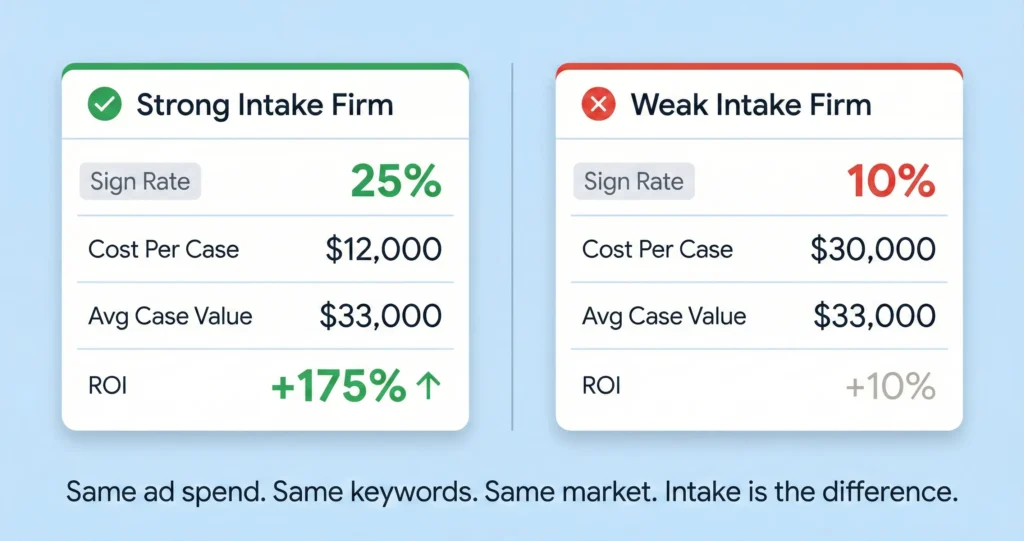
And here’s what makes the intake variable so important. If your intake process converts leads at 10% instead of 25%, your cost per signed case jumps from $12,000 to $30,000. Same ad spend, same keywords, same market. The only difference is how fast you answer the phone and how aggressively you follow up. That’s why I keep telling people that fixing intake usually returns more than optimizing the ads themselves.
What Each Practice Area Actually Costs Per Click and Per Signed Case
| Practice Area | CPC Range | Avg CPL (at 6% CVR) | CPA (at 25% sign rate) | Typical Case Value | Viable? |
|---|---|---|---|---|---|
| PI (Standard MVA) | $150-$500 | $2,500-$8,333 | $10,000-$33,333 | $15,000-$100,000 | Yes, if case values are high |
| PI (Catastrophic/Truck) | $500-$1,000+ | $8,333-$16,667+ | $33,333-$66,667+ | $100,000-$3,000,000+ | Yes, for capitalized firms only |
| Criminal Defense (DUI) | $80-$160 | $1,333-$2,667 | $5,333-$10,667 | $2,500-$5,000 retainer | Tight margins, volume dependent |
| Family Law (Divorce) | $50-$100 | $833-$1,667 | $3,333-$6,667 | $3,500-$10,000 retainer | Yes, at $3K+ monthly budgets |
| Bankruptcy | $11-$45 | $183-$750 | $733-$3,000 | $1,500-$3,000 | Yes, excellent unit economics |
| Estate Planning | $10-$40 | $167-$667 | $667-$2,667 | $2,000-$5,000 | Yes, but low search intent |
| Employment Law | $40-$80 | $667-$1,333 | $2,667-$5,333 | $5,000-$50,000+ | Yes, undervalued |
| Immigration | $10-$40 | $167-$667 | $667-$2,667 | $3,000-$8,000 | Yes, best PPC economics in legal |
The practice areas that jump out are the ones where the CPA-to-case-value ratio actually works. Bankruptcy and immigration have CPCs under $45 which means your cost per signed case can stay under $3,000, and both generate enough retainer revenue to cover acquisition costs on the first case. Employment law is undervalued because most firms aren’t bidding on it aggressively, so there’s less auction pressure.
Criminal defense is where it gets tricky. The DUI retainer of $2,500 to $5,000 sounds like it covers a $5,333 CPA, but it barely breaks even, which means profitability depends on volume. You need to sign 8 to 10 DUI cases a month from PPC to make the economics work after overhead, and that requires a budget north of $5,000. A solo doing 2 DUI cases a month from PPC is probably losing money once you count the ad management costs.
The $500 Budget Is a Donation to Google
Can a law firm run Google Ads on a $500 monthly budget? No, not viably. In personal injury markets where clicks cost $150, a $500 budget buys approximately 3 clicks per month. With a 5-7% conversion rate, a firm needs 15-20 clicks to statistically expect one lead. At 3 clicks, the probability of generating a phone call is near zero. Additionally, Google’s automated bidding requires conversion data to optimize, and a campaign generating zero conversions stays in the “learning phase” indefinitely, paying inflated prices for low-quality clicks. The minimum viable budget for competitive practice areas is $3,000-$5,000/month. In small markets or low-CPC areas like estate planning, $1,500/month can work.
This is the honest assessment that no agency selling you a $500 starter package will give you, and I’m going to explain exactly why with math so you can decide for yourself.
If a personal injury click costs $150 in your market, a $500 monthly budget buys you 3 clicks. Three. The industry average conversion rate is 5 to 7%, meaning you need roughly 15 to 20 clicks to statistically expect one lead. With 3 clicks you haven’t even approached the sample size needed for a single phone call, and your budget is gone.
And there’s a compounding problem that makes the small budget even worse. Google’s automated bidding systems need conversion data to learn who your ideal client is, and a campaign generating zero conversions never exits what Google calls the “learning phase.” It just keeps spending money inefficiently because it has no data to optimize against. You’re paying full price for the worst possible clicks because the algorithm never gets smart enough to find the good ones.
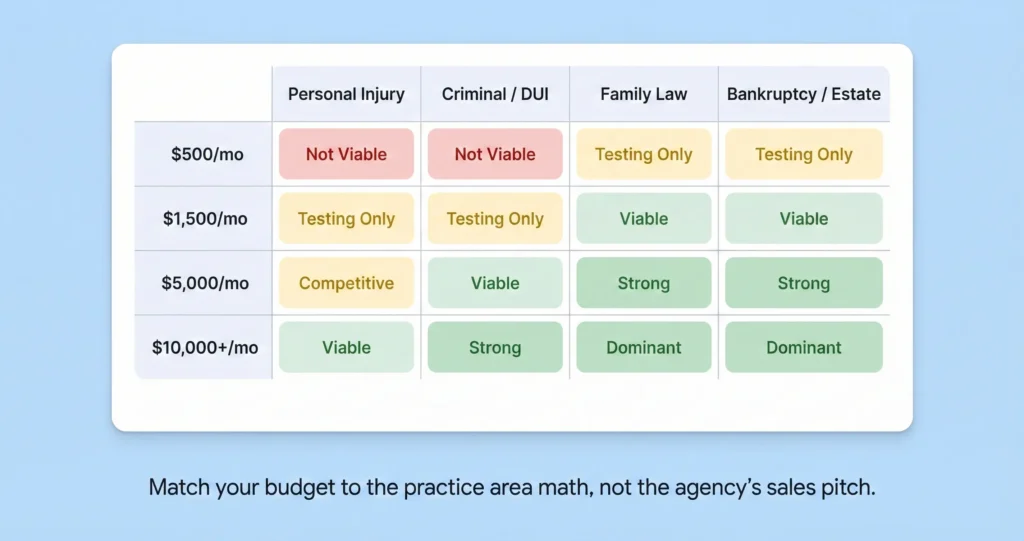
The minimum I’d recommend for competitive practice areas is $3,000 to $5,000 a month. That’s enough for 20 to 30 PI clicks which gives the algorithm data to start learning, and should produce 1 to 2 leads that turn into conversion signals for optimization. For lower-cost verticals like estate planning or bankruptcy where clicks run $10 to $45, you can start at $1,500 and get enough volume to test.
If your budget is under $1,500 and you’re in a competitive market, I’d honestly redirect that money toward SEO and content because the compounding return on organic is better than the guaranteed loss on underfunded PPC. The math doesn’t support it and nobody benefits from pretending otherwise.
Where Google Ads Will Lose You Money Every Time
When should a law firm NOT use Google Ads? Google Ads consistently loses money for: (1) Low-value practice areas where case revenue can’t cover acquisition cost, such as traffic tickets at $150-$300 per case with $50+ clicks. (2) Broad “general practice” targeting where clicks attract users seeking free advice or areas the firm doesn’t practice. (3) Research-intent queries like “how to file for divorce” or “is a DUI a felony” where users want information, not a lawyer. (4) Markets where Local Service Ads dominate the SERP and push traditional text ads below the fold. (5) Any firm with budget under $1,500/month in competitive markets.
Google Ads doesn’t work for everyone and pretending it does is how agencies keep billing firms that should have stopped spending three months ago.
Traffic tickets are the clearest example of practice areas where the math never closes. If the revenue from a ticket case is $150 to $300 and a click costs $50, the math never closes. You’d need a conversion rate north of 30% and a sign rate near 50% to break even, and those numbers don’t exist in real campaigns. The margin isn’t there and no amount of campaign optimization changes that.
General practice bidding is almost as bad. A firm targeting “lawyer near me” or “attorney” without a practice area qualifier is paying $50 or more per click for people who could be looking for anything from a will to a workers comp claim to free legal advice, and most of them are looking for something you don’t do. The relevance is so low that your conversion rate drops to maybe 2%, which makes your cost per lead astronomical.
And research-intent queries are the silent budget killer. Someone searching “how to file for divorce” or “average settlement for whiplash” or “is a DUI a felony” is looking for information, not a lawyer. They’ll click your ad, read whatever’s on the page, and leave. Paying $100 for that click is lighting money on fire, and the fix is aggressive negative keyword filtering to block terms like “free,” “how to,” “guide,” “statistics,” and “salary.”
If traditional text ads aren’t working because LSAs are dominating your search results, that’s a different problem with a different solution.
The Cash Flow Problem Nobody Talks About
There’s another ROI reality specific to personal injury that agencies love to gloss over. When an agency tells you “we signed a case worth $100,000 in fees” what they mean is the case has a potential value that might be realized in 12 to 24 months, assuming the case settles and doesn’t go to trial. In the meantime, your Google Ads bill arrives every month.
So the agency reports a 10x ROAS on paper, but your cash position is negative for a year or more. A firm spending $10,000 a month on PPC that signs one big PI case per quarter has a $120,000 annual ad bill against settlement revenue that might not arrive for two years. You need working capital to bridge that gap or you run out of money before the ROI materializes.
This is why hourly rate practice areas like criminal defense and family law sometimes produce better cash-on-cash returns from PPC even though the per-case value is lower. A DUI retainer of $3,500 paid at signing covers the acquisition cost immediately. A PI case worth $100,000 is a promise your bank account can’t spend yet.
If you’re evaluating whether your current agency is actually producing returns, ask them to show you cash-on-cash ROI, not theoretical case value. And if they can’t or won’t separate the two numbers, that tells you something about how they think about your money.
The Real Answer to “Are Google Ads Worth It”
The honest answer is that Google Ads is worth it for lawyers who have three things at the same time: enough budget to sustain the learning phase without running out of money, an intake operation fast enough to convert the leads the ads generate, and a practice area where the case economics cover the acquisition cost with room left over.
If you have all three, PPC is probably the fastest path to new clients. If you’re missing any one of those three, the math turns against you and it’s not a matter of finding a better agency or writing better ad copy; the economics themselves don’t support it.
And 97% of legal professionals saying PPC is “too expensive” aren’t wrong; they’re just describing what happens when one or more of those three conditions isn’t met. The platform works, but it works like a high-frequency trading system for legal claims, and you either have the infrastructure to play at that level or you’re the one funding someone else’s wins.
If your current setup isn’t producing and you’re not sure whether the problem is the budget, the intake, or the campaign itself, that’s something I can help you figure out before you spend another dollar.
Want to know if Google Ads can actually work for your firm?
I’ll run the unit economics for your practice area, market, and budget and tell you whether the math supports PPC or whether your money is better spent somewhere else. If it’s not PPC, I’ll tell you that.
How much to spend | Which channel first? | Fix your intake | Is your agency doing this right?