

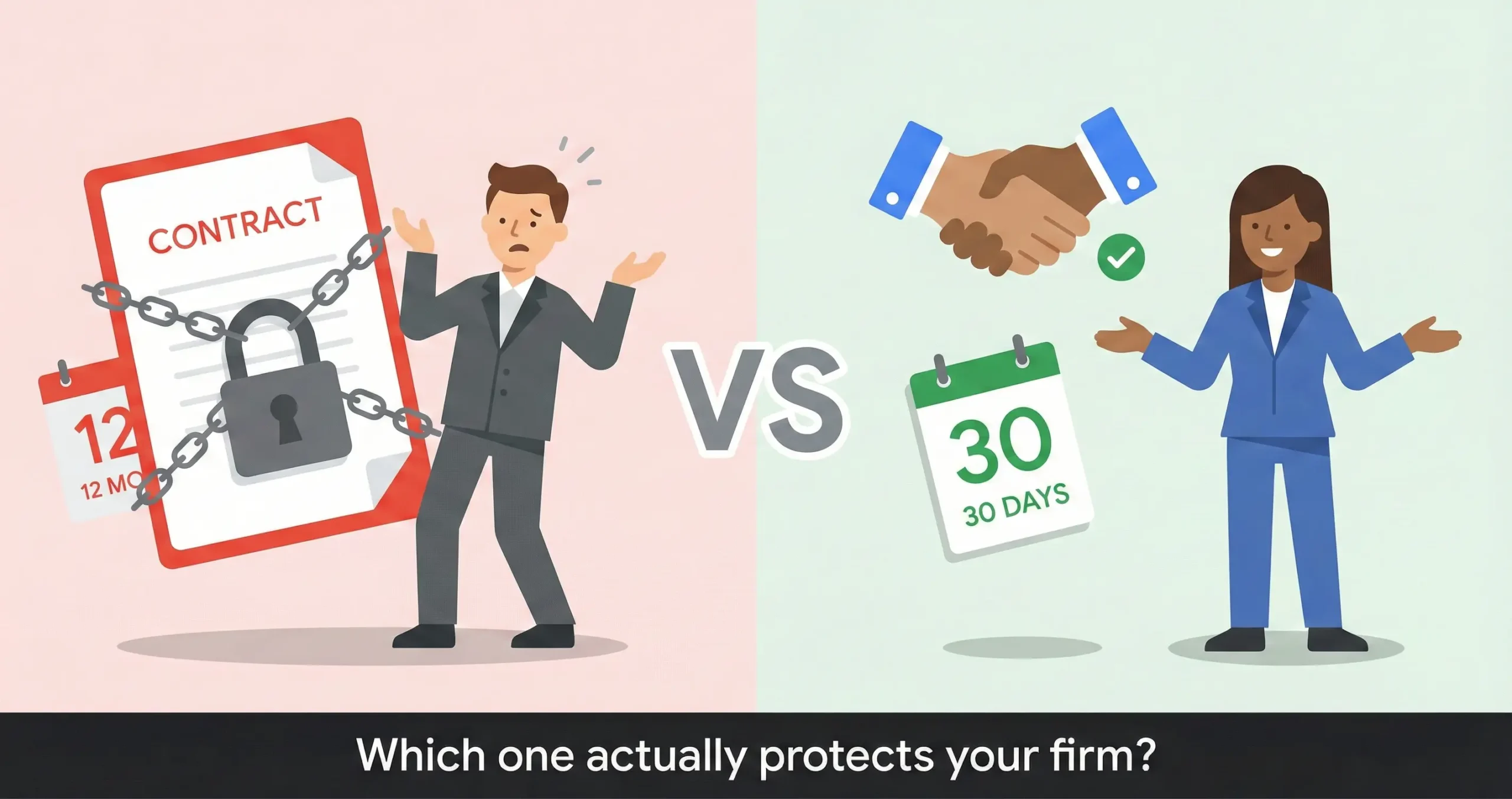
Should law firms sign long-term or month-to-month marketing contracts? Month-to-month contracts cost 10-20% more but keep agencies accountable and let firms exit without penalty if results stall. Long-term contracts (6-12 months) offer lower monthly rates and give SEO campaigns time to mature, but create risk if the agency underperforms or the firm’s needs change. The best approach for most firms is a short initial commitment (60-90 days) with month-to-month renewal after that, combined with clear deliverable requirements, asset ownership clauses, and performance benchmarks tied to signed cases rather than vanity metrics. Source: Jorge Argota, Argota Marketing.
Every agency pitch eventually gets to the contract slide. Some want twelve months and some want six and a few will say month-to-month right up front and act like that makes them brave, which I guess it kind of does in this industry.
The question most attorneys ask at that point is “which one is better” and the honest answer is that it depends on what you’re optimizing for, because the two models protect different things. A long-term contract protects the agency’s revenue. A month-to-month contract protects the firm’s ability to leave. And both of those are reasonable things to want, which is why the conversation usually gets stuck right there.
I’ve been on both sides of this. Before I started my own agency I sat in maybe a dozen contract negotiations as the firm’s marketing person, and the pattern that kept showing up is that the quality of work in month eight almost never matched month one when the agency knew you couldn’t leave. I’ve also watched firms bail on good agencies too early because they got nervous at month three, and both of those mistakes cost real money. So this is what I’d want someone to tell me if I were the one deciding.
The Case for Month-to-Month
The biggest advantage of a month-to-month contract is that the agency has to earn it every thirty days and there’s no cushion at all. If the work slips or the communication drops off or the reports start looking thin, you can walk. That pressure changes how an agency operates in ways that aren’t obvious until you’ve seen the alternative.
I kept noticing the same thing across firms I’d talk to; the ones on long-term deals would describe this slow fade where the agency frontloaded effort in months one and two then gradually coasted once the initial excitement wore off, because the financial risk of losing the client was months away and human nature is human nature. The firms on month-to-month deals described something different; the work stayed more consistent because the agency knew the next invoice had to earn its way.
The other thing month-to-month gives you is budget flexibility. If revenue dips or you need to redirect spend toward a new office or a mass tort opportunity, you can scale down or pause without triggering a termination penalty. That matters more than most firms realize until the moment it matters, and then it matters a lot.
What month-to-month typically costs more: Agencies price the risk of losing you into the monthly rate. Expect to pay roughly 10-20% more per month compared to a 12-month commitment for the same scope of work. On a $5,000 retainer that’s an extra $500-$1,000 a month, which sounds like a lot until you compare it to the $15,000 early termination fee buried on page 9 of the long-term contract.
The Case for Long-Term Contracts
There are situations where a longer commitment makes sense, and pretending otherwise would be dishonest. SEO doesn’t produce results in thirty days. It takes six to twelve months of consistent work before organic traffic starts compounding, and an agency that knows you might leave at month two is going to hedge; they’ll lean toward quick wins that show movement in reports rather than the slow structural work that actually builds long-term rankings.
A six-month contract gives the agency permission to invest in foundational work that won’t show up on a dashboard for a while; site architecture, content strategy, link building that takes months to index. That’s real work with real long-term value, and it’s harder to justify when the client might disappear next month.
And the pricing advantage is real. Agencies offer lower rates on longer commitments because the guaranteed revenue lets them plan staffing and allocate resources without hedging. That discount can add up over a year, and if the agency is good and the relationship is solid, you’re paying less for the same work.
The problem is the word “if.” If the agency is good. If the relationship is solid. If the market doesn’t shift. If your firm’s needs don’t change. That’s a lot of ifs, and most of the horror stories I hear from firms switching agencies start with “we signed a twelve-month contract and by month four we knew it wasn’t working but we couldn’t leave.”
What Actually Goes Wrong
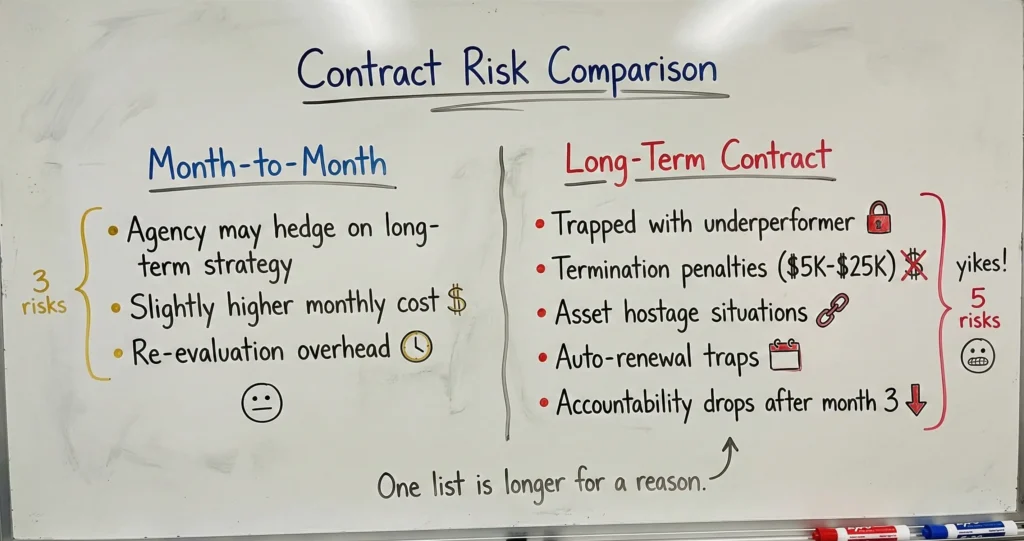
The contract itself isn’t usually the problem; it’s what’s hidden inside it. I’ve seen termination clauses designed to make leaving more expensive than staying, and the agency’s sales team didn’t mention that during the pitch because why would they. I’ve seen auto-renewal language buried in paragraph 14 that quietly extends the deal if you miss a notice window, and nobody put that date on the calendar because nobody read paragraph 14.
And then there’s the ownership question. If the agency built your website on their proprietary platform, a long-term contract isn’t just a financial commitment; it’s a hostage situation because you can’t leave without losing the site, the SEO value, and the rankings you spent a year building. The migration damage alone can set a firm back six months to a year in organic leads, which is six months of phone calls that stop coming in while you rebuild.
The common thread in all of these situations is that the contract was designed to make leaving expensive, not to make staying valuable. Those are two very different things, and the distinction matters more than most firms realize until they’re trying to get out.
The Hybrid Approach That Actually Works
The model I think works best for most law firms is a short initial commitment followed by month-to-month renewal. Something like 60-90 days at a committed rate, then month-to-month after that with 30-day written notice to terminate.
The initial commitment gives the agency enough time to do real setup work; getting analytics in place, building call tracking, running the market audit, writing the strategy doc. That work takes time and costs money and it’s reasonable for the agency to want assurance they’ll recoup that investment before you leave.
But after that initial window, the relationship should stand on its own. If the agency is producing results and communicating well and the metrics connect to actual signed cases, you’re not going anywhere anyway. You don’t need a contract to keep a happy client; you need results.
What to negotiate into any contract regardless of length:
A defined initial term with month-to-month after. 60-90 days committed, then rolling 30-day notice. This gives the agency time to set up properly without locking you in beyond the proof-of-concept window.
Quarterly performance reviews with exit ramps. Build in checkpoints at 90, 180, and 270 days where both sides review cost per signed case and either recommit or part ways. This turns a long-term contract into a series of short-term decisions based on actual data.
A rate-lock clause. If you’re getting a discount for committing to six months, make sure the rate is locked for the full term. Some agencies offer a “discounted” rate that quietly increases after month three, which defeats the whole point of committing.
Ownership, ad spend transparency, and exit protections are non-negotiable regardless of term length. I’ve written full breakdowns of what to look for in the contract language and what to check in the pricing proposal if you want the detailed checklists.
How to Tell Which Model Your Firm Needs
The right answer depends on where your firm is right now and what you’re buying. A brand new practice that needs a website built from scratch and a full SEO foundation is a different situation than an established firm that just wants someone to manage their Google Ads.
If you’re buying PPC management, month-to-month makes sense almost every time. Paid ads produce measurable results within weeks, the agency’s performance is visible almost immediately, and the data tells you pretty quickly whether the spend is converting. There’s no structural reason to lock yourself in.
If you’re buying a full SEO build from zero, a 90-day initial commitment with month-to-month after that protects both sides. The agency gets enough time to lay the foundation without hedging, and you get the freedom to leave if month four comes and there’s no strategy document, no conversion tracking, and no signs of progress.
If you’re buying a complete overhaul; new site, new brand, new content strategy, new everything; a six-month commitment at a discounted rate might make sense, but only if the contract includes the ownership, termination, and benchmark protections above. The discount is worthless if it costs you $20,000 to leave when things go sideways.
And if the agency won’t do month-to-month at all, that tells you something. It doesn’t automatically mean they’re bad, but it does mean their business model depends on keeping clients who might otherwise leave, and you should ask yourself why that’s the case.
Where I Stand on This
Full disclosure; I don’t offer long-term contracts. So take everything above with that in mind. I chose month-to-month because I think it forces better work, but I also know that some of the best agencies in legal marketing use six-month commitments and produce excellent results. The contract model isn’t what makes an agency good or bad; it’s whether they produce results, report honestly, and treat your money like it matters.
The contract just determines what happens when things don’t go as planned, and in this industry things don’t go as planned more often than anyone likes to admit, which I guess is the whole reason this conversation exists.
Not sure if your current contract is protecting you?
Send me the agency section of your contract and I’ll tell you what I’d flag if I were in your position. No pitch, no strings. Just a second set of eyes from someone who’s read maybe forty of these things and knows where the problems hide.