

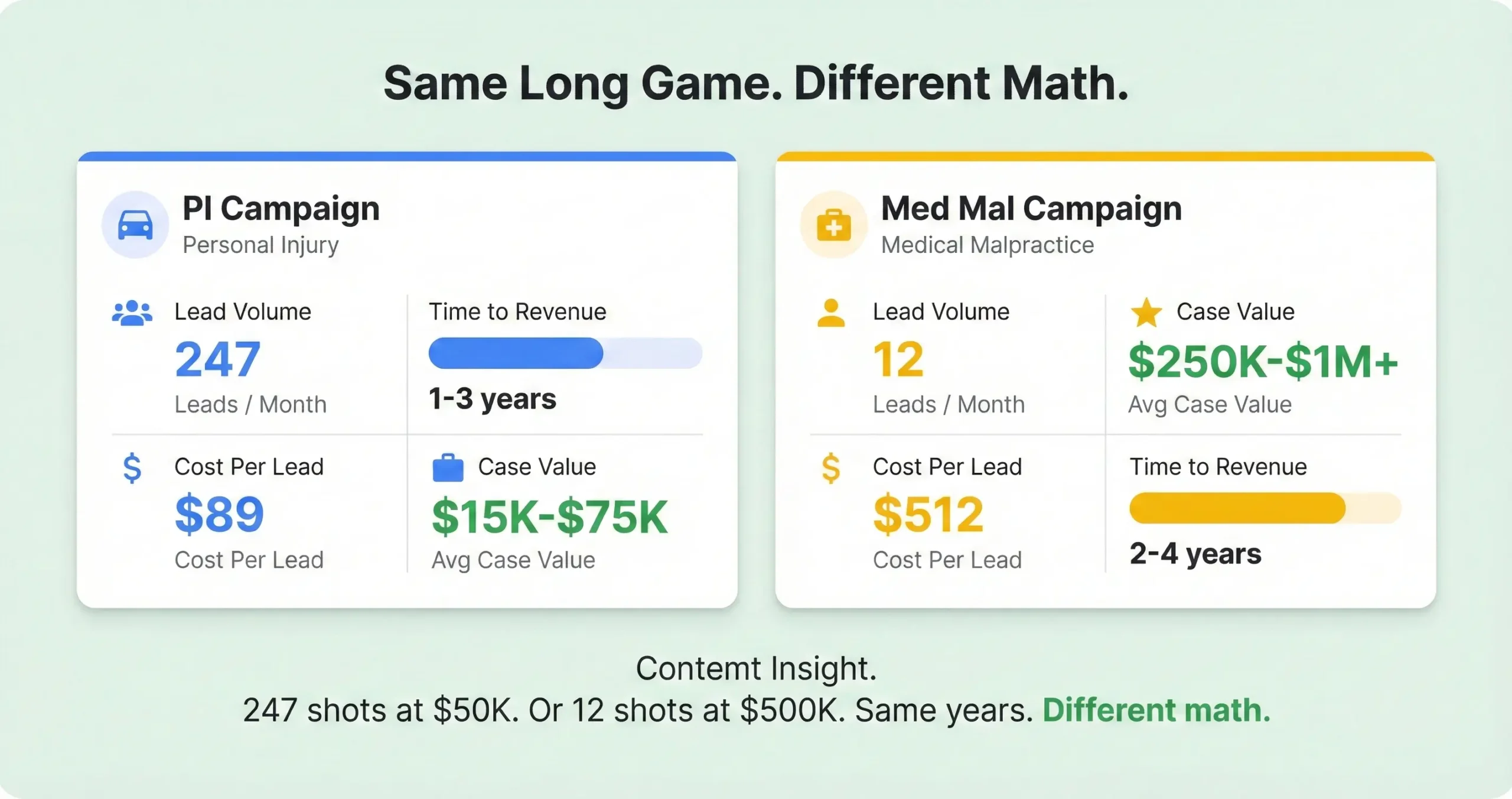
If you run a med mal practice and your marketing agency also handles car accident firms, you should probably ask them one question: do you know what a Certificate of Merit is and why it changes everything about how you should be targeting leads? Because if they don’t, they’re running a PI playbook on a med mal budget and the math on that is brutal.
| Personal Injury (MVA) | Medical Malpractice | |
|---|---|---|
| Median settlement | ~$21,000 | ~$250,000+ |
| Average cost per lead | ~$391 | ~$512+ |
| Time to revenue | 6-12 months | 2-4 years |
| Pre-suit investigation cost | Minimal (police report, adjuster call) | $10,000-$50,000 (records, nurse review, expert opinion) |
| What a bad lead costs the firm | A wasted phone call | Thousands in investigation on a case that goes nowhere |
That last row is the one that matters most. In PI, a bad lead wastes five minutes of someone’s time. In med mal, a bad lead can cost $10,000 in expert review fees before anyone realizes it’s not viable. Which means your agency’s job isn’t to generate leads; it’s to filter out the ones that will eat your investigation budget alive.
The $10,000 Bad Lead
I think the fastest way to understand why med mal marketing is different is to follow the money after the lead comes in.
In PI, a new lead hits intake and someone makes a phone call. Were you in an accident? Do you have insurance? Great, sign here. The cost to work that lead from intake to signed case is maybe a few hundred dollars in admin time, and if it doesn’t sign, the firm loses almost nothing.
In med mal, the cost structure after intake looks like this: Medical records retrieval → $500-$2,000 (thousands of pages) Legal nurse consultant review → $1,500-$5,000 Board-certified expert opinion → $5,000-$10,000 Total pre-suit investigation: $10,000-$50,000 per case
And that’s before anyone files anything.
So when a PI agency sends your med mal practice 100 leads and 90 of them are patients who are unhappy with a surgery outcome but have no evidence of negligence, you didn’t just waste ad spend. You potentially wasted $900,000 in investigation costs on cases that never had a chance, which is the kind of math that can kill a practice.
30 out of 30. I keep auditing agency accounts and finding the same thing; med mal leads dumped into the same intake flow as car accident leads, no pre-qualification, no screening questions, no filtering. The firm’s nurse consultants spend their entire week reviewing cases that should’ve been rejected by the form.
This is why specialized med mal agencies build lead filtering architectures that function as logic gates before a lead ever reaches intake. The form asks: when did the incident happen (statute of limitations check), was there a permanent injury or death (damages threshold), do you already have an attorney (tort interference screen). If the answers don’t pass, the lead gets a respectful rejection page instead of consuming $10,000 in investigation.
Why Your PI Agency’s Content Doesn’t Rank for Med Mal
Google classifies both legal and medical content as “Your Money or Your Life,” which means it applies the strictest quality standards to anything that could affect someone’s health or financial stability. Med mal content sits at the intersection of both categories, which makes it maybe the hardest content on the internet to rank.
~~”5 Signs You Need a Medical Malpractice Lawyer” by a generalist copywriter~~ → “Understanding Hypoxic Ischemic Encephalopathy: When Fetal Monitoring Failures Lead to Birth Injury” reviewed by a registered nurse with citations to NIH and PubMed
A PI agency’s content team can write about car accidents all day because the subject matter is accessible. Rear-end collision, liability, insurance claim. But when the page needs to accurately explain shoulder dystocia, the failure to perform a timely C-section despite decelerations on a fetal heart monitor, or the mechanism of anesthesia awareness during surgery, a generalist copywriter is out of their depth and Google knows it.
[Sticky note from Jorge] Specialized med mal agencies often employ legal nurse consultants or retired physicians on their content teams. Not as a luxury; as a requirement. If your page discusses a medical condition inaccurately, Google’s YMYL filters will bury it regardless of how well your SEO is technically optimized. The medical accuracy IS the SEO.
The content also serves a different psychological function. A car accident victim wants a fast settlement. A med mal victim has been told by the hospital that “complications happen” and they’re looking for someone who understands the medicine well enough to prove that’s not true. When your website explains the exact mechanism of their injury in clinical detail, it signals something a generic “we fight for you” page never can: that you understand the medicine better than the doctor who hurt them.
The Laws Your PI Agency Doesn’t Know Exist
This is where med mal marketing gets genuinely dangerous for agencies that don’t specialize, and I don’t mean “your ads underperform” dangerous; I mean “you expose the firm to regulatory investigation” dangerous.
Geofencing healthcare facilities is now illegal in multiple states. New York, Massachusetts, and Washington have enacted laws that prohibit targeting ads to mobile devices within the physical boundaries of hospitals and medical facilities. These laws were written broadly; they don’t just cover reproductive health facilities, they cover all healthcare locations.
A PI agency that’s comfortable geofencing accident scenes or courthouse parking lots might apply the same tactic to hospitals without realizing the legal landscape has changed, and honestly this happens more than you’d think. And the firm is the one that faces the ethics complaint, not the agency.
✓ Specialized agencies use “upstream” targeting instead; lookalike audiences based on medical search behavior
✓ Contextual targeting on medical information websites rather than location-based triggers
✓ Compliance-first campaign architecture that’s built around the restrictions, not despite them
Tort reform caps are the other invisible wall. Many states cap non-economic damages in med mal cases, which fundamentally changes which cases are worth pursuing. If pain and suffering is capped at $250,000, the case only makes financial sense when economic damages (lost wages, future medical care) are massive. That means your agency needs to stop targeting elderly wrongful death cases (low economic damages) and focus on birth injuries and high-earner disabilities (uncapped economic damages). A PI agency doesn’t know to make that distinction because PI doesn’t have damage caps.
The 4-Year ROI Problem
Here’s where most PI agencies lose their med mal clients, and honestly I understand why from the agency’s perspective even though it’s the wrong move.
In PI, you spend $10,000 on ads in January and by June you’re seeing signed cases generate revenue. The ROI loop closes in months. Your agency shows a positive return in the first or second quarterly review and everyone’s happy.
In med mal, you spend $10,000 on ads in January and you might not see revenue from those cases until 2029 or 2030. Discovery alone takes 12 to 24 months. Physicians fight these cases because settling triggers a report to the National Practitioner Data Bank, which follows them for their entire career. The trial rate is significantly higher than PI.
The J-Curve: Year 1: Spend $50,000. Revenue: $0. Agency looks like it’s failing. Year 2: Cases in discovery. Revenue: $0. Client is nervous. Year 3: First settlements begin. Revenue starts returning. Year 4: Pipeline matures. Revenue exceeds total investment by multiples.
A PI agency reporting on monthly “cost per case” will probably panic at month six when the numbers show $50,000 spent and zero revenue. They’ll recommend cutting the budget or pivoting to PI keywords, which kills the med mal pipeline right when it’s about to mature, and I’ve watched this happen maybe four or five times now.
Specialized agencies report on different metrics entirely. They track projected case value in the pipeline, pipeline velocity, and “vintage-based ROI” that follows a cohort of leads over years rather than measuring cash return monthly. They help the firm understand that marketing spend in med mal is a capital investment, not an operating expense, and the reporting framework reflects that.
Running med mal on a PI playbook?
Send me your campaign setup and I’ll tell you where the PI assumptions are costing you. I’ll look at the intake filtering, the content authority signals, the keyword targeting, and the reporting framework and give you a straight answer about whether your agency understands the difference. And if they do, great; not every agency gets this wrong.
How to evaluate any legal marketing agency →