


Every article ranking for “should I hire a marketing agency or do it in-house” is written by an agency, which means the answer is always “hire an agency” and the reasoning always sounds convincing because agencies are good at marketing, that’s literally what they do. There’s no honest version of this comparison available to the attorney sitting there trying to figure out whether the $5,000 a month retainer is worth it or whether that same money pays for a junior marketing person who at least shows up to the office and only works on their cases.
And there’s a third option that most solo and small firm attorneys don’t know about, which is the fractional model where you hire a senior marketing person for maybe 10 or 15 hours a month instead of 40, and they run strategy while a cheaper resource handles execution. For a lot of firms that’s the better answer than either extreme but nobody writes about it because agencies don’t sell it and in-house advocates don’t think of it.
I run an agency and I’m going to walk through when hiring one actually makes sense, when it doesn’t, and when the fractional model beats both, because the right answer depends on your budget and your case volume and how much of your own time you’re willing to spend on marketing, and anyone who gives you the same recommendation without asking those questions first is selling you their model, not solving your problem.
The Real Cost of an In-House Marketing Hire
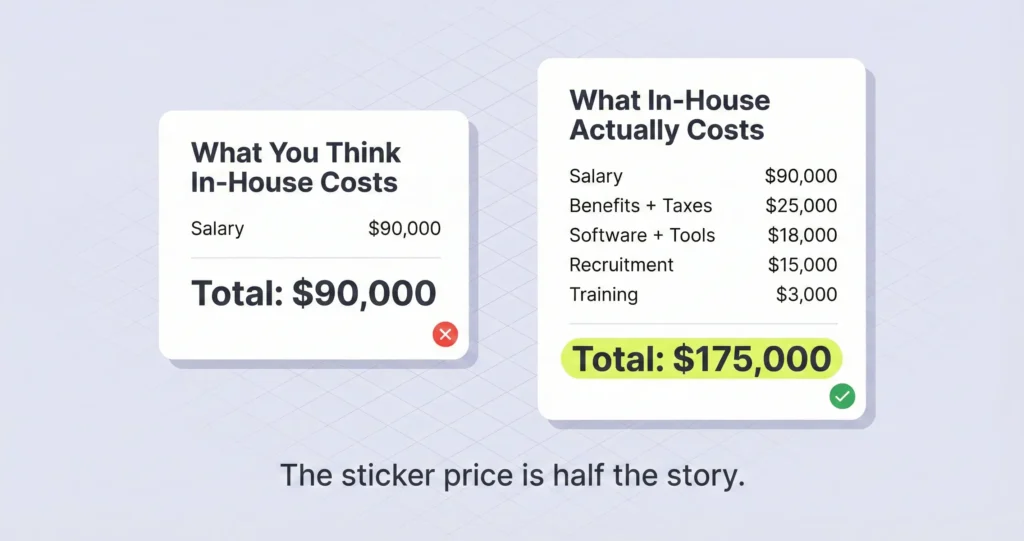
How much does it actually cost to hire an in-house marketing person for a law firm? The median salary for a legal marketing manager is around $88,000 to $95,000, but the actual cost to the firm is roughly $175,000 a year when you factor in payroll taxes and benefits at 25 to 30 percent, software licenses at $1,500 to $3,000 a month, recruitment costs amortized over the first year, and training. A specialized SEO person alone costs $60,000 to $87,000, and a PPC specialist costs about the same, which means you’d need two or three hires to cover what an agency provides with one retainer, and at that point you’re looking at $300,000 or more annually.
I think the number that surprises most attorneys is the software cost, because they assume the person shows up and just starts working and they don’t realize that marketing in 2026 requires a stack of tools that costs real money every month.
Your CRM alone might run $200 a month for something like Lawmatics, your SEO tools are another $300 to $500 for agency-level access to Ahrefs or Semrush, your call tracking is $150, your email platform is another $50 to $100, and before you’ve done anything the software alone is costing $12,000 to $24,000 a year on top of the salary.
There’s the unicorn problem, which is that the person you’re trying to hire doesn’t exist. You want someone who can do SEO and run Google Ads and manage your Local Service Ads and write content and design graphics and build landing pages and manage your social media and do analytics. That person at $90,000 a year is going to be mediocre at five things instead of excellent at one, and the reason agencies work is because they have separate people doing each of those jobs.
What an Agency Actually Gives You and What It Doesn’t
What are the real pros and cons of hiring a legal marketing agency? The primary advantage is access to a team of specialists for the price of one generalist hire; you get an SEO person, a PPC person, a content writer, and a strategist for $5,000 to $7,000 a month instead of $175,000 a year for one person who does all of those things poorly. Agencies also absorb the software costs and provide continuity if someone on the team leaves. The primary risk is conflict of interest; if your agency represents other firms in your practice area in your market, they’re optimizing two websites for the same keywords and only one can rank first.
I need to be honest about the conflict of interest thing because it’s the biggest risk in the agency model and most firms don’t ask about it. If your agency represents five personal injury firms in the same metro, they can’t get all five of you to page one for “car accident lawyer [city]” because there’s only one number one spot. So whose site gets the better links, whose content gets the more aggressive keyword targeting, whose Google Business Profile gets the most attention?
The answer that agencies give when you ask this directly is usually something like “well we have separate teams” or “it’s a big market” and honestly those are non-answers. The fix is to ask for an exclusivity clause in your contract that prevents them from taking other firms in your practice area within a defined radius, and if they won’t agree to that, you have your answer about how much they value your account.
The other risk is the cookie-cutter problem. Agencies make money by being efficient, which means they build templates and systems that they apply to every client the same way. Your website ends up looking like every other law firm website they’ve built, your content sounds like every other firm’s content, and your brand disappears into a sea of identical competitors.
There’s the bait and switch, which I’ve seen happen so many times it almost feels inevitable at this point. The senior partner pitches the account, you sign the contract, and then the actual work gets handed off to a junior account manager who’s 24 years old and has never been inside a law firm.
And they don’t understand the difference between a personal injury case and a medical malpractice case, which matters when they’re writing your content and choosing your keywords. You need to ask to meet the actual team working on your account before you sign anything, and if they can’t arrange that, the vetting checklist covers what else to look for.
When In House Actually Makes Sense
When should a law firm hire an in-house marketer instead of an agency? When the firm’s revenue consistently exceeds $2M and the volume of internal marketing work justifies a full-time salary. In-house makes sense when you need someone who understands your firm’s culture deeply enough to capture a partner’s commentary on a breaking case within an hour, when you’ve been burned by agencies who treat you like a number, or when your firm’s brand requires a level of control that an external vendor can’t provide. The cultural immersion of having someone embedded in daily firm life creates a kind of content and responsiveness that agencies structurally cannot match.
And the thing about in-house that nobody talks about is the isolation problem. Your marketing person sits in a room by themselves surrounded by lawyers and paralegals and nobody else who does what they do, and they have no other marketers to brainstorm with or learn from, and their skills start to stagnate because they’re not exposed to what’s working at other firms or in other industries.
And on top of that, half their time gets eaten by non-marketing work because they’re the only “creative” person in the office so suddenly they’re planning the holiday party and designing the CLE invitation and managing the firm’s sponsorship of the local bar association golf tournament, and none of that generates cases.
But when it works, it really works. An in-house person who understands your practice area can turn a partner’s offhand comment about a new case into a blog post or video within a day, and that kind of speed is something agencies can’t match because you’d have to submit a ticket and wait three days for your account manager to schedule a content call.
The other big advantage is data ownership. Everything lives on your servers, in your accounts, under your control. When agency relationships end badly, firms sometimes discover they don’t own their website, they don’t have admin access to their Google Ads account, and their analytics history walks out the door with the vendor. In-house eliminates that risk entirely, which is probably the strongest argument for keeping marketing internal even if it costs more.
The Third Option Nobody Talks About
What is a fractional CMO for a law firm? A fractional Chief Marketing Officer is a senior marketing executive who works with your firm part-time, usually 10 to 15 hours a week, for $5,000 to $15,000 a month. They set the strategy, choose and manage vendors, hold agencies accountable, and translate marketing metrics into language partners understand. Think of them as the quarterback who calls the plays while your agency or junior staff execute them. This model works best for firms between $1M and $10M in revenue that need senior strategic direction but can’t justify a $200,000 to $300,000 full-time CMO salary.
And this is the model I think most firms between $1M and $5M in revenue should be using but almost nobody knows it exists because agencies don’t promote it since it reduces their control over the account, and recruiters don’t promote it because there’s no placement fee on a fractional hire.
The way it works is you bring in someone with 10 or 15 years of experience who spends maybe 10 hours a week on your firm. They audit your current agency or in-house person’s work, they set the strategy, they decide where the budget goes, they review the ad spend and the SEO performance, and they translate the results into “we signed 12 cases this month at $340 per case” instead of “impressions increased 15%.”
The fractional CMO fills the gap between the partners who don’t have time to learn marketing and the agency that doesn’t have enough context about the firm to make the right strategic calls. They’re the person who says “your agency is charging you for 20 hours of SEO work a month but I can see from the reporting that they’re spending 5 hours max” or “your in-house person is doing great on social media but they have no idea how to run your intake process and that’s where the real leak is.”
And the cost is somewhere between $5,000 and $15,000 a month depending on the scope, which sounds like a lot until you compare it to the $175,000 a year for a full-time CMO who you’d have to recruit for six months and who might not work out. The fractional model gives you senior-level thinking without the full-time commitment, and if it doesn’t work you can walk away without severance or unemployment claims.
The Decision Framework by Firm Size
How should a law firm decide between agency, in-house, or fractional CMO? It depends on revenue, marketing maturity, and budget liquidity. Solo and small firms under $2M should use a niche agency or DIY approach because they can’t support an in-house salary. Growth firms between $2M and $10M should consider the hybrid model; a junior marketing coordinator internally plus a specialized agency for technical work, overseen by a fractional CMO if the budget allows. Large firms over $10M should be building an internal department with agency support for specialized campaigns and surge capacity.
And I want to lay out what this actually looks like at each stage because the mistake I see most often is firms hiring the wrong thing at the wrong time. A solo spending $2,000 a month on marketing should not be hiring an in-house person at any salary because the math doesn’t work; the solo marketing budget post covers what actually makes sense at that level.
At $2M to $5M you’re at the point where you have enough marketing activity to justify a junior coordinator at $50,000 to $65,000 who handles the daily stuff like social media posting, review requests, newsletter assembly, and event logistics. But the actual technical work like SEO, PPC, and conversion optimization stays with a specialized agency because the coordinator doesn’t have those skills and shouldn’t be expected to.
At $5M to $10M you add the fractional CMO layer on top of the coordinator and the agency. Now you have someone internal doing the daily work, an agency doing the technical execution, and a senior strategist making sure both are pointed in the right direction and holding everyone accountable to cases signed, not clicks generated.
And somewhere between $10M and $20M the math finally supports bringing a full marketing director in-house at $150,000 or more, building a small internal team, and using agencies only for specialized projects or overflow, which is how most national firms operate and honestly it took them years to get there too.
| Firm Revenue | Recommended Model | Monthly Marketing Cost | What You Get |
|---|---|---|---|
| Under $2M | Niche agency or DIY | $1,500 – $5,000 | External team, no internal overhead |
| $2M – $5M | Coordinator + agency | $7,000 – $12,000 | Internal daily work, external technical execution |
| $5M – $10M | Coordinator + agency + fCMO | $12,000 – $20,000 | Full coverage with strategic accountability |
| $10M+ | Internal department + agency augmentation | $20,000+ | Brand sovereignty with specialist support |
The Ethics Questions
Are there ethical risks to outsourcing law firm marketing to an agency? Yes, and they go beyond conflict of interest. The rise of AI chatbots on law firm websites creates unauthorized practice of law risk if the bot interprets legal facts and recommends a course of action instead of strictly handling intake. Fee splitting rules under ABA Model Rule 5.4 prohibit sharing legal fees with non-lawyers, which means any agency contract structured as a percentage of settlement or a bonus per signed case is an ethics violation in most states. And if your agency uses proprietary data from one client to benefit another client in the same market, that’s a business ethics problem that most firms never think to ask about.
And this one keeps me up at night because I watch agencies deploy AI chatbots on law firm websites as a “conversion optimization” tool and nobody asks whether the bot is crossing the line from intake into legal advice. If a visitor types “I slipped and fell at Publix, do I have a case?” and the bot responds with anything resembling legal analysis, that could be unauthorized practice of law depending on the jurisdiction, and the firm is the one who gets in trouble, not the agency.
The fee splitting thing is simpler but just as dangerous. Any agency offering a “pay per signed case” model or a percentage of recovery as their fee structure is putting the firm at risk of a bar complaint. The ethics post covers this in detail, but the safe zone is flat monthly retainers or flat per-lead fees, not anything tied to case outcomes.
And if your agency won’t tell you who else they represent in your market, that’s not just a competitive concern; if they’re using keyword conversion data from your account to inform strategy for a competing firm, that’s a data ethics violation that most contracts don’t even address.
Not sure which model fits your firm right now?
I’ll look at your revenue, your current marketing spend, and what you’re getting for it and tell you honestly whether you need an agency, an in-house hire, a fractional CMO, or some combination. And if your current setup is actually working I’ll tell you that too.