
I was sitting in a Florida Bar CLE last year and the ethics presenter asked the room how many of them had a system for asking clients to leave Google reviews, and maybe five hands went up out of a hundred. Then she asked how many of them were afraid that asking for reviews might violate the solicitation rules, and easily half the room raised their hands, and she just shook her head and said “that’s not what that rule means” and moved on to the next topic without explaining it.
And I was thinking about that moment later because it perfectly captures the problem; attorneys know reviews matter for Local Services Ads rankings and for the Map Pack and for conversion in general, but they’re so confused about the advertising ethics rules that they’d rather do nothing and lose ranking than risk a bar complaint over something they don’t fully understand.
The Solicitation Misconception
Is asking for a Google review considered solicitation for lawyers? No. Rule 7.3 prohibits live person-to-person contact when the motive is to gain a new client who is known to need legal services. A review request to a former client after case resolution is a communication about a completed service, not an offer of new legal services. The request does not target someone “known to need legal services” because their legal need has already been addressed. Stick to closed files where the matter has been resolved.
So the first misconception I keep running into is attorneys who think that asking for a review constitutes “solicitation” under Rule 7.3, and the confusion probably comes from people hearing the word “solicitation” and assuming it means any request for anything, but the rule is actually pretty specific. It prohibits live person-to-person contact when a significant motive is getting hired by someone who is known to need legal services. And the key phrase there is “known to need legal services” because a former client whose case is closed doesn’t need legal services from you anymore; you already provided them.
So asking that former client to share their experience on Google is a communication about past service, not an offer to handle a new legal matter. It’s closer to asking someone to write a Yelp review for a restaurant than it is to ambulance chasing, and most state bars agree on this even if they disagree on everything else.
But there’s a trap here that’s worth knowing about; don’t ask for reviews from people who just had a consultation but didn’t hire you, because they came to you with a legal need that hasn’t been addressed and contacting them again could arguably cross into solicitation territory, especially if you’re also trying to close them as a client at the same time.
The Nominal Gift Problem
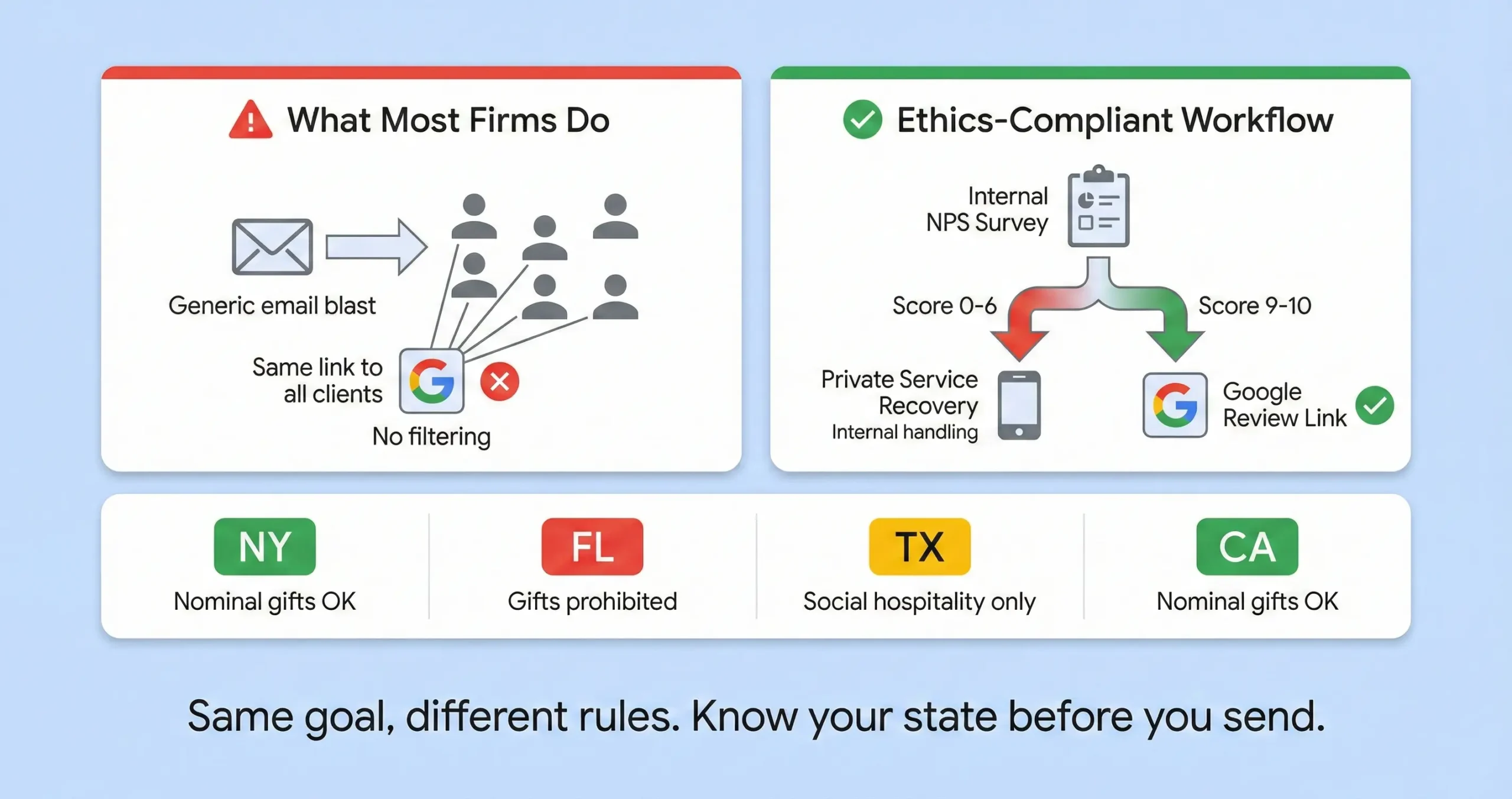
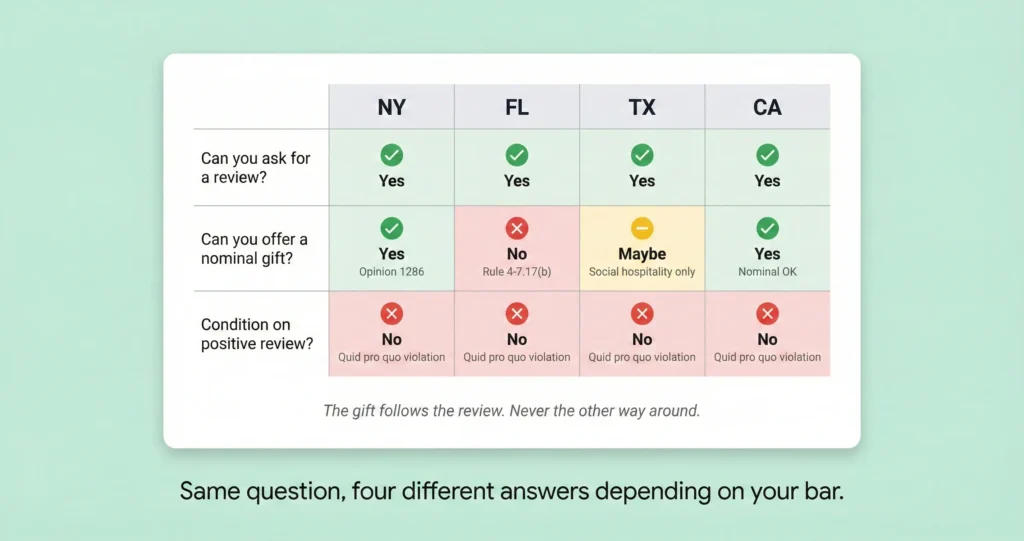
Can lawyers offer incentives for Google reviews? It depends entirely on the state. ABA Model Rule 7.2(b)(5) permits “nominal gifts” given as appreciation for a recommendation already made; a $10 coffee card after a review, not before. New York Ethics Opinion 1286 (2025) explicitly allows this for digital reviews. Florida Rule 4-7.17(b) prohibits giving “anything of value” for recommendations, making even systematic $5 gift cards risky. Texas permits “ordinary social hospitality” but scrutinizes cash equivalents. The gift must never be conditioned on the review being positive.
So the nominal gift question is where it gets messy because the ABA updated Model Rule 7.2(b)(5) to create what they call a “nominal gift” exception, which says a lawyer can give a token gift as appreciation for a recommendation that’s already been made. So in theory you could send someone a $10 Starbucks card after they leave you a review and that would be fine under the model rules. But the model rules aren’t law, they’re a template, and every state handles this differently.
New York issued Ethics Opinion 1286 in 2025 which explicitly said yes, a lawyer can ask a former client to write a Google review and can offer a nominal gift for doing so, as long as the lawyer doesn’t draft the review and the gift isn’t conditioned on the review being positive. They didn’t set a specific dollar amount but advisory opinions in similar contexts usually flag anything over $15, so a $10 coffee card is probably safe and a $100 dinner gift card is probably not.
And then there’s Florida which goes the other direction entirely. Rule 4-7.17(b) says you can’t give “anything of value” to a person for recommending your services, and the bar interprets that aggressively enough that running a systematic gift card program for every client who leaves a review could get you a disciplinary letter. I’ve talked to Florida attorneys who send thank-you cards with nothing in them and they’re still nervous about it, which is probably overly cautious but I understand the instinct when the bar has a reputation for enforcement.
Texas does the “ordinary social hospitality” thing where you can probably buy a former client lunch as a thank-you for a review, but sending a digital gift card might get more scrutiny because sharing a meal feels social and emailing a code feels transactional. California’s Rule 1.8.3 focuses on “substantial” gifts and generally aligns with the ABA model, so nominal thank-you gestures are fine but anything that looks like compensation crosses the line.
And across all of these states the universal rule is that you cannot condition the gift on the content of the review. “Leave us a 5 star review and get a $20 gift card” is a quid pro quo violation everywhere, including the states that allow nominal gifts. The gift has to follow the act, framed as “thank you for your feedback” and completely disconnected from whether the feedback was positive or negative, which I know sounds impractical but that’s the ethical standard.
When to Ask and When not to
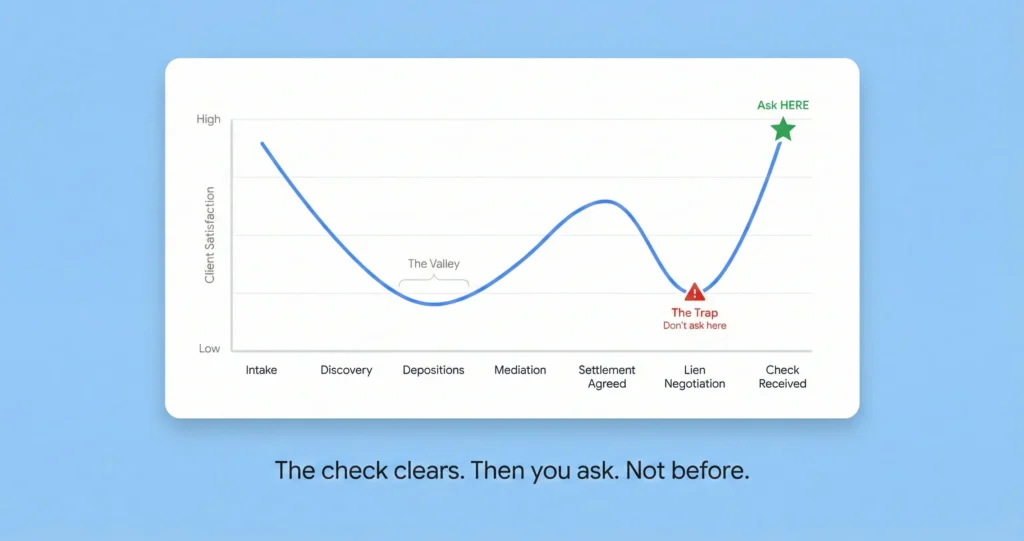
When is the best time to ask a law firm client for a review? Ask immediately after the client receives their settlement check or closing letter, not when the settlement is agreed to. Client sentiment follows a U-curve; high hope at intake, anxiety during litigation, and relief at resolution. The gap between settlement agreement and disbursement can be weeks of lien negotiation and high stress. Asking during this delay often backfires. The moment money hits their account is peak gratitude and peak willingness to write something positive.
The timing question matters more than most attorneys realize because client satisfaction isn’t a flat line, it’s more like a U-curve where they’re hopeful when they hire you, stressed and frustrated during the middle of the case when things are slow and confusing, and then relieved and grateful at the end when there’s a resolution. And the mistake I see firms make is asking for the review at the wrong point on that curve.
For personal injury firms the specific trap is asking when the settlement is agreed to instead of when the client actually gets their money. The gap between “we settled for $150,000” and the client receiving a check can be weeks of lien negotiation with medical providers and that’s a stressful period where the client is watching their settlement shrink and wondering why it’s taking so long, and if your review request lands during that window you might get silence or worse.
Wait until disbursement; that’s when the intake cycle is truly complete and the client feels the actual impact of the resolution.
For general civil or commercial matters the equivalent moment is the closing letter, which is when you formally tell the client the matter is concluded and their file is being closed. That letter should be warm and grateful and the review request should follow within 24 hours while the positive feeling is still fresh, or it won’t happen at all.
The Two Step Filter
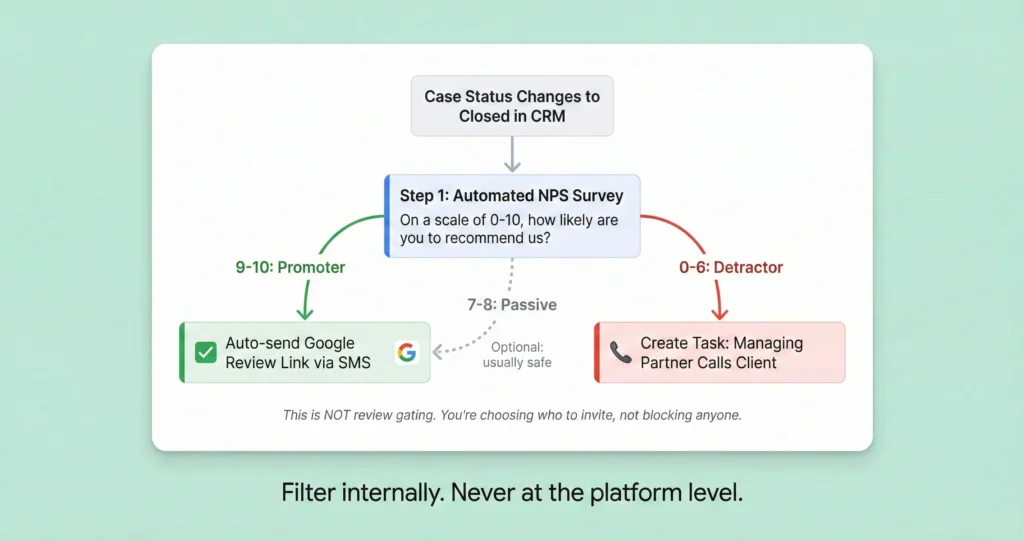
How do law firms avoid getting negative Google reviews? Use a two-step workflow with an internal Net Promoter Score survey before sending the Google review link. When a case closes, send a private “on a scale of 0 to 10” email first. Clients scoring 9 or 10 get the Google link automatically. Clients scoring 0 to 6 trigger a private service recovery call instead. This is not “review gating” because you’re not blocking anyone from posting; you’re choosing who to actively invite.
So there’s a workflow that I think every firm should be running and it’s basically a two-step filter where you don’t send the Google review link to everyone automatically. When a case status changes to closed in your CRM, whether that’s Clio or MyCase or whatever you’re using, the first automated message is an internal satisfaction survey using the Net Promoter Score format; “on a scale of 0 to 10 how likely are you to recommend us to a friend.”
If they score a 9 or 10 the system automatically sends a follow-up with the direct Google review link. If they score 0 through 6 the system does NOT send the Google link and instead creates a task for the managing partner to call the client and discuss what went wrong. And this isn’t “review gating” in the way Google prohibits it because you’re not preventing anyone from finding Google on their own and leaving a review; you’re just choosing who you actively invite to do so, which is a business decision, not a policy violation.
The 7 and 8 scores are the gray area and honestly I’d send those the Google link too because a 7 or 8 usually means the client is satisfied but not thrilled, and their review will probably be honest and reasonable which is fine. Text messages get a 98% open rate compared to maybe 20% for email, so for individual clients in PI or family law I’d use SMS and for corporate clients I’d use email, but either way the automation has to be built so it fires within 24 hours of case closure or you lose the window.
The Negative Review Trap
Can lawyers respond to negative Google reviews? Yes, but revealing any confidential information in the response is an ethics violation. ABA Formal Opinion 496 explicitly ruled that an online review is not a “legal controversy” that triggers the self-defense exception under Rule 1.6(b)(5). Confirming someone was a client, mentioning case details, or referencing outcomes are all prohibited. The safest response is the “Privilege Shield” script that cites professional obligations as the reason for silence.
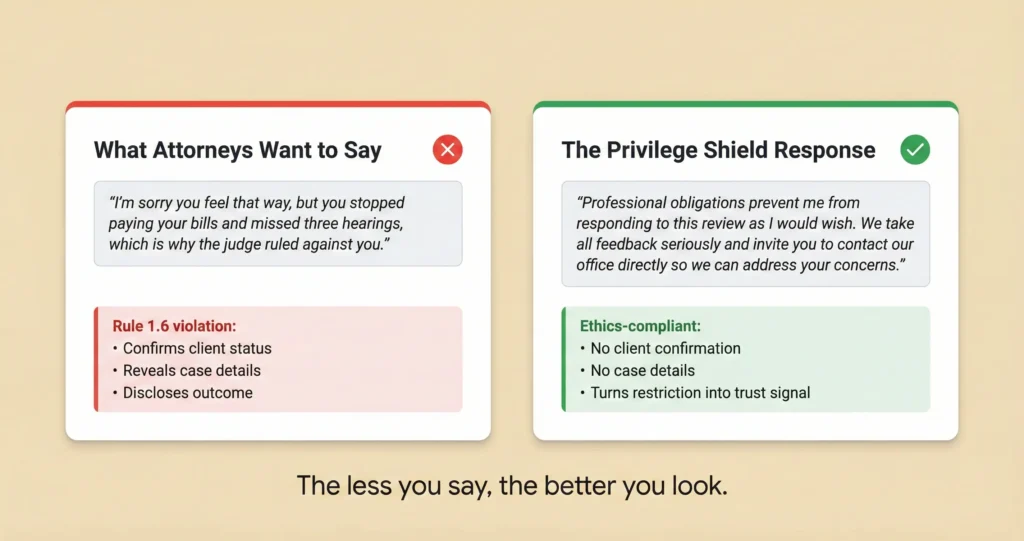
Now the negative review response is where I’ve seen attorneys actually get disciplined because the instinct when you get a nasty 1 star review is to defend yourself with facts, and the attorney thinks “well Rule 1.6(b)(5) says I can reveal confidential information to defend myself in a controversy with a client, so this review is a controversy and I can explain what really happened.” But ABA Formal Opinion 496 said no; an online review is not a legal controversy or proceeding, it’s informal social commentary, and the self-defense exception doesn’t apply.
So a response like “I’m sorry you’re upset but you stopped paying your bills and the judge ruled against you because you missed three hearings” is a confidentiality violation even though every word of it might be true. I’ve seen attorneys get suspended for responses like that and the bar’s position is that advertising ethics don’t get suspended just because someone said something unfair about you on the internet, which is frustrating but that’s the rule.
The strategy I recommend is what the research calls the “Privilege Shield” approach where you post a response that sounds professional and caring but actually says nothing. Something like: “Professional obligations prevent me from responding to this review as I would wish. We take all feedback seriously and invite you to contact our office directly so we can address your concerns.”
You haven’t confirmed they were a client, you haven’t revealed any details, and you’ve turned the ethical restriction into something that actually makes you look good because it shows you protect client information even when you’re being attacked, which is honestly a better signal than any factual rebuttal would have been.
If the reviewer was genuinely never a client; not a consultation, not a phone call, nobody by that name anywhere in your CRM; you can say “We have no record of a client by this name” but you better be absolutely certain because if they called for a free consultation three years ago and you forgot, you just confirmed a confidential communication and you’ve got a problem.
The Technical Traps Nobody Warns You About
Why do law firm Google reviews disappear? Google’s spam detection flags reviews left from the firm’s office IP address (clients using office Wi-Fi), sudden velocity spikes (going from 0 to 50 reviews in a week), and review gating software that blocks unhappy clients from seeing the review link. Reviews that lack specific detail about the service are given less weight by Google’s text analysis models. Aim for a steady 2 to 4 reviews per month rather than sporadic blasts.
And beyond the ethics side there are technical traps that Google sets for review acquisition that most review management programs don’t tell you about. The biggest one is the IP address problem; if a client leaves a review while connected to your office Wi-Fi, Google associates that IP with the business owner and frequently flags the review as fake or coerced, even if it was completely genuine.
So if you have a QR code in your conference room and the client scans it and writes the review right there, Google might remove it. Better to have them scan the code but write the review later on their own cellular data, which is an annoying extra step but it keeps the review from getting filtered.
The velocity trap is the other one where Google’s spam detection looks for unnatural patterns. If your firm has 8 reviews and suddenly gets 30 in one week, that looks like a purchased review campaign and many of those reviews will get filtered out. The research on this suggests that a steady 2 to 4 reviews per month is technically safer and algorithmically better than sporadic blasts.
There’s also evidence of a “10 review” threshold where profiles crossing from single digits to double digits see a meaningful ranking boost, which suggests Google treats 10 reviews as a kind of validity signal that the business is real and established and worth showing to searchers.
And Google’s natural language processing is getting better at analyzing the content of reviews themselves. A review that says “great lawyer” carries less algorithmic weight than one that says “helped me with my car accident case and explained everything about the insurance settlement process” because the second one contains practice area keywords that Google can match to search queries.
You can’t coach clients on what to write because that creates ethical issues, but you can prompt the topic naturally by saying something like “we’d love to hear your thoughts on how our team handled your case” instead of just “please write a good review,” which usually gets you more specific and more useful feedback anyway.
Not sure where your firm stands on review compliance?
If you’re in Florida and you’re confused about what the bar allows; or you’re running review campaigns in multiple states and don’t know which rules apply where; I can audit your current process against your state’s specific bar rules and tell you what’s safe and what isn’t. Or don’t, if your current approach is working and you haven’t gotten any letters from the bar, maybe that’s fine too.