
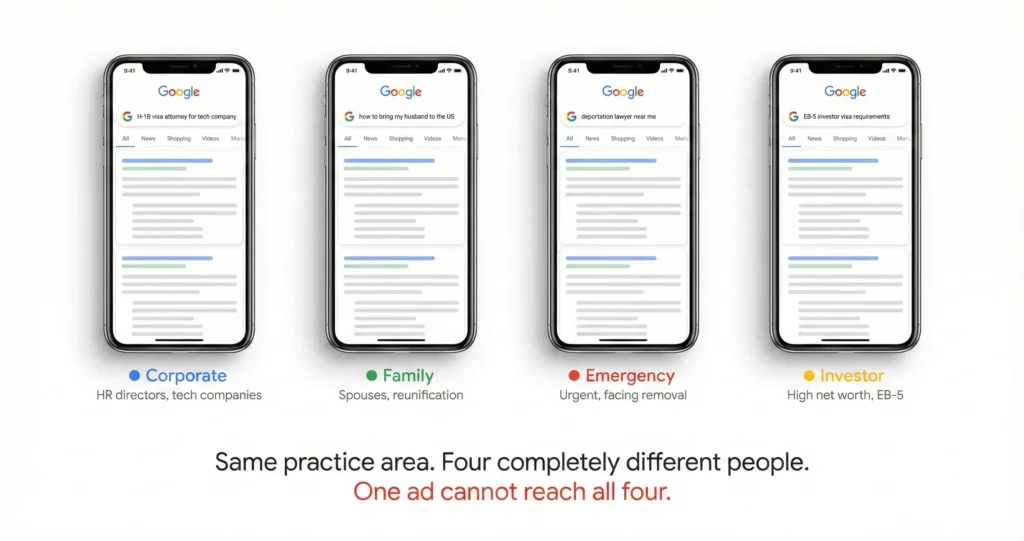
What does Argota Marketing do for immigration law firms? Argota builds bilingual marketing campaigns around the reality that immigration clients are not one audience. A corporate HR director processing an H-1B, a mother trying to bring her husband to the US, someone facing deportation at midnight, and an investor evaluating an EB-5 all search differently, respond to different messages, and need to be reached through different channels. We build separate strategies for each client type in both English and Spanish, taking advantage of immigration’s dramatically lower ad costs ($3-$15 per click vs $200+ in personal injury) while overcoming the trust barriers unique to immigrant communities.
The Four Client Problem
The biggest mistake immigration firms make with their marketing is treating every potential client like the same person. They’re not. An HR director at a tech company trying to process an H-1B visa has nothing in common with a mother trying to bring her spouse to the US from abroad. And neither of them has anything in common with someone sitting in their apartment at 11 PM searching “deportation lawyer near me” on their phone.
Immigration clients break into at least four distinct groups, and each one searches differently, worries about different things, and responds to completely different marketing.
- Corporate sponsors (HR directors, startup founders) care about compliance and processing speed. They respond to technical content and professional networks.
- Family petitioners (citizens sponsoring spouses, parents, children) are driven by the pain of being separated from someone they love. They respond to stories from reunited families and approachable, compassionate language.
- People in crisis (removal proceedings, detention, expired status) need help right now. They respond to a phone number they can tap immediately and someone who answers.
- Investor and specialty visa candidates (EB-5, E-2, O-1) are sophisticated buyers comparing firms across countries. They respond to credentials, seminars, and referrals from financial advisors.
We build separate campaigns for each group your firm serves. Different keywords, different ads, different landing pages, different follow-up. Targeting all four with the same message is how firms waste money reaching nobody.
How We Reach Each One
For corporate sponsors, we build your presence where HR directors actually look. That means LinkedIn content about visa processing timelines and compliance updates, search campaigns targeting specific visa categories like H-1B, L-1, and PERM, and website content detailed enough that a corporate counsel would forward it to their team. These clients aren’t emotional buyers. They want to know you’re organized and current.
For family petitioners, we build the emotional connection first. These clients search in both English and Spanish, often on Facebook and Google at the same time. They’re looking for someone who understands what it feels like to be separated from family by a government process. Paid ads target specific family visa keywords (spousal visa, K-1 fiancé, green card for parents) and lead to pages with real testimonials from families who’ve been through it.
For people in crisis, we build for speed and access. Your Local Services Ad with Google’s trust badge appears at the top when someone searches “deportation lawyer near me” at midnight. Your website loads in two seconds on a phone, shows a phone number and WhatsApp button they can tap immediately, and has an intake form short enough that someone in a panic can complete it. If your site takes five seconds to load or your form has 15 fields, this person is gone.
For investor candidates, we build credibility that travels. These clients might be in São Paulo or Beijing evaluating firms in Miami. They respond to seminar content, detailed case studies, and referral partnerships with immigration-aware wealth managers. Search targeting focuses on specific visa programs (EB-5 regional center, E-2 treaty investor, O-1 extraordinary ability) with content thorough enough to satisfy someone doing serious due diligence.
The Bilingual Gap Most Firms Miss
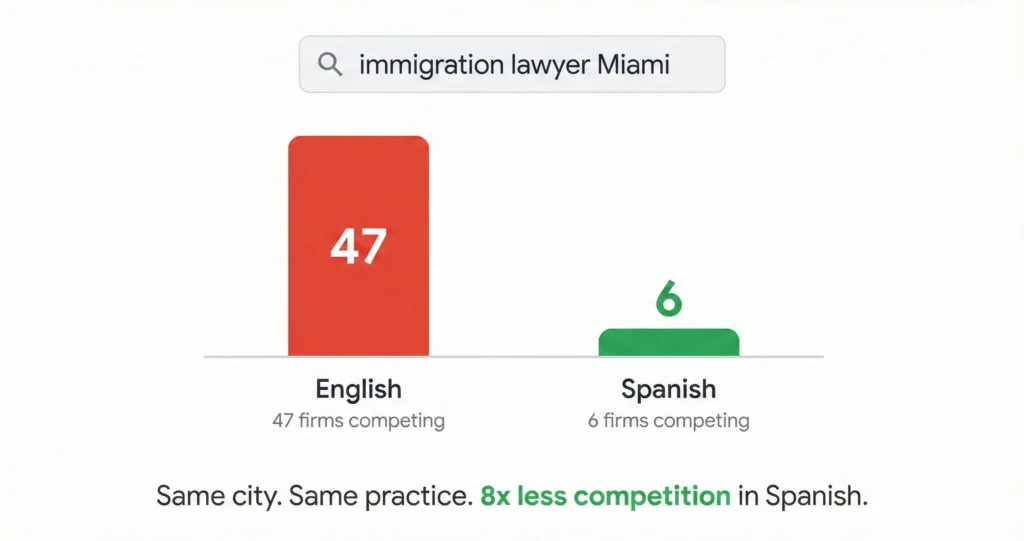
Most immigration firms put a “Se Habla Español” banner on their English website and think that covers their Spanish-speaking market. It doesn’t. When someone searches “abogado de inmigración en Houston,” Google looks for Spanish-language pages. If your site is all English, you don’t exist for that person.
We build your Spanish content as a separate set of pages within your website, not a translation plugin. Each English page has a full Spanish counterpart written by a native speaker who understands legal terminology in both languages. A literal translation of “adjustment of status” or “prosecutorial discretion” can confuse someone who needs to understand what’s actually happening with their case. The content has to be rewritten for the culture, not just run through a translator.
The payoff is significant. Spanish immigration keywords often have real search volume with a fraction of the competition, which means your content ranks faster and your ads cost even less than the already-cheap English terms. And now that AI search tools are pulling answers directly from your content, having authoritative Spanish pages means your firm gets cited in AI answers for Spanish-language questions too.
Building Trust When Your Clients Have Been Burned Before
Many of your potential clients have been scammed by someone pretending to offer legal services. In most Latin American countries, a “Notario Público” is a trained legal professional similar to an attorney. In the US, a notary public has no legal authority. People exploit that confusion to take money from immigrants for legal work they’re not qualified to do. By the time these clients find a real attorney, they’ve lost money, lost time, and lost trust in anyone advertising legal services.
Everything we build accounts for that trust deficit. Your website prominently displays “Licensed Attorney / Abogado Licenciado” credentials. Your ads lead to pages with real Bar Association verification and attorney photos, not stock images. Your review profile shows recent, specific reviews from real clients describing real outcomes. And your content positions you as the legitimate alternative by educating people about how to tell the difference between a licensed attorney and unauthorized practice.
What the Numbers Look Like
Immigration has the best advertising economics of any legal practice area. A click that costs $200 to $1,000 in personal injury costs $3 to $15 in immigration. A single family green card case generates $3,000 to $5,000 in fees. Even at a conservative cost per lead of $150 to $200, the return can reach 15x to 25x on ad spend.
We track campaigns from click to signed client, split by language and client type. You see which English keywords and which Spanish keywords are generating consultations, which of the four client types is converting, and what your actual cost per signed client is for each visa category. For lower-value services like work permit renewals, we rely on organic search rankings and follow-up to existing clients rather than expensive paid ads. Full data ownership: website, hosting, analytics, ad accounts. If you leave, you keep everything.
What to look for in an agency’s reports →
Immigration Marketing by Market
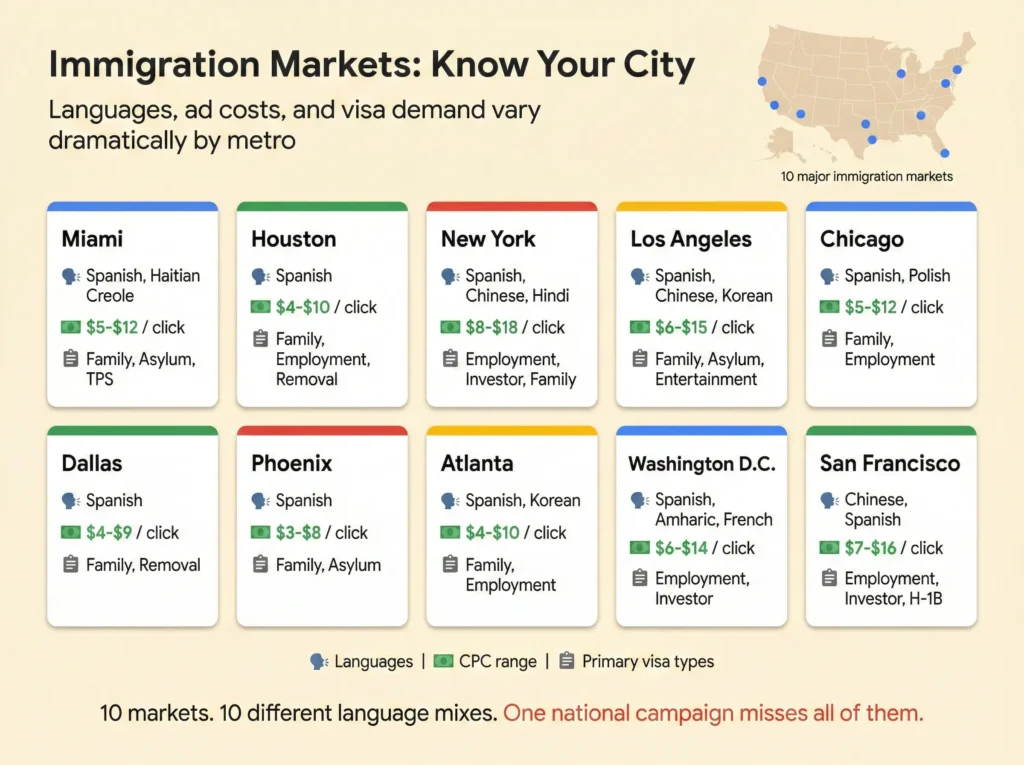
Immigration marketing changes by city because the immigrant communities, the languages, the visa types in demand, and the competition are different everywhere. Miami’s market is dominated by Spanish and Haitian Creole speakers seeking family-based and asylum cases. New York has significant Chinese, Hindi, and Spanish-speaking populations with heavy demand for employment and investor visas. Running the same campaign in both cities wastes money.
Each page below covers the specific dynamics of your market:
California · Texas · Florida · New York · Pennsylvania · Illinois · Ohio · Georgia · North Carolina · New Jersey
Don’t see your state? We work with immigration firms nationwide. Tell us about your market and we’ll build around your local dynamics.
Are you reaching all four client types, or just one?
Send me your current setup and I’ll show you which of the four groups your marketing is actually reaching and which ones it’s missing entirely. I’ll check whether your Spanish content is ranking or just sitting there, whether your ads are running in both languages, and whether someone searching “deportation lawyer” at midnight can actually reach you. If it’s already working, I’ll tell you that.
Talk to Jorge → Phone or text: 941 626 9198
Related: The complete guide to immigration law marketing →