

So maybe six months ago I started pulling the analytics for a bunch of law firm sites I manage and the numbers were doing something I’d never seen before. Traffic was down on a lot of pages, sometimes 30 or 40 percent, but the lead numbers were flat or in some cases actually up. And I couldn’t figure out what was happening because if fewer people are visiting your site you’d expect fewer leads, that’s just math.
But then I started looking at which pages lost traffic and it was almost entirely informational content. Blog posts answering questions like “what is the statute of limitations for personal injury in Florida” or “how much does a DUI lawyer cost” and those pages were getting crushed because Google was giving the answer itself right there in the AI Overview and nobody needed to click through anymore.
And the pages that kept their traffic were the ones where someone was ready to hire, like “Miami car accident lawyer” or “best medical malpractice attorney near me” and those people were still clicking and still calling.
And that’s when it clicked for me that AI search isn’t killing law firm marketing, it’s just killing the part that wasn’t actually generating cases anyway, which I don’t know maybe that’s a good thing or maybe it’s terrifying depending on how your marketing is set up right now.
The Numbers Are Pretty Bad If You’re Not Paying Attention
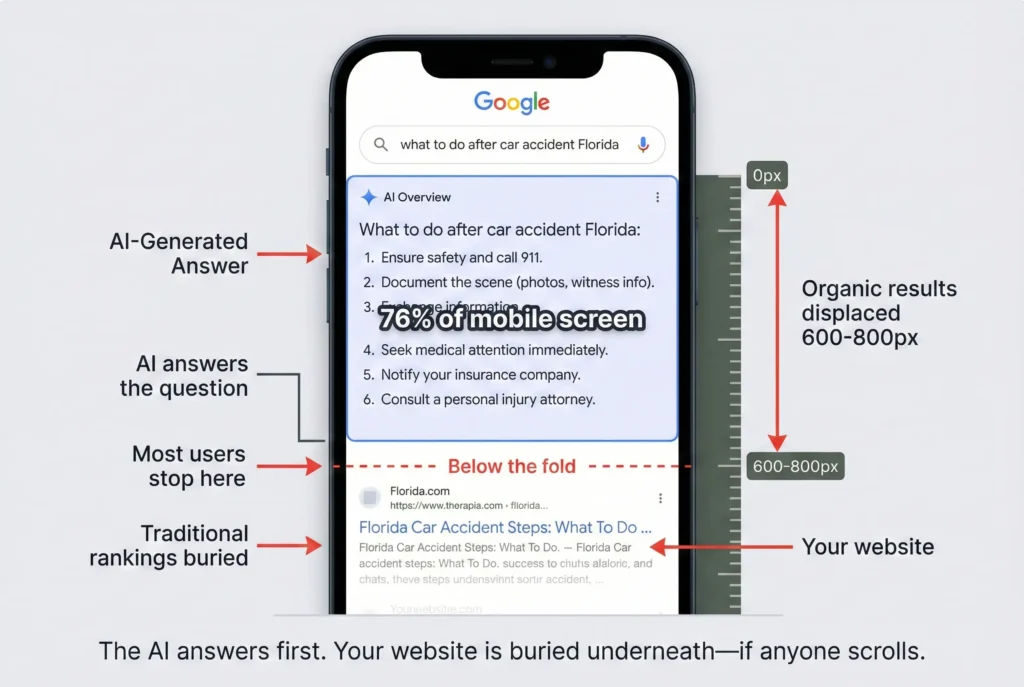
How much has AI Overview reduced law firm website traffic? When an AI Overview appears on a legal search, organic click-through rates drop by roughly 61%. Paid ad CTR drops 68%. The AI Overview physically pushes organic results 600 to 800 pixels below the fold on desktop and takes up 76% of the mobile screen. For every 1,000 Google searches, only about 360 clicks make it to any non-Google website. By 2026 projections show over 70% of legal searches will end without a click to a law firm site.
So here’s what the data actually says and I’m going to be specific because I think a lot of attorneys are hearing vague warnings about AI search but nobody is showing them the actual numbers. When Google decides to show an AI Overview for a legal query, the click-through rate for the results below it drops by about 61 percent.
And that’s not because your content got worse or your rankings dropped, it’s because the AI physically shoves your listing down the page. On desktop your result might be 600 to 800 pixels below where people are looking. On mobile it’s even worse because the AI Overview takes up about 76 percent of the screen.
And if you’re running Google Ads thinking paid search is safe from this, the data shows ads lose about 68 percent of their clicks when an AI Overview is present. People just read the AI answer and either leave or call the number the AI shows them. The AI is basically intercepting the traffic before it gets to anyone’s website.
Right now about 60 percent of all Google searches end without a click to any third party website, and on mobile where most legal searches happen that number is closer to 77 percent. Out of every 1,000 Google searches only about 360 clicks make it to the open web and that number keeps shrinking. And honestly when I first saw that I was like there’s no way that’s right, but the SparkToro data and the Semrush data both line up on this.
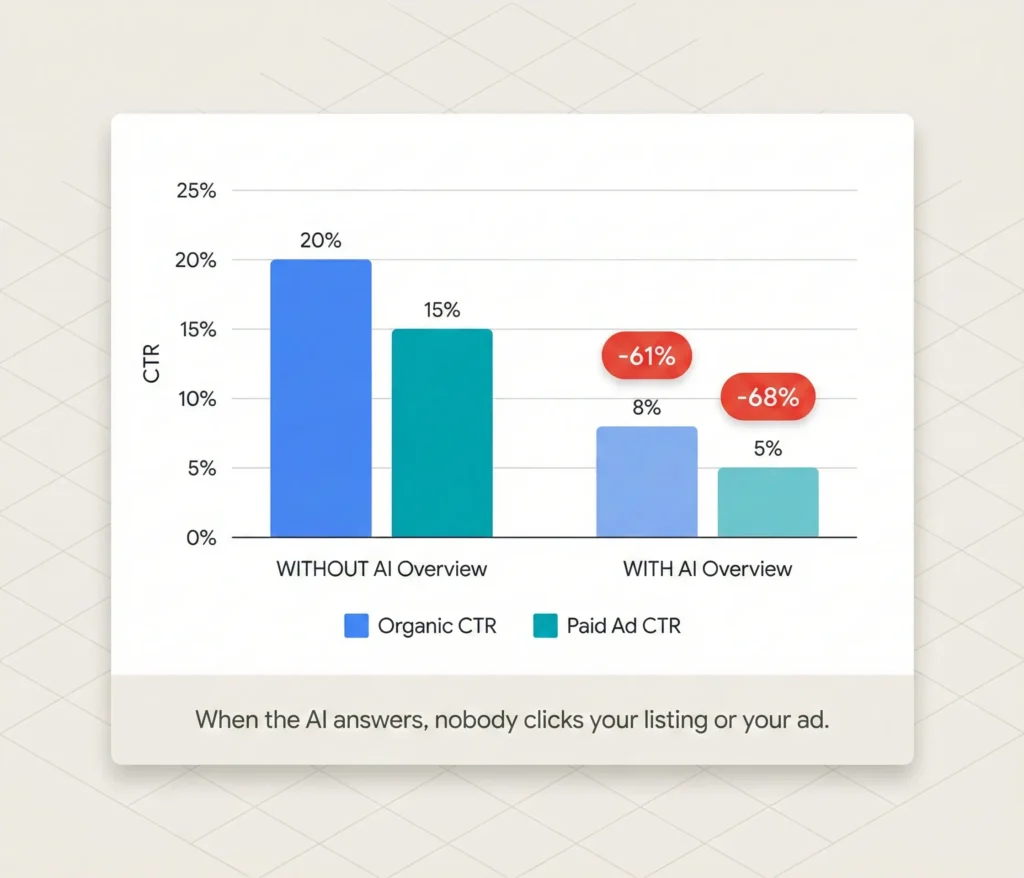
And let me put this in real terms because percentages don’t mean anything until you see what they do to your actual pipeline. Say you’re a personal injury firm and you rank number one for “what to do after a car accident in Florida” which gets maybe 2,000 searches a month. In the old world you’d get about 400 clicks from that ranking at a 20 percent CTR. Now with the AI Overview sitting on top of that result you’re getting maybe 160 clicks, and that’s assuming you’re still ranking number one which a lot of firms aren’t anymore.
That’s 240 fewer people hitting your site every month from just one keyword. And most firms are ranking for dozens of keywords like this. Multiply that across your whole blog and you’re looking at thousands of lost visits per month, which is exactly what QS Digital found when they analyzed 18 law firm sites in late 2025 and saw a median traffic drop of 19 percent with some firms losing close to 80 percent of their blog and FAQ traffic.
And here’s the part that makes it even worse. While your organic traffic is dropping, the cost of paid clicks to make up the gap keeps going up. PI lawyers are paying something like 568 percent more per click than they were in 2021. Some legal keywords are crossing $500 per click now and I’ve seen data showing certain terms above $1,000.
So you’re getting squeezed from both sides, organic traffic is shrinking because the AI is grabbing it and paid traffic costs more every quarter because everyone’s fighting over what’s left, and the math on that just keeps getting worse unless you change the strategy entirely.
SECTION: Which Legal Searches Are Getting Hit and Which Ones Aren’t
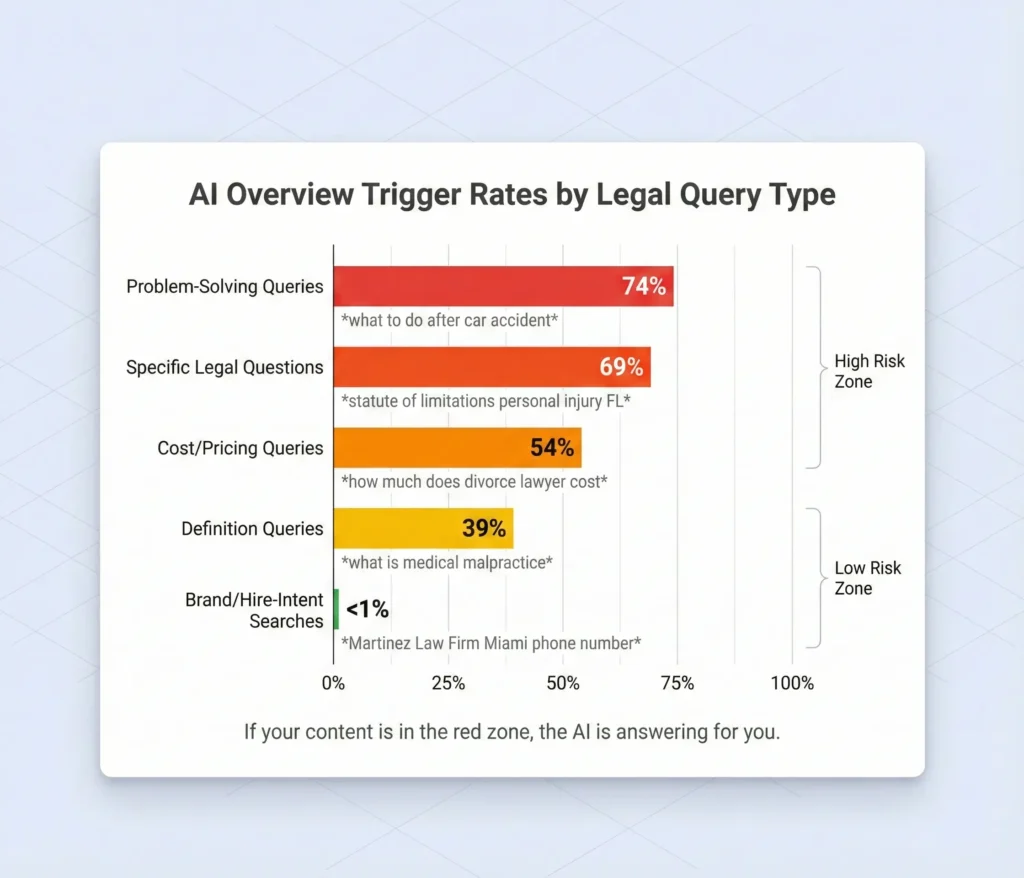
Which legal queries trigger Google AI Overviews? Problem-solving queries trigger AI Overviews 74% of the time (“what to do after a car accident,” “steps to file for divorce”). Specific legal questions trigger at 69% (“statute of limitations for medical malpractice in California”). Cost queries trigger at 54% (“how much does a DUI lawyer cost”). Definition queries trigger at 39% (“what is a tort”). Brand searches and “near me” hire-intent searches trigger at less than 1% because Google monetizes those with ads and Map Pack. Long-tail queries of 5+ words are most vulnerable.
And this is the part that matters most because not every search gets an AI Overview. If you understand which ones do and which ones don’t you can stop wasting money on content that Google is just going to steal from you and focus on the searches where your website still has a shot.
The highest trigger rate is what I’d call problem-solving queries, things like “what to do after a car accident in Florida” or “steps to file for divorce in Texas” and those trigger an AI Overview about 74 percent of the time. The AI loves these because the answer is a process with steps and the AI is really good at summarizing steps into a numbered list. If your whole blog strategy is built around writing “what to do” articles you’re in trouble because the AI can answer those without your help now.
Specific legal questions come in at about 69 percent, things like “what is the statute of limitations for medical malpractice in California” where there’s a factual answer the AI can pull from a statute. Cost questions trigger at about 54 percent because the AI pulls price ranges from a bunch of sites and puts them together. And definition queries like “what is a tort” are at about 39 percent which is lower because Google already had dictionary boxes and featured snippets for those.
But here’s what’s interesting and this is where I think the opportunity is. Brand searches, like “Morgan and Morgan phone number” or “Percy Martinez reviews,” trigger AI Overviews less than 1 percent of the time. And high-intent searches like “best personal injury lawyer near me” still mostly trigger the Map Pack and Local Ads because Google makes money on those. So the searches where someone is actually ready to hire a lawyer are mostly safe, and the searches where someone is just looking for free information are the ones getting intercepted.
And the risk gets worse the longer the query is. Short searches like “divorce lawyer” trigger the Map Pack. But long-tail searches like “can I keep my house if I divorce my husband for cheating in Georgia” trigger AI Overviews almost every time. And long-tail blog content is exactly what most law firm SEO strategies have been built around for the last decade, which is kind of the whole problem.
And here’s what I’d actually do with this information if I were running marketing for a law firm right now. Go into Google Search Console and pull every page on your site that gets organic impressions. Then sort each one, is it answering a “how to” question, a “what is” question, a “how much” question, or is it going after a hire-intent keyword like “best personal injury lawyer near me.”
If 70 or 80 percent of your pages fall into those first three categories, which is the case for most law firm sites I audit, then you know that 70 or 80 percent of your content strategy is sitting in the AI’s kill zone and you need to start shifting what you’re writing about before the traffic numbers get worse, which honestly they probably will.
The Part Nobody Is Talking About Where Fewer Clicks Is Actually Better
Is AI Overview traffic more valuable for law firms? Yes. Traffic from AI citations converts at 185% to 2,300% higher rates than traditional organic search traffic. The AI pre-qualifies visitors by answering basic questions before they click, so people who still click through are past the education phase and into the hiring phase. The metric that matters is shifting from “total sessions” to “engaged sessions” and “cost per acquisition.” Fewer visitors but better visitors means the math can actually improve.
So here’s where I’m going to say something that sounds crazy but hear me out. I think the traffic collapse is actually good for law firms that know what they’re doing, and I’ll explain why.
The traffic that AI Overviews are stealing is mostly people looking for free info. They want to know what comparative fault means or how long they have to file a claim. These are people just starting to look around and most of them were never going to hire you anyway. They’d read your blog post, get their answer, and leave. Maybe 1 or 2 percent would ever fill out a form.
But the people who read the AI answer and still click through to your site, those people are different. They already know the basics because the AI told them. The AI told them about comparative fault and the statute of limitations and now they’re looking at your site because they want to hire someone. Early data shows these visitors convert at 185 to 2,300 percent higher rates than traditional organic traffic and I know that range is huge but the research is still early and it depends on the practice area.
At Percy I always said I’d rather have 100 visitors who are ready to hire than 10,000 visitors who just want free information, and AI Overviews are basically doing that filtering for you now whether you asked for it or not. The AI is the new top of the funnel. It handles the education phase for you whether you asked for it or not. Your site just needs to handle the conversion phase.
And there’s another thing happening that explains why some firms are seeing more phone calls even though website traffic is down. Martindale-Avvo’s 2026 data shows what they call a “True Contacts Multiplier” of about 2.1, meaning for every 10 leads you can track, roughly 11 more are happening off-platform.
Someone sees your firm in an AI Overview, reads your reviews right there, and then types your name into Google Maps and calls you. Your data calls that a “direct” lead and misses the fact that the AI put your name in front of them. So the traffic numbers look bad in your dashboard but the actual business might be growing and you just can’t see the connection in your data, which is its own kind of problem honestly.
And that means the way you measure success needs to change. Total sessions as a KPI is becoming useless because it’s going to keep dropping and there’s nothing you can do about it. What matters now is engaged sessions, conversion rate, and cost per acquisition. If your traffic drops 40 percent but your leads stay flat, your marketing actually got more efficient. Your cost per signed case went down because you’re paying for less infrastructure to generate the same number of cases.
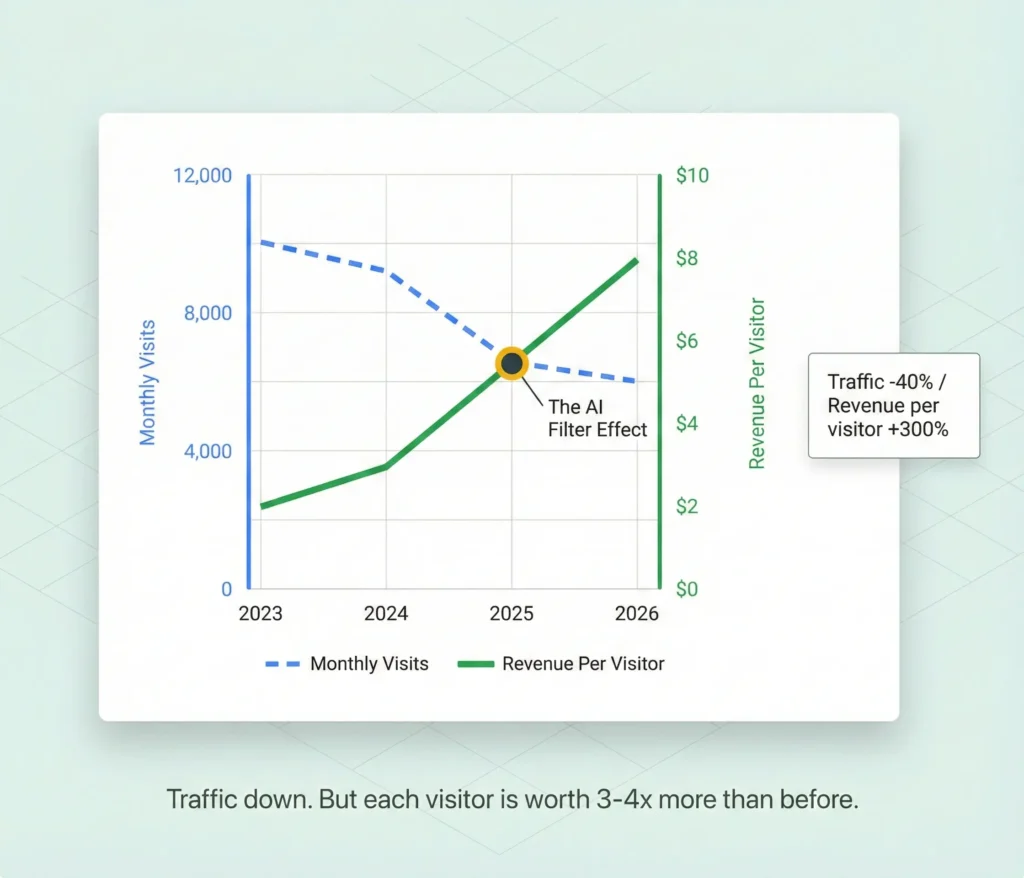
And I want to put actual dollar math behind this because I think that’s what makes it real. Say your firm used to get 10,000 monthly visits and 1 percent converted to consultations, that’s 100 consults a month. If you’re spending $5,000 a month on content and SEO, that’s $50 per consult.
Now say AI Overviews cut your traffic to 6,000 but the conversion rate goes up to 2 percent because those people left on your site are more serious. That’s 120 consults from fewer visits and your cost per consult dropped too. Your cost per consult went from $50 to $42 and you got 20 more consults out of it. The math works in your favor if you understand what’s happening and adjust your site to convert those higher-intent visitors instead of trying to get the old traffic numbers back, which honestly isn’t going to happen.
The Blog Strategy Problem That Nobody Wants to Admit
Should law firms stop blogging because of AI Overviews? Don’t stop, but change what you write about. Generic informational posts answering questions the AI can answer (“what is negligence,” “how to file for divorce”) are losing traffic rapidly. Content that still works: proprietary data from your own cases, local courthouse insights the AI can’t generate, subjective strategy opinions, and client stories. The shift is from “encyclopedia” content that defines terms to “insight” content that shares experience the AI doesn’t have.
And this is the part I think most law firms and honestly most agencies don’t want to hear. The blog strategy that worked for the last 10 years, where you write 4 to 8 posts a month answering common legal questions and those posts capture top-of-funnel search traffic, that strategy is dying. Not dead yet but the trajectory is pretty clear and it’s not going in a good direction.
Because every one of those posts is answering a question the AI can answer itself. “What is the statute of limitations in Ohio?” The AI knows the answer. “What are the penalties for a first-time DUI?” The AI has that data from 50 different sources. “How much does a divorce cost?” The AI can give a range. Your blog post gave the AI its answer, the AI took it, and now nobody needs to click through to your site to read it.
I watched this happen at Percy where we had blog posts that used to generate 500 visits a month and now they’re getting 150 because Google is literally quoting our answer in the AI Overview and giving us a tiny citation link that maybe 10 people click. And we wrote that content and we researched it and we published it. And the AI took the value out of it.
So what do you write instead? You write things the AI can’t generate on its own. Like “I analyzed 500 of our own DUI cases and here’s what the actual outcomes looked like” because that’s proprietary data the AI doesn’t have.
Or “in Miami-Dade County judges in Division 43 tend to rule differently on custody than judges in Division 12” because that’s local courthouse knowledge that only comes from actually practicing there. Or “in my experience juries in Broward react very differently to medical expert testimony than juries in Palm Beach” because that’s a subjective insight from a practitioner that the AI can’t synthesize.
The shift is from encyclopedia content that defines terms to insight content that shares experience. And the firms that figure this out first are going to own the citations because the AI actively looks for content it can’t generate itself, which is kind of the whole point of what I keep telling people about getting your firm visible in AI answers and I still don’t think enough attorneys are listening honestly.
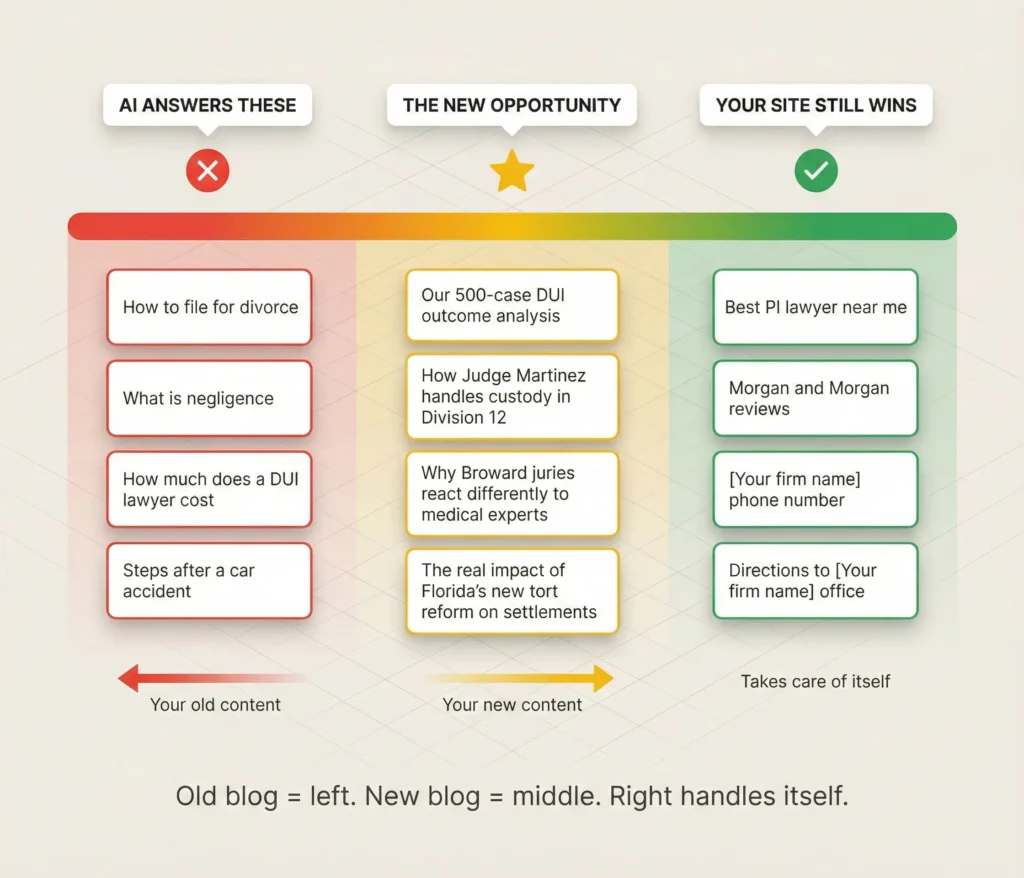
And let me give you some concrete examples of what this content pivot looks like across different practice areas because I think the concept makes sense but attorneys need to see what it looks like for their specific type of law.
If you’re a personal injury firm, stop writing “what is comparative negligence in Florida” and start writing “we tracked 200 intersection accident cases in Miami-Dade and here’s what the average timeline from filing to settlement actually looked like.”
If you’re a family law firm, stop writing “how to file for divorce in Texas” and start writing “the three custody arguments I’ve seen work consistently in Harris County and the two that judges there seem to hate.” If you’re a criminal defense firm, stop writing “penalties for first-time DUI in California” and start writing “I’ve defended 300 DUI cases in Orange County and here’s what actually happens versus what the statute says should happen.”
The AI can summarize a statute. It can’t summarize your experience in a specific courthouse with a specific judge in a specific county. That’s the content moat and it’s the only one the AI can’t climb over, at least not yet and probably not for a while.
What Happens Next and Why I Think It Gets Worse Before It Gets Better
What is the future of AI search for law firms? By late 2026 zero-click searches will likely stabilize around 70-75% for legal queries. Beyond that, AI agents will handle the entire process; a client will say “find me a divorce lawyer in Austin who handles custody and book a consultation” and the AI will do it without a browser ever opening. If your firm isn’t a recognized entity in the Knowledge Graph the agent won’t find you. Possible regulatory requirements may force AI to cite licensed professionals for legal advice, which would make verified entity status even more valuable.
And this is the part where I’m going to be honest about what I think is coming even though I’m not entirely sure about all of it and I don’t think anyone really is.
The zero-click rate for legal searches is probably going to settle around 70 to 75 percent by the end of 2026 and I don’t think it goes back down. And I think that’s just the new baseline we have to accept.
But the bigger shift is that AI is moving from answering questions to doing things. Right now someone asks ChatGPT “who’s a good divorce lawyer in Austin” and it gives them names and maybe phone numbers. Soon they’re going to say “find me a top divorce lawyer in Austin who handles custody, check their reviews, and book me a consultation for next week” and the AI agent will just do all of that without anyone ever opening a browser.
And in that world your website doesn’t matter at all. What matters is whether the AI knows you exist as a verified entity in the Knowledge Graph and whether it has enough confidence in your data to recommend you and book a consultation on your behalf.
If your firm name and your bar number and your practice areas and your address aren’t all verified and consistent across every database the AI checks, the agent won’t even consider you. It’s like not being in the phone book except way worse because there’s no way to browse and stumble on someone the AI didn’t recommend.
There’s also a regulatory angle that I think could actually help law firms if it plays out. Legal advice is a YMYL topic, “your money or your life” in Google’s terminology, meaning the AI has to be really careful about giving wrong answers. If someone follows AI legal advice and it’s wrong, there’s a liability question.
I think we’ll eventually see regulations that force AI to cite licensed professionals for certain legal topics, which would make being a verified entity in the Knowledge Graph even more valuable because the AI would be legally required to point people to actual lawyers rather than just summarizing blog posts.
But I don’t know when that happens, could be 2027 could be 2030, and in the meantime you have to deal with the reality that most of your informational traffic is going away and the firms that adapt their content strategy and their website structure around this shift are going to come out ahead, which I realize sounds like a sales pitch but it’s honestly just what the data says.
Want to see which of your pages are losing traffic to AI Overviews?
I can pull your analytics and show you exactly which queries are triggering AI Overviews and which ones aren’t. If your numbers look fine I’ll tell you that too. No pitch unless you want one.