

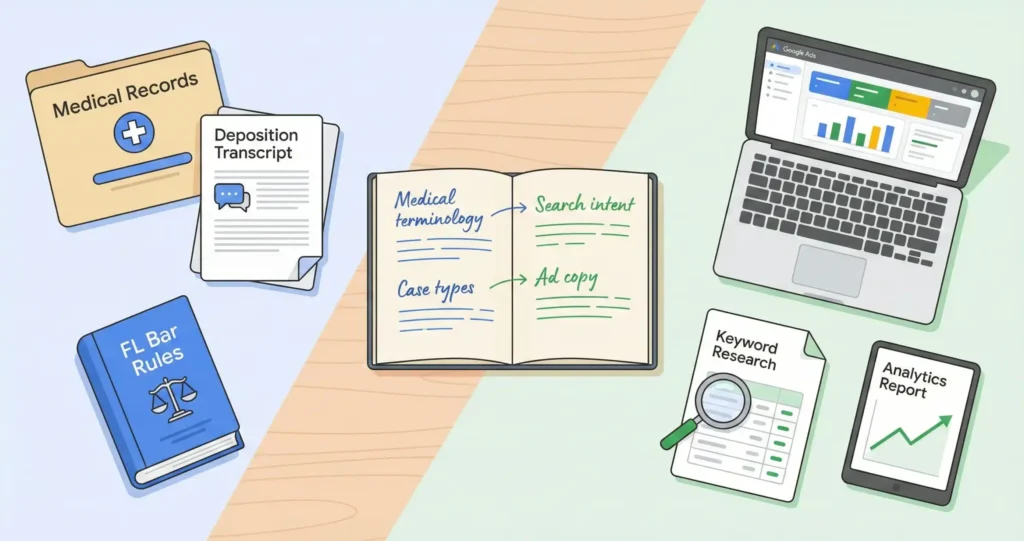

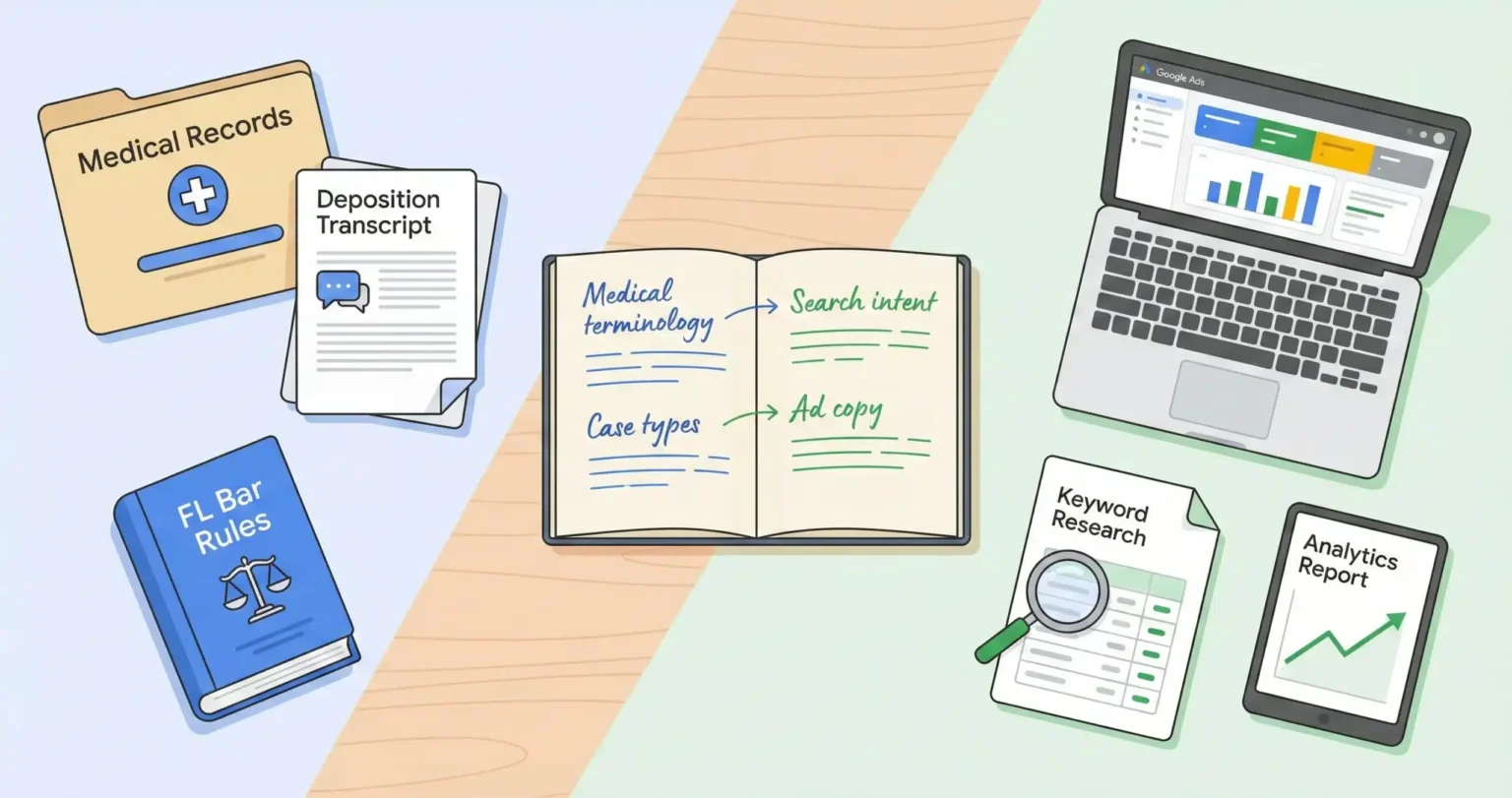




What legal industry expertise does Argota Marketing bring? Jorge Argota spent a decade as a paralegal at a medical malpractice firm handling intake calls, medical record retrieval, court attendance, and case investigation. This experience translates directly into marketing: clinical keyword granularity (targeting “Stage 4 decubitus ulcer” instead of generic “bedsore” keywords), bar-compliant content workflows that prevent ethics violations, intake process optimization that distinguishes “bad leads” from “bad intake,” and revenue attribution that tracks marketing spend to signed cases rather than clicks. The agency also prioritizes data sovereignty, ensuring firms own all code, hosting, and analytics. Source: Jorge Argota, Argota Marketing.
If you’re evaluating marketing agencies right now you’ve probably already talked to a few, and they probably all sounded pretty good in the pitch. They showed you dashboards with traffic graphs going up. They talked about SEO and PPC and content strategy. And maybe you’re trying to figure out what actually makes one agency different from another when they all seem to offer the same services with the same vocabulary.
So let me narrow it down. The difference isn’t the services; it’s whether the person running your campaigns understands what happens after the lead comes in. Whether they know what an intake call actually sounds like, what makes a case signable versus a waste of investigation time, which words on your website could trigger a bar grievance, and why “bedsore lawyer” and “Stage 4 decubitus ulcer attorney” aren’t the same keyword even though a generalist would treat them identically.
That’s what ten years as a paralegal at a medical malpractice firm taught me that no marketing certification ever could.
The Translation Problem
But honestly the biggest issue in legal marketing isn’t that agencies are bad at marketing. It’s that the agency and the law firm aren’t speaking the same language.
The agency talks about impressions, click-through rates, and conversion optimization. The firm is thinking about signed retainers, case viability, and whether the intake team is drowning in calls from people who need a public defender. Nobody translates between the two, so the agency celebrates a great month of traffic while the firm wonders why revenue didn’t move, and both sides get frustrated for completely legitimate reasons.
What the agency says: “We generated 200 leads this month.” What the firm hears: “We should have 200 new cases.” What actually happened: 140 were unqualified, 30 were out of statute, 20 were the wrong practice area, 10 were viable. The gap: The agency thinks they did great. The firm thinks they’re failing. Both are using accurate numbers that measure completely different things.
I spent ten years on the firm side of that gap. I was the person calling those leads, screening them, pulling the medical records, and telling the attorney which ones were worth investigating and which ones were a waste of time. Which means when I build a campaign now, I’m not optimizing for the number the agency wants to report; I’m optimizing for the number the firm actually cares about, which is cost per signed case.
Clinical Keywords That Generalists Miss
This is the part where the paralegal background turns into a direct competitive advantage and I’ll show you exactly how.
A generalist agency targeting a medical malpractice firm will bid on “medical malpractice lawyer” and “medical negligence attorney.” Those are the obvious keywords. They’re also the most expensive and the least specific.
At Percy Martinez I learned that the medical detail IS the keyword strategy. A Stage 2 pressure ulcer might be minor negligence with limited damages. A Stage 4 decubitus ulcer often means systemic facility failure, sepsis risk, and potential wrongful death; a case worth seven figures. Same body of law, completely different marketing target.
| What a generalist targets | What legal-medical expertise targets | Why it matters |
|---|---|---|
| “bedsore lawyer” | “Stage 4 decubitus ulcer lawsuit” | Filters for high-value systemic failure cases |
| “birth injury attorney” | “HIE from fetal monitoring failure” | Targets the specific mechanism that proves negligence |
| “surgical error lawyer” | “anesthesia malpractice” | Captures a terrified plaintiff searching their exact experience |
| “hospital negligence” | “MRSA infection post-surgical” | Matches clinical terminology plaintiff learns from discharge papers |
The person searching “anesthesia awareness” woke up during surgery. They’re not browsing. They’re in crisis and they’re using the medical term because that’s what the doctor told them happened. A generalist doesn’t know that keyword exists. Someone who spent years reading medical records does.
[Sticky note from Jorge] At Percy I reviewed maybe thousands of medical records over ten years. You start to learn the language; the ICD codes, the medical terminology patients actually use when they search, the difference between what the chart says and what the family describes. That vocabulary gap between what a generalist would target and what a plaintiff actually searches is where the highest-value clicks live, and it’s invisible to anyone who hasn’t worked inside a firm.
Bar Compliance Built Into the Workflow
I still don’t fully understand why most agencies treat bar compliance as an afterthought. They build the campaign, write the copy, launch the ads, and then maybe run it past someone who checks for obvious violations. By that point the landing page is live and the ad is spending and if there’s a compliance issue it’s already been seen by the public.
The way I build campaigns, compliance is in the architecture from the beginning. Not because I’m cautious by nature but because I watched what happens when it isn’t.
~~Build campaign → Write copy → Launch → Check compliance (maybe) → Fix violations after they’re live~~ → Compliance framework first → Copy written within it → Launch with disclaimers embedded → No retrofit needed
Florida requires specific disclaimers on every advertisement under Rule 4-7.13. You can’t promise outcomes. You can’t use the word “specialist” without Board Certification. You can’t respond to a negative review by revealing case details even if the review is completely false, because privilege doesn’t disappear just because someone said something unfair about you online.
✓ Every landing page auto-loads jurisdiction-specific disclaimers based on practice area
✓ Ad copy is written within bar advertising constraints from draft one, not corrected after launch
✓ Review response templates preserve privilege; polite, firm, and never engaging in factual disputes
✓ Social content positioned as educational rather than direct solicitation, staying within Rule 4-7.18(b)
A generalist agency doesn’t know these rules exist. And the attorney is the one who gets the grievance, not the agency, which I think is the part that should scare firms the most.
You Own Everything
I’ll tell you upfront something most agencies won’t mention until you try to leave: a lot of them build your website on proprietary systems where you’re renting your digital presence, not owning it.
If the relationship ends, you lose the site. You lose the code. Sometimes you lose the domain. And whatever search authority you built over years of content and link building goes with it, which means you’re starting from zero with the next agency and the previous one walks away with an asset you paid for.
I don’t do that. You own the code, the hosting, the domain, and every analytics account from day one. If you fire me tomorrow you walk away with everything intact and your next agency picks up where I left off instead of rebuilding from scratch.
The honest limitation: I’m not a 50 person agency and I’m not trying to be. But I’m also not just a legal marketer who read some blog posts about law firms. I co founded a used cooking oil recycling company that operates across three states. I built Churchill Public Adjusters’ digital presence across four South Florida offices. I created Stirling Food Systems from scratch; the name, the brand, the website, the content architecture for every major Florida metro. Every one of those businesses operates in a regulated industry with compliance requirements that would get a generalist agency in trouble, which is basically the same problem law firms have except the regulations are different. So when I say I understand compliance-driven marketing, I don’t mean I studied it. I mean I’ve built four businesses inside it and I know what happens when you get it wrong because the consequences land on me, not on some client I can walk away from.
Not sure if your agency understands the legal side of legal marketing?
Send me your current campaign. I’ll look at the keyword strategy and tell you whether it’s targeting clinical specifics or generic terms. I’ll check the landing pages for bar compliance. I’ll look at the attribution and tell you if they’re tracking to signed cases or just reporting clicks. And if they’re doing it right I’ll tell you that too, because honestly some agencies figure it out; it just takes them a while and a lot of your budget to get there. And if you don’t need my help I’ll tell you that too, which I know is a weird thing for a marketing person to say but I’d rather be straight with you than pretend I’m the answer to everything.