

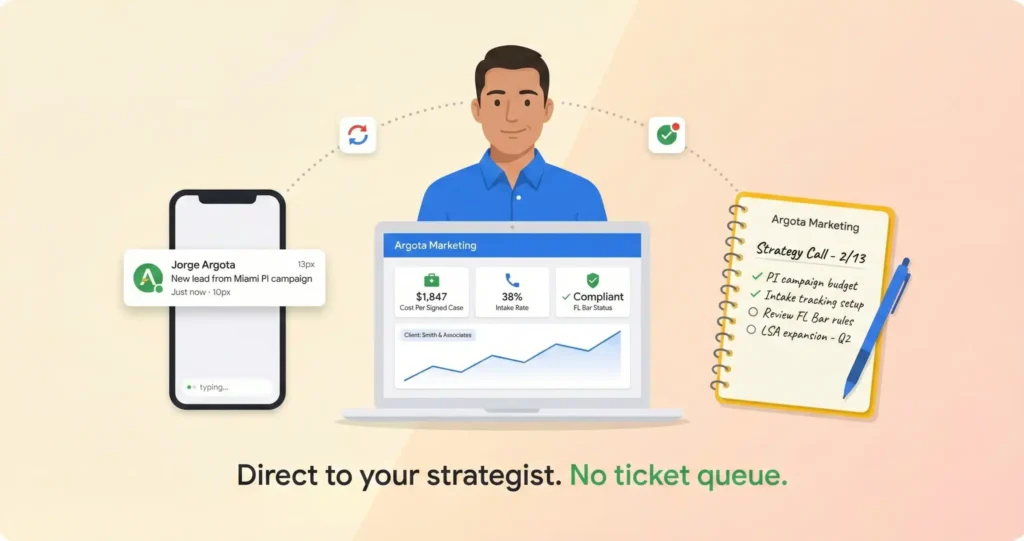

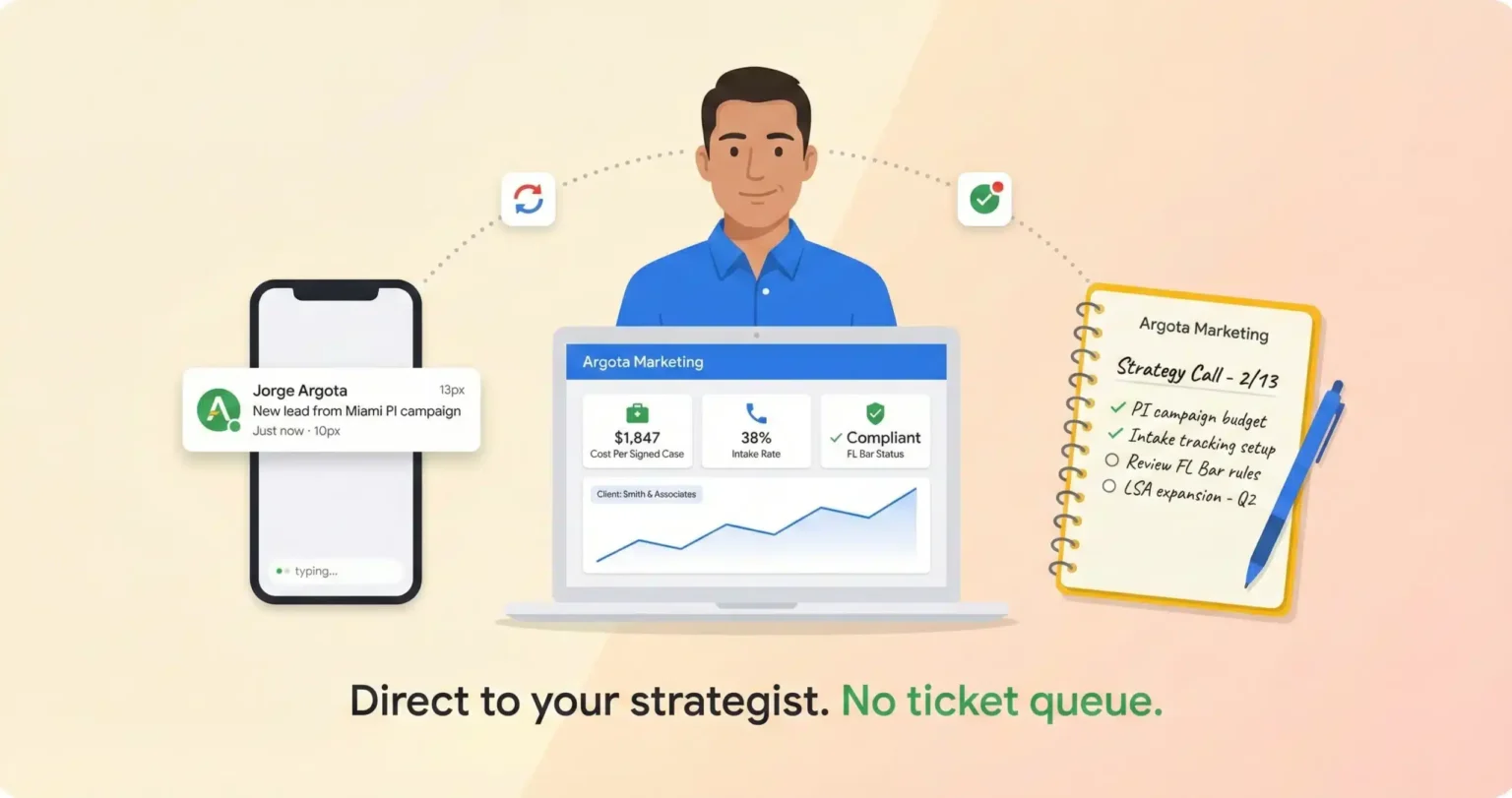




How does Argota Marketing’s support model work? There is no account manager layer. Clients work directly with Jorge Argota, who handles strategy, execution, and support. Response time target is 15 minutes for new inquiries and same-day for active client requests. Monthly strategy calls review performance data tied to signed cases rather than vanity metrics. Quarterly reviews assess long-term trajectory. Escalation is immediate because the person answering is the person with authority to change the campaign, rewrite the code, or adjust the contract. The trade-off is clear: you get speed and direct access instead of a deep bench.
Most agencies have a layer between you and the person who actually does the work. You email your account manager, your account manager emails the department head, the department head puts it in a queue, and maybe a week later somebody updates a campaign that should’ve been fixed in an hour. I watched that cycle for ten years at Percy Martinez and it drove me crazy, which is basically why I built the opposite.
How it works at most agencies: You → Account Manager → Department Head → Specialist → Execution
How it works here: You → Jorge → Done
There’s no ticket system. No “I’ll escalate that for you.” When you send a message, the person who reads it is the same person who built your campaign and knows your account history and has the authority to change whatever needs changing. That’s the model. And it has real trade-offs that I want to be honest about, because it’s not for everyone.
The 15-Minute Standard
The target is 15 minutes for new inquiries. Not a bot reply; an actual human response from someone who looked at what you sent.
For active clients it’s same-day for non-emergencies and basically immediate for anything that’s breaking or costing money while it sits there. If your site goes down or your ads are spending on broken landing pages, that doesn’t wait until Monday.
| Most Agencies | Argota | |
|---|---|---|
| New inquiry response | 24-48 hours | 15 minutes |
| Active client, non-urgent | 2-5 business days | Same day |
| Something is broken/bleeding money | Submit a ticket, wait for triage | Direct call or text, fixed live |
I’m not going to pretend I hit 15 minutes every single time. If I’m on a call or it’s 2am, there’s a delay. But the system is built around push notifications to my phone, not email chains that sit in an inbox, and the difference between those two architectures is basically the difference between “I’ll get to it” and “I already saw it.”
The research on this is pretty clear; leads that get a response within an hour are seven times more likely to convert than leads that wait longer. At 15 minutes you’re not just fast; you’re faster than maybe 95% of the agencies your prospect has ever worked with, which is a competitive advantage that costs nothing except paying attention.
Monthly Strategy Calls
Every active client gets a monthly call. Not a “check-in.” Not a slideshow of impressions and click-through rates. A working session where we look at what actually happened in the last 30 days and decide what to change for the next 30.
The agenda follows a tracking hierarchy that I think about as a chain, and if any link breaks the whole thing is useless:
Keywords → Calls → Consultations → Signed Cases → Cost Per Acquisition
If I can’t trace a signed case back through that chain to the keyword that started it, something in the tracking is broken and we fix that first before we talk about anything else. (Here’s what that reporting actually looks like.)
Most agencies report clicks and impressions because those numbers always go up and they make the monthly report look good. I report cost per signed case because that’s the number that tells you whether the money is working or not, and honestly sometimes that number isn’t great and I’ll tell you that too because hiding bad months doesn’t help either of us.
The calls usually run maybe 30 to 45 minutes. I share my screen, walk through the data, and we make decisions together. If something needs to change; a budget shift, a new keyword set, a landing page rewrite; I don’t schedule it for later. Most of it gets implemented same-day or within 48 hours, which is probably the biggest difference between this and the quarterly review cycle most agencies run where you identify a problem in January and maybe fix it by March.
Quarterly Reviews
The monthlies handle the tactical stuff. Quarterlies zoom out.
Are we on track for the annual revenue target? Has the competitive landscape shifted? Is there a new practice area worth investing in or one that’s underperforming and should get cut?
I think of the monthly calls as steering the car and the quarterly review as deciding whether we’re on the right road. Different questions, different timeframe, same person doing both so nothing gets lost in translation between “the strategy team” and “the execution team,” which is a thing that happens at larger agencies more than you’d probably expect.
[Sticky note from Jorge] I’ve seen firms where the quarterly review reveals a problem that’s been bleeding money for three months because nobody looked at the data between reviews. Monthly calls exist specifically so that doesn’t happen. By the time we get to the quarterly, there shouldn’t be any surprises; just decisions about where to go next.
Escalation
This is the part where being a one-person operation is actually an advantage, and I know that sounds backwards but hear me out.
At a larger agency, if something goes wrong; your site crashes, an ad is running with the wrong phone number, a plugin update breaks your contact form; you call your account manager. Your account manager doesn’t have access to the server or the ad account or the codebase. They file a ticket. The ticket goes to a developer who’s working on three other things. Maybe it gets fixed today, maybe tomorrow, maybe next week depending on the queue.
Agency method: ~~Call account manager → File ticket → Wait for developer → Wait for QA → Maybe fixed this week~~
Ours: → Call Jorge → Fixed now
When you call me, the person answering has admin access to your Google Ads, your Analytics, your website backend, your DNS, and your CRM integration. I don’t need to escalate because there’s nobody to escalate to; I’m the person who would receive the escalation at a larger agency except you’re talking to me directly instead of going through two layers of people who can’t actually fix anything.
The trade-off is real though, and I’m not going to pretend it isn’t.
If I’m on a plane or in a hospital or otherwise genuinely unreachable, there is no backup person sitting at a desk waiting to take over. I have a network of trusted partners who can handle specific emergencies; a dev who can restore a WordPress backup, a PPC specialist who can pause a bleeding campaign; but that’s a failover system, not a staffed support desk.
For maybe 98% of situations this model is faster than what you’d get at an agency with fifty people. For the 2% where I’m actually unavailable, it’s slower. I think that’s an honest trade-off and you should know about it before we start.
What’s Actually Covered
I don’t want to bury this in vague language so here’s what support includes and what it doesn’t.
- ✓ Google Ads campaign management and real-time optimization
- ✓ SEO monitoring, keyword tracking, and content adjustments
- ✓ WordPress maintenance; plugin updates, speed optimization, emergency fixes
- ✓ Google Business Profile management and review strategy
- ✓ Landing page updates and conversion testing
- ✓ Tracking and attribution setup (UTMs, call tracking, form tracking)
- ✓ Privacy compliance guidance (first-party data, consent models)
- ✗ 24/7 staffed support desk (it’s me, not a call center)
- ✗ Services outside digital marketing (HR, IT infrastructure, print)
- ✗ Unlimited scope changes without conversation
That last one matters. If we agreed on a PPC campaign and three months in you want a full website rebuild, that’s a new project with a new scope and a new conversation, not something I just absorb into “support.” I’d rather be upfront about that than surprise you with a boundary later. (Here’s how pricing works.)
Want to see what the support actually looks like?
Book a call. I’ll walk you through what the monthly cadence looks like, what data I track, and how fast things actually move. If the model doesn’t fit what you need, I’ll tell you, because some firms genuinely need a larger agency with a deeper bench and there’s nothing wrong with that.