

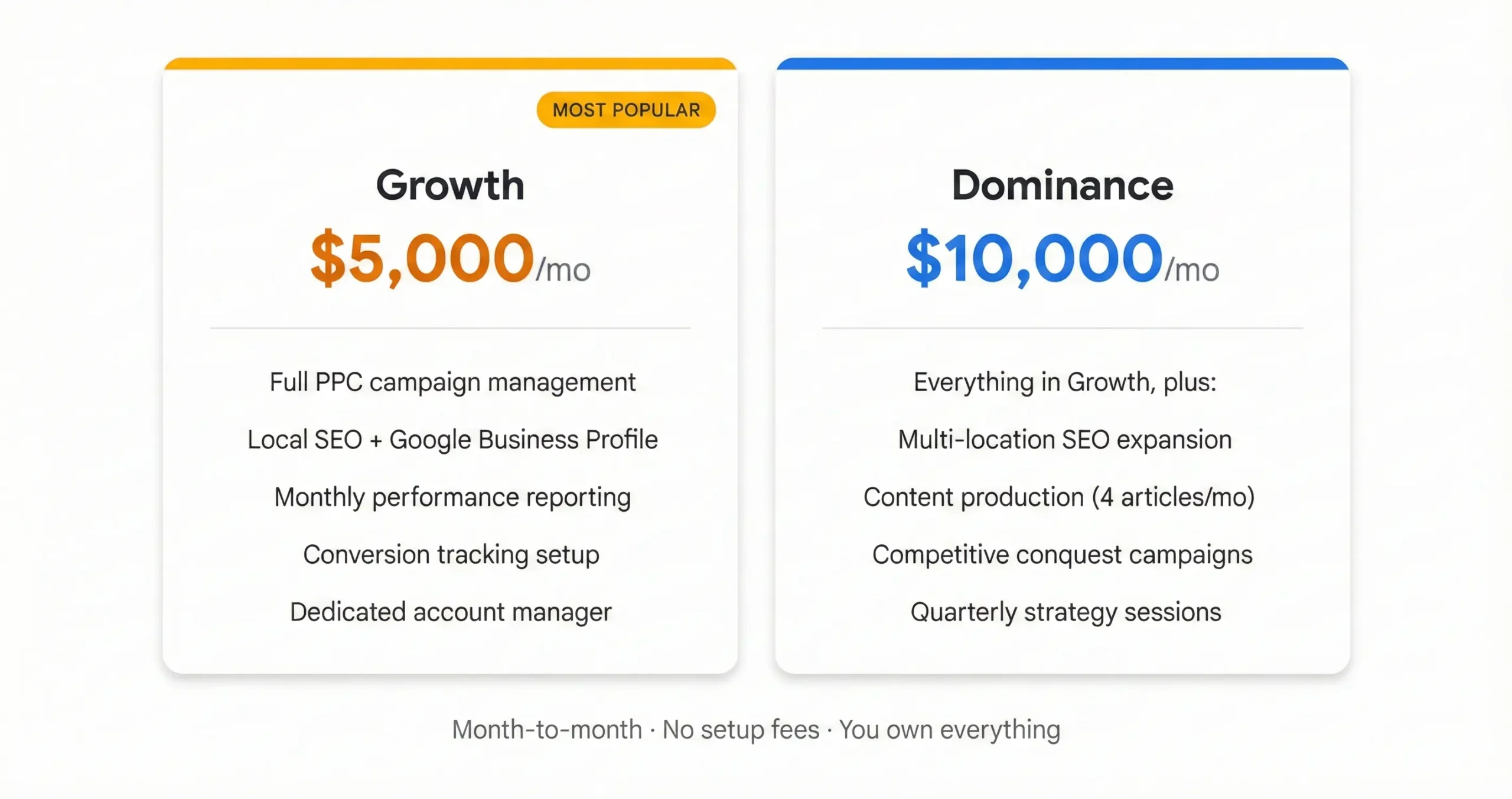
How much does Argota Marketing charge? Growth tier starts at $5,000/month and includes SEO, content marketing, PPC management, local SEO, and conversion tracking to signed cases. Dominance tier is $10,000/month and adds AI search optimization, digital PR, power pages, and dedicated strategy sprints. Both tiers are month-to-month; ad spend is separate and paid directly to Google. Website design is a one-time project starting at $5,000. Source: Jorge Argota, Argota Marketing, Miami.
Every attorney I’ve ever talked to has the same question, and it’s not about SEO or PPC or content strategy; it’s “what does this actually cost, total, every month, with nothing hidden.”
You’d think that would be easy to answer. But I’ve sat through maybe thirty agency proposals over the years and not a single one gave a straight number on the first call, which is something I still don’t really understand.
So what happens instead is you sit through a 45 minute discovery call where they ask about your “growth goals” and your “target markets.” Then two days later they send you a “custom proposal” that’s really just a PDF with your logo pasted on it.
That number is based on how much revenue they think you’re doing; not on the actual work. A $2 million firm gets quoted $8,000 for the same deliverables that a $500,000 firm gets quoted $4,000, and I guess that’s the whole point; they keep you in the dark so you can’t comparison shop.
You could keep sitting through those calls and hoping the next agency is different. Or you could demand a pricing page before you book anything; and if they don’t have one, you’d probably learn everything you need to know from that alone.
And here’s ours, all of it, right on the page. Two tiers, month-to-month, no setup fees, no custom quotes, no bait-and-switch. I’m going to show you something at the end that I think might be more important than the pricing itself; which is the list of things we don’t charge for that other agencies absolutely will, or whatever.
Growth Tier — $5,000 / month
Within 90 days you’ll know exactly which keywords are generating calls, which calls are turning into consultations, and which consultations are signing cases.
The entire point of this tier is turning $60,000 a year into a trackable pipeline that pays for itself three to five times over. I’ve seen firms go from “I think marketing is working but I’m not sure” to “I can tell you that keyword generated $340,000 in signed cases last quarter.”
That shift changes everything about how you think about your budget.
Think of it like this; right now your marketing is probably like a vending machine where you put money in and sometimes a case comes out but you can’t see the mechanism. What this tier does is replace the vending machine with a glass box where you can watch every dollar move through the system. That’s literally what conversion tracking to signed cases looks like when it’s set up right.
SEO and content. SEO is the foundation; technical audit, on-page optimization, title tags, meta descriptions, internal linking, schema markup, monthly monitoring. We publish four to five content pieces per month at 1,200 to 1,500 words each, targeted at keywords where someone is actually looking to hire a lawyer.
Link building. Two to five high-authority backlinks per month through manual outreach to legal publications and news outlets. Not paid directories, not blog comment spam; real editorial placements from sources Google trusts. This is the work most agencies skip because it’s tedious; and it’s also the single biggest reason one firm ranks and another doesn’t.
PPC. Google Ads and Local Service Ads across your practice areas. You pay Google directly from your own account; we never touch your ad spend, and there’s no percentage markup on top of whatever you’re spending on clicks.
Local SEO. Google Business Profile management, Map Pack spam fighting, NAP consistency, review strategy, weekly posts. For most law firms the Map Pack produces more cases than organic results; and getting into it requires consistent local signals that most agencies treat like an afterthought, which I think is maybe the most expensive mistake I see.
Timeline. I should be honest about this; the SEO side is a six to nine month play before you see meaningful ranking movement. Month one is fixing technical problems; months two and three are content and local signals; months four through six is when things start moving. Anyone who tells you otherwise is either lying or doing something that’ll get you penalized.
On the PPC side, calls come faster because you’re paying for visibility directly. But the organic pipeline compounds over time instead of resetting to zero every time you stop paying for clicks.
Why nothing cheaper. I used to think about offering a lower tier for solo practitioners who just need basic maintenance. But $2,500 a month doesn’t buy enough work to move the needle in any competitive market, and I’d rather turn someone away honestly than take their money for something that won’t match their goal.
Quick thing before I get into the next tier.
Percy Martinez had zero digital marketing presence when we started working together; no website traffic, no rankings, no online pipeline at all. His budget was maybe $500 and honestly most attorneys at that point would’ve been told to come back when they had more money.
The thing about online marketing for lawyers is it’s probably the safest and most reliable way to generate business without risking your bar license doing something you shouldn’t be doing.
We grew Percy from nothing into one of the top medical malpractice firms in Florida digitally, and he’s now ranking above Morgan and Morgan in Miami’s Map Pack. That didn’t happen because of a massive budget; it happened because the strategy was right from day one.
Dominance Tier — $10,000 / month
This is where firms stop competing on the same playing field as everyone else and start showing up in places their competitors don’t even know exist yet.
Within six months, you’ll have your attorneys getting quoted in legal publications and local media, your firm appearing in ChatGPT recommendations, and a content library deep enough that Google’s quality raters can’t ignore your authority.
So I’d normally expect people to look at $10,000 a month and think “that’s a lot of money for marketing.” Honestly it is a significant number to see on an invoice.
But the firms that need this tier are usually signing cases worth $50,000 to $500,000 or more. Which means a $120,000 annual investment that generates even ten additional cases isn’t an expense; it’s probably the highest returning line item on the whole P&L. I don’t know why more attorneys don’t run that math before they react to the sticker price, but they don’t.
Faster timeline. Double the content velocity means Google indexes and evaluates your authority twice as fast. Digital PR placements accelerate link acquisition by months compared to manual outreach alone. From what I’ve seen, Dominance clients hit meaningful traction in three to four months instead of six to nine; which is probably the single biggest practical difference between the two tiers.
Content at scale. Everything in Growth is included, and then it goes further. Content goes to eight or more pieces per month, including “power pages” at 2,500 to 3,000 words targeting your highest value practice areas with enough depth to outrank Avvo, FindLaw, and the national directories. These are the kind of pages that demonstrate genuine E-E-A-T; the content equivalent of showing up to court with a 40 page brief instead of a napkin.
Digital PR. Getting your attorneys quoted in local media and legal publications builds domain authority that regular link building can’t match. It’s honestly how Percy Martinez ended up ranking above firms with ten times his budget.
AI search. AI search optimization is included here, and this is the part I think most firms are going to regret ignoring. We build structured data profiles across Wikidata, legal directories, and your site’s schema so that when someone asks ChatGPT “who’s the best personal injury lawyer in Miami,” your firm shows up in the answer.
Twenty-eight percent of searches now start with AI, and that number keeps climbing. The agencies that figure this out in the next year or two will have a massive head start; and the ones that don’t will wonder why the phone slowed down even though their rankings look the same.
Your team. Bi-weekly strategy sprints instead of monthly calls, dedicated Slack access, full funnel management across every channel. I’m personally involved in strategy at this level; not a junior account manager reading from a playbook.
Website Design (One-Time, Separate)
Here’s what most firms are dealing with right now; they’re paying $2,500 a month for a website they don’t own, built on a template they paid custom prices for, hosted on a server they can’t access.
If they try to leave the agency wants $5,000 to release the files. But it doesn’t have to work that way; you pay once, you own everything, and if you fire us tomorrow you take it all with you.
Starter: $5,000 one-time. Eight to twelve pages, up to five practice areas, mobile optimization, 90+ PageSpeed at launch, WCAG 2.1 accessibility, SEO foundation, encrypted contact forms, training session. Built on WordPress with Kinsta hosting in your name. You own the site, the code, the hosting account, everything.
Custom: $10,000 one-time. Everything in Starter plus fifteen to twenty-five pages, multi-location support, client portal integration, SOC 2 Type II certified hosting, six months of priority support. For mid-size firms with needs like HIPAA-compliant intake forms or custom case result databases.
No monthly website fees unless you want ongoing support for patches and minor changes. You pay Kinsta directly at maybe $35 a month for hosting. Website design is separate from the retainer because building a site and marketing a site are two different things, and bundling them is how agencies hide what you’re paying for each.
What’s NOT Included (And Why This Might Be the Most Important Section)
Remember earlier when I said there’s something at the end that might matter more than the pricing itself; this is that section. The “what’s not included” list tells you more about an agency’s ethics than any testimonial page ever could.
You might feel nervous when you see things listed as “not included” because in your experience that usually means “surprise charge coming later.” Other firms have felt the same way after getting burned by hidden fees.
What they found when they looked at our model is that “not included” actually means “not hidden”; we’re telling you upfront so you can budget for it separately rather than discovering it on an invoice.
Ad spend. Your Google Ads budget, Local Service Ads budget, and any social ad spend go directly from you to the platform. We manage the campaigns as part of the retainer, but we never hold your money.
Most firms at Growth spend $3,000 to $10,000 a month on ads; at Dominance it’s usually $10,000 to $25,000. I’d rather you see two separate line items than one blended number where you can’t tell how much went to Google versus the agency.
Photography and video. Professional headshots, office photography, or video testimonials are scoped as separate projects because camera crews and post-production costs don’t belong in a predictable monthly retainer.
CRM and call tracking. We set up and configure CallRail, Clio, or whatever intake software you use, but you hold the account and pay the subscription. If you ever leave, you keep your data, your call recordings, your tracking numbers, and every lead. I’ve seen agencies hold phone numbers and analytics hostage after a client leaves; we don’t do that.
Legal compliance. We write the content and follow best practices for bar advertising rules, but the final sign-off on ethics compliance is your responsibility. We’re marketers, not lawyers; and I think more agencies should be honest about that instead of pretending they understand Rule 7.1 better than you do.
The Month-to-Month Thing
Both tiers are month-to-month with no strings attached. No 12 month contract, no early termination penalty, no recoupment clause.
I know what you’re thinking right now, because I hear it maybe once a week; “if there’s no contract, what stops me from leaving after you do all the setup work in month one.”
Look, that’s a reasonable thing to worry about. Other agencies felt the same way, which is why they lock you in; they’re afraid the work won’t speak for itself.
What we found is that when you front-load the deliverables instead of the billing, the retention takes care of itself. There’s no $5,000 onboarding fee we need to protect; we build the audit, the strategy document, and the technical foundation in month one as part of the retainer, not as a separate charge.
Most of our clients have been with us for more than a year, and not a single one is here because they’re contractually obligated to be. The work either produces cases or it doesn’t; and if it doesn’t, you should probably leave.
How to Figure Out Your Total Monthly Cost
Here’s the total picture so you can plan your actual budget, not just the retainer number.
| Growth | Dominance | |
|---|---|---|
| Monthly retainer | $5,000 | $10,000 |
| Typical ad spend range | $3,000 – $10,000 | $10,000 – $25,000 |
| Software (CallRail, etc.) | $100 – $300 | $200 – $500 |
| Total estimated monthly | $8,100 – $15,300 | $20,200 – $35,500 |
Those ranges are wide because ad spend depends on your market and practice area. A family law firm in a mid-sized Florida market might spend $3,000 a month on ads. A personal injury firm in Miami might need $15,000 just to stay visible.
We’ll tell you what we recommend based on the math, but the ad number is always your call.
No ad spend markup. We don’t take a percentage of your ad budget, ever. We don’t run it through our account. You pay Google directly, you see every penny, and there’s no blended billing where you can’t tell what went to clicks versus strategy. That separation is honestly the single biggest thing I’d tell any firm to demand from any agency, whether it’s us or someone else.
If you already have an agency and the numbers look similar to what you’re paying now, I’m not telling you to switch. Switching costs you two to three months of momentum, and if your situation is producing signed cases there’s probably no reason to change it.
But if you’re paying these kinds of numbers and you still can’t see your own data, and you don’t have a strategy document, and your “reports” are just impression counts with no lead attribution; then the problem probably isn’t the budget.
And the fact that you had to read a blog post to find this out instead of seeing it on your current agency’s pricing page; that should tell you something too.
Want to talk through which tier makes sense?
Pick a tier, get on a 20 minute call, and I’ll tell you honestly whether it’s the right fit for your market or whether you need something different entirely.