

Every “marketing on a budget” article for lawyers starts with paid ads, which is the wrong starting point when the budget is $1,500 a month. At that spend level Google Ads might produce a handful of leads if the targeting is tight, and the math on cost per lead versus what a family law case pays means you’d need almost every one of those leads to sign just to break even, which isn’t a marketing strategy, it’s a coin flip.
What $1,500 actually buys at the solo level is different from what most articles describe because it’s not ad spend, it’s infrastructure. The Google Business Profile that shows up in the map pack when someone searches your practice area in your city. The directory listings that make Google trust that your firm exists where you say it does. Basic SEO on your own site that you learn to do yourself because at this budget you can’t afford to pay someone $150 an hour to write title tags. Videos shot on your phone answering the questions your clients actually ask. And reviews, because a solo with 40 five-star reviews and a $1,500 budget will outperform a firm spending $5,000 a month on ads with a 3.8 rating every time.
The budget at this level covers tools and services that support things you’re doing yourself, not ad clicks that vanish the second you stop paying for them. And I think that distinction is what gets lost when agencies write about small firm marketing, because agencies make money on ad management fees and the advice tends to point wherever the revenue model points.
Why Paid Ads Are the Wrong Starting Point for Solos
Should a solo attorney spend money on Google Ads or Local Service Ads with a small budget? Probably not, and I know that’s not what most marketing blogs tell you. An LSA lead in family law costs $80 to $200, which means a $500 monthly ad budget gets you maybe two to five leads, and if even one of those is junk or goes to voicemail, you’ve lost 20 to 50 percent of your spend with nothing to show for it. Google Ads is even worse at this level because you’re paying per click not per lead, and at $100 to $150 per click for competitive practice areas your entire monthly budget disappears in a day. The math only starts working when you can spend $3,000 or more per month on ads consistently, which is where the volume smooths out the variance. Below that you’re gambling, and solos can’t afford to gamble with their marketing budget.
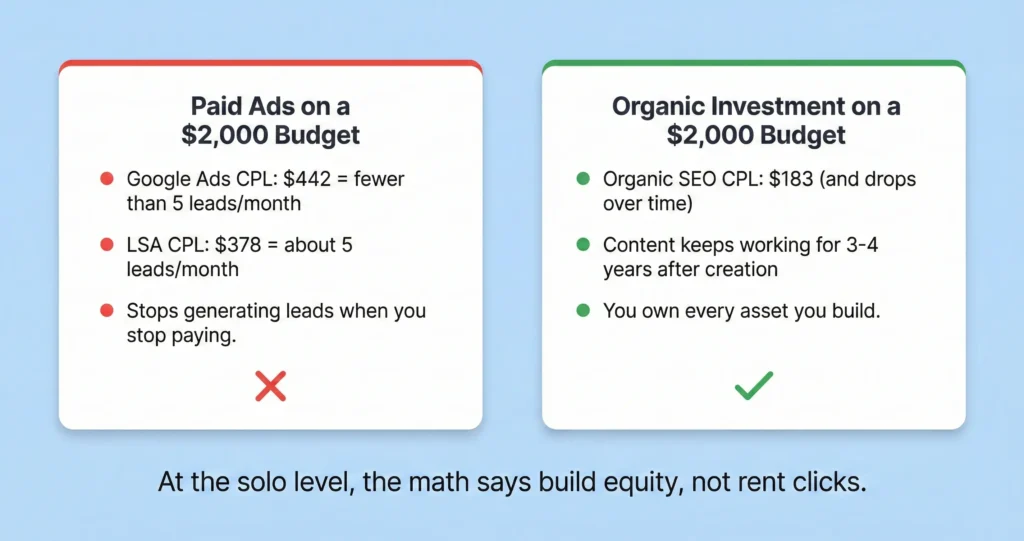
And I think the reason most solos feel stuck is because they’re looking at what the big firms do and trying to do a smaller version of that, which doesn’t work because the math is completely different at their level. The average cost per lead for personal injury through Google Ads in 2026 is around $442, which means if you gave your entire $2,000 budget to Google you’d get fewer than five leads total.
And at a 10 to 20 percent conversion rate from lead to signed case that’s zero to one new case per month, which is not a marketing strategy; that’s a statistical gamble with terrible odds, and the larger firms can absorb that variance because their volume smooths it out but a solo can’t.
A solo spending $500 on LSA gets maybe three leads and if one is a wrong number and one ghosts you after the first call, you’ve got one lead for $500 and that lead still has to convert to a signed case for the month not to be a total loss. Meanwhile the average cost per lead through organic SEO is $183 and through content-driven strategies it drops even lower over time because the content keeps working after you create it, which is the whole point.
The smarter play at this budget level is to invest in things that build equity over time rather than things that cost money every single month with no lasting value. A blog post you write today can generate leads for three or four years and costs nothing after the initial effort. A citation you build today strengthens your local rankings permanently.
A video you record on your phone today lives on YouTube forever and keeps showing up in search results. An ad click you bought today is gone tomorrow and you have to buy another one, and then another one the day after that, forever.
The Three Budget Tiers and What’s Actually Possible at Each One
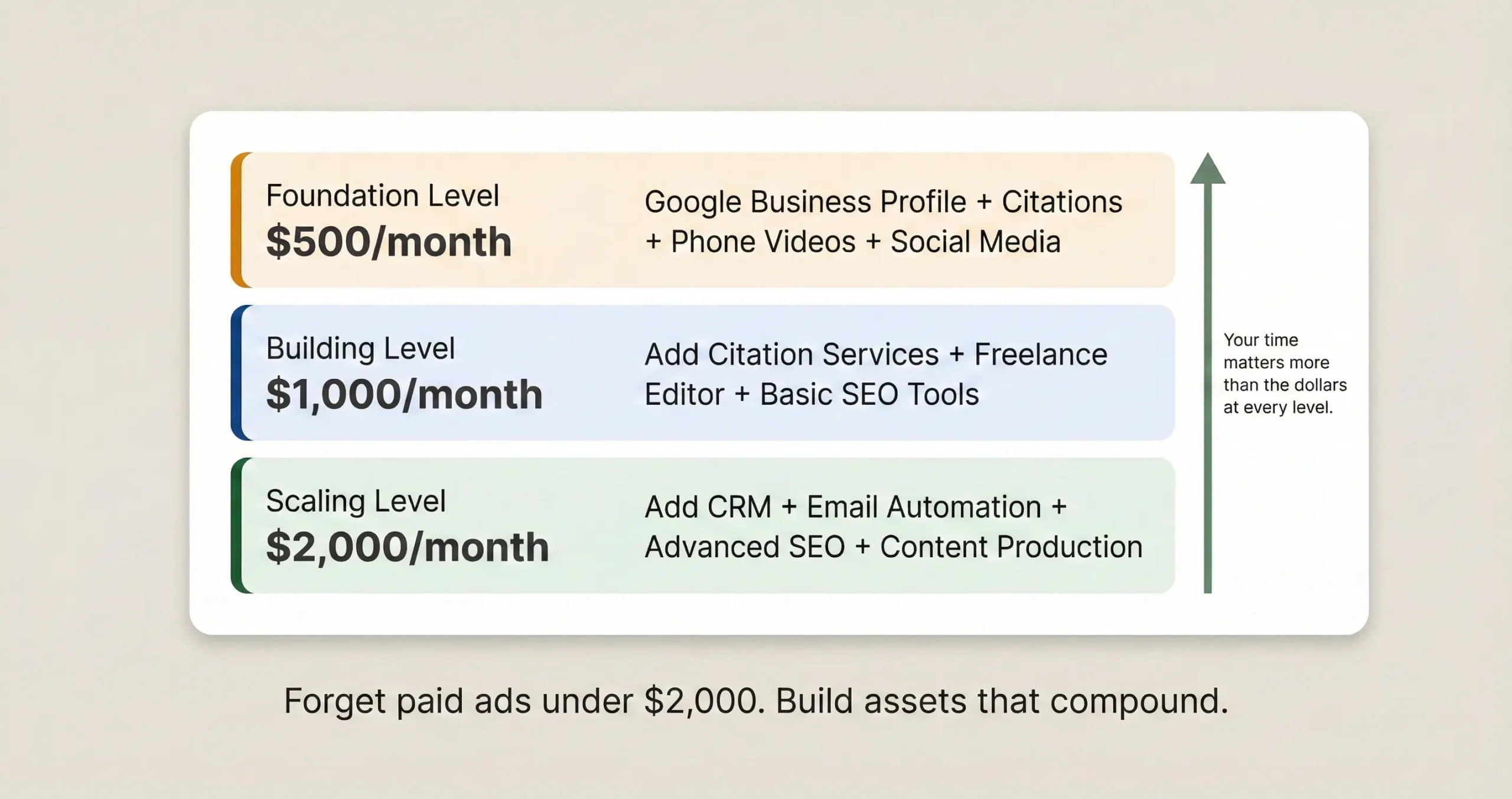
What can a solo attorney realistically accomplish with $500, $1,000, or $2,000 a month in marketing? Let me be clear about this; none of these budget levels work if you’re just writing a check and expecting leads to appear. At every tier you are the marketing department, and the budget covers tools, services, and education while you do the actual work. At $500 the budget goes to hosting, a citation service, and maybe a basic SEO tool while you’re recording phone videos, optimizing your Google Business Profile, collecting reviews, and posting to social media daily. At $1,000 you add a freelance editor for blog posts and a proper local SEO tracker. At $2,000 you add a CRM, email automation, and can invest in learning SEO properly or hiring a consultant to review your work. But at every level your 5 hours a week of personal effort matters more than the dollars.
I want to break this into three tiers because not every solo starts at $2,000 and honestly most shouldn’t. I started with a $500 budget at Percy Martinez competing against firms spending $50,000 a month on billboards and TV, and the reason that worked isn’t because $500 was enough; it’s because I was personally putting in 20 or 30 hours a week on the marketing side and the $500 just covered what I couldn’t do for free.
At $500 a month you’re the entire marketing department and there’s no way around it. Maybe $100 goes toward a citation building service like BrightLocal or Whitespark to get your firm listed consistently across 50 or 60 directories, $50 toward hosting and your domain, $100 toward a basic SEO tool so you can at least see what keywords you’re ranking for, and the rest toward networking lunches and coffee with referral sources.
Everything else is your time; recording videos on your phone, writing blog posts, optimizing your Google Business Profile, requesting reviews, and posting to social media every single day.
At $1,000 you can finally start breathing a little bit. About $150 goes to citation services, $100 for SEO tools, $300 for a freelance editor to polish two posts a month so you’re not doing literally everything yourself, $100 for a basic CRM so leads stop falling through cracks, and the rest toward a social media scheduling tool and networking. But you’re still recording the videos, you’re still coming up with the content ideas, you’re still sending the review requests, and you’re still the one engaging on social media personally.
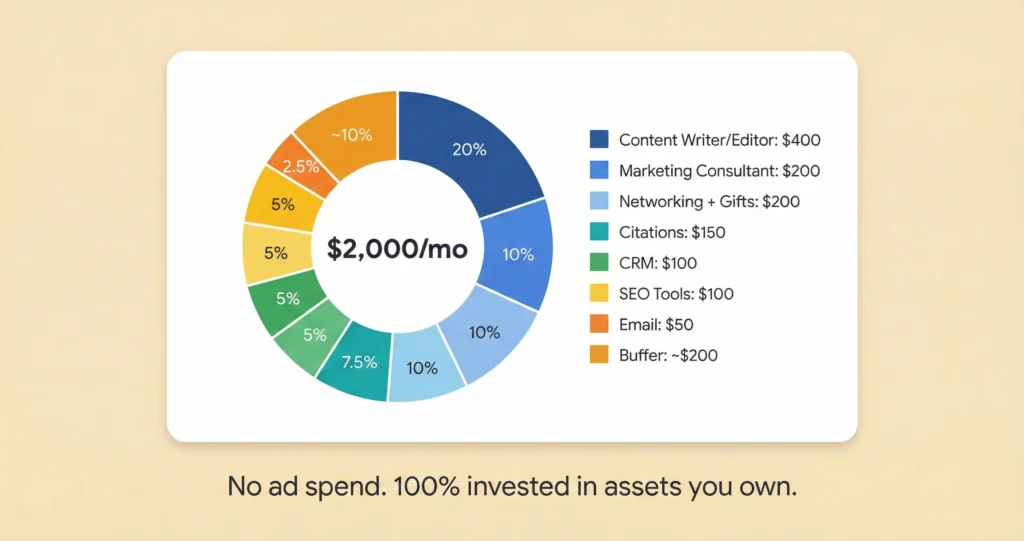
At $2,000 you’re running something that starts to look like a system but you’re still the engine. About $150 on citations, $100 on SEO tools, $400 on a freelance editor or content writer for four posts a month, $100 on a CRM like Clio Grow, $50 on email automation for past clients and referral sources, $200 on a marketing consultant who reviews your work monthly and tells you what to fix, and $200 on networking and referral gifts.
The rest is buffer for whatever comes up, and the strategy, the video content, the social media presence, the relationship building; that’s still you doing the work because nobody understands your practice area and your clients the way you do.
Your Google Business Profile Is Worth More Than Paid Ads
How important is Google Business Profile optimization for solo attorneys? It’s the single most valuable free marketing asset a solo attorney has and honestly at the under-$2,000 level it should get more attention than any paid channel. Your Google Business Profile controls what appears in the local map pack, which captures over 40% of clicks for local service searches. A profile with recent reviews, accurate practice area categories, real photos of the attorney, and weekly updates will outrank profiles with more reviews but less activity. Common mistakes include creating multiple profiles for different practice areas, which splits review equity, and using a logo instead of a headshot, which reduces trust when clients are hiring a person not a firm.
So before you spend a dollar on anything else you need to make sure your Google Business Profile isn’t working against you, because every referral and every organic search click and every person who hears your name at a networking event is going to Google you before they call, and if your profile has 2 reviews from 2022 and a stock photo of a gavel as the main image, everything else you’re doing is undermined.
And the mistakes I see solos make with their profile are the ones that seem small but actually kill your visibility. Listing a PO box or virtual office address instead of a real location, which Google is getting better at detecting and penalizing. Picking the wrong primary category like “lawyer” instead of “personal injury attorney” or “family law attorney,” which is the single biggest ranking factor for the map pack and most solos just pick whatever comes up first without thinking about it.
Leaving the services section empty or copying the same generic description every other attorney uses instead of writing out each specific service you offer with the city name included naturally is another one that costs you rankings for basically no reason.
And probably the biggest one is letting the profile go stale. Google rewards activity, and if you haven’t posted an update or added a photo in six months, your profile is losing ground to the attorney down the street who posts every week even if they have fewer reviews than you do.
And the photos thing matters more than people realize. Solo practice is personal; the client is hiring you, not a firm. A profile with a real headshot, a photo of your actual office even if it’s small, and a photo of you at your desk or in a courtroom builds more trust than a logo that looks like it was made in PowerPoint.
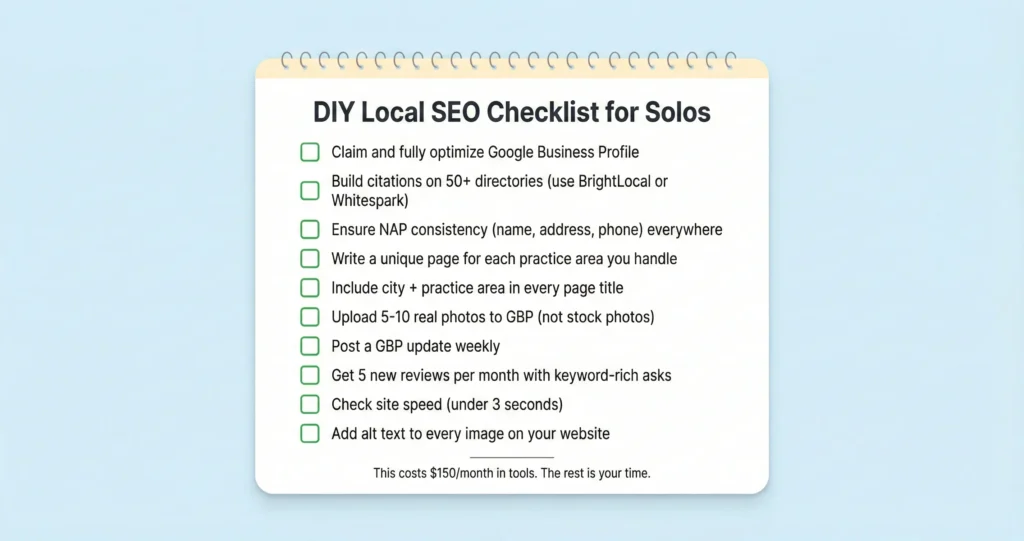
Upload 5 to 10 real photos and add a new one every month or so, and post an update to your GBP every week even if it’s just sharing a blog post you wrote, because Google treats activity as a ranking signal and a profile that hasn’t been updated in six months looks abandoned or worse.
Build Your Citations and Learn SEO Yourself
Should solo attorneys learn SEO or hire someone? At the under-$2,000 level you should learn it yourself, and I know that sounds intimidating but basic local SEO is not rocket science. The foundation is consistent citations, which means your firm name, address, and phone number listed identically across every directory on the internet. A citation building service like BrightLocal or Whitespark runs $100 to $150 a month and gets you listed on 50 to 80 directories, which is one of the strongest local ranking signals and something most solo attorneys completely ignore. Beyond citations, basic on-page SEO means putting your city and practice area in your page titles, writing unique content for each service you offer, and making sure your website loads in under 3 seconds. You can learn all of this with free resources online and a $39 a month SEO tool to track your progress.
And this is honestly where most of your budget should go at this level because citations and basic SEO are the only marketing investments that compound permanently. Every directory listing you build makes it a little bit easier to rank in the local map pack, and once you’re there you’re getting leads without paying for them, which is the entire point.
A citation service does the tedious work of submitting your firm’s name, address, and phone number to Avvo, FindLaw, Justia, Yelp, your local Chamber of Commerce, and 50 or 60 other directories that most solos don’t even know exist.
The key is that your information has to be identical everywhere; if Google sees “Law Office of J. Doe” on one site and “Jane Doe Attorney at Law” on another, confidence in the data drops and your rankings suffer. The service handles that consistency for you, and at $100 to $150 a month it’s probably the highest ROI line item in the entire budget.
Beyond citations, learning basic on-page SEO is something you can do with YouTube tutorials and a tool like BrightLocal or Ubersuggest tracking your progress. Put your city and practice area in your page titles, write a unique page for every service you offer instead of cramming everything onto one “practice areas” page, add alt text to your images, and make sure your site loads fast.
None of this requires a developer or an agency; it requires you spending a few hours learning and then applying what you learn to your own website, which you should own and control on WordPress anyway.
And one more thing that matters more now than it did even a year ago; the way you format your content determines whether AI systems like Google’s AI Overview and ChatGPT and Perplexity cite your website when someone asks them a legal question.
Start every page with a direct answer to the question in the first paragraph, like “In Florida you have 4 years to file a negligence lawsuit” instead of burying the answer behind three paragraphs of introduction. AI crawlers pull from pages that answer the question immediately, and structured data markup like FAQ schema tells the robots exactly what your page is about, which the GEO post covers in detail.
Pick Up Your Phone and Start Recording
Should solo attorneys make videos for marketing? Yes, and you don’t need equipment or a studio or a production budget. You need your phone, a quiet room, and answers to the questions your clients ask every week. A 2 to 3 minute video answering “what happens if I miss my DUI court date in Hillsborough County” uploaded to YouTube and embedded on your website creates two marketing assets from one recording session, and those assets keep generating leads for years without any ongoing cost. Only 30% of law firms create any video content at all and just 13% use Instagram, which means the competition for video in the legal space is almost nonexistent compared to written content. The clients who find you through video already feel like they know you before they call, which makes the intake conversation easier and the conversion rate higher.
And I know the instinct here is to think you need a professional setup or that your videos need to look polished, and I need you to hear me when I say that’s completely wrong. The attorneys getting the best results from video are the ones filming at their desk with their phone propped against a stack of books, talking directly to the camera like they’re explaining something to a client sitting across from them, and that raw unpolished quality is actually what makes it work because it feels real.
Record a 2 to 3 minute video answering one specific question you heard in a consultation that week. Upload it to YouTube with a title that matches how a real person would search, like “can my landlord evict me without notice in Florida” not “eviction law overview.” Then take that same video, run the audio through a free transcription tool like Otter or Descript, clean up the transcript with AI, and now you have a blog post too.
You just created a YouTube video, a blog post, and a social media clip from the same 3 minutes of talking into your phone, and you can share that video on LinkedIn, Facebook, Instagram, and your Google Business Profile updates for the rest of the week. And the video marketing post goes deeper on how to batch-film 15 to 20 of these in one afternoon so you’ve got a month of content from maybe three hours of total effort.
Social Media Mixed with Organic Posting Actually Works
Does social media marketing work for solo attorneys on a small budget? It works if you treat it like a conversation and not a billboard, and if you mix paid boosts with consistent organic posting rather than relying on either one alone. A $50 to $100 monthly boost on Facebook or Instagram pushing your best-performing video to people within 15 miles of your office is the only paid advertising I’d recommend at this budget level because the targeting is tight, the cost is low, and you’re amplifying content you already created for free. But the organic posting matters more than the boost; showing up daily with quick tips, case updates without confidential details, community involvement, and reshares of your own blog content builds the kind of familiarity that makes someone call you instead of the attorney they found on Google.
And I want to be specific about what “posting consistently” means because I see solos share something once a week and wonder why nothing happens. The algorithm on every platform rewards daily activity, and it doesn’t have to be polished; a quick text post on LinkedIn sharing something you learned in court today, a 30 second phone video on Instagram answering a common question, a Facebook post sharing a blog article you wrote last month.
The mix is what matters; some video, some text, some reshares of your blog content, some engagement with other people’s posts, and maybe once a week you boost your best performing piece for $15 to $25 to push it beyond your existing followers. That’s the only paid advertising I’d tell a solo to consider at this budget level, because a $50 to $100 monthly social boost on targeted local content is a completely different risk profile than a $500 Google Ads budget that disappears in three days.
And the social media effort ties back into your SEO and your Google Business Profile too, because Google is now indexing Instagram Reels and the engagement signals from your social posts contribute to your overall online authority. It’s all connected, and the solos who treat these channels as separate things end up doing twice the work for half the results, which is frustrating but fixable once you understand that one piece of content should live in five or six places.
The 5 Hour Weekly Plan That Actually Works
How can a solo attorney do their own marketing in just 5 hours a week? This is actually the most important section of this entire post because the 5 hours a week you put in personally matters more than whatever dollar amount you’re spending. Treat the schedule like a court date; same time every day, non-negotiable. Monday is reputation management; respond to reviews, request new ones from recent clients. Tuesday is referral networking; three handwritten notes and 30 minutes of real engagement on LinkedIn. Wednesday is content creation; record one video on your phone or draft one blog post. Thursday is distribution; publish, share to social media and Google Business Profile, boost your best post from last week. Friday is analytics; check your rankings, review your citation audit, and make sure no leads went unanswered. The consistency matters more than the volume; 5 hours a week every week beats 20 hours once a month every time.
The time problem is real and I’m not going to pretend it isn’t. You’re in court, you’re meeting clients, you’re drafting motions, and the idea of spending time on marketing feels like something you’ll get to eventually, and then eventually never comes and the pipeline dries up and you’re back to panicking.
So the system has to be rigid and small. One hour a day, five days a week, same time every day, and you protect it the way you’d protect a hearing on your calendar. Monday you spend 15 minutes checking and responding to reviews, 30 minutes sending personal review requests to two or three clients whose cases just closed with a direct one-click link to your Google review form, and 15 minutes checking your citation audit for any inconsistencies that need fixing.
Tuesday is all about relationships and referral sources. Write three handwritten notes or personal emails to referral sources, not sales pitches, just “saw your article” or “congrats on the verdict” kind of stuff, and spend 30 minutes actually engaging on LinkedIn with comments that add something instead of just scrolling. Wednesday you record one video on your phone answering a question you heard in a consultation that week, or draft a blog post if you’re not feeling the camera that day.
Thursday you publish it, share it to LinkedIn and Facebook and your Google Business Profile, boost your best performing post from last week for $15 to $25, and schedule two or three reshares of older content. Friday you spend 30 minutes checking your keyword rankings in your SEO tool and 30 minutes making sure no leads went unanswered or got stuck without follow-up, which I promise you is happening more than you think. And the intake post goes deeper on why that matters.
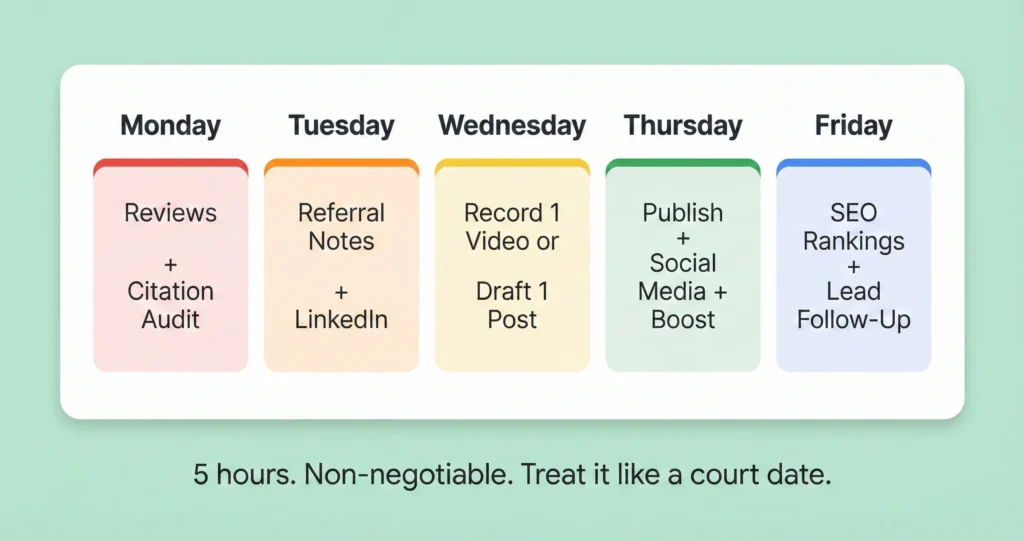
The “Non-Negotiable” 5-Hour Weekly Schedule
Treat these blocks like a hearing on your calendar, and if you skip one you’re in contempt of your own revenue.
| Day | Time Block | The Task | What You’re Building |
|---|---|---|---|
| Monday | 1 hour | Reputation Defense | Respond to reviews, send 3 review requests, check citation audit |
| Tuesday | 1 hour | Relationship Equity | 3 handwritten notes to referral sources, 30 min LinkedIn engagement |
| Wednesday | 1 hour | Asset Creation | Record 1 phone video or draft 1 blog post answering a client question |
| Thursday | 1 hour | Distribution | Publish to website, share to GBP + LinkedIn + Facebook, boost best post |
| Friday | 1 hour | Financial Audit | Check keyword rankings, verify every lead got a callback, review intake log |
Content That Signs Cases Without Paying for Clicks
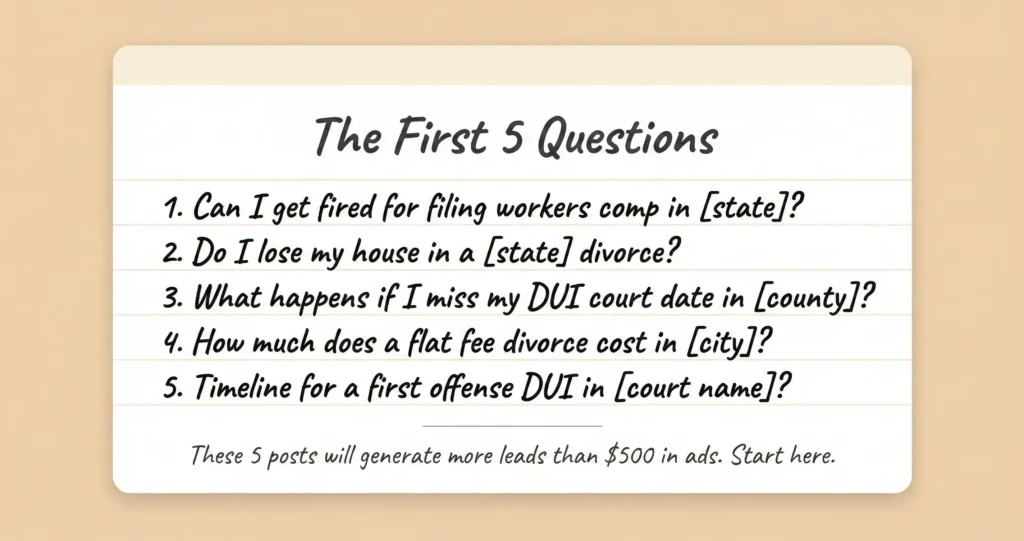
What kind of content should a solo attorney create for marketing? The specific questions your clients ask during consultations that nobody else is answering online. “Can I get fired for filing workers comp in Florida?” and “how is alimony calculated for business owners in Hillsborough County?” and “timeline for a first offense DUI in Orange County court” are the kinds of long-tail queries that large firms ignore because the search volume is too low for their traffic goals, but a solo can build a practice on 20 searches a month if those searches are from people with urgent, specific, high-value problems who are ready to hire. This is free traffic from Google that costs nothing after the initial effort of creating the content, which is the exact opposite of paid ads where every lead costs money forever.
And this is where solos actually have an advantage over bigger firms and I don’t think most of them realize it. The large firms are chasing “car accident lawyer” and “divorce attorney near me” because those terms get thousands of searches a month and they need volume to justify their overhead. But those terms are only accessible through paid ads at the solo level, and the organic competition is so fierce you’d need years and thousands of dollars in SEO to rank for them.
The questions your clients ask in consultations are different; they’re long-tail, they’re specific, and the competition to rank for them organically is often minimal because the big firms don’t bother. “What happens if I miss my court date for a DUI in Hillsborough County” gets maybe 20 or 30 searches a month, but those 20 people are way more likely to call than the 2,000 people searching “divorce lawyer,” and you can rank for that term with a single well-written blog post and a matching YouTube video in a matter of weeks.
And the framework I give every solo I work with is what I call the “First 5” method; sit down and write the five questions you hear most in initial consultations, and those become your first five blog posts and your first five videos.
Not “why hire us” or “our firm history” because nobody searches for that. The actual questions real people ask when they’re scared and confused and need a lawyer, and if you answer those five questions better than anyone else on the internet for your county, you’ve got the start of something that compounds over time in ways that paid ads never will.
And the other advantage solos have here is that big firms can’t create hyper-local content at scale. Morgan and Morgan isn’t going to write a page about “golf cart accidents in The Villages” or “boating injury liability in Charlotte Harbor” because those terms are too small for their traffic goals, but a solo practice in that area can dominate those searches with one well-written page and nobody competing for the space. Go narrow and go local and you’ll rank for things the giants literally cannot be bothered to target.
The Tools That Are Actually Worth Paying For
What tools does a solo attorney actually need for marketing? At the under-$2,000 level the essential stack is a citation building service at $100 to $150 a month, a local SEO tracking tool at $39, a social media scheduler at $6 to $15, a basic CRM at $50 to $100, an email marketing tool at $20, a design tool like Canva at $15, and an AI assistant at $20 for drafting content. Total runs about $250 to $360 a month, leaving the rest of the budget for a freelance editor, a consultant review, networking, and a small social media boost. The CRM is the most important piece because it stops you from losing the organic leads you worked so hard to generate; spending $50 a month on software that tracks follow-ups is worth more than $500 in ads if your current system is a sticky note on your desk.
I know this part feels boring but it’s where most solos either overspend on stuff they don’t need or underspend on the one thing that would actually change their numbers. The total tech stack for a solo should run $250 to $360 a month and anything above that means you’re paying for features you’re not using or worse, you’re paying for an agency-lite service that’s adding a markup on tools you could subscribe to yourself.
The citation service is the unsung hero because it does the tedious work you’d never get around to manually; submitting your firm to 50 or 60 directories, monitoring for inconsistencies, and cleaning up duplicate listings that are hurting your rankings. BrightLocal at about $39 a month also tracks your keyword positions so you can see whether your SEO efforts are actually moving the needle, which is important because otherwise you’re just guessing.
Everything else is support; Buffer or something similar for scheduling social posts so you can batch everything on Thursday and not think about it the rest of the week, Mailchimp for automated email sequences that keep past clients and referral sources aware you exist, Canva for making a social graphic without hiring a designer, and an AI tool like Claude or ChatGPT for drafting blog posts that you then edit for accuracy and voice.
The Solo “Lean Stack” (Under $350/month)
| Tool Category | Recommended | Cost (Est.) | What It Does |
|---|---|---|---|
| Citations | BrightLocal / Whitespark | ~$100/mo | Fixes your NAP data across 50+ directories |
| SEO Tracking | Ubersuggest / SE Ranking | ~$39/mo | Shows whether your rankings are moving |
| Social Scheduling | Buffer / Metricool | Free – $15/mo | Batches your posting so Thursday handles the week |
| CRM | Clio Grow / Lawmatics | ~$50-100/mo | Stops leads from falling through the cracks |
| Mailchimp (Free Tier) | $0 – $20/mo | Automates referral and past client check-ins | |
| Design | Canva Pro | ~$15/mo | Social graphics without hiring a designer |
| AI Drafting | Claude / ChatGPT | ~$20/mo | First drafts you edit for accuracy and voice |
| Total | ~$260-310/mo | The rest goes to content help and networking |
When to Stop Doing It Yourself
When should a solo attorney hire a marketing agency? When the budget consistently exceeds $3,000 to $4,000 a month and managing the campaigns is taking time away from practicing law. Below that threshold the agency retainer eats too much of the budget; a $1,500 monthly retainer on a $2,000 budget leaves nothing for actual marketing activities, which is why most solo-agency relationships fail. What works better at the under-$3,000 level is a guide or consultant who teaches you what to do and checks your work periodically rather than doing it all for you. Think of it like hiring a personal trainer versus hiring someone to exercise for you; at the solo level you need to be the one doing the reps, you just need someone making sure you’re doing the right exercises in the right order.
And I want to be honest about this part because I run an agency and telling people not to hire an agency yet feels weird, but the math is the math. If your total marketing budget is $1,500 a month and an agency charges a $1,500 retainer, you have zero dollars left for tools, citations, content, or anything else and the agency is going to “optimize your Google Business Profile” for six months and call it strategy.
The marketing budget post goes deeper on allocation, but the short version is that full-service agency retainers make sense when you can spend at least $3,000 to $4,000 total. Below that, what actually works is a consultant or guide relationship where someone with experience tells you exactly what to do, reviews your work, and course-corrects when you’re heading in the wrong direction, and you do the actual execution yourself because you can’t afford to pay someone else to do it yet and honestly you’ll learn more this way anyway.
The analogy I keep coming back to is the personal trainer thing. A trainer doesn’t lift the weights for you; they tell you which exercises to do, how many reps, and they correct your form when you’re about to hurt yourself. That’s what a solo attorney at this budget level needs from a marketing person, not a full agency running everything but someone who understands the landscape well enough to keep you from wasting six months on the wrong things.
But there’s a flip side, which is that at some point your time becomes more expensive than the help. If you’re billing $300 an hour and spending 5 hours a week managing your own marketing, that’s $6,000 a month in opportunity cost, and hiring someone to handle it for $2,000 frees up $4,000 worth of billable time.
That’s when the switch makes sense, and for most solos that tipping point comes somewhere between year two and year three of consistent marketing when the pipeline is full enough that the time you spend managing it starts competing with the time you need to actually practice law, which is a nice problem to have but still a problem.
Not sure where to focus your time and money first?
I’ll look at your practice area, your market, and what you’re working with and tell you exactly where to start and what order to do things in. Most solos don’t need an agency; they need someone to point them in the right direction so they’re not wasting the limited hours and dollars they have. And if you’re already doing fine on your own I’ll tell you that too.