Written by Jorge Argota · Personal Injury Marketing · Miami, Florida
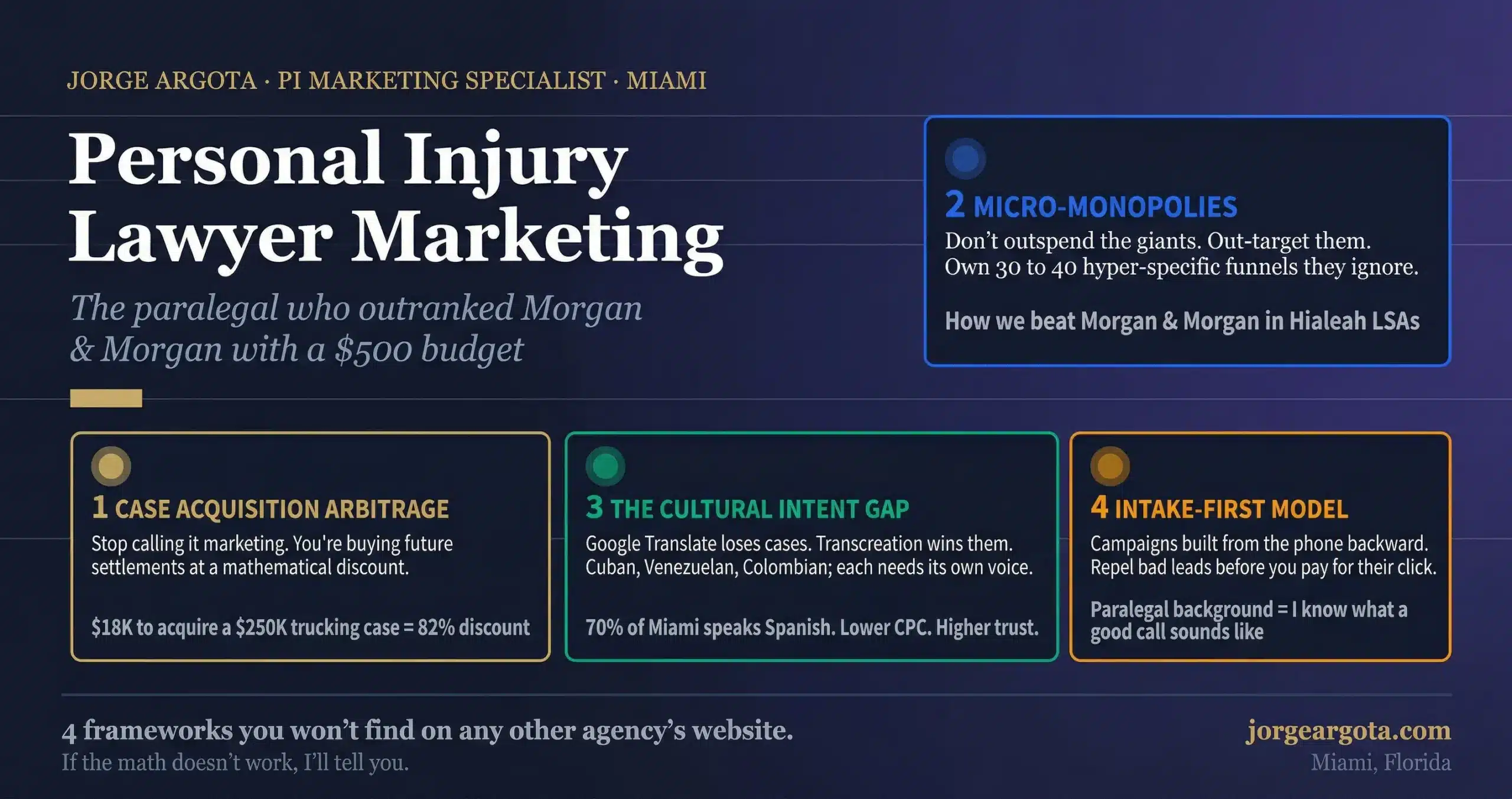
I started as a paralegal answering intake calls at a medical malpractice firm in Miami. We had a $500 marketing budget. The firms on the billboards around us were spending $50,000 a month on TV. In 10 years time that solo attorney practice had expanded to four cities across Florida and ranked above Morgan and Morgan in Local Service Ads in Hialeah. Not because we outspent them. We couldn’t. We out targeted them. And the way we did it is the foundation of everything I build for PI firms today.
Most PI marketing agencies organize their pitch around services: “we do SEO, we do PPC, we do web design.” That tells you nothing about signed cases. It just tells you what software they use. This page is organized around four things I learned spending a decade inside a PI firm that you won’t find on any other agency’s website.
TL;DR
I don’t sell “SEO and PPC.” I build case acquisition systems for PI firms based on four frameworks developed over a decade inside a medical malpractice practice. Case Acquisition Arbitrage: the math that turns marketing into a vending machine where you buy future settlements at a discount. Micro Monopolies: hyper targeted landing pages that let a small firm outrank the billboard giants by owning 30 to 50 small territories they don’t bother defending. The Cultural Intent Gap: transcreated Spanish campaigns that convert because they sound like a person, not Google Translate. The Intake First Model: every campaign reverse engineered from the signed retainer backward so you stop paying for leads that waste your intake team’s time. You own everything I build from day one.
STOP CALLING IT MARKETING. IT’S CASE ACQUISITION ARBITRAGE.
PI lawyers don’t need “marketing.” What they need is a system that buys future settlements at a mathematical discount. And once you see it that way, everything about how you spend money changes.
How many $100,000 settlements can you buy for $18,000 each?
A trucking case that settles for $250,000 generates roughly $100,000 in fees. If your total marketing cost to acquire that case across all channels was $18,000, you just bought a $100,000 asset for 18 cents on the dollar. When the tracking is built correctly, marketing isn’t a slot machine. It’s a vending machine where you insert $18,000 and extract a $100,000 fee. The question isn’t “is marketing too expensive.” The question is “how many $100,000 settlements can I buy for $18,000 each.” The paid search breakdown has the channel specific math on cost per click and cost per lead.
But this math breaks if you can’t distinguish a signed case from a tire kicker. That’s the tracking spine I build; different phone numbers for different sources, your case management software carrying source data from the first touchpoint to the signed retainer, and conversion data flowing back to your ad platforms so the algorithms learn what a good lead looks like and stop wasting your money on bad ones. The pipeline guide has the full technical setup. What I build: the tracking infrastructure that connects every marketing dollar to a signed retainer so you can see the arbitrage math on every case type, every month, without guessing.
THE PI CASE ACQUISITION CALCULATOR
Drag the sliders to match your practice. Trucking cases: set fee to $100K+. Auto accidents: set fee to $15K to $50K.
BUILDING MICRO MONOPOLIES: HOW A SMALL FIRM BEATS THE BILLBOARD GIANTS
You cannot outspend Morgan and Morgan on the keyword “personal injury lawyer.” It’s financial suicide for any firm that isn’t spending nine figures a year on marketing. But you don’t need to. The giants cast a massive net across the entire state. They build one generic page for “personal injury” and try to rank for everything. That approach wins on volume. It loses on relevance.
What I build instead are micro monopolies. Instead of trying to rank for “Miami personal injury lawyer” against every firm in the county, I build a dedicated page for “Hialeah rear end collision attorney” with specific content about rear end whiplash injuries, the local courthouse for that jurisdiction, a phone number at the top, and a three field form. The giant has one generic page. You have a page that matches exactly what the person searched for, which is why the conversion rate runs 3 to 4 times higher. The person searched for exactly what they need and your page is exactly about that.
The proof: This is how we outranked Morgan and Morgan in Hialeah with a fraction of the budget. We didn’t try to win Miami. We won Hialeah. Then we won specific accident types. Then specific injury keywords. Each micro monopoly is a small piece of territory the big firms don’t bother defending because individually each one is too small to matter to them. But when you own 30 or 40 of those micro monopolies, the total case volume adds up to a firm competing with the billboards without spending billboard money.
And one thing most PI firms don’t realize; Google specifically blocks you from showing follow up ads to people who searched for injury terms because injuries are classified as sensitive health conditions. That means your page has to convert the first visit because you can’t chase that visitor around the internet afterward. Which is exactly why the micro monopoly approach works; the page matches the search so precisely that you don’t need the follow up if the first touch converts. What I build: 30 to 50 hyper targeted landing pages, each one built for a specific accident type and geographic area, with dedicated tracking numbers and conversion optimized layouts. You end up owning dozens of small territories that add up to a practice competing at the top of your market.
THE CULTURAL INTENT GAP: WHY TRANSLATION LOSES CASES
Over 70% of Miami-Dade speaks a language other than English at home. Most PI firms try to capture this by running their English website through Google Translate and calling it a Spanish page. That creates what I call the Cultural Intent Gap. A translated site uses formal, academic Spanish that a frightened, injured construction worker doesn’t search for and doesn’t trust when they find it.
Native speakers can tell the difference immediately. Google Translate produces text that reads like a legal textbook translated by a machine, because that’s what it is. The phrasing is technically correct but emotionally wrong. It sounds like a document, not a person. And when someone is hurt and scared and searching for help in their language, they need to feel like the firm understands them, not like the firm ran their English copy through a filter.
Translation vs Transcreation: Translation converts words from one language to another. Transcreation rebuilds the message from scratch for the cultural context. Cuban Spanish in Miami is different from Venezuelan Spanish is different from Colombian Spanish. I research the actual search terms people use when they’re hurt; the localized slang, the way they describe accidents in their own words; and I build the campaigns around how they actually speak. The cost per lead on Spanish keywords is cheaper because the competition is lower, and the trust is immediate because the page sounds like a person who understands their situation.
Bad Spanish pages are worse than no Spanish pages. If your site has Google Translate Spanish right now, a native speaker landing on that page isn’t just confused; they actively distrust the firm because the page signals that you couldn’t be bothered to communicate with them properly. That’s not a marketing problem. That’s a reputation problem. What I build: native Spanish campaigns transcreated from scratch for the cultural context of your specific market; Cuban Spanish in Miami, Venezuelan in Doral, Colombian in Weston. Separate keyword research, separate landing pages, separate ad copy, all built by native speakers who understand how your potential clients actually describe their injuries when they search.
THE INTAKE FIRST MODEL: CAMPAIGNS BUILT FROM THE PHONE BACKWARD
Marketing agencies build campaigns based on search volume. I build campaigns based on what a profitable case sounds like on the phone. Because I spent years answering PI intake calls, I know that the majority of “high volume” traffic produces callers who will never sign; people who were at fault, property damage only accidents, people calling for a friend, and researchers who aren’t ready to hire anyone.
I reverse engineer the campaign by starting with the signed retainer and working backward. What did the person search? What page did they land on? What did they see first? Was there anything in the page copy or the ad targeting that could have filtered out the bad leads before you paid for their attention? The answer is almost always yes. Qualifying language in the content, landing pages that speak to specific injury types instead of generic “personal injury,” and negative keyword strategies on the paid side all work to repel the leads that waste your intake team’s time and attract the ones worth pursuing. The paid search page goes deeper on the targeting and negative keyword setup.
At Percy we treated intake like an emergency room. The phone got answered within minutes. The first question was always about what happened, not about whether they had insurance. And we tracked which campaigns produced the calls that turned into cases versus the calls that went nowhere, so we could shift the budget toward the sources that produced real cases and away from the ones producing noise.
That’s the model I bring to every PI firm I work with. The conversion guide has the full intake benchmarks. What I build: a closed loop system where every lead is tagged at source, tracked through intake to signed retainer, and the data flows back to every marketing channel so you’re spending more on what produces cases and less on what produces noise. Your intake team gets a lead quality report every week showing exactly which sources are worth the money and which ones aren’t.
THE PRICE OF ADMISSION
I’m not putting a specific price on this page because it depends on your market, your case type mix, and how aggressive your growth targets are. But I’ll tell you the ranges where the arbitrage math works.
Small PI Firms (1 to 5 Attorneys)
$5,000 to $15,000/mo
Strategy, content, and SEO. Ad spend is separate and managed transparently in your own accounts. You’re building the micro monopoly foundation; owning your suburb, your accident types, and the organic content that compounds over time. Expect 6 to 12 months before organic produces cases at scale, with early wins from Local Service Ads and targeted content in the first 90 days.
Mid Size PI Firms (6 to 20 Attorneys)
$15,000 to $40,000+/mo
The full system. Organic search at scale across all case types, content built for AI search visibility, dedicated landing pages for every micro monopoly, and the tracking spine connecting every channel to signed retainers. Ad spend is always separate and always in accounts you own.
The timeline: organic search takes 6 to 12 months to compound but once it does the cost per case drops every month because a growing share of cases comes from organic at nearly zero incremental cost. I’ve seen firms cut their cost per signed case by 40 to 70% over 18 to 24 months using this model. I’ll give you realistic projections based on your specific market when we talk.
If You’re Switching from an Agency
Ask your current agency three things before you decide.
- What is my cost per signed case by case type for the last 6 months? If they can’t answer, they don’t have the tracking.
- Do I own my website, my ad accounts, and my content? If any answer is no, that’s a problem.
- Show me the real links you’ve built in the last 90 days. If they say “proprietary network” that usually means fake sites. I build everything on WordPress. You own it all from day one.
The transition plan runs with zero downtime; the phone keeps ringing through the entire switch. The agency evaluation guide has the full 15 question scorecard.
Send me your case type mix, your market, and what you’re currently spending through the contact page and I’ll run the arbitrage math for your specific situation. If the numbers work I’ll tell you what I’d build and what it would cost. If the numbers don’t work at your current budget level I’ll tell you that too because I’d rather turn down work than take money that doesn’t produce cases. That’s the whole philosophy and it hasn’t changed since the $500 budget days.
Related: How to Get More PI Cases · Paid Search for Law Firms · Google Ads Cost and ROI · SEO for Lawyers · Predictable PI Pipeline · Conversion Optimization · AI Search Visibility · How to Choose an Agency