
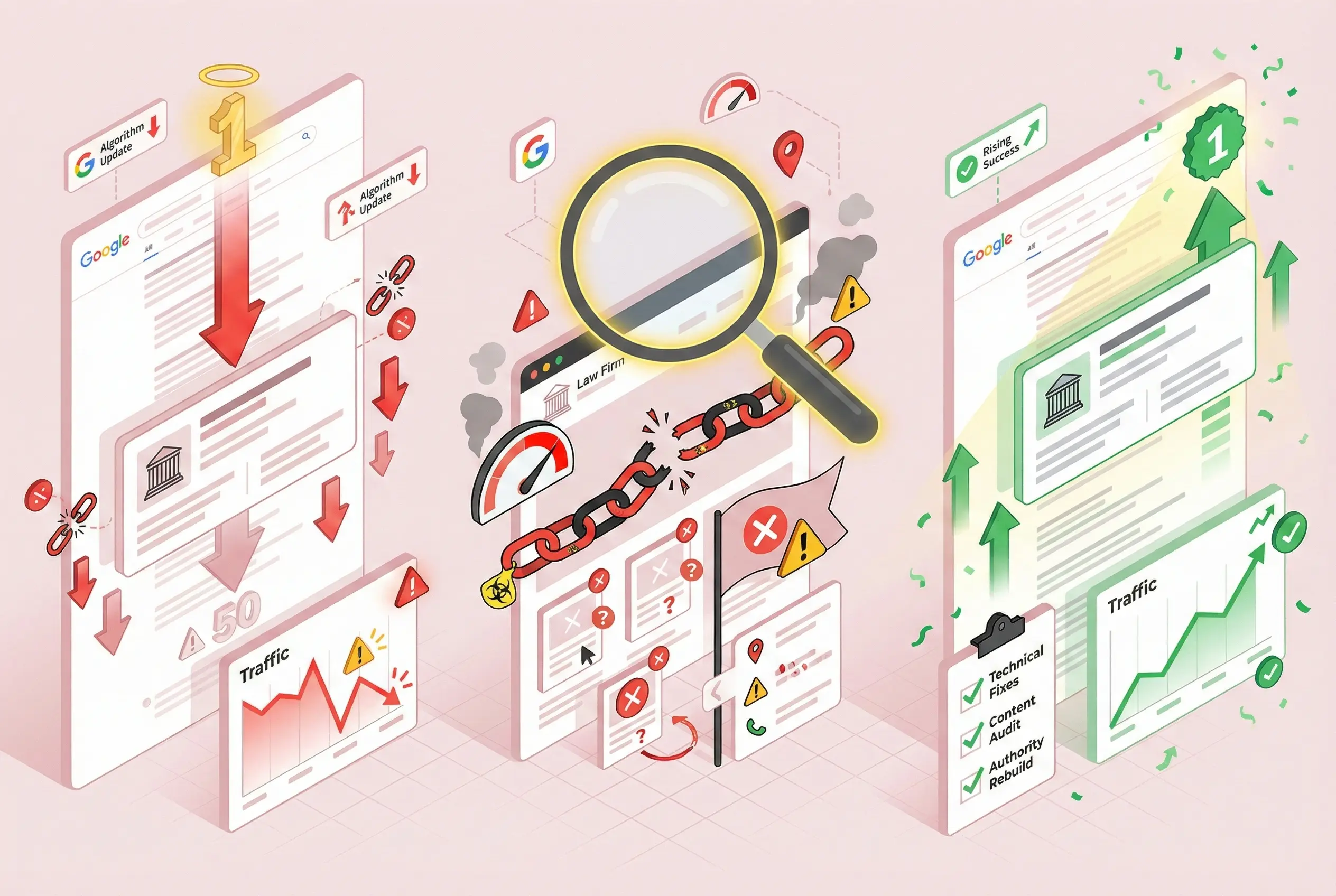
There’s a version of the same conversation I keep having where an attorney tells me they were on page one for two or three years and then sometime in the last six months everything dropped and they don’t know why. And the thing that makes it worse is that in markets like Miami where a single PI case can clear six or seven figures, “dropped off page one” isn’t an abstract analytics problem, it’s the phone going quiet and cases going to whoever replaced you.
Usually it’s not something the attorney did. It’s something an agency did to their site two years ago that Google finally caught up with, or an algorithm update that changed what “good content” means, or a technical issue that’s been quietly breaking things for months while the agency kept sending reports that looked fine. The attorney is paying for decisions they didn’t make and in most cases didn’t even know were being made.
I’ve been on both sides of this; inside a firm watching competitors disappear from the rankings and trying to make sure the same thing didn’t happen to us, and now outside firms diagnosing what went wrong after it already did. Most of the time I can tell within maybe 20 minutes whether it’s fixable or whether the site needs to start over, and honestly the fixable ones outnumber the disasters by a lot, which is the one piece of good news in this whole situation.
The Two Updates That Killed Most Law Firm SEO
What Google updates killed law firm SEO in 2024-2025? Two major updates: (1) November 2024 Core Update penalized “unhelpful content” including generic blog posts from content mills. Sites with hundreds of short, non-local posts saw domain-wide ranking suppression. (2) August 2025 Spam Update (August 26 – September 22, 2025) devalued link spam including private blog networks (PBNs), paid directory links, and link schemes. Firms relying on aggressive link-building dropped from page 1 to page 5 overnight. If traffic dropped late August 2025, cause is backlinks. If November 2024, cause is content quality.
If your rankings dropped sometime in late 2024 or late summer 2025, there’s a good chance I can tell you exactly why.
November 2024 Google rolled out what they called a “Core Update” but what it really was is a quality mandate, and it specifically went after websites with hundreds of short generic blog posts that exist to capture search traffic but don’t actually help anyone. You know the type, “What To Do After A Car Accident In Miami” that’s 400 words of obvious advice that could apply to any city in America and doesn’t cite any Florida statutes or mention any local courts or hospitals.
If your agency was churning out 10 blog posts a month at $50 each from some content mill, those posts are now actively hurting you. Google doesn’t just ignore them, it uses them as a signal that your whole site is low quality, and it suppresses your rankings across everything, not just the bad pages.
August 2025 was even worse for a lot of firms. This one targeted link spam, and it hit Miami hard because so many agencies here were doing aggressive link building that crossed the line into what Google considers manipulation. Private blog networks, paid directory links, links from sites that have nothing to do with law, all of that got devalued overnight.
And here’s the thing that makes this so frustrating: you probably didn’t know your agency was doing this. They called it “proprietary link building” or “authority development” or whatever and you trusted them because you’re an attorney not an SEO expert. But now your backlink profile is 80% garbage and your authority score effectively dropped to nothing.
I watched this happen to firms that were dominating Miami for years. One month they’re position 1, next month they’re position 50, and they didn’t change anything on their end because the damage was already done by their previous vendor.
Technical Problems That Make You Invisible
What technical issues prevent law firm websites from ranking? Most common: (1) Slow site speed from chat widgets (Ngage, Intaker, ApexChat) blocking main thread, failing Core Web Vitals INP metric. (2) Mobile usability issues including intrusive pop-ups covering screen. (3) Missing schema markup (LegalService, Attorney, LocalBusiness). (4) Crawl errors in Google Search Console preventing indexing. (5) Mixed content HTTPS errors. Google indexes mobile version only. Site speed must be under 2.5 seconds. Most law firm sites score 30s on PageSpeed; competitive sites score 90+.
Sometimes the problem isn’t penalties or bad content, it’s that Google literally cannot read your website or it can read it but the experience is so bad that Google won’t rank you.
The most common thing I see with law firm websites is they’re slow, and they’re slow because of all the lead capture stuff that’s supposed to help you get clients. Live chat widgets like Ngage or Intaker or ApexChat, video backgrounds, tracking pixels for Facebook and Google Ads and LinkedIn, all of that loads when someone hits your page and it makes everything take 5 seconds instead of 1 second.
And here’s the paradox: chat widgets can increase conversions once someone is on your site, but they can prevent anyone from finding your site if they damage your speed metrics enough. Percy’s site loads in under a second and scores 100 on PageSpeed. Most law firm sites I audit score in the 30s.
The other big one is mobile. Google indexes the mobile version of your site, not the desktop version, which means if your site looks great on desktop but is a mess on mobile, Google is judging you on the mess. Pop-ups that cover the whole screen, buttons that are too close together to tap with a thumb, content hidden behind accordions that Google might not even see, all of that hurts you.
And then there’s schema markup, which is basically code that tells Google “this is a law firm, this is an attorney, these are our practice areas, this is our address.” If you don’t have it or it’s wrong, Google has to guess what your site is about, and Google doesn’t like guessing.
Why You’re Not in the Map Pack
Why is my law firm not showing in Google Maps? Three causes: (1) NAP inconsistency – Name, Address, Phone listed differently across directories (“Suite 100” vs “Ste 100” vs “#100”) causes Google to lose confidence and suppress listing. (2) Competitors reporting your listing as spam or creating fake keyword-stuffed listings pushing you down. (3) Missing local citations from Miami-Dade Chamber of Commerce, Coral Gables Chamber, Avvo, Justia, and local directories. Fix: audit NAP across all platforms, report fake competitor listings via Google Business Redressal Complaint Form, build citations in local directories.
The Map Pack, those three business listings at the top of local searches, is where most of your leads should be coming from for local intent queries. If you’re not there, you’re invisible for searches like “Miami personal injury lawyer” no matter how good your organic rankings are.
The most common reason I see is NAP inconsistency, which just means your Name, Address, and Phone number are listed differently across the internet. Your website says “Suite 100,” your Florida Bar profile says “Ste 100,” Yelp says “#100,” and Google sees all these variations and loses confidence that it knows where you actually are. Data confusion leads to suppression because Google doesn’t want to send someone to the wrong place.
The second reason is competitors playing dirty, and this happens a lot in Miami because the stakes are so high. Someone hires a service to report your listing as spam, or they create fake listings with keyword-stuffed names like “Miami Accident Lawyer” instead of an actual firm name, and those fake listings push legitimate firms off the map. At Percy we dealt with spam reports and fake reviews and listing disputes across all four cities we operated in, we literally had to travel to each location and photograph real signage to prove we were legitimate.
And the third reason is you’re just not prominent enough in the local ecosystem. Google looks at citations, which are mentions of your firm across the web, and if you’re not listed in the Miami-Dade Chamber of Commerce, Coral Gables Chamber, legal directories like Avvo and Justia, and Miami-specific sources like Calle Ocho News, you’re signaling that you’re not really part of this community.
How to Know If You Have a Google Penalty
What are signs of a Google penalty for law firms? Two types: (1) Manual penalty – notification appears in Google Search Console under “Security & Manual Actions.” Signs: site doesn’t appear when searching exact firm name, specific sections disappear entirely. Common causes: unnatural links, thin content, cloaking. (2) Algorithmic suppression – no notification, traffic drops align with update dates. Signs: brand name still ranks but all non-branded keywords lost, new content indexes but gets zero impressions. Third possibility: negative SEO attack where competitor points thousands of toxic links at your site. Sign: sudden spike in backlinks from Russian, Chinese, or gambling/porn domains.
There’s a difference between a manual penalty and algorithmic suppression, and knowing which one you have changes everything about how you fix it.
A manual penalty means a human at Google looked at your site and said “this violates our guidelines.” This is the worst case scenario. You’ll know because there’s a notification in Google Search Console under “Security & Manual Actions” that explicitly tells you what’s wrong. Common ones for law firms are “unnatural links to your site” which means someone built spammy backlinks, or “thin content with little added value” which means your pages are basically empty or scraped from somewhere else.
The signs of a manual penalty are severe: your site doesn’t show up even when someone searches your exact firm name, or a specific section of your site completely disappears from results while other sections remain.
Algorithmic suppression is more common and harder to diagnose because Google doesn’t tell you anything. Your site just slowly slides from position 1 to position 50 over a few weeks or months. The way you diagnose this is by looking at when your traffic dropped and comparing it to when Google rolled out updates. If you lost 40% of your traffic in late August 2025, that’s the Spam Update and your problem is almost certainly backlinks. If you lost traffic in November 2024, it’s probably content quality.
The signs of algorithmic suppression are: you still rank for your brand name but you’ve lost all your non-branded keywords, your new content gets indexed but never gets any impressions or clicks, and your traffic has flatlined even though you’re still publishing.
There’s also a third scenario which is negative SEO, where a competitor deliberately points thousands of toxic links at your site to trigger a penalty. This happens in Miami because the market is so competitive. If you see a sudden spike in backlinks from Russian or Chinese domains or porn and gambling sites, that’s an attack, and you need to disavow those links immediately.
Why Your Competitors Are Outranking You
Why are competitors outranking my Miami law firm? For organic rankings: competitors may have stronger E-E-A-T signals (attorney bios with credentials, content citing Florida statutes, backlinks from Florida Bar and legal publications). For Map Pack: primary category selection has massive weight (193/200 in local algorithm) – “Personal Injury Attorney” outranks “Law Firm” for specific searches. Also: citation consistency, proximity to searcher, and local relevance signals. 66% of Miami-Dade speaks Spanish – competitors with native Spanish content capture “abogado de accidentes” searches you’re missing. Some competitors use fake listings with keyword-stuffed names – report via Google Business Redressal Complaint Form.
When an attorney tells me “my competitors are outranking me and they’re not even better than us,” I believe them, but “better” in the legal sense doesn’t translate directly to Google rankings, and understanding what Google actually measures is everything.
For organic rankings, Google is looking at E-E-A-T signals: does your content demonstrate Experience, Expertise, Authoritativeness, and Trustworthiness? That means attorney bios with real credentials, content that cites specific Florida statutes, references to local courts and procedures, and backlinks from authoritative sources. A competitor with thinner content but better backlinks from the Florida Bar and legal publications will often outrank you.
For the Map Pack, it’s different. Google weighs proximity (how close you are to the searcher), prominence (citations, links, review signals), and relevance (does your primary category and content match the query). The primary category you select in your Google Business Profile has massive weight, something like 193 out of 200 in the local algorithm according to research I’ve seen. If your competitor selected “Personal Injury Attorney” and you selected “Law Firm,” they’re appearing for more specific searches than you are.
Reviews matter for the Map Pack, but they’re one signal among many, not the whole picture. A firm with 50 reviews at 4.9 stars can outrank a firm with 200 reviews at 4.5 stars if they have better category selection, more consistent citations, and stronger local relevance signals.
The other thing I see in Miami specifically is the bilingual gap. 66% of Miami-Dade speaks Spanish at home, and if your competitor has a real Spanish-language section of their site, not Google Translate garbage but actual native Spanish content, and you don’t, they’re capturing half the market you’re ignoring. Spanish speakers search differently too, “abogado de accidentes” not “car accident lawyer,” and if you’re not optimized for those terms you’re not even in the running.
And then there’s legacy authority. Some firms have been building their online presence for 15 years and that compounds. They have thousands of legitimate backlinks from news coverage and legal publications and community involvement. You can’t replicate that overnight, but you can chip away at it by being more strategic and more local.
But sometimes competitors are outranking you because they’re cheating. Fake listings, keyword-stuffed business names, review manipulation, all of that happens in Miami constantly. If you see a competitor in the Map Pack whose business name is “Miami Personal Injury Lawyer” instead of an actual firm name, report them using Google’s Business Redressal Complaint Form. Removing 3 spam competitors can move you from position 4 to position 1 instantly.
The 90 Day Fix
How do I fix my law firm’s Google rankings? 90 day plan: Weeks 1-2 (Technical): fix site speed by deferring chat widgets, compress images to WebP, implement schema markup, fix mobile issues. Weeks 3-6 (Content): audit all pages, delete zero-traffic “zombie pages,” combine redundant posts into comprehensive guides, add E-E-A-T signals (author bios, Florida statute citations, local court references). Weeks 7-12 (Authority): audit and disavow toxic backlinks, fix NAP inconsistencies across all directories, build citations in Miami-Dade Chamber and legal directories, optimize Google Business Profile, implement review generation system. Expect 6-12 months for full recovery.
If your rankings dropped, you need a structured plan, not panic. Here’s the 90-day approach that actually works.
Weeks 1-2: Technical triage. Fix the stuff that’s preventing Google from properly reading and valuing your site. Defer your chat widgets so they load after the page, not during. Compress images to WebP format. Fix any crawl errors showing in Search Console. Implement proper schema markup for your attorneys and practice areas. Make sure your mobile experience doesn’t have any blocking issues.
Weeks 3-6: Content audit. Export a list of every page on your site and look at which ones got zero traffic in the last 12 months. Those are zombie pages and they’re dragging down your whole domain. Use the “kill, keep, combine” protocol: delete the irrelevant stuff (company picnic photos, holiday posts), keep the high performers, and combine the redundant stuff. If you have 5 different blog posts about car accidents, merge them into one comprehensive guide.
Then inject E-E-A-T into your key pages. Add author bios with real credentials. Cite specific Florida statutes, not just “Florida law says.” Mention local courts, local hospitals, local highways where accidents happen. Make it obvious you’re actually practicing law in Miami, not just claiming to.
Weeks 7-12: Authority rebuild. If you have toxic backlinks, build a disavow file and submit it to Google. Audit your citations across the web and fix every NAP inconsistency you find. Get listed in the directories that matter locally: Miami-Dade Chamber, Coral Gables Chamber, Florida Bar, legal directories. Optimize your Google Business Profile with the right primary category, service areas, and weekly posts. And implement a system to generate reviews from satisfied clients, because review velocity matters and a steady stream looks more natural than 50 reviews in one week.
When to Start Over vs When to Fix
Should I rebuild my law firm website or fix the existing one? Rebuild if: manual penalty with extensive violations, domain penalized multiple times, technical debt overwhelming, or previous agency used black-hat tactics extensively. Fix if: algorithmic suppression from specific fixable issues, domain has existing authority worth preserving, problems isolated to content or backlinks. Critical: if rebuilding, migrate URLs properly – every page with rankings or backlinks needs 301 redirect to new location. Breaking URLs destroys SEO equity. Percy Martinez rebuilt twice in 10 years with zero traffic loss through careful URL migration.
Sometimes the honest answer is your current site is too damaged to save and you need to start fresh. But sometimes starting fresh throws away years of authority you could have preserved.
Consider rebuilding if: you have a manual penalty with extensive violations that would take longer to clean up than to rebuild, your domain has been penalized multiple times and has a “bad reputation” with Google, the technical debt is so overwhelming that fixing everything would cost more than a new build, or your previous agency used black-hat tactics so extensively that your backlink profile is unsalvageable.
Consider fixing if: your suppression is algorithmic and tied to specific issues you can address, your domain has existing authority and backlinks worth preserving, your problems are isolated to content quality or a batch of bad backlinks, or your technical issues are fixable without a complete overhaul.
At Percy we did two complete rebuilds over 10 years, 2016 to 2022 to 2025, and never lost traffic because we migrated carefully. Every URL that had value got redirected properly. We didn’t just throw up a new site and hope for the best, we preserved the equity we’d built.
If you do rebuild, the critical thing is URL migration. If your old site had a page at /miami-personal-injury-lawyer/ that had rankings and backlinks, your new site needs to either keep that exact URL or redirect it to the new location. Breaking those URLs is like burning money.
The Florida Bar Problem Nobody Talks About
Can law firm SEO violate Florida Bar rules? Yes. Common violations: (1) Using “best” or “expert” without board certification – prohibited even in title tags and meta descriptions. (2) Listing case results (“$1 Million Settlement”) without disclaimer “past results do not guarantee future outcome” – disclaimer must be clear and conspicuous. (3) Video content with actors or dramatizations not labeled as such. May 2025 rule changes shifted ad review to email-only but substantive rules unchanged. Aggressive SEO claims that improve click-through rates may trigger both Google penalties and Bar complaints.
Here’s something most SEO agencies don’t mention: some SEO tactics that work can get you in trouble with the Florida Bar.
Using terms like “Best Lawyer in Miami” or “Expert” is generally prohibited unless you’re board-certified. But those terms get clicks, so agencies use them in title tags and meta descriptions without thinking about the ethical implications. Now you have an SEO problem AND a potential Bar complaint.
Listing case results like “$1 Million Settlement” without a disclaimer that “past results do not guarantee a future outcome” is a violation. The disclaimer has to be clear and conspicuous, not buried in 8-point font at the bottom of the page.
Video content with actors or dramatized scenes has to be labeled as such.
The May 2025 rule changes shifted the ad review process to email-only, but the substantive rules are still strict. If your SEO agency is making aggressive claims to improve click-through rates, make sure those claims don’t violate advertising guidelines. The last thing you need is to fix your Google rankings and then get a Bar complaint.
Want to Know Why You’re Not Ranking?
I’ll look at your Search Console data, your backlink profile, and your technical setup and tell you what’s actually wrong. Sometimes it’s an easy fix, sometimes it’s a rebuild, sometimes it’s just patience. But at least you’ll know what you’re dealing with instead of guessing.

See Miami SEO services | Read the SEO cost guide | Compare with AI optimization