
What does Argota Marketing do for mass tort law firms? Argota builds direct mass tort acquisition campaigns where every piece, the search rankings, the paid ads, the AI visibility, the website, and the intake flow, is timed to where a specific litigation actually sits in its lifecycle. We generate exclusive leads for your firm instead of reselling shared inventory, and we measure results by how many signed retainers actually make it to filing rather than how many you collected.
Why Mass Tort Marketing Works Differently
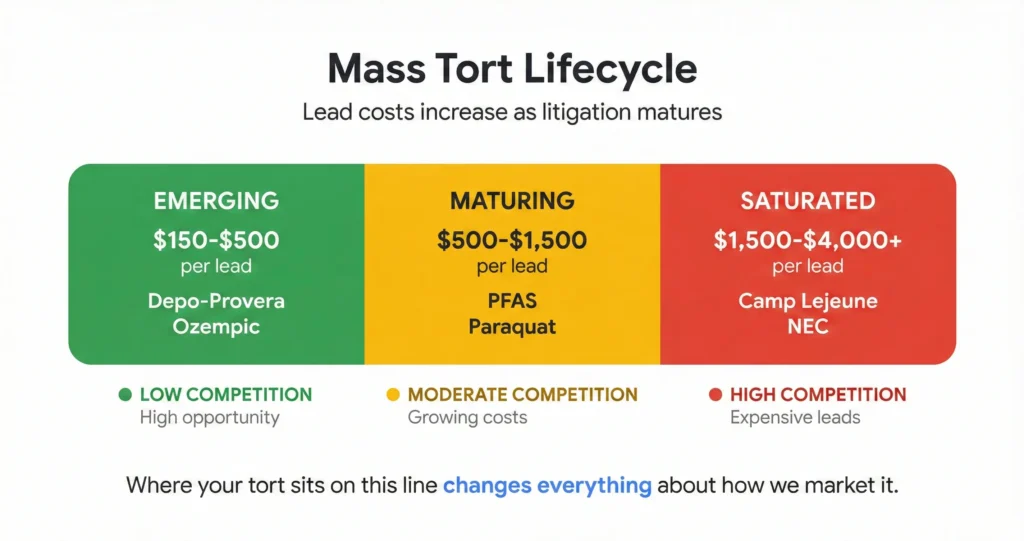
The cost to acquire a single mass tort case can range from $150 to over $4,000, and the difference comes down to one thing: how far along the lawsuit is. An emerging tort where most people don’t know they have a case is cheap to reach but carries scientific risk. A saturated tort where most claimants are already signed is expensive and picked over. The channels that work, the budget you need, and the way you screen leads all change depending on where that litigation sits right now.
That timing is what we build every campaign around. A Depo-Provera campaign needs educational video reaching people who haven’t connected their medication to their diagnosis yet. A Camp Lejeune campaign needs precise search ads finding the specific claimants still looking in a market that’s been advertised for years. We wrote a detailed breakdown of mass tort lead quality if you want the deeper analysis on why this distinction matters so much.
What We Do for Mass Tort Firms
We handle six services, and the weight shifts depending on where your tort sits. Early-stage litigations lean on video and awareness. Mid-stage leans on search dominance and AI. Late-stage leans on targeted ads and trust. Here’s what each one looks like for mass tort.
Search rankings and clinical content. A single blog post about your litigation doesn’t rank anymore. We build your site as an interconnected set of pages covering the science, the eligibility, the court timeline, and the settlement landscape so Google treats your firm as the authority on that specific tort, not just another site repeating what the government already published. How we build search campaigns →
AI search visibility. When someone asks ChatGPT “do I qualify for the PFAS lawsuit,” the AI pulls an answer from somewhere. We structure your site so that somewhere is your firm. We add code that tells AI systems what litigations you handle, and we format your content so AI can extract clean, citable answers from it. That gets your firm named in the response, not just ranked in a list. How AI search works for law firms → / AI search strategy →
Paid ads built around health privacy rules most agencies get wrong. Social platforms won’t let you target people by health condition, and ad copy that says “do you have this disease” gets rejected or gets your account banned. We use educational video content with broad targeting and let people self-identify by engaging with the content. Those who watch most of a video about Depo-Provera and meningioma have told us they’re interested without us ever asking about their medical history. On Google, we run search ads and Local Services Ads targeting the specific questions people type when they already know they might have a case.
Website and landing pages designed to screen before they convert. Mass tort landing pages need to ask the qualifying questions, did you use the product, when, and have you been diagnosed with the specific injury, before someone fills out a full intake form. That way your team isn’t chasing claimants who can’t produce the evidence courts now require. We build fast, mobile-first sites where the screening happens on the page and only qualified leads reach your intake team.
Review management that protects you in a space full of complaints. Mass tort clients wait years for resolution. That creates frustration. Negative reviews from people who are still waiting for a settlement they haven’t received yet are common, and responding to them without revealing confidential case details requires careful handling. We manage your review profile with bar-compliant responses and automated systems that keep fresh positive reviews flowing in, which directly affects your ad visibility on Google.
Intake speed and automation. A lead contacted within five minutes is 21 times more likely to sign than one contacted after thirty. We set up automated text confirmation the moment someone submits a form, and screening tools that ask the qualifying questions around the clock so your staff focuses only on claimants who’ve already passed the initial filter.
How We Do It Differently
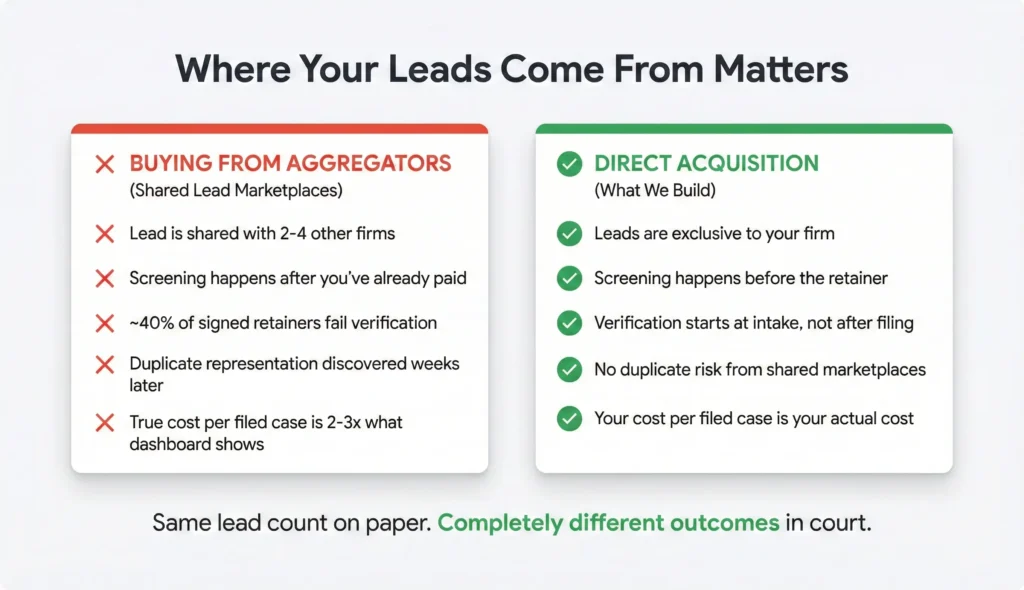
There’s an entire industry built around generating mass tort leads in bulk and selling them to multiple firms. The model works: an aggregator runs ads, collects names, and sells them. Sometimes exclusively. Often to three or four firms at once. You sign a retainer, start pulling records, and discover the claimant never actually used the product, or their diagnosis doesn’t match, or they already signed with another firm through a different ad.
New federal court rules effective December 2025 made this worse. Courts now require early disclosure of evidence supporting each claim. You can no longer file thousands of thinly vetted retainers and sort them out later. A signed retainer without verified product use and a confirmed qualifying injury is now a liability heading toward dismissal.
We build direct campaigns instead. Your ads, your landing pages, your intake screening, your exclusive leads. The claimant came from your campaign and signed with your firm. No shared marketplace, no duplicate risk, and the screening happens before you spend money on records retrieval.
The Number That Actually Matters
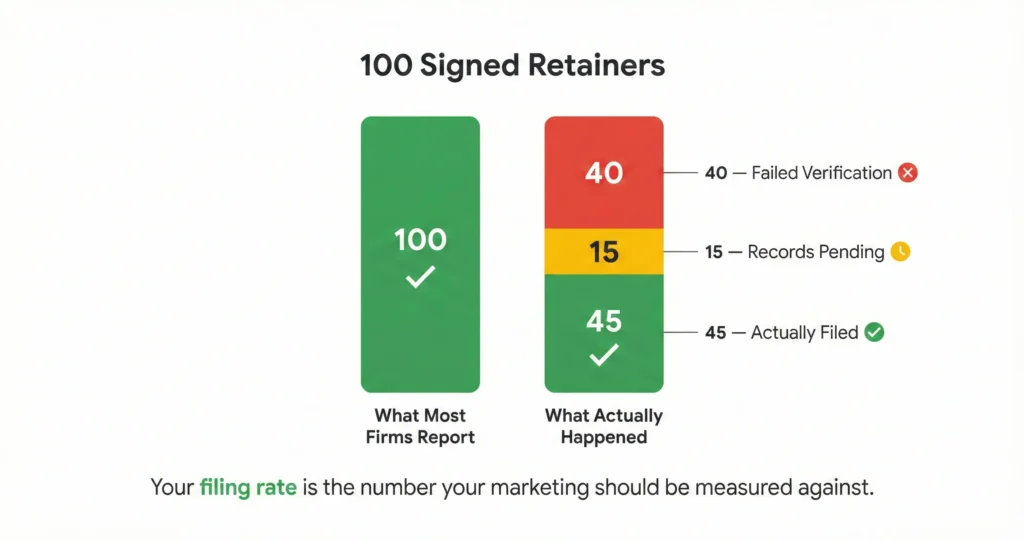
Roughly 40% of signed mass tort retainers fail one of the verification checks before they ever reach court. That means the cost per case your dashboard shows is probably half of what you’re actually paying when you account for records retrieval, staff time, and filing prep on cases that went nowhere.
We track your campaigns by filing rate. How many leads pass screening. How many retainers produce verified records. How many survive duplicate checks. How many actually get filed. That’s your real cost per case, and it’s the number that tells you whether the campaign is profitable. Full data ownership: website, analytics, ad accounts. If you leave, you keep everything.
What to look for in marketing reports →
Torts We’re Running Campaigns For
We build campaigns around specific litigations based on lifecycle position and whether the economics justify investment right now.
Emerging (high opportunity, higher risk): Depo-Provera (meningioma), Ozempic/GLP-1 (gastroparesis, bowel obstruction), hair relaxer (uterine cancer)
Maturing (proven causation, growing competition): PFAS/AFFF firefighting foam (multiple cancers), Paraquat (Parkinson’s disease), hernia mesh (chronic pain, revision surgery)
Saturated (most claimants represented, targeted approach only): Camp Lejeune (contaminated water), NEC baby formula (necrotizing enterocolitis), Roundup (non-Hodgkin lymphoma)
The budget, channels, and screening are different for each. We don’t run the same playbook across all of them because the economics at each stage demand a different approach.
Working a tort not listed here? Tell us about it and we’ll assess where it sits and whether direct acquisition makes sense right now.
Mass Tort Marketing by State
Mass tort is federal litigation, but the claimants are local. The advertising costs, the competing firms, and the density of potential claimants vary by state. A PFAS campaign in a state with military bases and industrial contamination sites looks different from one in a state without them. A Camp Lejeune campaign concentrates where veterans live. The state pages below cover the specific competitive landscape, ad costs, and claimant demographics in your market.
California · Texas · Florida · New York · Pennsylvania · Illinois · Ohio · Georgia · North Carolina · New Jersey
Don’t see your state? We work with mass tort firms nationwide. Tell us about your market and we’ll build around your claimant landscape.
Are you acquiring cases or just collecting retainers?
Send me your current mass tort numbers and I’ll show you what your filing rate looks like when you account for verification failures, duplicate signatures, and records that never arrive. If the numbers are strong, I’ll say so. If a chunk of your signed inventory is headed for dismissal under the new court rules, better to know now than after you’ve spent on records retrieval for all of them.
Talk to Jorge → Phone or text: 941 626 9198
Related: Mass tort lead quality metrics →