
Every January the same agencies publish the same law firm marketing trends article and it’s always some version of “AI is important, content is king, video matters” and they list maybe ten things in bullet points and half of them were on last year’s list too and nobody ever goes back to check which ones were wrong, which I think says a lot about the industry honestly.
And I get why they do it that way because trend pieces get search traffic in Q1 when firms are setting budgets for the year, but the problem is that when everything is a “trend” nothing is, and a managing partner reading one of those lists can’t tell the difference between something that will actually change their business this year and something that sounds exciting but doesn’t apply to a three attorney family law practice in Jacksonville.
So what I want to do here is separate the stuff that’s actually moving the needle from the stuff that’s just conference talk, and for each real trend I’ll point to the data and for each fake one I’ll explain why it’s not worth your time yet, and if you want to go deeper on any of them I’ve written about most of these individually already.
AI Search Isn’t Coming, It Already Ate Your Top of Funnel
How is AI changing legal marketing in 2026? AI has moved past the adoption phase; 79% of legal professionals now use AI tools daily and 58% confirm that entry-level lawyers are not being replaced. The real marketing impact is on the client side. Potential clients are having multi-turn conversations with ChatGPT and Perplexity before contacting any firm, arriving “pre-educated” with specific questions that generic intake scripts can’t handle. LLM referral traffic to legal websites surged 527% year over year, meaning more people are clicking through from AI conversations to firm websites than ever before, but those visitors behave differently because they’ve already filtered their options before they arrive.
And the thing that keeps getting lost in the “AI is changing everything” conversation is that the disruption isn’t really about the tools law firms are using internally, because 79% adoption basically means AI is table stakes now and nobody’s getting a competitive edge from using ChatGPT to draft a motion anymore.
The disruption is about the client and how they find you now. A person who gets into a car accident in 2026 doesn’t just google “car accident lawyer near me” and click the first result anymore. They open ChatGPT and type something like “I was hit by someone running a red light and the insurance company is offering me $4,000, is that fair” and the AI gives them a ten paragraph answer explaining liability and comparative fault and settlement ranges.
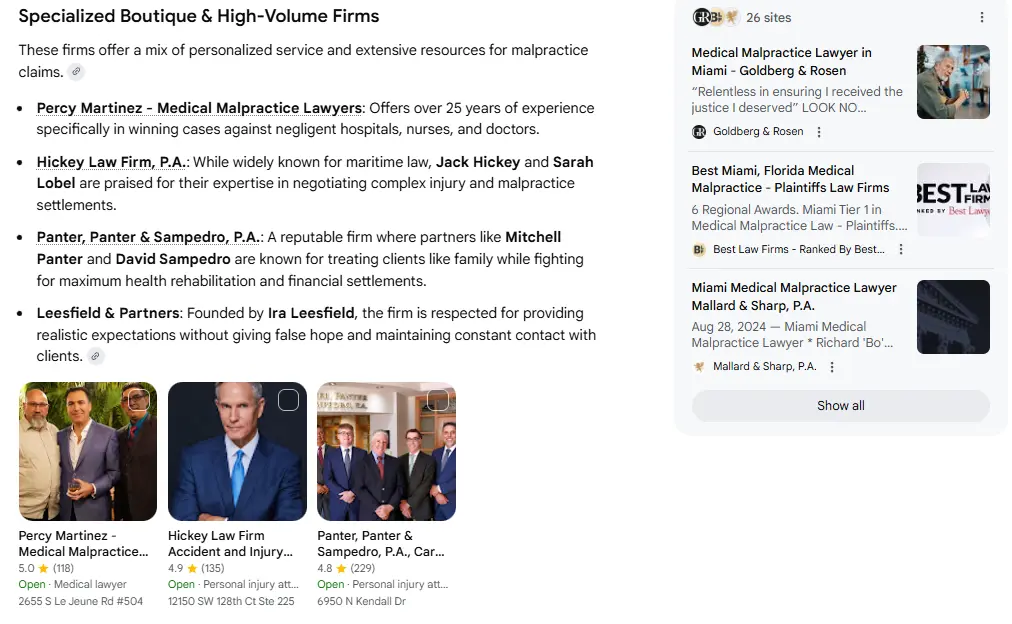
And then it recommends two or three firms, and those firms get the call and everyone else doesn’t, and I wrote about how that recommendation engine actually works if you want to understand the mechanics of it.
And what that means for your marketing is that the generic blog posts that used to bring in top of funnel traffic are basically dead as a lead source. AI answers “what is a tort” and “how long do I have to file a personal injury claim” instantly, and nobody needs to visit your website to learn that anymore.
The content that still works is the middle of funnel and bottom of funnel stuff; the situational, specific, hard to answer questions where a real attorney’s experience actually adds something the AI can’t generate on its own, which is a whole separate conversation about GEO and how to structure content so the AI cites you instead of summarizing you.
The Google Verified Badge Rewired Paid Ads
What changed with Google Local Service Ads and the Verified badge in 2026? Google retired the separate Google Screened, Google Guaranteed, and License Verified badges in October 2025 and consolidated them into a single Google Verified checkmark. The money-back guarantee tied to the old badges was discontinued. The new badge algorithmically rewards firms with fast response times and high review velocity; verified firms are seeing up to 42% lower cost per lead while firms failing the operational metrics are getting pushed into more expensive traditional PPC auctions. Response time now displays publicly on your ad, so potential clients can see “usually responds in 5 minutes” before they ever contact you.
And this is one I’d call a real trend because it changed the economics of paid advertising for every law firm running Local Service Ads in a way that most firms still haven’t fully adjusted to.
The short version is that the badge used to be a differentiator; you either had the green Screened checkmark or you didn’t, and having it meant you stood out. Now everybody who’s verified has the same blue checkmark, so the badge itself is table stakes and the actual differentiator is operational; how fast you respond, how many reviews you have, and how high those reviews score.
And what this created is a split where firms that respond quickly and manage their intake well are getting cheaper leads and firms that don’t are getting punished with higher costs or lower visibility, and the gap between those two groups is getting wider every month.
On top of that, traditional Google Ads CPCs for legal keywords went up somewhere between 13 and 20 percent year over year depending on the practice area, which means the cost per signed case keeps climbing while the organic results keep getting pushed further down the page by AI Overviews at the top and ads in between, and that squeeze is real and it’s not going away.
ChatGPT Ads Are a Real Thing Now
Can law firms advertise on ChatGPT? OpenAI started testing ads inside ChatGPT conversations in February 2026. Unlike Google Ads which trigger on keywords, ChatGPT ads are context-aware, meaning if a user is describing a car accident scenario the ad can appear as a sponsored suggestion within that conversation. Early indications suggest a CPM-based cost model with high entry thresholds; initial beta partners are reportedly spending $200K or more per month, though broader access at lower price points is expected as the platform matures. This is the first paid channel that sits inside the conversational workflow where clients are increasingly doing their research.
And this is one I’m genuinely keeping an eye on because the intent signal in a ChatGPT conversation is completely different from a Google search. On Google someone types “accident lawyer” and you’re competing with everyone else bidding on that keyword. On ChatGPT someone types a paragraph describing their specific situation and the ad that appears is contextual to that exact scenario, which means the targeting potential is significantly better than keyword matching even if we don’t fully know the economics yet.
The problem right now is the cost floor. If early access really does require six figure monthly commitments then this is a big firm channel for now, and most of the attorneys reading this aren’t going to be spending $200,000 a month on ChatGPT ads or probably shouldn’t be. But the trajectory here matters because every new ad platform starts expensive and then democratizes access as it scales, and the firms that learn the platform early tend to have an advantage once the costs come down, which is basically what happened with Google’s LSA program when it first launched.
I’d say allocate maybe 5 to 10 percent of your paid budget as a test if you can get access, and if you can’t get access yet then at least make sure your firm shows up organically in ChatGPT and Perplexity by building the entity signals that those platforms use to recommend firms, because that organic visibility is free and it’s available right now.
Video Went From Nice to Have to Mandatory
Is video marketing actually important for law firms in 2026? 52% of consumers now watch a video before hiring an attorney, and short-form vertical video on YouTube Shorts, Instagram Reels, and TikTok has become a primary discovery channel for legal services. The shift isn’t about going viral; it’s about the “parasocial” effect where a potential client watches enough of your videos to feel like they already know you before they call, which reduces intake friction and increases conversion rates. Only 30% of law firms create any video content and just 13% use Instagram, so the competitive gap is still wide open for firms willing to pick up a phone and record.
And I’ve already written a full breakdown on short-form video for lawyers so I won’t repeat all of it here, but the trend to flag for 2026 specifically is the “pre-educated client” meeting the “parasocial attorney” which creates a conversion pattern that didn’t exist even two years ago.
What I mean by that is a person watches maybe eight or ten of your sixty second videos over the course of a week, and then they get into a situation where they need a lawyer, and they don’t google “lawyer near me” because they already have someone in mind, they already trust that person’s judgment from the videos, and they call directly. By the time your intake team picks up the phone, this person is basically pre-sold.
And the firms that figured this out early are seeing acquisition costs that are a fraction of what Google Ads charges because the video content is free to create and the only cost is a small boost budget on the posts that perform well organically. The math on this compared to PPC versus SEO versus LSA is honestly embarrassing for paid search, which I think is why most agencies don’t push video hard since they don’t make money managing it.
What’s Actually Hype and You Can Safely Ignore
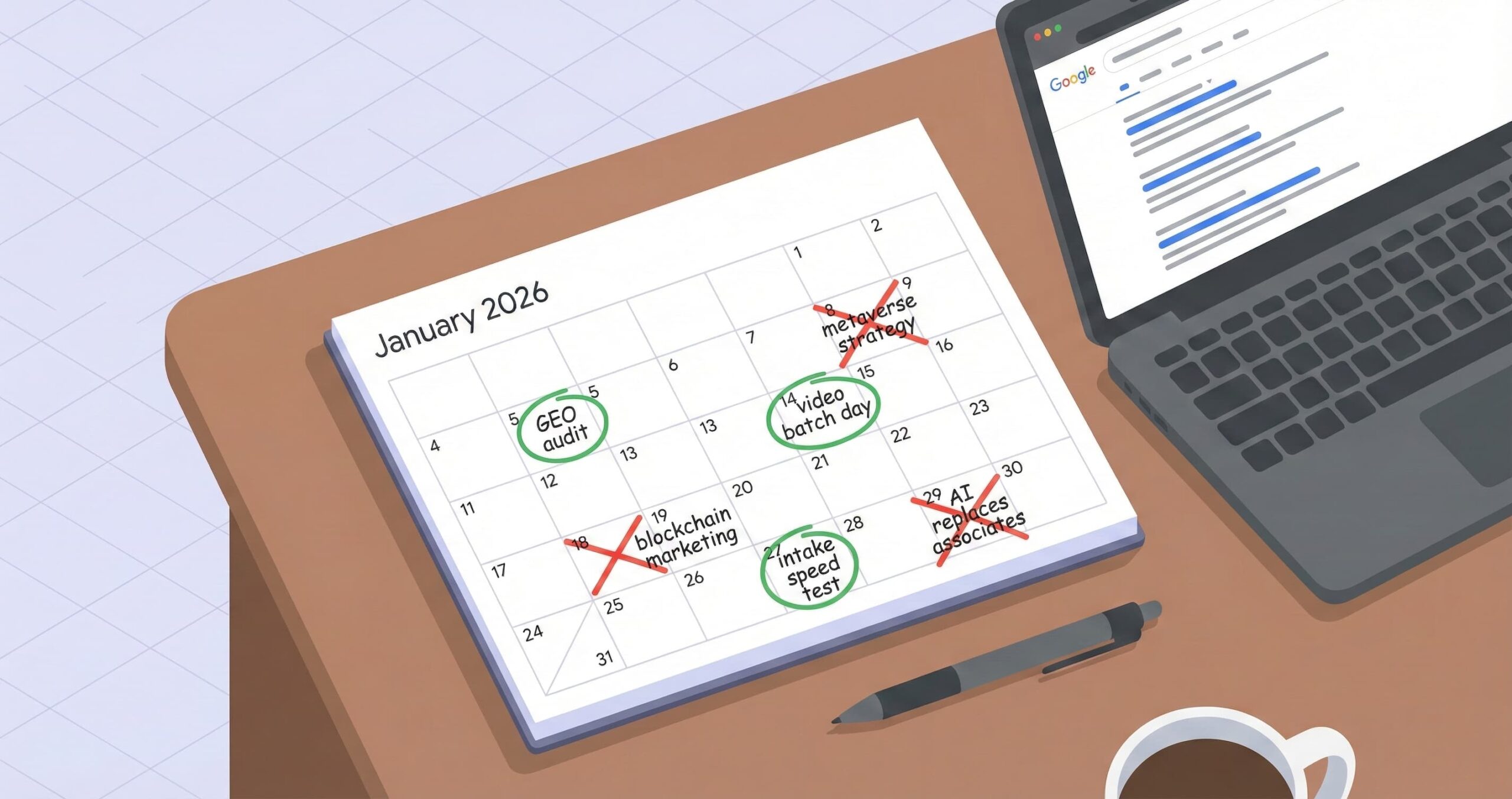
What legal marketing trends are hype and not worth investing in for 2026? Three things that keep showing up on trends lists but don’t deserve your budget: metaverse marketing for law firms, blockchain as a client acquisition channel, and the prediction that AI will replace attorneys. The metaverse has seen deteriorating buyer interest and no meaningful consumer adoption for legal services. Blockchain has matured into backend compliance infrastructure, not a marketing channel. And 58% of legal professionals explicitly reject the claim that even entry-level lawyers are being replaced by AI. If a trends article leads with any of these three, it was probably written by someone who doesn’t actually market law firms.
And I know it might seem weird to put a “here’s what to ignore” section in a legal marketing trends piece for 2026, but honestly I think this is the most useful part because every dollar you spend chasing something that doesn’t work is a dollar you didn’t spend on something that does.
The metaverse one is the most obvious. Three or four years ago every marketing conference had a session about “your firm in the metaverse” and some agencies were actually pitching virtual law offices, and I watched a couple of firms spend real money on this and the ROI was nothing because clients want a phone call or a Zoom, not a VR headset just to ask about their divorce.
The only exception is maybe IP or tech law where having a metaverse presence signals industry competence to your target clients, but for personal injury or family law or med mal this is a complete waste of budget and always was.
Blockchain as marketing is the same story; it’s genuinely useful as backend infrastructure for things like evidence verification and smart contracts, but nobody is acquiring clients through blockchain and nobody is going to, and if your marketing budget is under $10,000 a month you need every dollar going to things that generate cases today.
And the “AI replaces lawyers” narrative is the one that I think actually hurts firms because it makes some attorneys hesitant to invest in marketing at all since they’re worried the whole profession is going to disappear in five years. It’s not happening and the data backs that up pretty clearly. Clients want human judgment for high stakes legal decisions and that hasn’t changed and I don’t think it will. The firms that lean into their human element in their marketing and stop trying to compete with AI on information are the ones winning right now.
The One Operational Thing That Matters More Than Any Trend
What is the single most important thing a law firm can do for marketing in 2026? Respond to leads within 5 minutes. Every other trend in this post is meaningless if your intake process bleeds the leads before anyone picks up the phone. Firms responding within 5 minutes see 400% higher conversion rates, 80% of legal consumers abandon firms that don’t respond within 48 hours, and 72% move on within 24 hours. This isn’t a marketing trend; it’s an operational requirement that determines whether any marketing investment pays off at all.
And every year I watch firms chase the next channel or the next platform or the next algorithm change and ignore the fact that their phone goes to voicemail at 5:15pm on a Tuesday, and I’ve written about the full intake framework but the quick version is that none of the trends in this post matter if you’re not answering the phone.
You can have the best GEO strategy in the world and get cited by ChatGPT and Perplexity and rank first in the Local Pack and produce amazing video content that gets 500,000 views, and if the person who calls your office waits four hours for a callback they’re already talking to your competitor.
And that’s the part of legal marketing trends for 2026 that nobody puts on the listicle because it’s boring and unsexy and it doesn’t require a new tool or a new platform, it just requires somebody to pick up the phone, which apparently in 2026 is still a lot to ask for reasons I’ve never fully understood.
Not sure which of these trends actually applies to your firm this year?
I’ll look at your current marketing, your practice area, your budget, and tell you which of these shifts actually matter for your specific situation and which ones to ignore. And if what you’re doing now is already working and you just need to keep going, I’ll tell you that too and we can skip the whole sales pitch.