
The leads usually aren’t bad. I know that’s not what it feels like when the attorneys are saying “these leads are garbage” but when you pull the call recordings and actually listen, most of the time it’s someone who needed a lawyer and called and nobody picked up, or someone picked up and said “can you hold” and they hung up, or the form submission sat in a general inbox for two days because nobody owned it.
And that’s the thing about intake that I think most firms and most agencies miss entirely. The advertising is working. The clicks are real, the people are real, the demand is there. The breakdown happens in the 30 seconds after someone reaches out, and that window is where more cases die than in any ad account or SEO campaign, which is a hard thing to hear when you’re spending $20,000 a month on marketing and blaming the leads instead of the process that’s supposed to catch them.
The Numbers on How Much You’re Actually Losing
How much revenue do law firms lose from bad intake processes? The average law firm loses approximately 8% of potential revenue due to intake inefficiency. For a firm averaging $10,000 per case, losing just eight leads equals $80,000 annually; often more than the entire monthly marketing budget. A Hennessey Digital study found that 26% of law firms never respond to online leads at all, meaning one in four marketing dollars is wasted immediately. Additionally, 74% of callers who reach voicemail hang up without leaving a message, and 42 to 48% of legal inquiries come in outside business hours when most firms have no coverage.
The data on this is hard to look at. About 26% of law firms never respond to online leads at all; not slowly, not the next day, just never. One out of every four marketing dollars those firms spend disappears the second someone fills out a form because nobody on the other end is going to read it.
And the voicemail numbers are worse. About 74% of callers who hit voicemail hang up and dial the next firm on the results page without leaving a message or trying again. They’re anxious and they’re in a hurry and they don’t interpret voicemail as “we’re busy, call back later,” they interpret it as “this firm doesn’t want my case,” and the call goes to whoever picks up next.
And then you factor in that somewhere between 42 and 48% of legal inquiries come in outside business hours; between 5 PM and 9 AM; and the math gets ugly fast. A firm running 9 to 5 intake with ads running 24 hours a day is paying to generate calls during the exact hours when nobody’s there to answer them, which is like keeping the kitchen open but locking the front door during the dinner rush.
Why Everyone Tracks the Wrong Number
What is the difference between cost per lead and cost per case for law firms? Cost per lead measures marketing efficiency; if you spend $10,000 and get 100 leads, your CPL is $100. Cost per case measures business efficiency; if your intake team answers 50 of those calls, qualifies 10, and signs 2, your cost per case is $5,000. Firms that optimize only for cheaper leads often see cost per case increase because low-intent leads flood the intake team with noise. A $200 click that converts at 20% through a good intake process is more profitable than a $50 click that converts at 2% through a bad one.
And this connects to something I see constantly which is that firms and agencies obsess over cost per lead when the number that actually matters is cost per signed case. And I know I’ve talked about this before in the context of evaluating agencies but it’s worth explaining here because it’s directly connected to the intake problem.
If you spend $10,000 on marketing and get 100 leads, your cost per lead is $100 which looks great on a dashboard. But if your intake team only answers 50 of those calls, and qualifies 10, and signs 2, your actual cost per signed case is $5,000. And the agency sends you a dashboard showing $100 per lead and everybody thinks the marketing is working when actually the intake is losing you $4,900 per case in efficiency.
And the counterintuitive part is that firms who try to lower their cost per lead by buying cheaper traffic often make the intake problem worse because now you’re flooding the phone with low-intent calls that waste your team’s time and bury the good leads in noise.
I’d rather spend $200 on a click from someone who actually needs a personal injury lawyer and have a good intake team sign them at 20% than spend $50 on ten garbage clicks that nobody can convert, but that requires tracking to signed cases which most firms still aren’t doing for reasons I’ve never fully understood.
The 5 Minute Cliff and Why the First Firm to Answer Wins
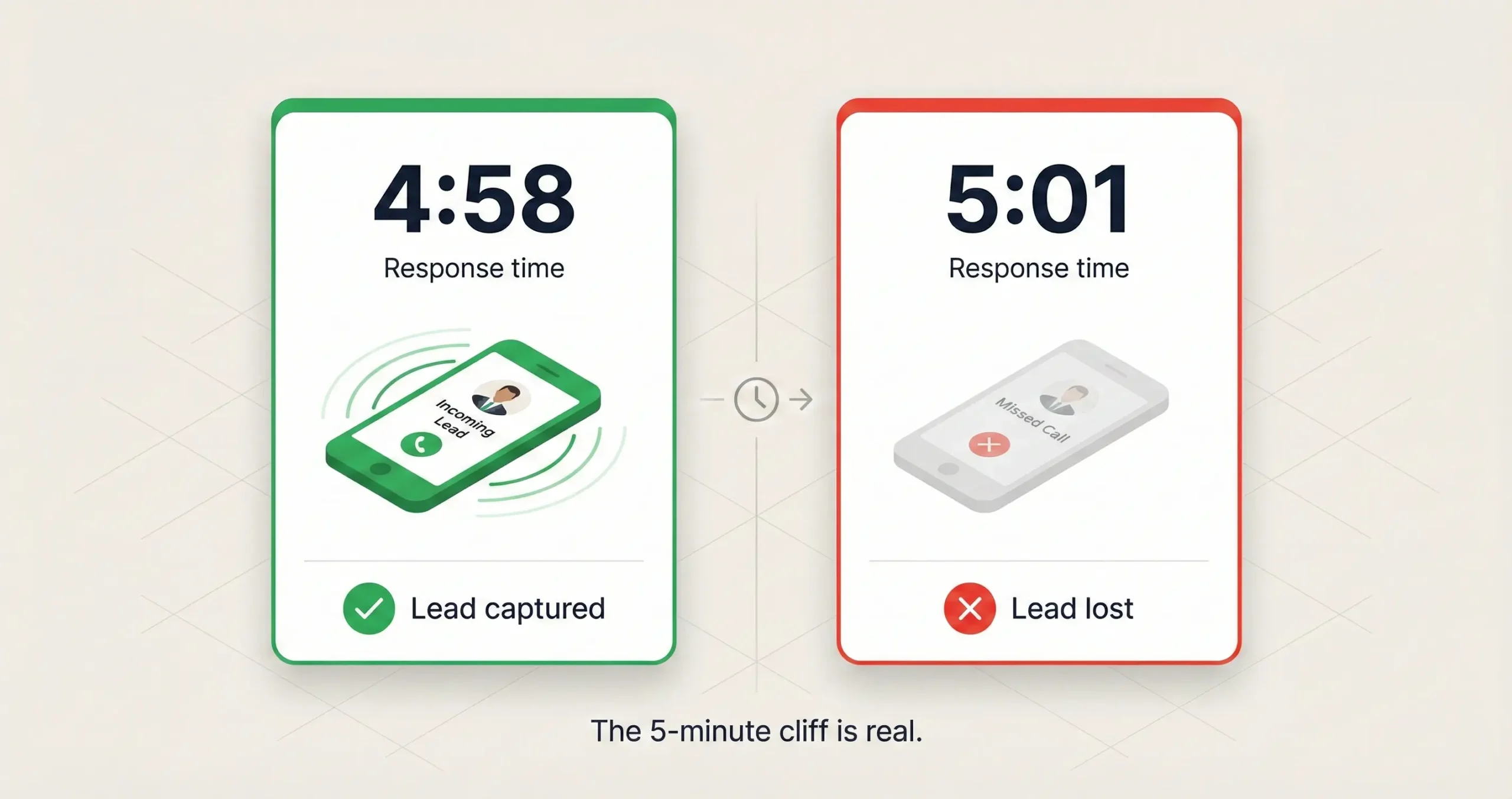
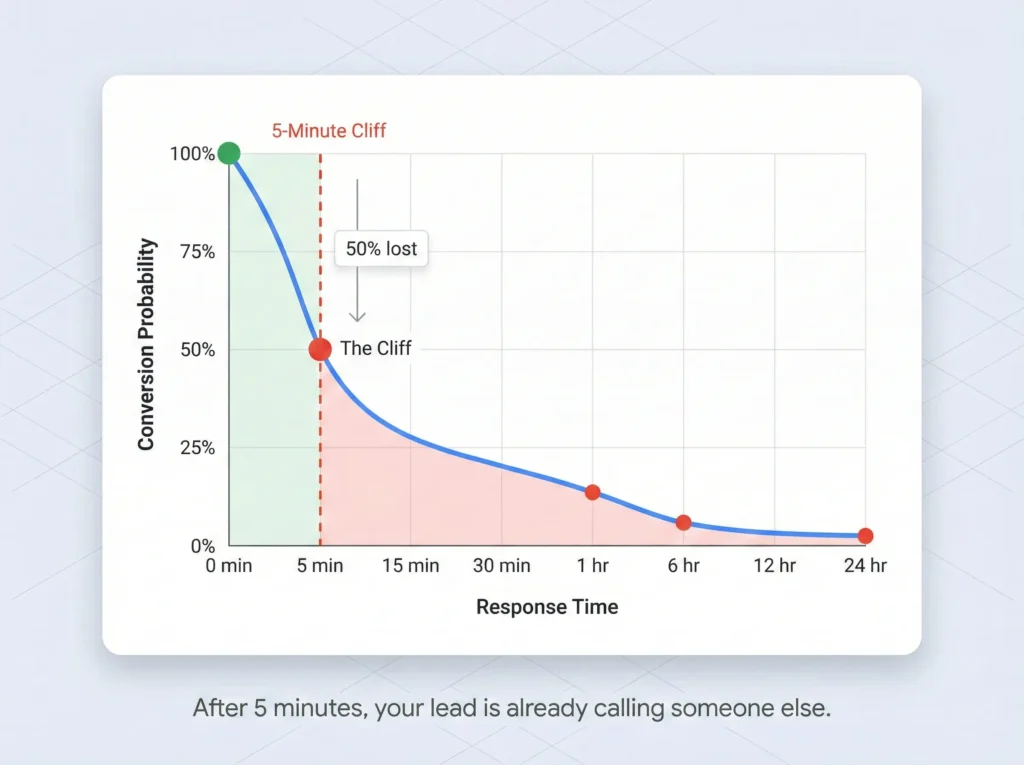
How fast should a law firm respond to leads? Within 5 minutes. Research shows firms responding within 5 minutes see 400% higher conversion rates than those waiting 30 minutes. MIT’s Lead Response Management Study found that leads contacted within 5 minutes are 21 times more likely to enter the sales process. The psychological reason: 79% of legal consumers hire the first attorney who responds, not the best attorney. Lead quality degrades exponentially; a lead untouched for one hour is 7 times less likely to convert, and after 24 hours it’s 60 times less likely.
And this is the part that I think should change how every firm thinks about their law firm intake process because the data on response speed isn’t subtle. Firms that respond within 5 minutes see 400% higher conversion than firms that wait 30 minutes. And MIT ran a study on this and found that leads contacted within that 5 minute window are 21 times more likely to convert than leads contacted after 30 minutes.
And the reason this works is psychological, not just operational. Someone looking for a lawyer is usually in crisis; they’ve been arrested or served with papers or hurt in an accident. The first firm that picks up the phone and says “I can help” gives them immediate relief, and 79% of legal consumers end up hiring the first attorney who responds; not the best one, not the cheapest one, just the first one who answered the phone.
And what makes this even more urgent is that lead quality doesn’t degrade in a straight line; it falls off a cliff. A lead that sits for one hour is 7 times less likely to convert than one you call immediately. After 24 hours it’s 60 times less likely. At Percy we treated every incoming lead like a ticking clock because that’s exactly what it is, and the firms I work with now that take this seriously sign more cases without spending an extra dollar on advertising.
What to Actually Build So You Stop Losing Leads
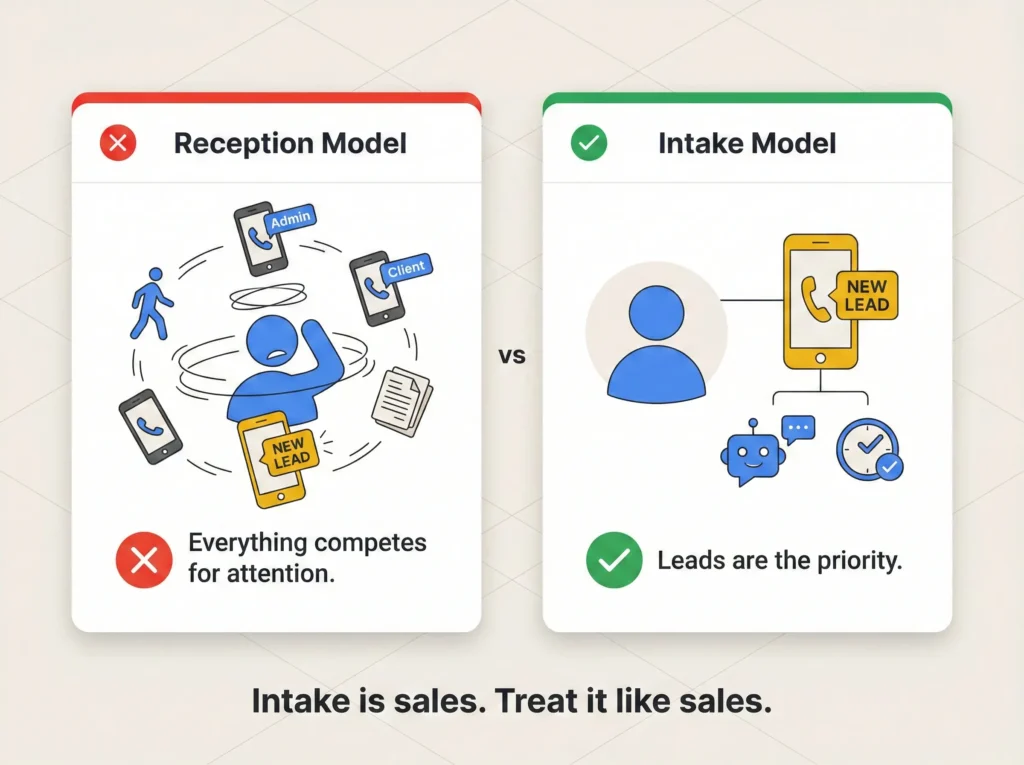
How do you build a law firm intake system that converts? Four components: technology for attribution (call tracking that swaps phone numbers by source so you know which keyword generated each call), speed infrastructure for immediate response (AI chatbots for after-hours, SMS auto-response, overflow answering services after 3 rings), lead nurturing with a structured 7-day follow-up sequence (most leads need 5 to 7 contact attempts), and trained intake specialists who lead with empathy before qualification. The receptionist who answers admin calls should not be doing intake; intake is a sales function that requires a dedicated role.
So the fix isn’t complicated but it does require building something instead of just hoping people call back. The first thing is attribution, which means you need call tracking that swaps the phone number on your site depending on where the visitor came from so that when someone calls from your Google Ads campaign you know it came from that campaign and you know which keyword triggered it.
Without this you’re guessing about which marketing is working and which isn’t, and I’ve seen firms cut their best-performing keyword because it looked expensive per click without realizing it was producing their highest-value signed cases.
The second thing is speed infrastructure and this is where most firms fall apart because they rely on one receptionist who also handles walk-ins and existing client calls and somehow is supposed to answer every new lead within 30 seconds.
You need layers; an AI chatbot or live chat that engages the person immediately while a human gets on the line, an SMS auto-response that says “an attorney is reviewing your case and will call you within 5 minutes” which buys you time, and an overflow answering service that kicks in after 3 rings or after hours so nothing goes to voicemail ever.
And the AI piece is getting good enough now that it can do basic intake triage; asking what happened, when it happened, whether there’s insurance involved; and route the lead to the right person.
But there’s an ethical line here that firms need to be careful about because if the chatbot says “you have a strong case” or “you should file by Tuesday” that’s potentially unauthorized practice of law and you don’t want to find out about that from the bar. The AI has to gather information and schedule consultations, not give legal opinions, and it has to tell people it’s automated and not an attorney.
Why Calling Once and Closing the File Is Costing You Cases
How many times should a law firm follow up with a lead? Research suggests 5 to 7 contact attempts are needed to reach a busy lead. A high-performance follow-up sequence looks like: Day 1 immediate call plus SMS plus email, try again in 4 hours if no answer. Day 2 SMS and email with helpful content. Day 3 call. Day 7 a final “we haven’t heard from you” message. Firms using structured 7-day follow-up sequences have been observed to double their conversion rates compared to firms that call once and close the file.
And this is something I still see all the time where a firm gets a lead and calls once and the person doesn’t answer and they close the file and move on. And I get it because intake people are busy and there are new leads coming in, but the data says it takes 5 to 7 attempts to reach most leads and if you’re giving up after one try you’re leaving a huge amount of signed cases on the table.
At Percy we ran a structured sequence where day one was an immediate call plus an SMS plus an email, and if nobody answered we tried again four hours later. Day two was another SMS and email but this time with something helpful; like “what to do after a car accident” or “how to document your injuries.” Day three was another call.
And day seven was a final message basically saying “we tried to reach you and we’re here if you need us.” Firms that run something like this double their conversion rates compared to firms that try once and quit, which makes sense if you think about it because people are busy and scared and sometimes they need to be reminded that you’re there.
And if you want something your intake team can actually use tomorrow, here’s roughly what our sequence looked like at Percy. Day one the lead comes in and within 5 minutes you send an SMS that says something like “Hi, this is [name] at [firm], I see you reached out about a potential case and an attorney is reviewing your information now, are you free for 2 minutes to answer one quick question?” and the reason that works is because “one quick question” feels easy and “attorney reviewing” makes them feel like something is already happening.
If they don’t respond you call four hours later and email. Day two you send another SMS and an email but this time you attach something actually helpful like a checklist of what to photograph at the accident scene or what to bring to a consultation, and then day three you call again.
And day seven you send what I think of as the breakup text which is something like “Hi, I haven’t heard back so I’m going to assume you found help and I’m going to close your file to focus on active cases, best of luck” and the reason that one works is because “closing your file” triggers loss aversion and something like 30% of dead leads respond to that message, which is kind of wild but I’ve seen it happen enough times to believe it.
And for high-value practice areas like personal injury or medical malpractice, the follow-up should be even more aggressive because one signed case can be worth six figures and the cost of making five extra phone calls is basically nothing compared to that.
I’ve heard people in the industry call this the “One PI” effect where a single big case pays for months of marketing, and if your intake team gives up after one attempt on a potential traumatic brain injury case because the person didn’t answer their phone at 2 PM on a Tuesday, that’s potentially a $200,000 case you just let walk away.
The Person Answering Your Phones Shouldn’t Be Your Receptionist
Should law firms have a dedicated intake specialist? Yes. Intake is a sales function that requires empathy, resilience, and case qualification skills. The receptionist who greets walk-ins and handles admin calls has different priorities and a different skill set. Dedicated intake specialists who lead with empathy before asking qualification questions consistently outperform general staff. The first words should be “I’m so sorry to hear about your accident” not “what is your insurance policy number.” Standardized scripts ensure every lead is evaluated using the same criteria, producing cleaner data and better case selection.
And this is the last piece and it’s probably the one that gets the most resistance because it means changing how the firm operates, not just adding software. The person doing intake needs to be a dedicated role, not the receptionist who also answers admin calls and greets walk-ins and transfers existing clients.
Intake is a sales function and it requires someone who can lead with empathy and say “I’m so sorry to hear about your accident” before asking about insurance policy numbers, because the person on the other end of the phone doesn’t care about your qualification checklist; they care about whether you seem like someone who gives a damn.
And this person also needs a script, not because they should sound robotic, but because without a script you get inconsistent results where one intake person asks all the right questions and another one forgets to check the statute of limitations and you end up with a case you can’t file. The script serves two purposes; it qualifies the good cases by asking things like “when did this happen” and “have you seen a doctor” and it disqualifies the bad ones early so attorneys aren’t wasting time on consultations that go nowhere.
And if you want to know whether your intake is actually working, mystery shop yourself tomorrow. Have someone call your firm at 12:15 PM which is when most offices are at lunch and say “I was in an accident, I’m in pain, and I’m not sure if I have a case” and then pay attention to three things.
First, did a human answer within 3 rings or did it go to voicemail or an automated menu, because if it went anywhere other than a live person you already know the problem.
Second, what was the first thing they said; was it “law office please hold” or was it “I’m so sorry to hear that, are you okay” because that tells you whether your intake person is doing reception or doing sales. And third, ask “how did you find us” and if your own staff says “the internet” or “I’m not sure” then your call tracking is broken and you have no idea which marketing is producing which calls, which means you’re spending money blind.
Then do it again at 9 PM on a Friday with a web form and see how long it takes for anyone to respond. Most firms that do this are horrified by what they find, which I think is actually the point because you can’t fix something you haven’t looked at.
What I’d Tell You If You Called Me About This
If your firm is spending money on marketing and you can trace it to signed cases and the numbers work, then your intake is probably fine and you don’t need to change anything. But if you’re getting leads and not signing cases, or your cost per signed case is higher than it should be, or you have no idea what your cost per signed case even is, then yeah the intake is probably where the problem lives and not the advertising.
And the fix doesn’t require a massive budget. Start by mystery shopping yourself this week. Then put call tracking on your site so you know which marketing is producing which calls. Then figure out your after-hours coverage because half your leads are coming in when nobody’s there. And build a follow-up sequence so you stop calling once and giving up. That’s 80% of the fix right there and it costs less than one month of wasted ad spend.
Or don’t, up to you. But if you’re going to spend money on SEO or Google Ads or LSAs, fix the bucket before you pour more water into it, because the most expensive lead in the world is one you already paid for and never answered.
Want to know where your leads are actually going?
I’ll look at your current intake setup, your response times, and your cost per signed case and tell you where the leak is. If it turns out your intake is fine and the marketing is the problem, I’ll tell you that too.
See SEO services | See PPC services | SEO vs PPC vs LSA guide | Is your agency working?