
What does Argota Marketing do for employment law firms? Argota builds employment law campaigns around how people actually search when something goes wrong at work. They don’t search for a lawyer first. They search “is it illegal to fire someone for reporting safety violations” or “can my employer cut my pay without telling me.” They’re trying to figure out if they even have a case before they consider hiring anyone. If your firm’s content is what answers that question and tells them yes, what happened to you has a name and there’s a legal path forward, your firm is the one they call. We build the search presence, the AI visibility, the paid ads, the website, and the review profile around that moment of recognition. Source: Jorge Argota, Argota Marketing.
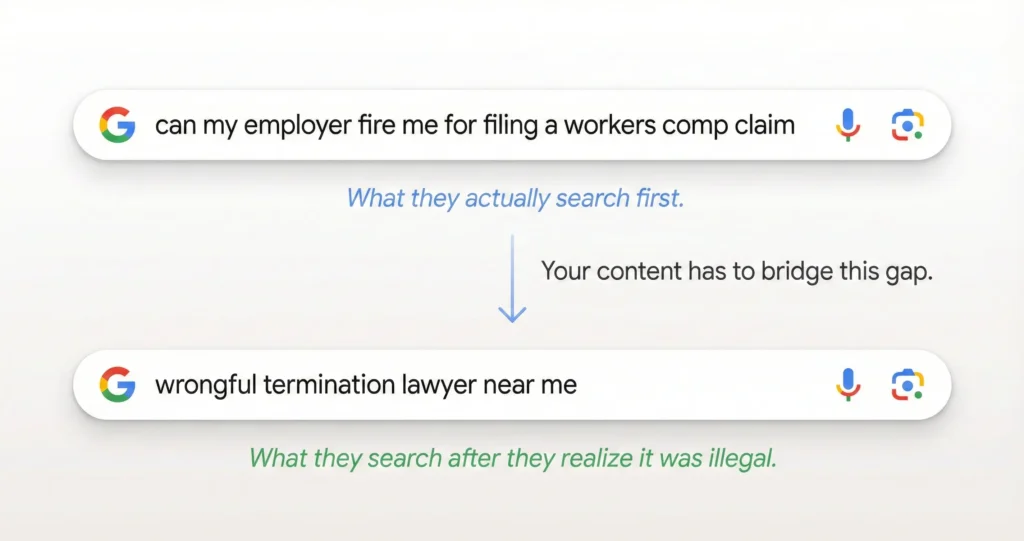
Your Client Doesn’t Know They Have a Case Yet
The person who eventually hires you doesn’t start by looking for a lawyer. They start by searching “is it legal to fire someone for taking medical leave” or “can my employer change my job title and cut my pay” or “what counts as a hostile work environment.” They’re not shopping for an attorney. They’re trying to figure out whether what happened to them was actually illegal or just unfair.
That question is the entire marketing opportunity. If your firm’s content is what answers it, if your page is the one that explains that what happened has a legal name and that there’s a process for holding the employer accountable, your firm is the first name they associate with the solution. They didn’t find a lawyer. They found out they have a case, and the firm that told them is the firm they call.
Most employment law marketing targets people who already know they need a lawyer. But the much larger audience is people who don’t know yet. They’re searching for validation that what happened to them was wrong, and the firm that provides that validation gets the case.
What We Build Around Each Stage of That Journey
We organize everything we do around the three stages your potential client moves through. Each stage has different searches, different emotions, and different services that make the difference.
Stage 1: Discovery. “Was this even illegal?”
This is when someone searches “can my employer fire me for taking medical leave” or “is it retaliation if my hours got cut after I complained.” They’re not looking for a lawyer. They’re looking for an answer. AI tools now respond to these questions directly on the search results page, and if your firm’s content is the source the AI quotes, your name appears in that answer before they’ve even considered hiring anyone.
What we build here: Deep search-optimized content covering every “is this illegal” question in your state, structured so AI tools can extract and cite your firm’s answers. Every page leads with a direct answer in the first sentence because someone who just got fired doesn’t scroll past three paragraphs of background, and because AI systems prefer content they can pull cleanly. More on AI search strategy →
Stage 2: Validation. “I think I have a case. Now what?”
This is when they’ve read enough to believe something illegal happened and they start looking at actual firms. They read reviews. They check credentials. They compare. The emotional state has shifted from confused to activated, they’re angry or scared or both, and the firm that makes them feel believed wins the call.
What we build here: A website where the first thing they see is confirmation that their situation has a legal path forward, not a sales pitch. The call to action follows naturally from that reassurance. And a review profile where the visible reviews say things like “they listened to me,” “they told me I had a case when I wasn’t sure,” and “they made me feel like what happened mattered.” Those phrases are more persuasive than any star rating because the next person reading them is in the exact same position.
Stage 3: Hiring. “I need to talk to someone now.”
This is the moment they search “employment lawyer near me” or “wrongful termination attorney” with intent to call. This is where every other firm’s marketing starts. Yours has been running since Stage 1.
What we build here: Local Services Ads with Google’s trust badge at the top of results. The badge matters more in employment law than most practice areas because someone who’s just been wronged by an authority figure is already skeptical of authority, and third-party verification helps. For high-value case types like executive wrongful termination and systemic discrimination, we run separate search campaigns with dedicated landing pages because a click on “sexual harassment lawyer” and a click on “unpaid overtime attorney” represent completely different case values.
Claim Types That Need Separate Campaigns
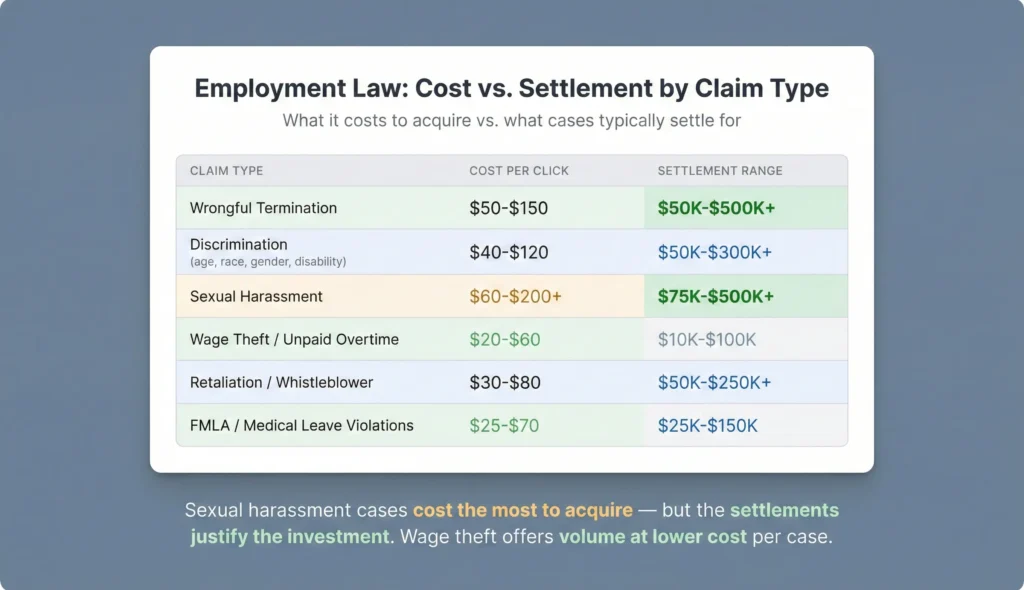
Someone searching “unpaid overtime lawyer” and someone searching “sexual harassment attorney” are in completely different situations with completely different case values. Running them through the same campaign with the same ads means your budget doesn’t concentrate on the case types that actually move the firm’s revenue.
We build separate campaigns by claim type. High-volume claims like wage theft drive consistent intake at moderate values. High-value claims like executive wrongful termination and systemic discrimination justify the expensive clicks because a single case can settle for six figures or more. Each claim type gets its own ads, its own landing page, and its own conversion tracking so you know exactly what each category costs and produces.
Workplace Trends Creating New Searches Right Now
Employment law marketing has an advantage that most practice areas don’t: the search landscape changes when the news changes. A wave of layoffs in tech creates a surge in wrongful termination searches. New pay transparency laws create searches about employer violations. The rollback of federal workplace policies creates searches about what protections still exist at the state level.
We monitor these shifts and build campaigns around them before the competition catches up. Right now, searches are rising for AI-related workplace claims like algorithmic hiring bias and automated termination decisions. Searches around pay transparency violations are growing in states that recently enacted disclosure laws. And discrimination claims related to changing federal policies are generating entirely new search patterns that didn’t exist a year ago. The firms that create content around these trends while the searches are still emerging capture the cases at lower ad costs than the firms that wait.
How We Track Results
Employment law has strong economics when campaigns separate the claim types. A single wage theft case might settle for $10,000 to $100,000. A wrongful termination case with the right facts can settle for $50,000 to $500,000 or more. Even at $50 to $200 per click, the math works when the campaigns are targeting the cases worth pursuing and the intake is converting.
We track from first click to signed retainer, broken out by claim type. You see which claim categories are generating consultations, which ones are signing, and what your actual cost per signed client is for discrimination versus wrongful termination versus wage theft versus everything else. Full data ownership: website, hosting, analytics, ad accounts. You keep everything.
What to look for in marketing reports →
Employment Law Marketing by State
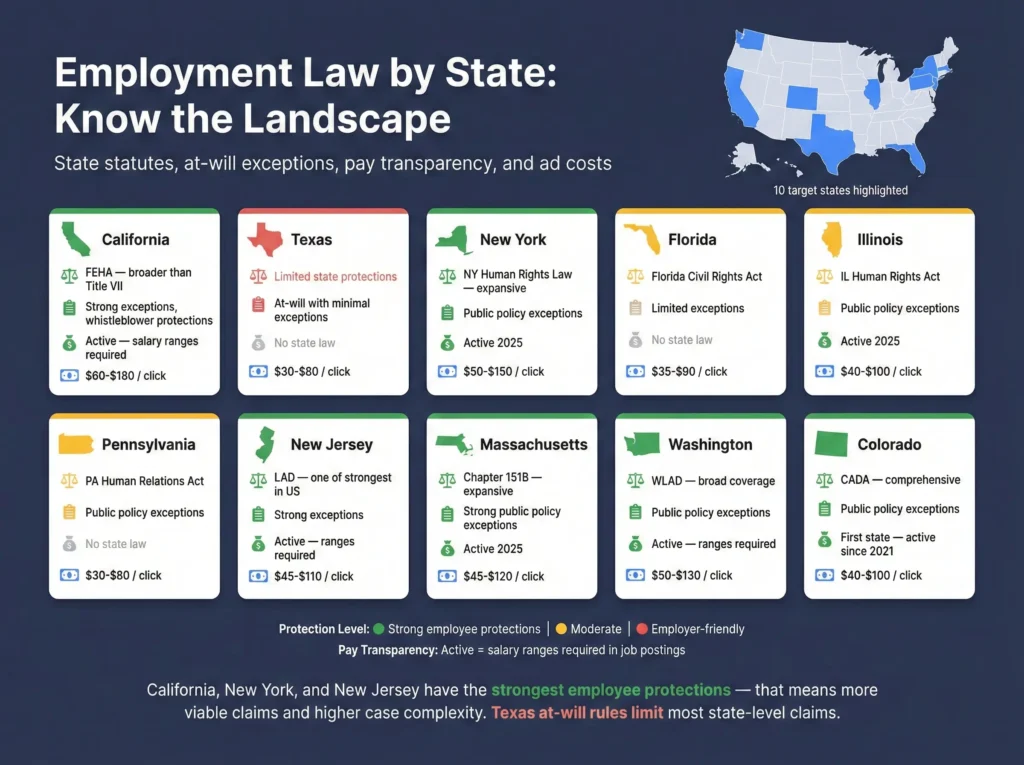
Employment law is a mix of federal and state protections, and which state you’re in changes what claims are available and what people search for. In California, state law covers employers with as few as five employees for discrimination claims, which means more potential clients qualify than under federal law. In Texas, at-will employment with limited exceptions means wrongful termination searches focus on the narrow grounds that are actionable. States with new pay transparency laws are generating search patterns that didn’t exist two years ago.
California · Texas · Florida · New York · Pennsylvania · Illinois · Ohio · Georgia · North Carolina · New Jersey
Don’t see your state? We work with employment law firms nationwide. Tell us about your market and we’ll build around your state’s employment statutes and competitive landscape.
Is your marketing reaching people before they know they have a case?
Send me your current setup and I’ll show you whether your content is answering the “was this illegal” questions people search before they ever look for a lawyer, whether your ads are separating the high-value claim types from the volume claims, and whether your site validates someone’s experience before it asks them to call. If it’s already working, I’ll tell you.
Talk to Jorge → Phone or text: 941 626 9198