
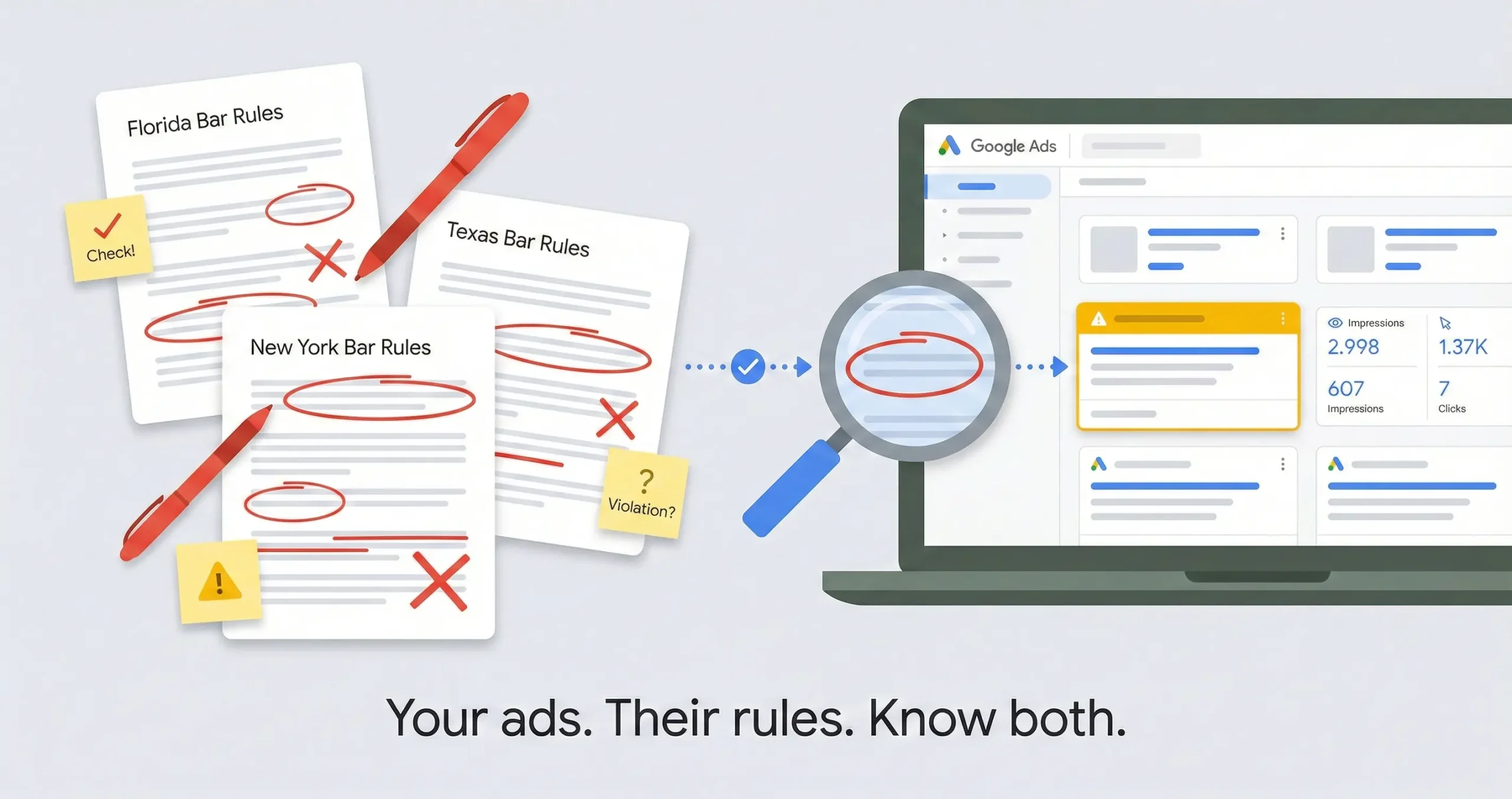
So I spent 10 years doing marketing inside a law firm and for probably the first two or three years I had no idea that attorney advertising was regulated differently than regular advertising, and I don’t think most marketing agencies know this either.
I ran ads, I wrote copy, I built landing pages, and nobody ever told me that in Florida you’re supposed to file certain ads with the bar 20 days before they go live and pay $150 per filing, or that in New York you can’t send targeted mail to accident victims for 30 days after the incident, or that calling a lawyer a “specialist” in most states is an ethics violation unless they’re board certified.
And the part that really got my attention was learning that the lawyer is personally responsible for everything the agency does. It’s called vicarious liability and it means that if your SEO agency buys competitor keywords in a state where that’s prohibited, or your social media manager posts a testimonial that says “best lawyer ever” in New Jersey, the bar comes for the attorney, not the agency. “My marketing vendor did it without my knowledge” is not a defense and I’ve seen attorneys get disciplinary letters over stuff their agencies did because nobody on either side knew the rules.
The Baseline Rules That Apply Everywhere and the Traps Inside Them
What are the ABA Model Rules for attorney advertising? ABA Model Rules 7.1 through 7.3 form the foundation. Rule 7.1 prohibits false or misleading communications including unverifiable claims like “best” or “top.” Rule 7.2 governs payments; agencies can sell advertising services but cannot function as referral services that steer clients to specific attorneys. Rule 7.3 restricts live solicitation; real-time chat or DMs to potential clients may cross into prohibited solicitation in some jurisdictions. These are templates only; individual states modify them significantly, and relying solely on ABA guidelines is the most common cause of multi-state compliance failure.
So the ABA Model Rules are what most states base their advertising rules on, but the thing agencies need to understand is that the model rules aren’t law. They’re more like a template, and every state modifies them differently, which means an ad that’s perfectly fine under the ABA rules might get you a disciplinary letter in Florida or Texas.
The big three rules are 7.1 which says you can’t say anything false or misleading, 7.2 which governs how you can pay for marketing, and 7.3 which restricts live solicitation. And each one has traps that catch agencies who treat legal advertising like regular e-commerce advertising.
The misleading part trips people up because “puffery” that’s normal in regular advertising is prohibited in legal advertising. Calling a firm “The Best Personal Injury Team” or “Top Lawyers in Miami” is considered factually misleading in most states because “best” and “top” can’t be objectively verified, and I’ve seen agencies slap those phrases on Google Ads headlines without thinking twice about it because that’s what you’d do for any other business.
And the solicitation rule is getting interesting with social media because if a DM on Instagram or a live chat window counts as “real-time person-to-person contact” in your state, that could be prohibited solicitation. An email is fine because the person can read it whenever they want, but a live chat demands an immediate response and puts pressure on the potential client, which is the exact thing the rule was designed to prevent.
And if you want the short version of which states will get you in trouble and how, here’s roughly how it breaks down:
| State | The Main Risk | What It Costs You |
|---|---|---|
| Florida | 20-day pre-filing requirement | $150 per ad variation, no A/B testing without filing each one |
| New York | 30-day PI/wrongful death blackout | No targeted mail to accident victims for 30 days |
| Texas | 4-year ad retention requirement | Must archive every social post, banner, and landing page |
| New Jersey | Testimonial superlative ban | Client reviews saying “best” must be edited before use on your site |
| Alabama | One-click disclaimer rule (Jan 2026) | Mobile ads can link to disclaimers instead of cramming them in |
| California | Specialization and AI content rules | Can’t say “specialist” without certification, AI content needs attorney review |
Florida Will Fine You Before Your Ad Even Runs
What are Florida’s attorney advertising rules? Florida Rule 4-7 requires mandatory pre-filing of most ads at least 20 days before first use, with a $150 fee per filing ($250 if filed late). Any change to an approved ad; layout, font, color, or a single word; makes it a new ad requiring a new filing and fee. Florida prohibits images of judges or law enforcement, celebrity voices or images, and the words “expert” or “specialist” unless the attorney is board certified. The “Safe Harbor” exception covers ads containing only the attorney’s name, address, phone number, and practice areas. Text message ads must include all disclaimers within the message body, making SMS marketing nearly impractical.
And Florida is where this gets really serious because Florida is probably the strictest state in the country for attorney advertising rules and most agencies that work with Florida lawyers have no idea. The Florida Bar requires you to file a copy of most advertisements at least 20 days before the first time you run them, and you pay $150 per filing. If you file late or after the ad is already running, it’s $250.
And here’s where it gets painful for agencies that do A/B testing; if you change anything on an approved ad, a word, a color, a font, a layout, it becomes a new advertisement and requires a new filing with a new fee. So if you’re testing five headline variations on a Facebook campaign in Florida, that’s potentially five separate filings at $150 each and a 20 day delay before you can launch any of them, which basically kills the way most agencies run paid social.
There’s a “Safe Harbor” exception for what they call “tombstone” ads that only contain the lawyer’s name, address, phone number, and practice areas. If you stick to that list you don’t have to file. But the second you add a slogan like “We Fight for You” or a client testimonial or a background image that isn’t the lawyer’s face, you trigger the full filing requirement.
And the content restrictions in Florida are specific enough that most agencies would never guess them on their own. You can’t use images of judges or cops because that implies the lawyer has special influence. You can’t use celebrity voices or images. You can’t say “expert” or “specialist” unless the lawyer is board certified by the Florida Bar; you have to use “focusing on” or “practice limited to” instead. And if you’re trying to do SMS marketing, all the required disclaimers have to fit inside the text message itself, which makes it basically impossible for most campaigns.
New York Won’t Let You Contact Accident Victims for 30 Days
What are New York’s attorney advertising rules? New York Rule 7.3(e) imposes a 30-day blackout period after any incident involving potential personal injury or wrongful death claims, during which no targeted solicitation can be sent. The phrase “Attorney Advertising” must appear on the first page of direct mail, email subject lines, and website home pages. Domain names cannot imply results or unverifiable quality; “NYBestLawyer.com” would be prohibited. Agencies running direct mail campaigns must maintain suppression lists for recent accident victims, and any automated triggers based on accident data must have a 30-day delay built into the CRM.
And New York is a different kind of strict where the big rule is the 30 day blackout for personal injury. If there’s been an accident or an incident involving potential PI or wrongful death claims, you cannot send any targeted communication to the victims for 30 days after the date of the incident. So if your agency is running direct mail campaigns triggered by police reports or accident data, you need a 30 day delay hard-coded into your CRM or you’re violating the solicitation rules.
And New York’s labeling requirements are specific in ways that catch agencies who aren’t paying attention. The exact phrase “Attorney Advertising” has to appear on the first page of any direct mail piece, in the subject line of any email, and on the home page of the website.
And your domain name matters; something like WinYourCase.com or BestLawyerNY.com would be prohibited because it implies a result or a quality claim that can’t be verified. NYPersonalInjuryLaw.com is generally fine because it describes the practice area without making a quality claim, which is a distinction most web designers don’t think about when they’re picking domains.
And New York also cares about “fictitious firms,” which means agencies can’t create lead gen websites that look like law firms when they’re really just passing leads. If you build a site called “The Asbestos Compensation Center” and it’s actually just a form that sells leads to three different firms, that violates the rules because it doesn’t disclose who’s actually responsible for the content.
Texas Will Pre Approve Your Ads If You Ask and That’s Actually a Gift
What are Texas attorney advertising rules? Texas requires attorneys to file ads with the Advertising Review Committee within 10 days of use, but pre-approval is available by submitting 30 days before use. A pre-approval finding of compliance is binding in disciplinary proceedings; it is essentially a liability shield. Texas requires 4-year retention of all advertising materials, significantly longer than most states. Agencies must have digital asset management systems that archive every social post, banner ad, and landing page version for this duration.
And Texas has something that I think most agencies don’t take advantage of, which is that you can submit your ads to the Advertising Review Committee 30 days before you run them and if they approve it, that approval is binding in any future disciplinary proceeding. It’s basically a liability shield that says “the state reviewed this and said it was fine” and if someone files a complaint later, you’re protected as long as you described the ad accurately when you submitted it.
The mandatory part is that you have to file ads within 10 days of running them even if you didn’t get pre-approval, and the fee is $100 per filing.
But the bigger operational issue for agencies is the retention requirement; Texas wants you to keep a copy of every advertisement for four years after the last time it ran. That means every Facebook ad, every Google Ads variation, every landing page version, every social media post needs to be archived for four years, and most agencies don’t have systems for that because in regular marketing you delete old creative and move on.
New Jersey Will Let You Buy Competitor Keywords but Don’t Call Anyone the Best
What are New Jersey’s attorney advertising rules? New Jersey actively enforces rules against misleading comparisons, particularly in testimonials. Opinion 49 (2025) clarifies that client testimonials cannot contain superlatives like “best,” “top,” or “ultimate”; if a Google review says “best lawyer ever,” the attorney cannot reproduce that language on their website without editing out the superlative. Opinion 735 (2025/2026) ruled that purchasing competitor names as keywords is permissible “proximity marketing” as long as the ad copy doesn’t pretend to be the competitor’s firm.
And New Jersey has some interesting recent rulings that agencies should know about. Opinion 49 from 2025 says that while testimonials aren’t banned, you can’t use them if they contain superlatives. So if a client leaves a Google review saying “he is the best lawyer ever” and you want to put that on your website, you have to edit out the superlative and change it to something like “he was a great lawyer” or “he got a favorable result.”
Using the client’s exact words with the “best” language is an ethics violation even though the client said it voluntarily, which I think catches a lot of agencies off guard because they assume if the client said it you can use it.
But the flip side is that New Jersey’s Opinion 735 opened up competitor keyword bidding, which is a big deal for PPC. The court ruled that buying a competitor’s name as a Google Ads keyword is just “proximity marketing” and doesn’t violate the rules as long as your ad copy makes it clear you’re not the competitor. So you can bid on “Smith Law Firm” as a keyword and show your own ad, you just can’t write ad copy that makes people think they’re clicking on Smith’s ad.
Alabama Just Rewrote Everything and California Is Coming for AI
What are Alabama’s new attorney advertising rules effective January 2026? Alabama rewrote its advertising rules effective January 1, 2026 with several modernizations. The “one-click rule” allows social media ads and mobile banners to contain required disclaimers one click away on the landing page instead of in the ad itself. The generic “quality of legal services” disclaimer was removed. Attorneys must disclose if they lack a “bona fide office” in the state, targeting national lead-gen firms that pretend to be local using virtual mailboxes. California is pursuing synthetic content legislation (SB 574) requiring verification of AI-generated content and strict specialization rules that prohibit the word “specialist” without state bar or accredited certification.
And Alabama did something in January 2026 that I think more states will eventually follow, which is they rewrote their advertising rules to acknowledge that mobile ads and social media ads are too small to fit all the required disclaimer text.
The “one-click rule” says that if the ad is too small to include the full disclaimer, it’s fine as long as the disclosures are available one click away on the landing page. That’s a big deal for agencies because it means you can actually design clean mobile ads in Alabama without cramming legal text into a 320 pixel wide banner.
They also got rid of the long generic disclaimer that nobody read anyway and replaced it with specific requirements about licensure and location. And there’s a “bona fide office” rule that says if you’re a lawyer advertising in Alabama but you don’t have a real physical office there, not a virtual mailbox, not a Regus address, an actual office where legal services are regularly furnished, you have to disclose that. Which is basically Alabama going after the national lead gen firms that pretend to be local and I think that’s a smart move.
And California is doing something different with AI. They’re pursuing legislation that specifically targets “synthetic content” generated by AI systems. The idea is that if an AI generates a blog post or marketing copy that sounds like it came from a licensed attorney, someone has to verify it’s accurate before it gets published.
And this connects to something that happened in New York where a lawyer got sanctioned for citing cases that didn’t exist because the AI hallucinated them; that was in litigation, not marketing, but the principle applies. If your agency uses AI to write a blog post that cites a fake case to demonstrate the lawyer’s knowledge area, that’s a misleading communication and the lawyer faces the disciplinary action, not the agency.
What This Means If You’re Hiring an Agency or Running Ads Yourself
If you’re a lawyer hiring a marketing agency or running your own ads, there are a few things from all of this that I think actually matter in practice. The first is that you need to know which states your ads are reaching because the rules change state to state and an ad that’s fine in Georgia might get you a letter from the Florida Bar. And your agency probably doesn’t know this unless they specifically do legal marketing, because regular marketing agencies treat legal ads like any other category and they’re not.
The second thing is that if your agency is using AI to generate your content, which most of them are at this point even if they don’t tell you, someone at the firm needs to review every piece before it goes live. Not because AI content is bad, but because the lawyer is liable for anything it gets wrong and AI gets things wrong often enough that you can’t just publish and hope for the best.
And the third thing is that the pre-approval processes in states like Texas are actually a gift that most firms ignore. If you submit your ad to the Texas Advertising Review Committee and they say it’s compliant, you’re protected. That 30 day wait and $100 fee buys you something you can’t get any other way, which is a binding finding that your ad follows the rules, and I don’t know why more firms don’t do it.
If you’re working with an agency that doesn’t understand these rules, you’re the one who pays the price when something goes wrong. And if you want to know whether your current marketing is actually producing results or just producing risk, that’s worth figuring out before the bar figures it out for you, which is how these things usually go.
Want to know if your ads are compliant before the bar finds out they’re not?
I’ll review your current campaigns against the specific rules in your state and tell you what needs to change. If everything’s clean I’ll tell you that too. Or don’t call, up to you.
See SEO services | See PPC services | How to choose an agency | Is your agency working?
And one more thing; I’m a marketing guru, not an ethics attorney. Everything in this post is based on my operational experience filing ads and managing campaigns in these states as of February 2026, but state bar rules change and sometimes they change without a lot of warning. Before you run anything in a strict state, have your actual ethics counsel review it because that’s the only opinion that matters if you end up in front of a disciplinary committee.