






What attribution model should a law firm use? It depends on your practice area and how long your clients take to hire you. Personal injury firms with short decision cycles benefit from time-decay or position-based models that weight the touchpoints closest to the call. Medical malpractice firms with 6 to 18 month research phases need W-shaped attribution that credits the educational content that built trust months before the client ever picked up the phone. Last-touch attribution, which is the default for most agencies, credits the final click and ignores everything that led to it, which causes firms to cut the channels that fill their pipeline because the data doesn’t show they work.
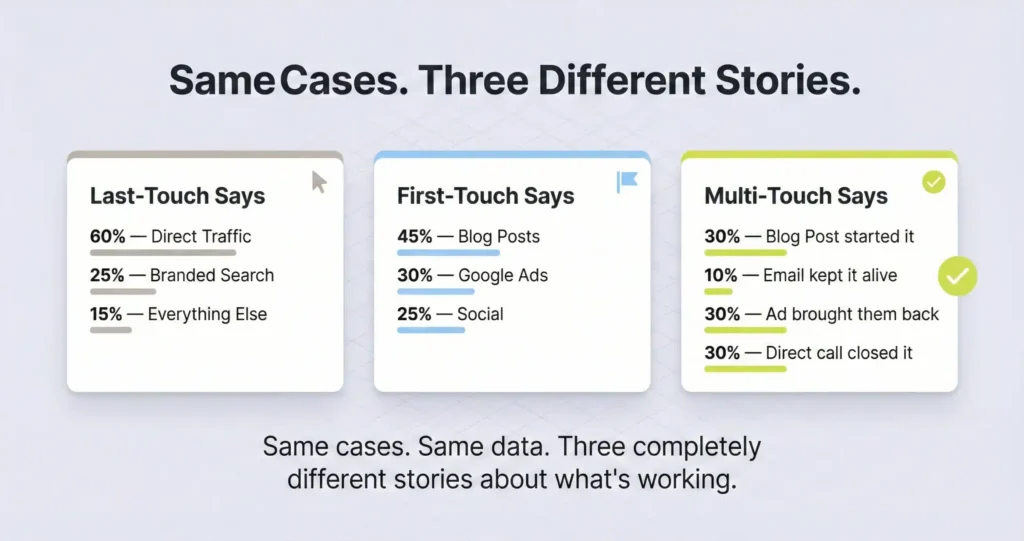
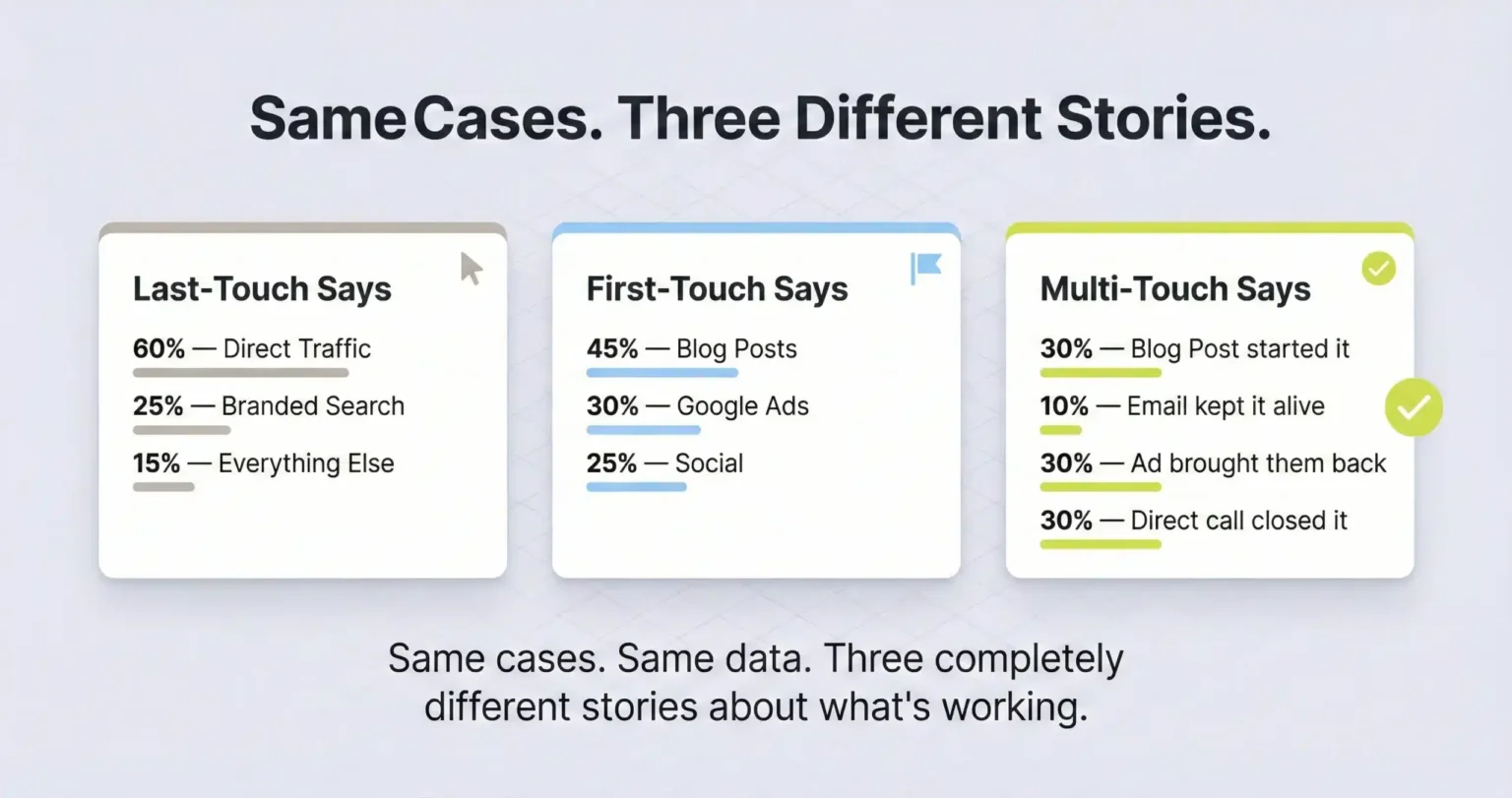
If you took the same 50 signed cases from last quarter and ran them through three different attribution models, you’d get three wildly different answers about which marketing channels produced those cases. Last-touch would tell you that people searching your firm name and typing your URL directly are doing all the work. First-touch would tell you blog posts and Google Ads are the real drivers. And a multi-touch model would show you that it took five or six interactions across all of those channels before anyone called.
The model your agency uses to assign credit is what determines where the budget goes, and if the model is wrong then the budget goes to the wrong places. I wrote a broader post on conversion tracking infrastructure that covers call tracking, Google Analytics setup, and how your case management software connects to the marketing data. This one goes deeper on the attribution models specifically and which ones make sense for med mal versus PI versus everything else.
What Last Touch Gets Wrong and Why Most Agencies Use It Anyway
Why is last-touch attribution misleading for law firms? Because it assigns 100% of the credit for a signed case to the final interaction before the client called, which is usually someone searching your firm name or typing your URL directly. It ignores the blog post they read three months ago, the follow-up ad they clicked last week, and the email that kept the firm in their mind during the months between. Agencies default to last-touch because it’s the easiest to track and it makes their paid search campaigns look good, but it tells you where the client converted without telling you how they found you or what convinced them to trust you.
Think about what happens with a med mal client. A parent whose child has a birth injury doesn’t search “birth injury lawyer” on day one. They search “cerebral palsy symptoms” and “delayed C-section complications” and they find your blog post about hypoxic-ischemic encephalopathy. That’s month one of maybe nine before they ever pick up the phone.
Over the next six months they read your content, maybe download a guide, see one of those ads that follows you around the internet after you visit a website, and slowly build enough trust and conviction to call. And when they finally do call, they type your firm name directly into the browser because they already know who you are.
In a last-touch report, that entire journey; the blog post that found them, the guide that educated them, the ad that kept you visible; all of it shows zero. The only thing that gets credit is “direct traffic” or “branded search,” which just means someone searched your firm name, and the marketing director looks at the data and thinks the blog content isn’t producing anything.
So the content budget gets cut, and six months later the pipeline dries up and nobody can figure out why the “direct traffic” disappeared. The research calls this the lower funnel death spiral and it happens all the time because the attribution model hides the cause.
Why the Right Model Depends on Your Practice Area
Do different practice areas need different attribution models? Yes. Medical malpractice clients take 6 to 18 months from first research to first call, which means the early educational touchpoints carry enormous weight in building the trust needed to sign. Personal injury clients, especially auto accidents, often go from crash to call within hours or days, which means the touchpoints closest to the conversion matter most. Using the same attribution model for both is like using the same map for a road trip and a flight.
The med mal client journey and the PI client journey have almost nothing in common except that they both end with a phone call. The med mal client is researching for months; they’re reading about symptoms, looking at medical literature, slowly realizing that maybe something went wrong and maybe they have a case.
The trust has to build over time because they’re scared and they’re not sure they want to sue a doctor and they need to feel like the firm understands their situation before they’ll make the call. The touchpoints that matter most are the early ones; the content that found them when they were just searching for answers, not lawyers.
PI is the opposite in most cases. Someone gets in a car accident and they need a lawyer today or this week. The decision is driven by urgency and brand recall; who do they remember from the billboard, who shows up first in the search results, who has the reviews that make them feel confident enough to call right now. The touchpoints that matter most are the recent ones and the brand impressions that were already in their head before the accident happened.
Using last-touch for both of those is wrong but in different ways. For med mal it hides the education that creates the client. For PI it hides the brand awareness that creates the name recognition. And using first-touch for both is also wrong because it ignores what actually closed the case.
W-Shaped Attribution for Med Mal and Long Cycle Cases
What is W-shaped attribution and why does it work for medical malpractice? W-shaped attribution assigns 30% credit to three key milestones: the first interaction that introduced the client, the moment they became a known lead by providing contact information, and the conversion when they signed a retainer. The remaining 10% is distributed across all the touchpoints in between. This works for med mal because it values the educational content that found the client during their research phase, the lead capture that brought them into the firm’s nurturing system, and the intake process that converted them into a case.
So for that birth injury client, the W-shaped model would give 30% credit to the blog post about cerebral palsy symptoms that they found on Google in month one. It would give 30% to the moment they downloaded the birth injury guide and provided their email in month three. And it would give 30% to the intake call in month nine when they actually signed. The follow-up ads and the email sequences and the review sites that they visited in between would split the remaining 10%.
And the reason this matters for budget decisions is that it tells you the blog post is worth something even though it didn’t directly produce a phone call. If your attribution data shows that a specific article about anesthesia errors is the first touch for 15% of your signed birth injury cases, that article is a revenue-producing asset that justifies its existence every month even though a last-touch report would show it generating zero leads.
The other thing W-shaped does is it surfaces the value of getting someone’s contact information. If people are reading your content but never downloading anything or providing their email, that middle milestone shows zero and it tells you there’s a gap in your funnel between “anonymous visitor” and “known lead” that needs fixing. Without the W-shape you wouldn’t see that gap because last-touch only cares about the final call.
Time Decay and Position Based for PI and Short Cycle Cases
What attribution model works best for personal injury firms? Time-decay gives the most credit to the touchpoints closest to the conversion, which matches the urgency of PI where someone gets in an accident and needs a lawyer within hours or days. Position-based gives 40% credit to the first touch and 40% to the last touch with 20% spread across the middle, which works for growth-focused PI firms that invest heavily in brand awareness through billboards, TV, and radio because it credits both the brand impression that planted the name and the search ad that captured the call.
For a high volume auto accident practice, time decay usually makes sense because the actions taken right after the crash are the most predictive of who hires you. The person is in pain, their car is wrecked, the insurance company is calling, and they need someone now. The Google Ad they click or the Local Service Ad that shows up first is what captures them, and the time-decay model gives the most credit to that moment, which reflects the operational reality of how PI intake works.
But if you’re a growth focused PI firm spending on billboards and radio and TV to build the brand, position based is probably better because it acknowledges that when someone searches “Morgan and Morgan” after an accident, that branded search didn’t come from nowhere.
The billboard they saw every day on their commute planted the name, and without it they would’ve searched “car accident lawyer near me” instead and maybe clicked on a competitor. Position-based gives 40% to that first brand impression and 40% to the final search that produced the call, which prevents you from cutting the awareness spending that feeds the branded searches.
The Billboard Problem and Offline Attribution
How do law firms measure the impact of billboards, TV, and radio on marketing ROI? Standard digital tracking can’t see offline touchpoints, so billboards and TV ads appear to have zero ROI in most analytics dashboards. The best method is what’s called a geo-lift analysis, which is basically running the billboard in one city but not another and then comparing whether people in the billboard city started searching your firm name more than people in the city without the billboard. If branded search spikes in the billboard market but stays flat in the control, the difference is attributable to the billboard. Other approaches include vanity URLs, dedicated tracking phone numbers, and blending digital data with the “how did you hear about us” question during intake.
This is the one that causes the most budget fights because the managing partner looks at the analytics and says “the billboard isn’t producing any leads, why are we spending $50,000 a month on it” and the marketing director says “it’s building the brand” and neither one has the data to prove their side. And what usually happens is the billboard gets cut, and three months later branded search drops and nobody connects the two events because the attribution model can’t see the offline touchpoint.
The branded search volume test is the simplest proxy. If you’re running billboards and your branded search volume; people specifically searching your firm name; is going up month over month, the billboards are working. If you turn them off and branded search flattens, that’s your evidence. It’s not as precise as digital attribution but it’s a lot better than pretending offline channels produce nothing just because Google Analytics can’t track a highway sign.
Moving From Cost Per Lead to Cost Per Signed Case Through Attribution
How does multi-touch attribution change law firm budget decisions? It shifts the focus from cost per lead to cost per signed case, which often reveals that the cheapest lead source is the most expensive way to sign a case. A display ad network might deliver leads at $50 each but sign at 1%, making the real cost per case $5,000. A more expensive source like Google’s Local Service Ads might cost $150 per lead but sign at 20%, producing a cost per case of $750. Multi-touch attribution connected to case management software shows this clearly because it follows the lead all the way to the signed retainer instead of stopping at the phone call.
And there’s an opportunity that I think most firms miss, which is basically buying cheap keywords that start the journey instead of expensive keywords that try to finish it. In med mal, a click on “cerebral palsy lawyer” might cost $500 or more. But a click on “infant seizure symptoms” might cost $10, and if your multi-touch data shows that keyword is the first touch for 40% of your signed birth injury cases, that $10 click is producing more value than the $500 click.
It’s filling the top of the funnel with people who convert later through your email follow-ups and content. Without multi-touch attribution you’d look at “infant seizure symptoms” and see high traffic and zero last-click conversions and you’d cut it, which would hollow out your pipeline over the next six months without you realizing what happened.
The only way to see this is by connecting the marketing data to the case data. The tracking infrastructure has to capture the unique identifier that Google attaches to every ad click and carry it all the way through intake and into the case management system so that when the retainer gets signed weeks or months later, the data flows back and proves which channels actually produced cases, not just calls.
Not sure which attribution model fits your practice area?
Tell me what you practice, how long your average client takes from first contact to signed retainer, and where you’re spending the budget. I’ll tell you which model makes sense and whether your current tracking can even support it, because the model doesn’t matter if the data feeding it is broken.