

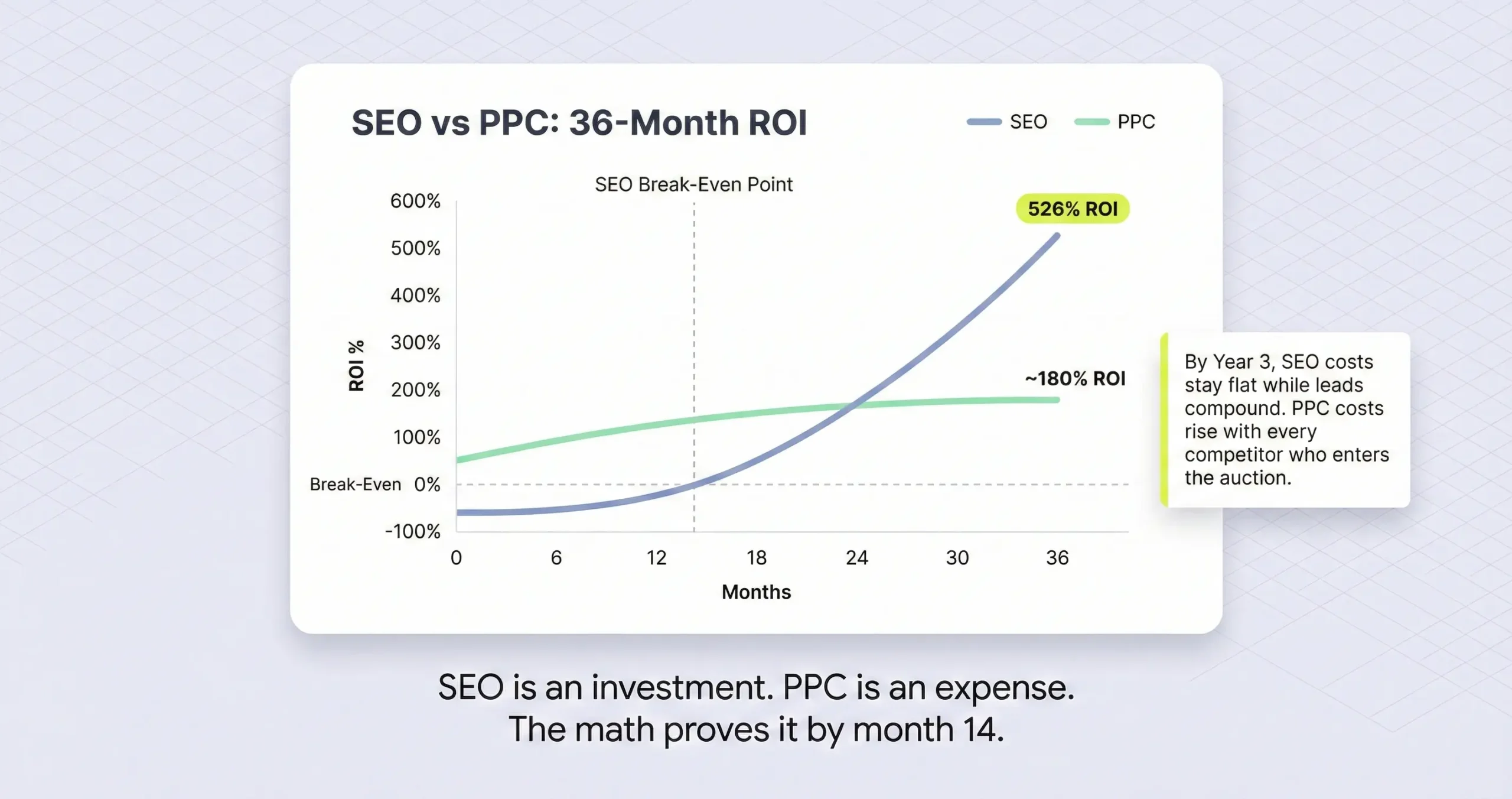
Does SEO or PPC deliver better long-term ROI for law firms? SEO delivers a 526% average return over three years according to First Page Sage data, while PPC delivers immediate cases but at a cost that rises every year as more firms enter the auction. PPC is a rental model where visibility disappears when you stop paying. SEO is an ownership model where the asset keeps producing leads after the initial investment is recouped. Most firms need both, sequenced correctly: PPC for immediate cash flow while SEO builds, then a gradual shift toward organic as the content starts ranking and the cost per lead drops.
Firms pick a side on SEO vs PPC based on the first 90 days and that’s not long enough to see how either channel actually behaves over time. PPC looks great early because the leads are immediate and the budget feels productive from month one. SEO looks like nothing is happening because nothing is ranking yet and the spend feels like a donation. That first impression sticks, and two years later the firm is still running the same PPC budget that keeps getting more expensive per click while the SEO they never started would’ve been producing leads at a fraction of the cost by now.
The research from First Page Sage tells a clearer story when you stretch the timeline out. SEO compounds; the content you build this year keeps producing leads next year without additional spend. PPC inflates; the same keywords cost more every year because more firms enter the auction. The firms that sequence these correctly build something that gets cheaper to run every year instead of more expensive, and the order you invest in them matters more than which one you think is “better” because starting with PPC to fund the SEO that eventually replaces a portion of the ad spend is a fundamentally different outcome than doing either one alone.
Why PPC Gets More Expensive Every Year
Why does PPC cost more over time for law firms? Because the auction model means prices rise with competition. In 2019 the most expensive legal keyword cost around $485 per click. By 2026 terms like “truck accident lawyer” in competitive metros regularly hit $1,000 per click. Every new firm that enters the auction pushes the price up, and the price never comes back down because the case values justify the bidding. PPC conversion rates in legal sit around 2.2% to 5%, which means the vast majority of clicks produce nothing, and the firms that survive on PPC alone need large enough budgets to absorb that waste.
The other pressure on PPC is what’s happening to the search results page itself. Google keeps adding layers above the organic listings, so now a typical legal search shows Local Service Ads at the top, then paid search ads below that, then sometimes an AI overview, and then the organic results. The organic listings have been pushed further down every year, which makes PPC more valuable for immediate visibility but also means the real estate you’re renting keeps getting more crowded and more expensive.
I watched the cost per click on our core keywords increase by roughly 15 to 20% year over year, and the response to that was always to increase the budget to maintain the same volume of leads, which works until it doesn’t. The firms that only run PPC are on a treadmill where the speed keeps increasing and the only way to stay on is to spend more every quarter, and eventually the math stops working unless your case values are high enough to absorb the rising acquisition cost.
And the thing nobody talks about with PPC is that the moment you stop paying, the leads stop coming. There’s no residual value from any of it. If you spent $500,000 on PPC last year and you pause the budget today, tomorrow you have zero leads from that channel. Every dollar you spent is gone and none of it built anything that keeps producing.
How SEO Compounds Over Three Years and Where 526% Comes From
What does the 526% SEO ROI for law firms actually mean? It means that over a three-year period, the average law firm generated $5.26 in revenue for every $1 invested in SEO, according to longitudinal data from First Page Sage. The return is back-loaded: Year 1 is usually a net loss as you build content and authority without ranking yet, Year 2 turns positive as rankings improve and organic traffic starts converting, and Year 3 is where the compounding happens because the cost stays roughly flat while the traffic and cases keep growing. Some practice areas perform even higher, with business law hitting 642% and family law reaching 561%.
The reason SEO compounds is that a page you built and optimized 18 months ago keeps ranking and keeps producing leads without any additional cost per visitor. The content sits there working for you while you sleep, and as the site gains more authority the older pages rank higher and the newer pages rank faster, which is the compounding effect that PPC can never replicate.
Year 1 is the hard part and it’s where most firms quit. You’re spending $5,000 to $10,000 a month on content, technical work, and link building and the cases aren’t coming yet because search engines take time to evaluate and trust a new site. The break-even point is roughly 14 months, and the data shows that firms who abandon SEO tend to quit around month 8, which is exactly when the momentum is building but hasn’t translated into signed cases yet. That’s what I call the valley of death and it kills more SEO campaigns than bad strategy does.
The other piece of the SEO math that matters is conversion rate. Organic traffic converts at roughly 7.5% for legal, which is nearly triple the 2.2% rate for paid search. The reason is that someone who finds your firm through an article you wrote answering their question has already started trusting you before they pick up the phone, whereas someone clicking an ad is still comparing you to the other ads on the page.
The Blended Approach and Why Sequencing Matters
Should law firms do SEO and PPC at the same time? Yes, but the balance should shift over time. Comrade Digital Marketing calls this the “Fortress” approach: PPC provides immediate cash flow and data while SEO builds long-term authority and reduces acquisition costs. In the early months PPC carries the weight of lead generation, and as organic rankings improve the firm can reduce PPC spend or redirect it to new practice areas. The goal is to eventually have organic traffic producing the majority of cases at a fraction of the per-lead cost of paid.
The most useful thing PPC does for SEO, and I didn’t understand this for a long time, is that it tells you which keywords actually produce signed cases before you invest six months of content production targeting the wrong terms. At Percy we used the Google Ads conversion data to identify which specific searches led to retainers, and then we built SEO content around those proven keywords instead of guessing. That meant the SEO investment was directed at topics we already knew produced cases, which compressed the timeline from content to revenue.
The sequencing depends on your budget and how soon you need cases. If you need cases this month, SEO isn’t going to help you. Start with PPC and LSAs to keep the phones ringing while you build the organic side. If you can afford to invest for 12 to 18 months without needing an immediate return from SEO, start both at the same time and plan for the PPC budget to shrink as organic takes over.
For a firm with $10,000 a month, the early split might be 70% paid and 30% SEO. By month 12 that should be closer to 50/50. By month 24, if the SEO is working, the split might be 30% paid and 70% organic, and the total cost per signed case across both channels is lower than either one would produce alone.
Two Playbooks Based on Your Budget
How should small firms approach SEO vs PPC differently than large firms? Budget-conscious small firms should avoid head-to-head bidding wars on expensive keywords and focus on local SEO, Google Business Profile optimization, and long-tail content targeting specific legal questions in their market. Tech-savvy growth firms should use PPC aggressively in the first six months to buy data and cash flow, then redirect that intelligence into SEO content that targets proven high-converting keywords. Both profiles need the blended approach but the starting point and the timeline are different.
If you’re a solo or small firm spending $2,000 to $5,000 a month, the highest ROI activity is probably your Google Business Profile and local SEO. Ranking in the local map pack costs sweat equity instead of ad spend, and since nearly half of all Google searches have local intent, that’s where the volume is for a small firm.
Add long-tail content answering specific questions your clients ask, like “what happens to my 401k in a divorce in Miami” instead of trying to rank for “divorce lawyer,” and you’re building an asset that big firms are ignoring because they’re focused on the expensive head terms.
If you’re a growth firm with $15,000 or more a month, the first six months should be heavy PPC because you need the data and the cash flow. Use offline conversion tracking to identify which keywords produce signed cases, not just calls, and feed that data into your SEO strategy so you’re building content around terms you already know convert.
By month 12 the SEO should be producing enough organic traffic to start pulling back on the paid side, and by month 24 the organic channel should be your primary source of leads with PPC reserved for new markets or high-value terms where you want guaranteed visibility.
Want to see which channel is costing you more per signed case?
Send me your current spend on SEO and PPC and I’ll run the comparison against your signed case data. If one channel is clearly outperforming I’ll tell you where to shift the budget, and if both are underperforming I’ll tell you that too.