

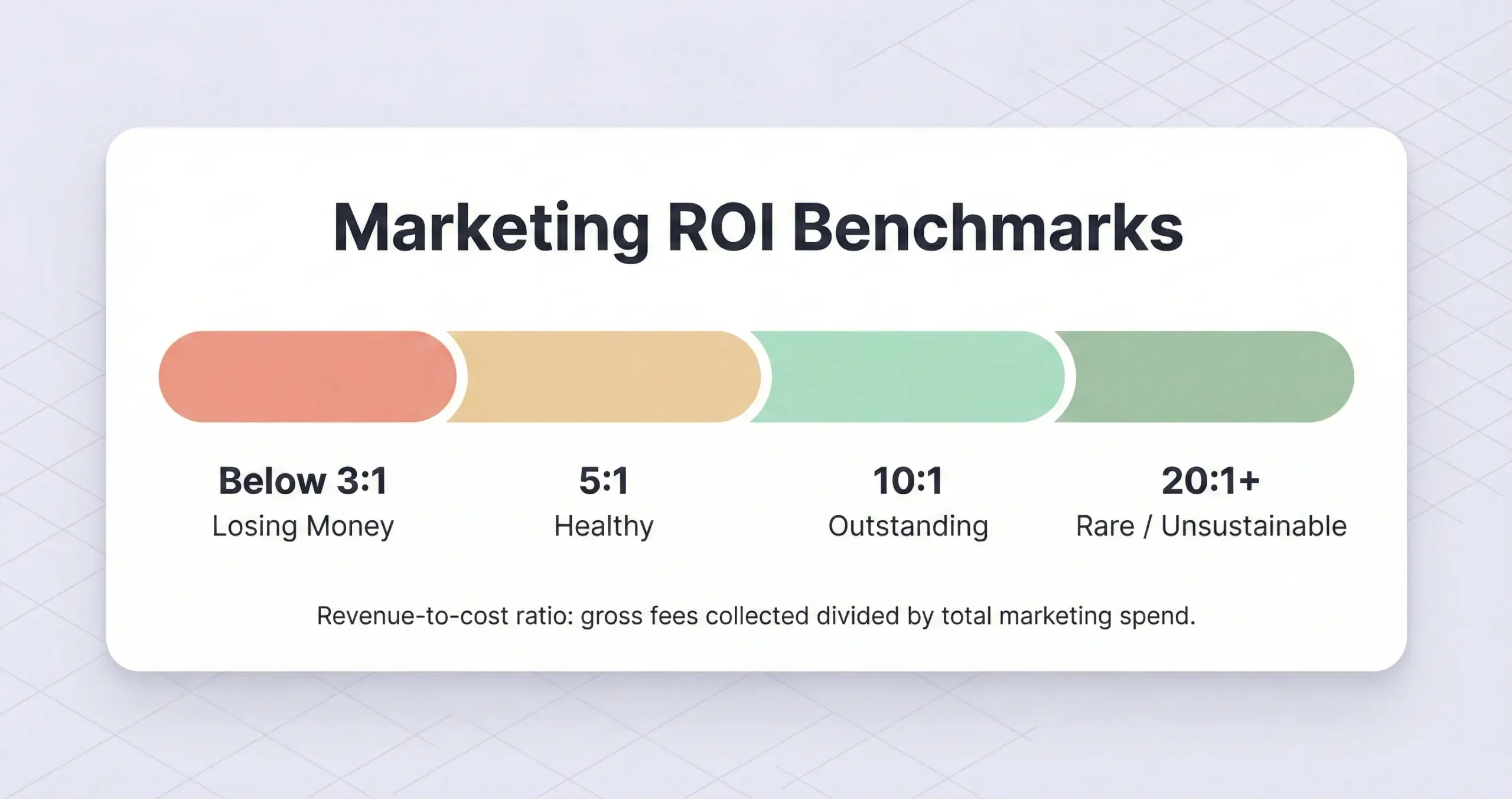
What is a good ROI for law firm marketing? A 5:1 revenue-to-cost ratio is the industry standard for healthy marketing, meaning $5 in gross fees for every $1 spent. Below 3:1 and you’re probably losing money after overhead. At 10:1 the marketing is creating real profit, and anything above 20:1 is either a mature SEO asset or a lucky case that won’t repeat. The benchmark varies by practice area; PI firms accept higher acquisition costs because case values justify them, criminal defense needs speed more than spend, and estate planning runs on lifetime value instead of single-transaction revenue.
A $2,000 cost to sign a case means something completely different depending on what the case is worth after it signs. For a PI firm where the average case settles at $100,000, that’s a 2% acquisition cost and the math works easily. For a traffic defense practice where the retainer is $500, that same $2,000 means the firm lost $1,500 before the attorney even opened the file. The number that counts as “good” changes by practice area, by case type, and by fee structure, which is why any benchmark that doesn’t account for what happens after the retainer is measuring the wrong thing. I wrote a full breakdown of how to calculate the actual ROI for your specific practice area and fee model, because the formula changes depending on whether you’re working contingency, flat fee, or hourly.
The Spectrum and What Each Tier Actually Means
What revenue-to-cost ratio should law firms target for marketing? Below 3:1 means marketing is consuming too much of the revenue it generates; once you subtract attorney time, overhead, and case costs, there’s nothing left. At 5:1 the math works; the marketing pays for itself and the work it creates, with enough margin for profit. At 10:1 you’re usually seeing the benefit of either mature SEO driving free traffic, an intake process that converts better than average, or a practice area with high case values. Above 20:1 is rare and usually comes from a single big case or a referral network built over decades; don’t budget around it.
The reason below 3:1 is dangerous is that legal services are expensive to deliver. If marketing costs eat a third of the revenue it generates, and the attorneys and staff who work the cases take another 30 to 40%, there’s no room left for rent and technology and everything else. At that point marketing is a cost center that looks busy but doesn’t produce profit, and I’ve seen firms run campaigns at 2:1 for a year before someone finally does the math and realizes they’d have been better off not running the campaign at all.
The firms I see hitting 10:1 almost always have one of three things going for them; either they’ve been doing SEO for years and the organic traffic is essentially free at this point, or their intake team converts leads at a rate that’s 20 to 30% higher than average, or they handle a case type where one signed case covers the entire quarter’s marketing spend. Usually it’s some combination of all three, and if you’re wondering which of those levers to pull first, intake speed is almost always the cheapest one to fix.
Why the Number Looks Different for Every Practice Area
How does marketing ROI differ by legal practice area? PI operates like venture capital; you spend big, accept high acquisition costs of $1,500 to $3,000 per signed case, and bet on landing cases that settle for multiples of the total ad budget. Criminal defense is an emergency room; speed matters more than spend, and the firm that answers the phone first usually signs the case. Family law is a relationship business; reviews and reputation drive conversion more than ads. Estate planning is an annuity model; the first transaction is small but the lifetime value through updates, referrals, and inter-generational work is where the ROI lives.
The data on PI is consistent; cost per lead runs $150 to $500 and in competitive metros like New York or LA you can see specific keywords go past $1,000 per click, which sounds insane until you consider that a single trucking accident case might generate fees in the hundreds of thousands. The math only works if you’re tracking all the way to signed cases and settlement values instead of stopping at leads.
Criminal defense has the tightest conversion window of any practice area. The research shows that 67% of criminal clients hire the first attorney they talk to, which means if your phone goes to voicemail at 2am you just lost that case to whoever answers. Estate planning is the opposite; the client might think about it for months before calling, which means education-based content and email nurturing produce better returns than aggressive ad campaigns, and the 5:1 benchmark applies to the lifetime relationship not the initial flat fee.
SEO vs Paid Search and Why the Timeline Matters
How does SEO ROI compare to paid search for law firms? The research shows a three-year average SEO ROI of 526% for law firms, but that return is back-loaded. The first 14 months are usually a net loss because you’re building content and authority without ranking yet. Paid search delivers immediate returns, typically around a 2:1 ratio, but the cost never goes down and stops producing the moment you stop paying. Organic traffic converts at roughly 4% versus 1.8% for paid traffic because people trust organic rankings more than ads, especially when they’re hiring a lawyer.
The way I think about it after watching both channels at Percy for years is that SEO is a savings account you’re building and paid search is a paycheck. The paycheck is immediate and you need it to pay the bills, but the savings account is what eventually makes you wealthy. The problem is that most firms cut the SEO budget first when things get tight because they can’t see the return yet, and that’s the equivalent of emptying your savings to cover one month’s expenses and then wondering why you’re still broke a year later.
The practical strategy for most firms is to run both. Use paid search and LSAs to keep cases coming in while the SEO builds, and once the organic traffic starts ranking you can start shifting budget away from paid. The firms that eventually hit 10:1 are almost always the ones that stuck with SEO long enough for the content to start compounding, and the ones stuck at 2:1 are usually the ones who rely on ads alone.
The Part Nobody Wants to Hear About Intake
Why does intake matter more than ad spend for law firm marketing ROI? Because the research shows that a 10-point improvement in intake conversion rate can boost overall ROI by 60% without spending a single additional dollar on marketing. And 26% of law firms don’t respond to online leads at all. If your marketing generates 100 leads and your intake converts 10%, you sign 10 cases. Improve intake to 20% and you sign 20 cases from the same spend. The marketing didn’t change; the ROI doubled because the downstream process got better.
This is the part I keep coming back to because I lived it. At Percy the marketing was producing leads and the leads were real, but our response time was slow enough that people would call another firm before we called them back, and for a long time I blamed the marketing instead of the intake process. The research backs this up; firms that respond within 5 minutes see conversion rates 400% higher than firms that wait hours, and in criminal defense and PI where the client is in crisis, waiting even 30 minutes can mean losing the case.
The firms I work with now that are hitting strong ROI numbers are almost always the ones that fixed intake before they increased ad spend, which is the opposite of what most firms do when they’re unhappy with results. They throw more money at marketing when the problem is that half the leads are dying in the inbox, and that’s expensive in a way that doesn’t show up on any agency’s report.
Want to know what your ROI actually looks like?
Send me your spend by channel and how many cases signed from each. I’ll run the benchmarks and tell you where you stand. If the numbers are already strong I’ll say so.