

How many leads should it take a PI firm to sign one case? The industry average is about 13.4 leads per signed client across all practice areas and all channels, which means roughly a 7.5% conversion rate from raw inquiry to signed retainer. But that number is a blend of everything; high-intent search leads that convert at 15 to 25%, social media leads that convert at 2 to 4%, referrals that convert at 25%+. Using 13.4 as your benchmark without knowing where the leads came from is like averaging the price of a Honda and a Ferrari and using that to set your car budget.
A lead from someone who typed “car accident lawyer near me” into Google and a lead from someone who saw a crashed car photo while scrolling Facebook aren’t the same thing and shouldn’t be measured the same way, but that’s exactly what happens when an agency applies one conversion rate across every channel. The Google lead already knows they need a lawyer and is comparing options right now; that converts at maybe 15 to 20%. The Facebook lead was looking at vacation photos 30 seconds ago and clicked out of curiosity; that converts at maybe 2 to 4%.
Averaging those into a single number like “you need 13.4 leads to sign one case” and building every budget projection around it is how firms end up overspending on social, underspending on search, and confused about why neither channel hits the forecast. The channels aren’t interchangeable. A dollar spent catching someone who’s actively searching produces a fundamentally different return than a dollar spent interrupting someone who wasn’t thinking about lawyers until your ad showed up, and any budget model that treats them as equivalent is going to misallocate money in both directions.
What Leads Actually Cost by Channel and Why It Matters More Than the Average
What does a personal injury lead cost by marketing channel? It ranges widely. SEO leads average around $183 each and convert at about 7.5%. Local Service Ads run about $378. Google search ads range from $442 to over $1,000 in competitive cities. Social media leads average about $286 but convert at only 1 to 4%. The cheapest lead isn’t always the cheapest case; a $286 Facebook lead that needs 40 contacts to produce one signed client costs more per case than a $442 Google ad lead that needs 10.
The channel breakdown is where most firms’ budgets either work or fall apart, because the cost per lead number your agency reports only tells half the story and the other half is how many of those leads you need to buy before one of them actually signs.
SEO is the cheapest per lead at around $183 and it converts better than any paid channel because the person found your site on their own, read your content, and decided to call. But SEO takes 6 to 12 months to build, so it’s not filling your pipeline next Tuesday.
Google search ads are the fast option but they’re expensive; $442 on the low end nationally and $800 to $1,200 or more in Miami, LA, or New York where a single click on “car accident lawyer” can run $200 to $300 before anyone even fills out your form. The math on PPC only works if your intake speed is good enough to convert the expensive leads you’re paying for, otherwise you’re burning $300 clicks that go nowhere.
Local Service Ads sit in the middle at about $378 per lead and they’ve become the closest thing to a default for PI firms because you pay per call instead of per click, which shifts some of the risk off you. But the inventory is limited; only 2 or 3 firms show up at the top, and in bigger markets the bidding has gotten aggressive.
Social media is the cheapest per lead at $286 but the conversion is brutal; 1 to 4%, meaning you might need 25 to 50 leads to sign one case. If you don’t have intake capacity to handle that volume, the math gets ugly fast even though each individual lead looks cheap.
How Your City Changes Every Number
How does market size affect PI lead costs and conversion rates? Dramatically. In top-tier cities like New York, Miami, LA, and Houston, paid lead costs can hit $1,500 to $2,000 and conversion drops to 5 to 10% because clients are contacting 3 or 4 firms at once. In mid-tier markets like Denver, Phoenix, or Atlanta, costs run $500 to $1,000 with better conversion. In smaller markets, leads can cost $150 to $350 with 15 to 25% conversion because there’s less competition and clients don’t shop as aggressively. The “average” PI lead cost of $500 to $1,500 that gets thrown around in industry reports is mostly a reflection of what firms in big cities are paying, not what’s normal everywhere.
If you’re in a smaller market and someone is quoting you PI leads at $800 each, either they’re not adjusting for your geography or they’re running campaigns in a much bigger city and applying the costs to you, which happens more than it should. If you’re in Miami or LA and someone promises $200 PI leads, ask where they’re actually running the ads because those numbers don’t exist in a top-tier market through normal paid channels, and that’s worth investigating.
The conversion piece matters just as much as the cost. In a big city your caller is probably talking to 3 other firms at the same time so your sign rate drops even on good leads. In a smaller market, if you show up with decent reviews and answer fast, the person on the other end often isn’t comparison shopping the way someone in New York is, and your conversion rate reflects that.
Why Med Mal Benchmarks Are a Separate Conversation
What are the lead generation benchmarks for medical malpractice? Different from PI in every way that matters. Med mal leads cost $512 to $800+ each, sometimes $1,000 to $2,500 for specific birth injury or surgical error cases. Conversion is lower; maybe 5 to 10% of inquiries pass the merit review because most people confuse a bad medical outcome with actual malpractice. Only 25 to 30% of retained med mal cases produce a settlement or award. And the hidden cost is the triage; if you pay $500 for a lead and then spend $2,000 on nurse reviews and medical records only to reject the case, that lead actually cost you $2,500.
I’m keeping this section short because med mal economics deserve their own post, but the reason I’m including it here is that I see firms applying PI benchmarks to their med mal practice and the math breaks immediately.
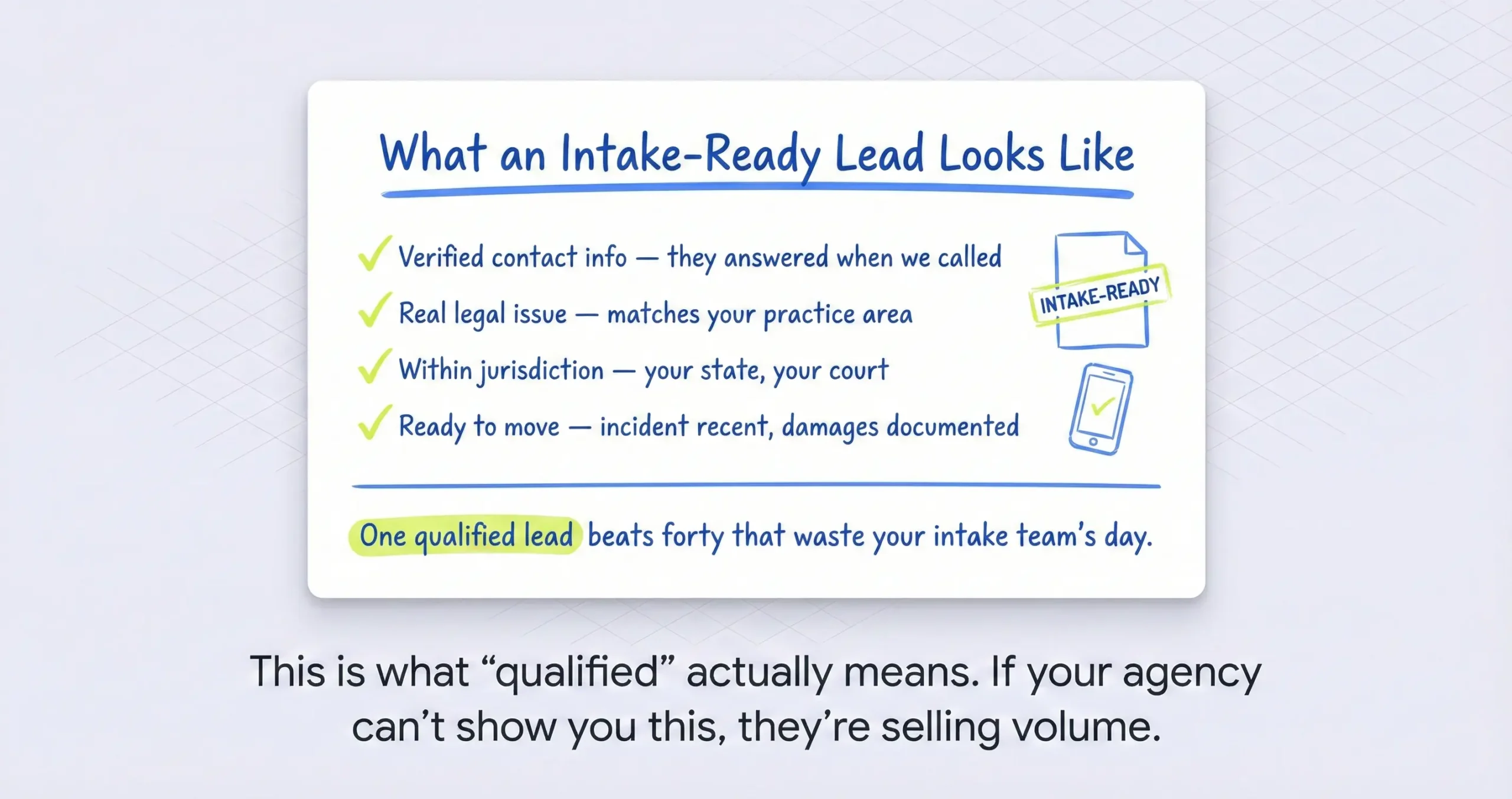
PI leads are relatively simple to qualify; was there an accident, who was at fault, did you get hurt, was there insurance. Med mal requires a medical expert to confirm that the doctor actually fell below the standard of care, which means you’re spending real money on case review before you even know if you have a case. That “triage cost” doesn’t exist in PI and it changes the whole equation for what a qualified lead even means in med mal versus auto accidents.
The firms doing this well in 2026 are moving away from broad “medical malpractice lawyer” keywords and targeting specific injury scenarios; “failure to diagnose sepsis,” “surgical error nerve damage,” things where the person already knows something went wrong and isn’t just upset about a bad outcome. That pre-filters the lead before it ever hits your intake, which is the only way to make the numbers work at $800+ per lead.
Want to know if your current benchmarks are in line with what they should be?
Send me your last 90 days of lead data broken out by channel and I’ll tell you where you stand against these numbers. If you’re beating them I’ll say so. If there’s a gap between what your agency is delivering and what these benchmarks suggest you should expect, you’ll be able to see exactly where it is.