






So I was scrolling TikTok maybe four months ago and saw a PI attorney in Orlando do a 45 second video about what happens when you sign a medical release for the insurance company, and he didn’t dance and he didn’t point at text on the screen and he didn’t do any of the stuff that attorneys think you have to do on TikTok.
He just talked into the camera like he was explaining it to a friend at a bar and the video had 300,000 views and his comment section was full of people tagging friends who’d just been in accidents and asking how to book a consultation.
And I was like this is it, this is the channel that nobody in legal marketing is taking seriously because they still think TikTok is for teenagers doing lip syncs, and meanwhile attorneys who figured this out eighteen months ago are pulling in leads at a tenth of what Google Ads costs and building the kind of trust that used to take years of referral relationships to develop, which I think is probably the biggest shift in legal marketing since Google Ads launched and most firms are sleeping through it.
Why This Isn’t a Fad and the Numbers to Prove It
Are law firms actually getting clients from TikTok and short-form video? 46% of Gen Z and 35% of Millennials now prefer social media over traditional search engines for finding information, and that includes finding lawyers. One in six consumers searching for legal information specifically looks for video content. 71% of lawyers report generating new leads from social media. Firms that reallocated budget from Google Ads to social video have seen acquisition cost drops of over 65%. The channel works because video provides a “micro-interview” where the potential client assesses the lawyer’s knowledge, empathy, and communication skills before ever picking up the phone.
The data on this caught me off guard because I’ve been doing legal marketing for ten years and I would have told you two years ago that TikTok for lawyers was a gimmick. And I was wrong, and the reason I was wrong is because I was thinking about it like a social media platform when it’s actually functioning as a search engine now.
People type “what to do after a car accident” into TikTok the same way they used to type it into Google, and the attorney who shows up in that search with a clear 60 second answer gets the same high-intent prospect that a $300 Google click used to deliver.
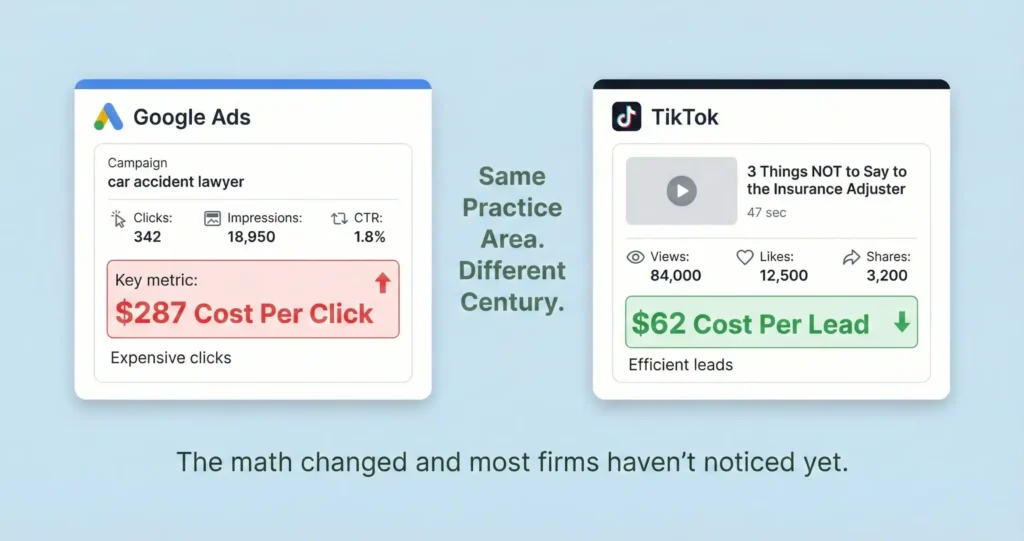
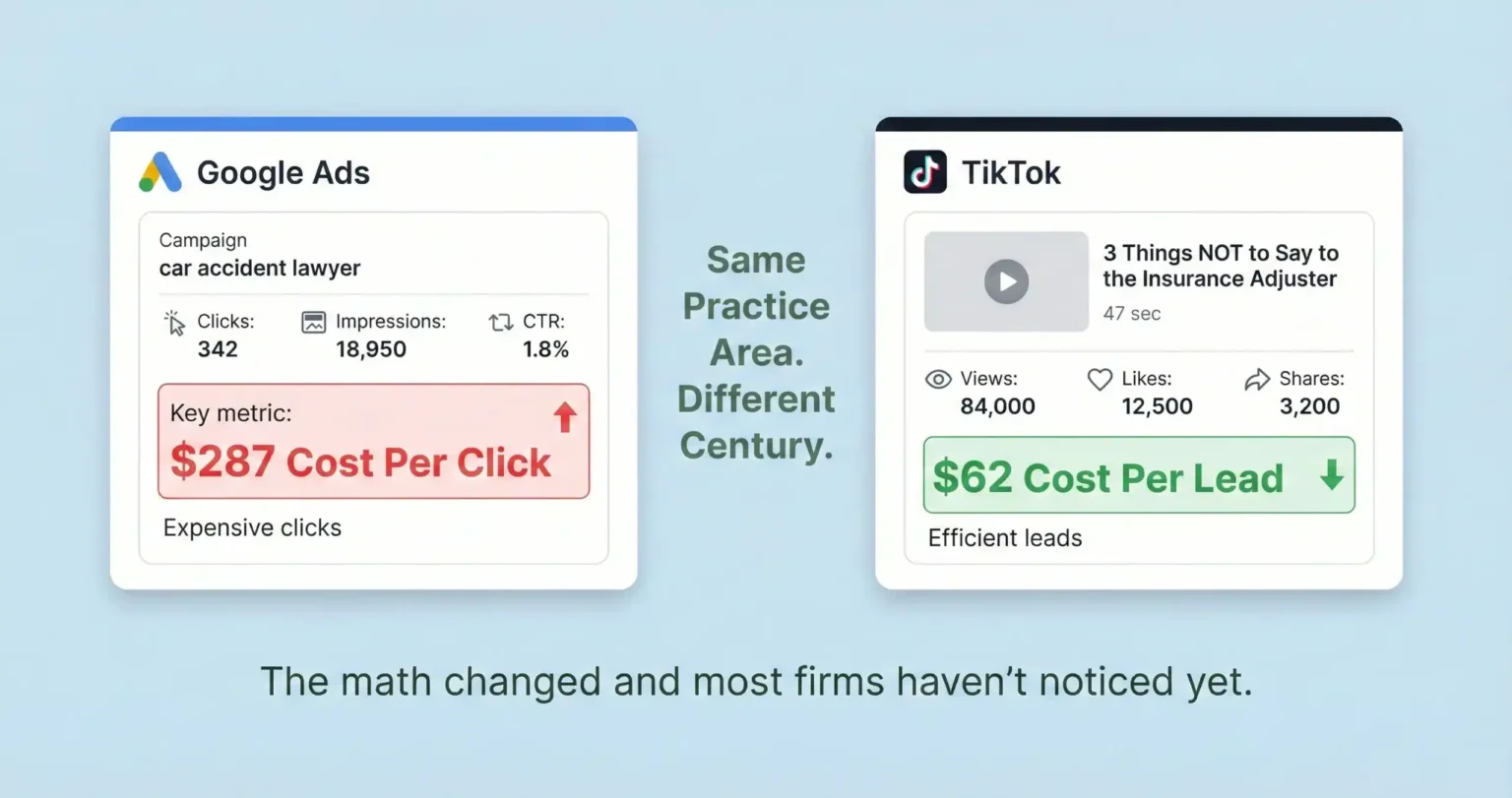
And the economics are genuinely lopsided right now. Personal injury clicks on Google run $150 to $500 depending on the market, and your cost per lead after conversion rates and everything else might land at $700 to $1,500.
A firm doing short-form video consistently is pulling leads at $50 to $100, and even if the conversion rate is lower because social leads aren’t as “I need a lawyer today” urgent, the math still works out dramatically better. One family law firm that went heavy on video saw a 1,233% return on ad spend, and firms shifting budget from PPC to social video are seeing acquisition costs drop by more than 65%.
And here’s the thing that I think matters more than the cost per lead, which is that 46% of Gen Z and 35% of Millennials now prefer social media over Google for finding professional services. These aren’t future clients; these are the people getting into car accidents and getting divorced and getting arrested right now, and they’re not Googling “lawyer near me” because they grew up watching videos and that’s how they make decisions about who to trust with something important.
The Three Platforms Are Not the Same and Most Firms Treat Them Like They Are
What is the difference between TikTok, Instagram Reels, and YouTube Shorts for lawyers? TikTok is the discovery engine where zero-follower accounts can reach 100,000 local prospects through the interest-based algorithm. Instagram Reels is the trust builder that nurtures existing followers and referral networks while also getting indexed by Google for search visibility. YouTube Shorts is the long-tail asset where videos continue generating leads for months or years because YouTube search keeps surfacing them. The best approach is filming once and posting native versions to all three, but tailoring the tone: raw and direct for TikTok, polished and shareable for Reels, educational and keyword-rich for Shorts.
So the biggest mistake I see firms make is they film one video and post the exact same file to TikTok and Instagram and YouTube and wonder why it performs on one platform and dies on the other two, and the reason is these three platforms reward completely different things even though they look identical on the surface.
TikTok is the one that scares most attorneys because it feels like the Wild West, but it’s actually the most powerful for reaching people who’ve never heard of you. The algorithm doesn’t care how many followers you have; it shows your video to people based on what they’ve watched before, and if you make a 60 second video answering “can I get fired for filing workers comp” and someone who just filed workers comp watches it to the end, the algorithm categorizes that as high quality and pushes it to more people in the same situation.
Watch time and completion rate account for maybe 40 to 50 percent of the ranking signal, which means the only thing that matters is whether people finish your video.
Instagram Reels works differently because it lives inside the Meta ecosystem and it shows your content to people who already follow you plus new people through the Explore page. And there’s a development in 2026 that most firms don’t know about, which is that Google now indexes public Instagram Reels, so a well-optimized Reel about “what to do after a car accident in Tampa” can show up in regular Google search results too. That’s a double visibility play that nobody is talking about.
YouTube Shorts is maybe the most underrated of the three because unlike TikTok where a video might peak and die in 48 hours, YouTube indexes Shorts in its search engine and they keep generating views for months or years. I’ve seen attorneys post a Short about “DUI mistakes” that’s still pulling views and consultation requests eight months later, which makes it the highest ROI option for long-term lead generation if you think about it on a per-video basis.
What Actually Works and What Gets You an Ethics Complaint
What type of video content works best for lawyer TikTok marketing? Educational explainers answering common consultation questions generate the most qualified leads. “What to photograph at the accident scene” and “can they search your car without a warrant” and “what happens to your house if you die without a will” are the formats that pull high-intent viewers. Myth-busting reaction videos using the Stitch feature get the most views. Behind-the-scenes “day in the life” content builds trust. The videos that don’t work are dancing, trend-chasing, and anything that looks like you’re trying to be an influencer instead of a lawyer. The critical script structure is hook in the first 3 seconds, value for the next 40 to 50 seconds, and a soft call to action at the end.
I think the reason most attorneys won’t touch TikTok is because they picture themselves doing a dance or pointing at floating text or stitching some viral meme, and I get it because that’s what the platform looks like if you spend five minutes scrolling as a consumer. But the content that actually generates leads for law firms looks nothing like that, and the attorneys who are building real practices from short-form video are just talking into a camera and answering the same questions they answer in every initial consultation.
The strongest format is what I’d call the FAQ killer, where you take the question you hear most in consultations and answer it in 60 seconds or less. “Can I get fired for filing a workers comp claim?” or “what happens if you die without a will in Florida?” or “should I talk to the insurance adjuster after an accident?” If one client asks it, a thousand people are searching for it on TikTok right now.
And the hook has to happen in the first 3 seconds or nobody watches the rest; don’t start with “hi I’m John Smith from Smith and Associates,” start with “if your boss fires you for filing workers comp they might owe you a lot of money” and then explain why.
The myth-buster format also works well because you can Stitch or Duet a viral video of a traffic stop or a workplace dispute and say “lawyer here, this is what you should do in Florida but this would destroy your case in Texas” and that kind of reaction content tends to get massive reach because it’s riding the engagement of the original video while adding genuine value.
And for the ethics side, which I know is what stops most attorneys from even trying; your state bar almost certainly considers TikTok videos to be attorney advertising under Rule 7.1 and 7.2, which means you need “Attorney Advertising” somewhere visible, usually in the bio or as a hashtag. If you mention past results you need “prior results do not guarantee a similar outcome” visible on screen, not buried in a caption nobody reads.
And whatever you do, don’t comment on someone’s viral accident video saying “call me I can help” because that’s solicitation under Rule 7.3 and some bars will absolutely come after you for it, which I covered in detail in the ethics post if you want the state-by-state breakdown.
How to Film 20 Videos Without Losing Billable Hours
How do busy attorneys find time to create TikTok and short-form video content? Batch production: one afternoon per month filming 15 to 20 videos creates a 2 to 3 week content backlog. The equipment list is a smartphone, a $20 lapel mic, and a window or ring light. Audio quality matters more than video quality; a grainy video with clear audio is watchable but a 4K video with echo is instantly skipped. Bring 3 different jackets to create the illusion of different filming days. Never edit yourself; send raw files to a freelancer or use AI tools like Opus Clip to slice a 30 minute recording into 10 vertical clips automatically. The total time commitment is roughly 4 hours per month for daily content.
The time objection is the one I hear from every attorney and it’s the easiest one to solve because the attorneys who are actually doing this well are not filming every day. They’re blocking one afternoon a month, usually a Friday when court calendars are light, and they film 15 to 20 videos back to back in about three hours. Bring three different jackets or ties so the videos don’t all look like they were shot at the same time, which they were, and you’ve got two to three weeks of daily content from one session.
And the equipment question is where attorneys overthink things. You need your phone, a $20 lapel mic from Amazon, and either a window with natural light or a $30 ring light. Audio quality is more important than video quality by a huge margin; I’ve seen videos shot on an iPhone 13 in a parking garage that got 200,000 views because the audio was crisp, and I’ve seen videos shot in a professional studio that got 400 views because the room had echo.
Don’t edit anything yourself because that’s where the time sink happens. Send the raw files to a freelancer on Fiverr for $10 to $15 per video and they’ll add captions, jump cuts, and text overlays. Or if you already have long-form content like webinar recordings or podcast episodes, tools like Opus Clip or Munch can take a 30 minute recording and automatically slice it into 10 vertical clips with captions and speaker detection, which means you might already have a month of TikTok content sitting in your Zoom recordings and you just didn’t know it.
The Lead Is Different and Your Intake Has to Change
How do you convert TikTok leads for a law firm? Social leads behave differently than Google leads. A Google lead is high intent but low trust; they’re calling three lawyers and the first one to answer wins. A TikTok lead is medium intent but high trust; they already like and trust the attorney from the video but might not need a lawyer today. Intake teams must be trained to nurture social leads differently. They expect to speak with the person they saw on video. A robotic intake script kills these leads instantly. Attribution is also tricky because someone might watch a TikTok, Google the firm name a week later, and call from the website; standard analytics credits “organic search” and TikTok gets zero credit. Add “How did you hear about us” with a TikTok/Instagram option to your intake form to capture this dark social traffic.
And this is where I think most firms will mess this up even if they get the content right, because the leads that come from TikTok are fundamentally different from the leads that come from Google and if you run them through the same intake process you’re going to lose most of them.
A Google lead searched “car accident lawyer Tampa” and they need a lawyer right now and they’re probably calling three firms and whoever picks up first wins. A TikTok lead watched your video three weeks ago and saved it and then their friend got in an accident and they sent the video to their friend and now the friend is calling you, and the friend already trusts you because they watched you explain something clearly on camera and their trusted friend recommended you. That’s a completely different emotional starting point and it requires a completely different intake approach.
These leads expect warmth and they expect to feel like they’re talking to the person from the video or at least someone who has the same energy. If they get a cold “thank you for calling, can I get your case number” script they’re gone, and that’s not because the lead was bad, it’s because your intake wasn’t designed for someone who already feels like they know you.
And the attribution problem is real because maybe 30 or 40 percent of your TikTok-sourced clients will show up in your analytics as “direct traffic” or “organic search” because they watched the video, Googled your name a few days later, and called from the website.
Your analytics will never connect that call to TikTok unless you add a “how did you hear about us” question to your intake form with specific social media options, and if you don’t do that you’ll look at the data in six months and think TikTok isn’t working when it actually sourced half your new consultations.
Not sure if video marketing makes sense for your practice area?
I’ll look at your market, your practice areas, and your current cost per case and tell you whether short-form video is worth the time investment or whether your budget is better spent somewhere else. And if you don’t need my help I’ll tell you that too.