

Written by Jorge Argota · Legal Marketing · United States
Originally published from budget data through early 2026. Updated as benchmarks change.
So the number that gets thrown around is 7 to 8% of revenue and I’ve never been able to track it to a reliable source. The original page it supposedly came from has been taken down and it wasn’t legal specific anyway; it was a general small business recommendation. After ten years of looking at law firm budgets the pattern I see is simpler and more extreme than that. The firms that are growing spend roughly 12 to 15% of revenue on marketing. The firms that are flat spend maybe 5%. And the firms spending zero are slowly disappearing, which is what happens when you’re invisible in a market where your competitors aren’t.
TL;DR
How much should a law firm spend on marketing? Solos typically spend $1,000 to $4,000 a month. Small firms $3,000 to $15,000. Mid-size firms $10,000 to $60,000. The right law firm marketing budget depends on your practice area, market, and growth goals; but the firms investing 12 to 15% of revenue consistently outgrow the ones investing 5% by a wide margin. PI firms in competitive metros may spend $50,000 or more monthly on ads alone.
The smarter approach is to start from your revenue target and work backward to the spend, because a budget built from “what can we afford” produces very different results than a budget built from “what does it cost to sign 10 more cases a month.” Source: Jorge Argota, 10 years in legal marketing, campaign data from hundreds of law firm audits.
And there’s no single right answer to “how much should I spend” because a PI firm in Miami competing against the billboard firms is playing a completely different game than a family law solo in a mid-size city. But there is a pattern to what works and what doesn’t, and I’ve seen it enough times across enough firm sizes and practice areas to be pretty confident about the ranges below.
WHAT LAW FIRMS ACTUALLY SPEND BY SIZE
The thing that always surprises me is how many firms don’t have a marketing budget at all. It’s close to half the industry. They spend what feels right when something comes up and they don’t track whether it produced anything, which is sort of like running a law practice where you bill clients but never check if they pay.
The firms that do budget intentionally fall into pretty consistent ranges.
Show me data for
| Firm Size | Monthly Range | Annual Range | % of Revenue |
|---|---|---|---|
| Solo Practitioner | $1,000–$4,000 | $12K–$48K | 10–15% |
| Small Firm (2–10 attorneys) | $3,000–$15,000 | $36K–$180K | 7–12% |
| Mid-Size Firm (11–50) | $10,000–$60,000 | $120K–$720K | 3–8% |
| Large Firm (50+) | $50,000–$150,000+ | $600K–$1.8M+ | 2–5% |
| New Firm (first 2 years) | Varies | Varies | 10–20% of projected |
And the percentage drops as the firm gets bigger because larger firms have brand equity, referral networks, and institutional clients that don’t come from marketing. A solo doing $400K a year might spend $40K on marketing and feel every dollar. An Am Law 200 firm doing $200M might spend $4M and barely notice it on the P&L.
The gap that matters is between the firms that are growing and the ones that aren’t. Across the firms I’ve worked with, the ones growing at 15 to 20% a year spend roughly three times more on marketing as a percentage of revenue than the firms that are flat. Not three times more in total dollars; three times more as a percentage. The growing firms treat marketing as an investment with a return. The flat firms treat it as an expense to minimize.
WHAT IT COSTS BY PRACTICE AREA
The practice area changes everything. A PI firm and an estate planning firm can be the exact same size with the same number of attorneys and the law firm marketing budget looks completely different because the case values, the competition, and the click costs are different worlds.
Personal Injury
Criminal Defense
Family Law
Employment Law
Estate Planning
Business/Corporate
Based on campaign data and firm audits through 2026. Hover or tap for details.
| Practice Area | Monthly Spend Range | % of Revenue |
|---|---|---|
| Personal Injury | $20,000–$150,000+ | 12–20% |
| Criminal Defense | $5,000–$30,000 | 8–15% |
| Family Law | $4,000–$20,000 | 8–12% |
| Employment Law | $3,000–$15,000 | 7–12% |
| Estate Planning | $2,500–$10,000 | 5–10% |
| Business/Corporate | $3,000–$12,000 | 5–8% |
PI is at the top because the case values justify aggressive spend. A single trucking case can settle for six or seven figures to the firm, which means spending $50,000 a month on marketing can produce a 10x return if the cases are the right kind. Estate planning is at the bottom because the case values are low enough that there’s less room for error; you need to run very tight campaigns or the cost per case eats the profit.
And for family law marketing specifically, I keep seeing firms that are underinvesting relative to the opportunity. The CPCs are moderate, the case values are decent, and the conversion rates are middle of the road, which means the return on incremental spend can be very strong. One family law firm I’m aware of went from $1,500 a month to $6,000 a month and revenue nearly doubled within a year. That kind of return is unusual in PI because the click costs eat up so much of the budget, but in family law the economics are genuinely favorable for firms willing to invest.
If You’re in Miami or a Top 10 Competitive Metro
Miami is one of the most expensive legal markets in the country and I’ve worked in it long enough to know the budget ranges above shift toward the high end and sometimes past it in markets like this. PI clicks in Miami run close to $900 for the high intent terms. Client acquisition costs are climbing over 20% a year.
If you’re looking for a Miami law firm marketing agency or working in a similarly competitive metro like LA, Houston, or Chicago, the numbers in the practice area table above represent the floor, not the ceiling.
PI firms in these markets often spend $50,000 or more monthly on Google Ads alone, and that’s before SEO, content, and intake infrastructure on top. A bilingual presence is also non-negotiable in Miami where roughly 70% of the population speaks Spanish at home, which means your Spanish pages can’t be Google Translate quality; they need to be real transcreation or native speakers will click away immediately.
WHAT EACH BUDGET LEVEL ACTUALLY BUYS YOU
At $1,000 to $2,000 a month you’re getting Google Business Profile optimization, maybe basic Local Services Ads, and not much else. I’ll be straight with you; below $2,000 a month you’re not really competing in digital. You’re just maintaining a basic presence. This works if you’re a solo running almost entirely on referrals in a non-competitive market and you just need to exist online so the referrals can find your website and confirm you’re real.
At $3,000 to $5,000 a month you can run a real SEO retainer or a real PPC campaign, but not both simultaneously. Pick the one that matches your timeline; PPC if you need cases now, SEO if you can wait six months for the compounding to kick in. This is the entry point for meaningful attorney marketing services and where most small firms start. For family law and estate planning outside major metros, this budget can produce real case flow.
At $5,000 to $10,000 a month is where things change. You can run SEO and PPC together, add call tracking and intake software, and start building a system that learns over time. The channels start feeding each other; your converting PPC keywords tell you what to write SEO content about, your organic rankings reduce your paid dependence, and the compounding effect starts working in your favor. Most legal SEO agency retainers that actually produce results start at this level.
At $10,000 to $25,000 a month you’re running a multi-channel operation. SEO plus content, managed PPC across multiple campaigns, social media, call tracking, CRM, reputation management, email marketing. I’ve seen a criminal defense firm go from maybe 8 cases a month to over 20 after scaling from $4,000 to $18,000 a month. A PI firm at $22,000 a month rebalanced their allocation across channels and cost per case dropped from $680 to $420 within six months; same total budget, just connected better.
At $25,000 to $50,000 or more you’re running everything above at scale, potentially with dedicated marketing staff or a fractional CMO, professional video, paid social, and advanced attribution. The ppc for law firms spend alone might be $15,000 to $30,000 with the rest going to SEO and infrastructure. The Google Ads cost page covers the PPC economics in detail if you’re trying to figure out how much of this number should go to paid search versus organic.
Why $500 a month produces worse than zero results. At that price point you can’t even cover the cost of the professional tools, let alone expert time to run them. Agencies charging $500 a month for SEO tend to use tactics that can get your site penalized by Google, which leaves you worse off than if you’d done nothing. I looked at 47 South Florida firms and found that roughly 70% of their spending was wasted on disconnected tactics that nobody ever connected into a system. The issue almost always isn’t the total budget; it’s that nobody connected the pieces. A firm spending $8,000 a month with everything running as one system will outperform a firm spending $15,000 a month with five disconnected vendors every time.
HOW TO SPLIT YOUR BUDGET ACROSS CHANNELS
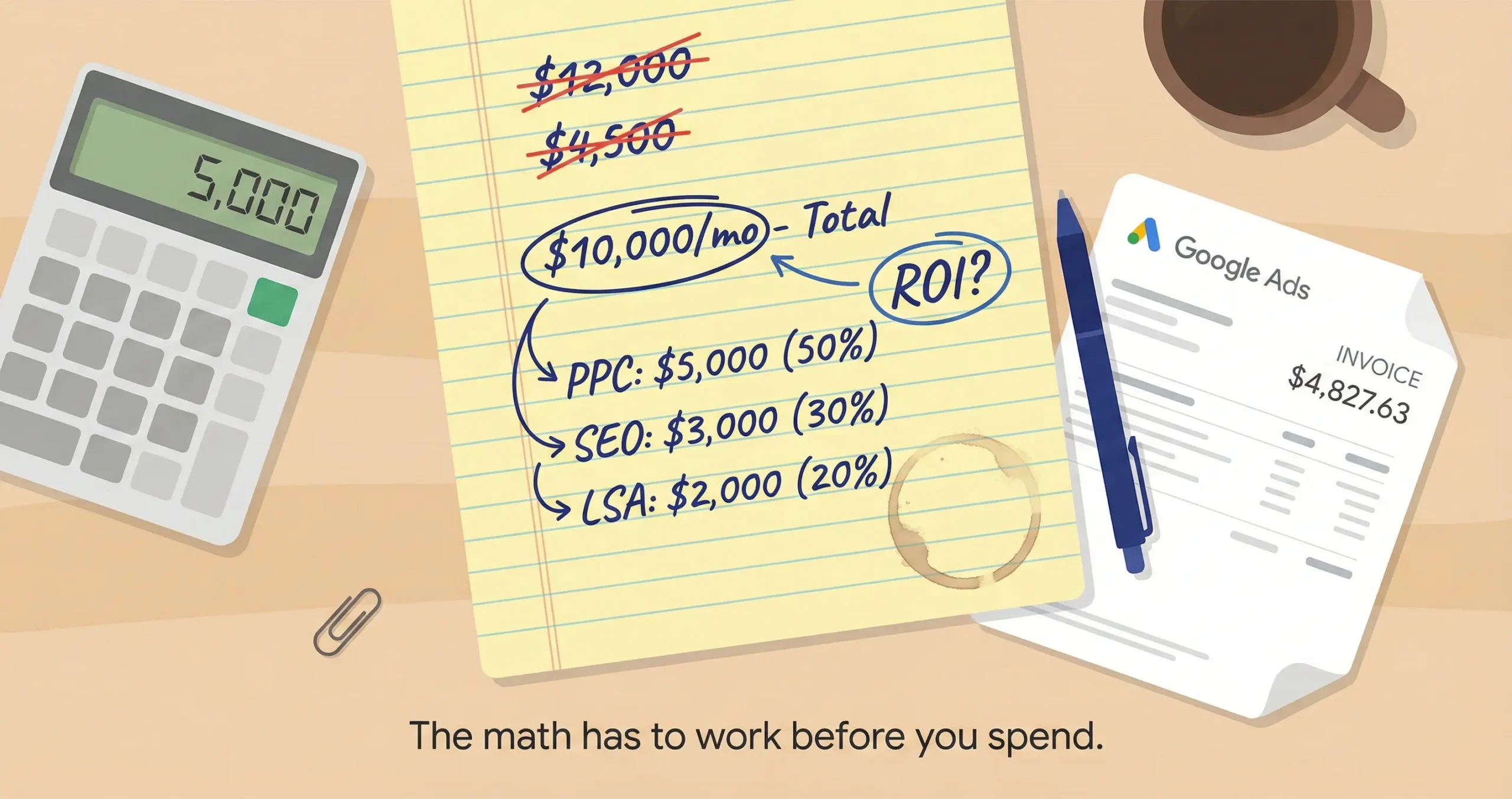
So this is the question I get more than almost any other and the answer depends on your firm type, but the general framework I use with most growth oriented firms looks something like this.
Growth-oriented allocation at $15K/mo. Based on campaign data through 2026. Hover or tap a slice for details.
| Channel | % of Budget | Monthly at $15K |
|---|---|---|
| SEO and Content | 35–45% | $5,250–$6,750 |
| PPC and LSAs | 25–30% | $3,750–$4,500 |
| Content Marketing | 10–15% | $1,500–$2,250 |
| Website and Technical | 10% | $1,500 |
| Reputation Management | 10% | $1,500 |
| Email Marketing | 5% | $750 |
But this shifts dramatically depending on where you are and what you need.
If you’re a new firm launching from zero, you need to overweight PPC and LSAs to maybe 50% of the budget because you need leads now. You can’t wait a year for SEO to compound. Get the immediate channels running, get cases coming in, and use 20% of the budget to start building the SEO foundation that will reduce your paid dependence over time.
If you’re a PI firm in a competitive metro, PPC and LSAs take 35 to 40% because the urgent intent keywords are where the high value cases come from. SEO and content take another 30 to 35% because organic traffic is where the long term cost advantage builds. And you probably need some brand investment too; community presence, thought leadership, video; because in PI the person who gets hurt three months from now is going to call the firm they already know.
If you’re a family law firm in a mid-size city, lean heavier on SEO and local search at 40 to 45% because the CPCs are manageable and organic traffic compounds beautifully in this practice area. PPC at 25 to 30% for the immediate case flow. And reputation and reviews at 10 to 15% because family law prospects read reviews obsessively before choosing; the decision is emotional and trust dependent in a way that PI isn’t.
If you’re a criminal defense firm, PPC and LSAs should take the largest share at 45 to 50% because the intent is urgent. Someone searching “DUI lawyer” at midnight needs help right now and if your ad shows up with a call extension and theirs doesn’t, you get the case. SEO at 25 to 30% for the base load that compounds. And I’d put the rest into reputation and brand because criminal defense is a trust practice; people need to believe you’ll fight for them before they call.
And there’s decades of marketing research showing that firms spending everything on lead generation and nothing on brand building consistently underperform firms that split more evenly. Most law firms spend basically everything on activation; PPC, directories, lead gen; and almost nothing on being known. The strategy guide covers why that’s the most common strategic mistake I see and how the firms that build brand alongside activation grow more predictably.
WHAT EACH CHANNEL COSTS ON ITS OWN
So when you’re budgeting for SEO for lawyers specifically, the variation is enormous. A $2,000 a month SEO retainer and a $12,000 a month retainer are buying very different things and I want to walk through what each level actually delivers because I think a lot of firms buy SEO without understanding what they’re getting.
Entry Level
Mid-Tier
Full Service
Premium
Average legal SEO agency investment: $4,500–$7,500/mo. Hover or tap for what each tier includes.
| SEO Tier | Monthly Cost | What You Get |
|---|---|---|
| Entry Level | $1,500–$3,000 | Basic keyword research, on-page optimization, GBP setup, 1-2 posts |
| Mid-Tier | $3,000–$5,000 | Strategy, content, technical SEO, local citations, some link building |
| Full Service | $5,000–$10,000 | 4-8 content pieces, active link building, multi-location, analytics |
| Premium | $10,000–$20,000+ | All of above at scale, national targeting, attorney-level content |
SEO takes time and I know that’s frustrating to hear. The first non-revenue improvements show up at three to six months. Meaningful traffic and qualified leads arrive at six to twelve months. The real ranking breakthroughs in competitive metros take a year to two years. But the compounding is the whole point; last month’s content still generates leads next year, which is the opposite of PPC where last month’s spend only produced last month’s leads and then it’s gone.
PPC management for lawyers runs $1,500 to $10,000 a month in management fees on top of the ad spend. Percentage models charge 10 to 20% of the ad budget. And the minimum ad spend matters because the algorithm needs enough conversions to learn; for PI the minimum is around $6,500 a month in ad spend, for less competitive practice areas maybe $1,500 to $2,000 per practice area. The Google Ads cost page has the full break even math by practice area if you’re trying to figure out whether the PPC numbers work for your firm.
On law firm website design cost, template sites run under $5,000, custom WordPress $5,000 to $15,000, custom design and development $15,000 to $50,000, and enterprise builds for large firms $40,000 to $150,000 or more. I’ll say the same thing I always say; build on WordPress or a platform you own. Proprietary platforms like what some of the big legal marketing companies use mean you don’t own your website. If you leave you start from scratch. I’ve seen firms trapped for years paying thousands a month because the cost of leaving was too high.
Content marketing is where firms either overpay or underpay. A basic blog post runs $50 to $200 and usually produces nothing because it’s too thin to rank or convert anyone. A real practice area page written at the level a potential client actually needs runs $500 to $1,500 and that’s the kind of content that ranks and produces leads for years. The firms getting the best content results right now are using AI for first drafts and having attorneys edit and add real expertise, which cuts the cost per piece significantly while keeping the quality high enough that Google and AI search engines cite it.
CRM and intake tools run $40 to $140 per user per month. If you’re not tracking leads from source through signed case in a CRM, you can’t measure whether any of the rest of your budget is working. The pipeline guide puts this in the first layer of the system because without it everything else is guesswork.
Agencies vs Consultants: What You’re Actually Paying For
A law firm marketing agency executes the work; they run your SEO, manage your PPC, build your content. Monthly retainers for full service run $5,000 to $25,000 or more. A legal marketing consultant works on your side of the table; they audit your current spend, tell you what’s working and what isn’t, and help you hold your vendors accountable to signed cases instead of dashboards.
Hourly rates for consultants run $50 to $200, SEO consultants $75 to $300, and a fractional CMO runs $150 to $500 an hour or $4,000 to $25,000 a month on retainer. For comparison a full time CMO salary runs roughly $350,000 a year, so the fractional model saves a lot and you get senior level thinking without the full time commitment.
The question is whether you need hands to execute or a brain to direct, and most firms below $25,000 a month in total budget need the agency for execution and use the consultant or fractional CMO role only when they’ve scaled past the point where the managing partner can manage the marketing themselves.
HOW TO CALCULATE YOUR BUDGET FROM YOUR REVENUE GOAL
So instead of picking a number and hoping it produces enough cases, the approach I use with firms is to start from what they want to make and work backward to what they need to spend. It’s the same reverse budget calculation from the pipeline guide applied to the budget question.
Say you want to grow from $600K to $1.2M. That’s $600K in new revenue.
If your average case value is $7,500, you need 80 new clients to close that gap.
If you close 25% of your leads, you need 320 leads to get 80 clients.
If Google Ads produces leads at $40 each and you want 180 from that channel, that’s $7,200 a month. If SEO produces the next 100 at $15 each in content retainer cost, that’s $1,500. If referrals produce the other 40 at zero incremental cost, your total budget lands around $8,700 a month.
And then you check it against the ratio. The target is roughly 5 to 1; for every dollar you spend acquiring a client, the lifetime value of that client should be at least five dollars. If your average client is worth $10,000 to the firm, your maximum acquisition cost should be about $2,000. If the reverse calculation puts you above that, something in the funnel needs to improve before the math works, and it’s usually intake speed or landing page conversion, not the ad budget.
WHAT IT ACTUALLY COSTS TO GET A LEAD AND SIGN A CASE
So this is the table that makes everything above concrete, because the cost per lead is the number that connects your budget to how many cases it produces. And I should flag that these numbers represent ranges I’ve seen across multiple markets and firm types; your specific cost will depend on your market, your competition, and how well your campaigns are managed.
Personal Injury
Criminal Defense
Family Law
Estate Planning
Immigration
Based on campaign data through 2026. Hover or tap for channel breakdown.
| Practice Area | Google Ads CPL | LSA CPL | SEO CPL |
|---|---|---|---|
| Personal Injury | $400–$2,000 | $250–$500 | $150–$300 |
| Criminal Defense | $500+ | $50–$200 | $130–$400 |
| Family Law | $100–$300 | $75–$100 | $50–$150 |
| Workers’ Comp | $600–$1,500 | ~$150 | $100–$300 |
| Estate Planning | $80–$120 | $45–$100 | $40–$80 |
| Bankruptcy | $80–$100 | $50–$150 | $40–$100 |
| Immigration | $50–$200 | $18–$50 | $30–$80 |
| Employment Law | $200–$500 | $100–$200 | $100–$250 |
The cost per lead is only half the picture though. What actually matters is the cost per signed case.
| Practice Area | Channel | Cost Per Signed Case |
|---|---|---|
| Personal Injury | Google Ads | $1,800–$3,000 |
| Personal Injury | SEO | $550–$900 |
| Personal Injury | LSA | $1,000–$1,500 |
| Criminal Defense | SEO | $1,000–$2,000 |
| Family Law | LSA | $750–$1,000 |
| Bankruptcy | Google Ads | $550–$700 |
| Workers’ Comp | LSA | $500–$700 |
| Immigration | LSA | $90–$250 |
And the thing to notice is the gap between channels. PI via Google Ads costs maybe $2,500 per signed case. PI via SEO costs maybe $700. Same case type, same client, different channel. That’s why the channel economics page ranks every channel by cost per signed case and the allocation table above weights SEO so heavily; it’s the channel with the lowest cost per case once it matures, which is why the firms that invest in it early end up with the lowest blended cost per case over time.
Your intake changes the budget math more than anything else on this page. A firm with the same spend and the same cost per lead can pay $6,000 per signed case with bad intake or $1,000 with great intake. Most firms don’t answer the phone reliably, which means they’re paying for leads and then letting them walk. Fixing intake costs almost nothing and makes every marketing dollar you’re already spending work three to four times harder. The pipeline guide has the full architecture. The tactics page has the missed call text back automation. Start there before increasing your ad budget because doubling your close rate is the same as doubling your spend at zero additional cost.
HOW LONG EACH CHANNEL TAKES TO PAY BACK
The timeline matters for budget planning because the channels play different roles. If you need cases this month, SEO isn’t going to help; that’s a PPC and LSA problem. If you’re trying to build long term equity that compounds and reduces your cost per case every quarter, PPC isn’t going to do that; that’s an SEO and content problem.
Google Ads
Local Service Ads
SEO
Content Marketing
| Channel | First Results | Break-Even | Peak ROI Period |
|---|---|---|---|
| PPC / Google Ads | 1–2 weeks | 30–45 days | Month 6+ |
| Local Service Ads | Immediate | Month 1–2 | Month 3+ |
| SEO | 3–6 months | 12–14 months | Year 2–3 |
| Content Marketing | 3–6 months | 6–12 months | Year 2+ (compounds) |
| Social Media (paid) | Weeks | Varies | Lower than search |
And the pattern I keep seeing is that firms running PPC without the infrastructure underneath it are dissatisfied with the ROI, but firms running PPC with proper landing pages, call tracking, negative keywords, and offline conversion tracking are very happy with it. The channel isn’t the problem. The infrastructure is. Same budget, managed well, produces three to four times the results of the same budget managed badly, which is why the channel synergy data matters and why “connected” beats “expensive” every time.
If you want help figuring out the right number for your firm, send me what you’ve got
Your revenue, your case count, your current spend by channel, and what you’re trying to grow to. I’ll run the reverse calculation and tell you what the budget should look like for your practice area and your market. And if what you’re spending is already right I’ll tell you that too.
P.S. The firms spending the most aren’t always signing the most cases. And the firms signing the most cases aren’t always spending the most. The difference is almost always whether the budget is connected into a system or spread across disconnected vendors who never talk to each other. The strategy guide covers how the pieces connect. The Google Ads cost page covers the PPC math. And for small firms figuring out where to start, that covers the sequencing when you can’t afford everything at once.
Related: Complete 2026 Strategy Guide · Google Ads Costs and ROI · Predictable PI Lead Pipeline · Google Ads and GBP Tactics · Channel Economics by Signed Cases · Cross-Channel Synergy · Small Firm Marketing