SEO vs Google Ads vs LSAs for Law Firms: Where to Invest
I managed marketing inside a law firm for 10 years and talked to maybe seven agencies during that time and every one of them recommended a different channel without ever asking what our practice area economics looked like or what we could actually afford to spend.
10 years working alongside Percy Martinez P.A. on channel allocation, blended CAC modeling, and the budget math agencies do not run. Built and managed paid programs for 10 plus Florida firms since 2016.
Specializes in
Channel allocationLSA optimizationBlended CACPractice economicsFL Bar compliance
Solution aware. “We know we need marketing. Which channel goes first?”
The promise
A 5 variable decision engine, not a generic SEO vs PPC pros and cons list. Built around practice economics, city tiers, and the blended CAC math.
The proof
Real CPC ranges from major US metros, real LSA cost per lead by practice area, real timeline data from 10 years of legal account work.
Compliance
No promises of outcomes. Florida Bar Rules 4-7.13 and 4-7.14 referenced where ad copy or schema fields are involved.
TL;DR · There is no best channel
For law firms, there is no single best channel. There is only the best sequence based on practice area, budget, city tier, case velocity, and intake capacity.
If you are under $2,500 a month, prioritize Google Business Profile and local SEO. At $2,500 to $5,000, test LSAs in lower cost practice areas while building SEO content. At $5,000 to $15,000, run LSAs, targeted PPC, and an SEO retainer together. Above $20,000, go omnichannel with brand. LSAs are the fastest path to cases this month, SEO is the only channel that builds a transferable asset, and PPC is the volume lever when capital allows. Based on 10 years of live account data from Florida and major US metros.
The realityStage: Awareness
What the search results page actually looks like now
Before picking a channel, look at what a “personal injury lawyer” search in 2026 actually returns. The layout itself explains why each channel exists and where the money is going.
Position 1
AI Overview (when triggered)
Free, but limited reach
Position 2
Local Service Ads (LSAs)
Pay per lead
Position 3
Google Ads (PPC)
Pay per click
Position 4
Map Pack
Free, organic local
Position 5
Organic results (SEO)
Free, 12 to 14 months to ROI
Something changed in October 2025 that most firms missed. Google killed the “Google Screened” badge that used to be specific to lawyers and replaced it with a generic “Google Verified” checkmark. the same badge a locksmith or a plumber gets. The trust signal that used to separate attorneys is gone. The thing that separates a firm in LSAs now is review count, response speed, and intake quality. Honestly that is probably how it should have been all along, but it does change the game for any firm whose LSA strategy was built on the old badge.
The free real estate on the search page is shrinking. The paid real estate is growing. AI Overviews are eating into organic clicks. That is the reality every channel decision is now being made inside.
Plain language version
SEO: Free traffic from ranking in organic results, takes 12 to 14 months to pay off. Google Ads (PPC): Pay every time someone clicks, results show within days. LSAs (Local Service Ads): Pay per qualified lead, sit at the top of the page with a Verified checkmark. All 3 appear on the same search page, stacked top to bottom in the order shown above.
The economicsStage: Problem aware
Why Google Ads has become a rich firm’s game
Private equity firms and national legal networks brought 8 figure marketing budgets into local legal markets over the last 3 years. The auction inflation that followed has pushed cost per click on premium PI keywords past $1,000 in major metros. That is per click. Not per lead. Not per case.
For a solo PI attorney with $5,000 a month at $500 per click, the budget buys 10 clicks. At a 5 percent conversion rate, that is half a lead. Not enough data to know if anything is working. I have seen firms burn through $10,000 in a week with zero signed cases because they did not realize the auction was stacked against their budget level.
The capital moat is real. The national consolidators have made paid search so expensive in PI that smaller firms cannot buy enough clicks to run a real test. Mid sized firms with $2 to $10 million in revenue get squeezed the hardest: too big to live on referrals, too small to outbid the giants.
Jorge Argota · May 2026
The good news is this is not true for every practice area. Immigration clicks still run $3 to $15. Family law clicks run $40 to $80. Estate planning clicks run $30 to $60. The auction is brutal in PI and mass tort. It is reasonable everywhere else. When someone asks if Google Ads is worth it for lawyers, the answer is always “for which practice area and at what budget.” The economics are not the same across legal.
The frameworkStage: Solution design
The 5 variables that actually decide everything
Every law firm’s channel mix can be reduced to 5 inputs. Once those are defined, the answer stops being “it depends.” Run any firm’s situation through these and the right channel mix becomes mechanical.
01
Practice area economics
A med mal firm with an 18 month sales cycle and $150,000 average case value runs a completely different channel mix than a PI firm that needs 30 car accident cases a month at $8,000 each. Higher case value plus longer cycle equals SEO and content lead. Lower case value plus urgency equals LSA and PPC lead. If then: if case values are high and sales cycles are long, SEO and content lead; if case values are lower and decisions are urgent, LSAs and PPC lead.
02
Monthly budget level
Each channel has a minimum spend threshold below which the data is too thin to optimize. PPC in PI needs at least $5,000 a month to buy enough clicks for real signal. LSAs work down to $1,500. SEO is the same effort whether the firm has $3,000 or $30,000. If then: if PI PPC budget is under $5,000 in a Tier 1 metro, do not run PPC at all; route that budget to LSAs and SEO instead.
03
Case velocity need
If the firm needs cases this month, SEO is useless. If the firm is building a sellable asset, SEO is the only channel that creates equity. The honest answer is usually: start with LSA for cash flow, then layer in SEO when cash flow allows for the 14 month runway.If then: if the firm needs cases this month, LSA goes first; if the firm is building a 5+ year asset, SEO starts immediately alongside LSA.
04
Market competitiveness tier
A PI firm in NYC is operating in a $300 to $1,000 CPC market with national consolidators in every auction. The same firm in Tampa is operating in a $40 to $150 CPC market with mostly local competition. The channel mix that works in Tier 1 cities will bankrupt a firm in Tier 3 if applied without adjustment.If then: if the firm is in a Tier 1 metro with under $15K monthly budget, skip PPC and stack LSA+SEO; if Tier 3 or lower, PPC becomes viable as primary.
05
Intake capacity
Channel decisions assume the firm can convert what it generates. The LSA algorithm penalizes firms that miss calls. The PPC algorithm wastes spend if intake takes 4 hours to call back. Intake is not a separate problem from channel selection. It is variable 05 and it overrides 1 through 4 when broken. If then: if intake misses more than 20 percent of calls or response time exceeds 5 minutes, pause all paid spend and fix intake first.
The diagnostic
If a firm asked me today which channel to invest in first, I would ask 3 of the 5 variables before answering anything: practice area, monthly budget, case velocity need. The answer comes from those 3, not from whatever channel I happen to sell. An agency that recommends a channel without asking these 3 questions is selling, not consulting.
By marketStage: Market context
City tier breakdown: what works in NYC fails in Tampa
The channel mix is not portable across metros. CPCs, LSA cost per lead, and competition density vary by a factor of 10 or more between Tier 1 and Tier 4 markets. The table below is the rough segmentation I use as a starting point on every audit.
Tier
Example metros
PI CPC range
Channel strategy
Tier 1
NYC, LA, Chicago, Houston
$300 to $1,000+
LSA plus SEO foundation. PPC only with $15K+ monthly capital. In Tier 1 metros, legal CPCs are on par with or above other red hot verticals like insurance or high end home services, which is why capital behaves like a moat for mid sized firms.
Tier 2
Miami, Dallas, Atlanta, Phoenix
$150 to $400
LSA plus selective PPC plus SEO retainer. Sweet spot for the 3 channel stack. Mid sized firms can compete here with disciplined channel sequencing.
Tier 3
Tampa, Nashville, Orlando, Charlotte
$50 to $150
PPC becomes viable as primary channel. Legal CPCs here are closer to what you see in competitive home services, which means smaller firms can actually buy enough clicks to optimize. LSA still wins on cost per lead. SEO becomes a moat against new entrants.
Tier 4
Smaller markets, county seats
$15 to $60
SEO dominance is possible. Lower competition means organic ranks faster. PPC is cheap enough to scale. LSA presence is often enough to own the top of page.
The strategic mistake I see most often is a firm reading a playbook written for Tier 3 economics and trying to execute it in a Tier 1 market, or vice versa. The same $5,000 monthly PPC budget that produces 30 leads in Tampa produces 5 leads in NYC. The channel sequencing has to match the market. The same tiering logic shows up outside legal too. Insurance, roofing, and HVAC follow similar CPC gradients across metros. Legal hits the top of the range in Tier 1, which is why copy pasting non legal PPC advice into PI campaigns is dangerous.
Channel rolesStage: Solution aware
What each channel actually does in the mix
Generic SEO vs PPC vs LSA articles compare the channels as if they are interchangeable substitutes. They are not. Each channel plays a different role in a working stack. The right way to think about them is as 3 different tools with 3 different jobs.
Channel 01
LSAs
Time to first call2 to 3 weeks
Pricing modelPer lead
PI cost per lead$50 to $300
Role: Fastest cash flow. Algorithm tied to intake response speed. Firms that miss calls drop in ranking within days.
Channel 02
PPC
Time to launchDays
Pricing modelPer click
PI CPC, Tier 1$300 to $1,000
Role: Volume lever. Scales linearly with budget. Capital dependent. Best for aggressive growth when cash flow can absorb the math.
Channel 03
SEO
Time to ROI~14 months
Pricing modelRetainer or in house
Effective CPL at scale$30 to $120
Role: Asset builder. Lowest CPL once it crosses the break even threshold. Creates equity that transfers if the firm is ever sold.
The most common mistake is treating these 3 as substitutes. A firm running only LSAs is paying the highest cost per lead it will ever pay because it never built the SEO asset that lowers blended CAC over time. A firm running only SEO is gambling on a 14 month runway with nothing producing cases in months 1 through 13. A firm running only PPC is exposed to every CPC inflation event that hits its market. The channels work together. They do not work alone for very long.
Quick comparisonStage: Reference
SEO vs Google Ads vs LSA at a glance
The opinionated framework above explains the why. The table below gives the fast reference version: when each channel should be the first investment, when it should be the second, and when it is the wrong fit entirely.
Channel
First when
Second when
Bad fit when
LSAs
Case velocity is urgent and budget is modest. Practice area is PI, criminal, or family.
SEO foundation is already built and producing organic leads.
Intake is broken. The algorithm penalizes missed calls within days.
PPC
In low CPC verticals like immigration, or when capital exceeds $15K/month in Tier 1 metros.
LSA is maxed and SEO is in flight. PPC becomes the volume lever.
Under $5K monthly PI budget in Tier 1. Auction is unwinnable at that level.
SEO
Buying cycles are long. Estate planning, family law, complex civil.
Cash flow is tight but the firm can survive 14 months for the asset to mature.
Firm needs cases this month and cannot survive the 14 month runway.
The table is a fast lookup. The decision engine at the bottom of this article ties all 5 variables together and gives the specific recommendation per situation. Most firms need both: the table to orient, the decision engine to commit.
The mathStage: Advanced
The blended CAC curve most agencies will not show you
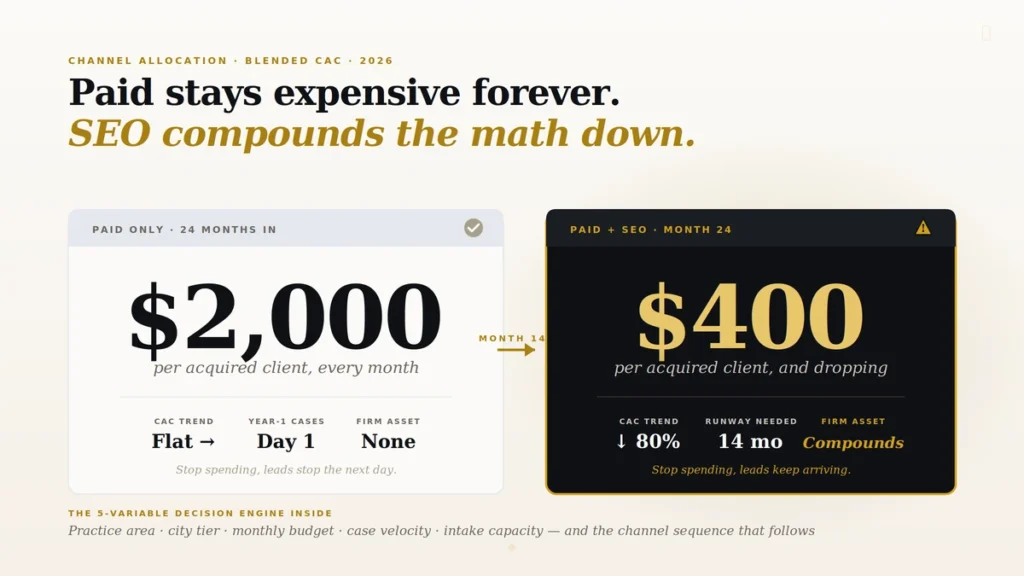
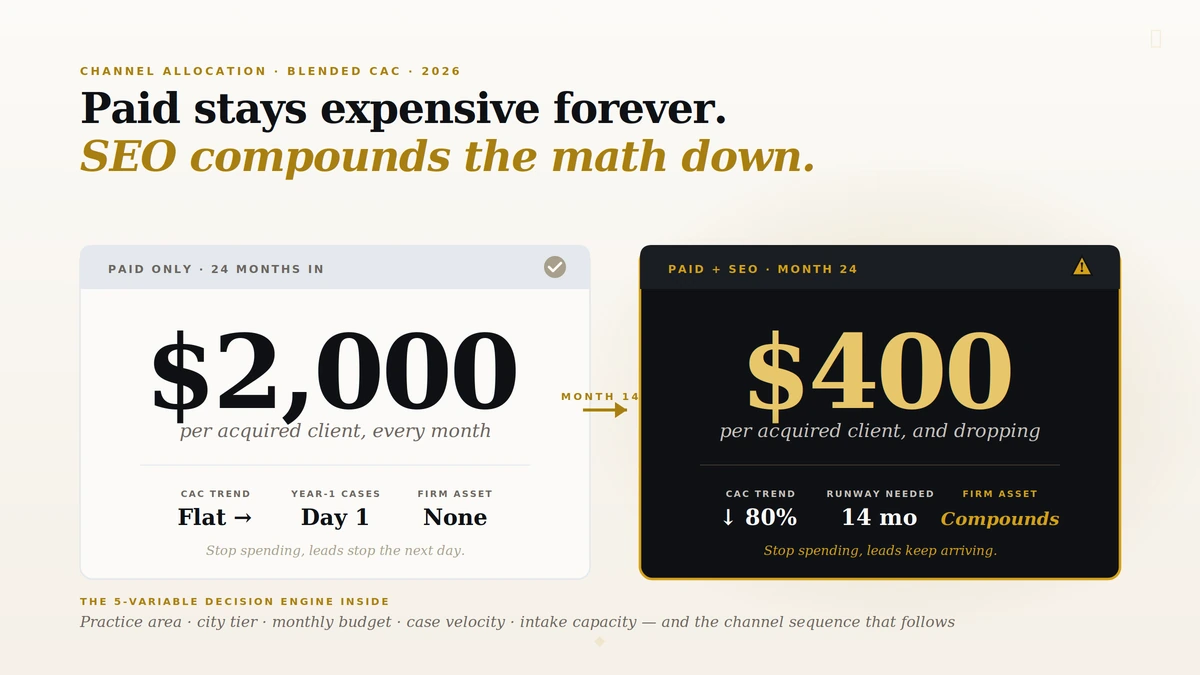
This is the part of the channel decision most agencies skip because it requires honesty about month over month numbers across all 3 channels at once. Paid CAC stays flat or rises over time as auction prices inflate. SEO CAC drops over time as the content asset matures. The blended CAC, weighted across both, is the number that actually determines firm profitability over a 24 month window.
Blended CAC curve over 24 months
Hypothetical PI firm spending $8,000/month split between LSAs+PPC and SEO. PPC CAC stays flat, SEO CAC drops as the asset matures, blended CAC bends downward after the SEO break even at month 14.
The PPC line stays flat because auction prices do not drop. The SEO line drops sharply after month 14 as the asset matures. The blended line (what the firm actually pays per client) only bends downward when both channels run together long enough to cross the break even.
A firm that runs only PPC for 24 months pays roughly $2,000 per client every month for 24 months. A firm that runs PPC plus SEO from month 1 pays roughly $1,800 per client in month 1 and roughly $1,100 per client in month 24. Over 24 months that gap compounds into hundreds of thousands of dollars in CAC difference. The blended CAC curve is the single most important math in the channel decision, and it is the math agencies almost never run because it requires them to plan beyond the next quarter. The same CAC math is what drives the case value vs CPL bidding decision at the campaign level once a firm starts measuring properly.
Why SEO makes ads cheaper
Google Ads charges based on Quality Score, which factors landing page experience and content relevance. A fast site with deep content lowers PPC cost per click by 20 to 30 percent versus a slow site with thin content. The SEO investment literally makes the PPC investment cheaper. Most agencies do not mention this because they manage the channels in silos. The firms wasting the most money are the ones running PPC through one agency and SEO through another that never talk to each other.
By budgetStage: Decision
Where the money should go by monthly budget
The honest answer at each budget level. Most agencies will not tell a firm with $2,500 a month that paid search is a bad use of their budget because the agency wants the management fee. The math below is what I tell clients when there is no commission tied to the advice.
Monthly budget
First channel
Second channel
The play
Under $2,500
Google Business Profile + reviews
Nothing paid
Survive on local SEO until cash flow supports paid testing. $2,000 of PI PPC in Miami is setting money on fire.
$2,500 to $5,000
LSAs in lower cost areas
Start SEO content
Family law, estate, immigration LSAs at $50 to $150 per lead. SEO content seeds while cash flow accumulates.
$5,000 to $15,000
LSAs maxed
Targeted PPC + SEO retainer
The sweet spot. Buying cases today via LSA. Building the asset for tomorrow via SEO. PPC on specific high value keywords only.
$15,000 to $30,000
All 3 channels
Brand starts mattering
Volume mode. Add brand awareness layer (retargeting, YouTube, OTT) because branded queries cost less per click.
Over $30,000
Omnichannel + brand
Market share play
Not just getting cases. Making it harder for competitors to compete. Brand advertising lowers blended CPC everywhere.
By practice areaStage: Decision
Why channel economics vary by practice area
The right channel for a personal injury firm in Houston is the wrong channel for an estate planning firm in Atlanta. Below is the rough mapping I use as a starting point, organized by buying behavior and urgency profile.
Personal injury
LSA → SEO → PPC
Why: Injury victims want the Verified badge and the star rating, not a 2,000 word blog post. LSA fills the urgent slot. SEO lowers blended CAC over 14+ months. PPC adds volume only when capital can absorb the $300 to $1,000 CPC.
Family law / divorce
SEO → LSA
Why: Clients research for weeks before hiring. They read about custody, asset division, filing strategy. SEO builds trust during the long decision window. LSAs layer in at $80 to $150 per lead because the urgency moment is short but real.
Criminal defense / DUI
LSA + PPC together
Why: Pure urgency. Someone arrested at midnight is not reading the firm’s blog about Fourth Amendment rights. They call the first number with good reviews that answers. Requires 24/7 intake. SEO is a slow secondary play, not a starting channel.
Immigration
PPC dominant
Why: Clicks cost $3 to $15. The most efficient paid channel in legal. A real campaign runs on $2,000 a month with enough data to optimize. LSA secondary. SEO long game for long term cost reduction.
Estate planning
SEO dominant
Why: 30 to 90 day buying cycle. Clients want to feel educated before they hire. Educational content carries the trust building. LSA picks up the smaller urgent slice. PPC rarely justifies cost relative to retainer size.
Med mal / mass tort
SEO + co counsel referrals
Why: Case values $250K to $7M+. Long sales cycles. National competitor budgets dominate the PPC auction. SEO and referral networks win the math. PPC reserved for specific surgical campaigns on high signal terms.
The hidden variableStage: Operational
Why intake speed matters more than channel selection
The right channel running perfectly produces zero cases if nobody answers the phone. This is variable 05 from the framework above, and it overrides the other 4 when broken. The LSA algorithm in 2026 is brutal about this specifically because Google figured out that intake quality predicts case quality better than any other input.
The LSA platform penalizes firms that do not answer calls within 30 seconds or respond to messages within 4 hours. Missing 3 calls in a row can drop a firm from the top 3 spots for days. The penalty is invisible until rankings drop, and by then the firm has lost a week of leads to the competitor that took the calls.
The 5 minute rule applies across every channel, not just LSAs. Industry data shows leads contacted within 5 minutes are 9 times more likely to convert than leads called back in an hour. A $20,000 monthly marketing budget that only converts 60 percent of calls is functionally a $12,000 budget. The other $8,000 is being paid to generate leads competitors are signing.
The channel does not fail. The intake does. A firm with broken intake and a $30,000 budget signs fewer cases than a firm with great intake and a $10,000 budget. Channel selection is variable 4 of 5. Intake is the variable that makes the other 4 matter.
Jorge Argota · May 2026
Before debating SEO vs PPC vs LSAs, the first audit is whether intake can handle what marketing is about to send it. If the answer is no, no channel decision matters yet. The diagnostic for marketing not working covers the mystery shop protocol I use to test intake response speed and empathy at noon, at 5:15 PM, and on Saturday morning.
The decisionStage: Implementation
The decision engine, in if then form
Run the 5 variables through this table and the channel answer becomes mechanical. Practice area plus tier plus budget plus velocity equals a specific recommendation. The “it depends” answer goes away when the inputs are defined.
If then logic · channel mix decisions
Match the inputs, read the recommendation
PI firm, Tier 1 city, under $5K/month, need cases now
LSA only. PPC auction is unwinnable at this budget. SEO is a 14 month commitment the firm cannot afford yet.
PI firm, Tier 2 city, $8K to $15K/month, growing
LSA + SEO retainer + targeted PPC on top 5 terms. The sweet spot stack. Blended CAC drops by month 14.
Family law firm, Tier 2 city, $5K/month, building reputation
SEO content + LSA. PPC not worth the spend at this budget. Long buying cycle rewards content.
Criminal defense, any tier, any budget
LSA + PPC together, immediately. 24/7 intake mandatory. SEO secondary.
Immigration firm, any tier, $2K+/month
PPC primary. Clicks cost $3 to $15 so the budget actually buys data. LSA and SEO secondary.
Estate planning, any tier, any budget
SEO and educational content first. LSA picks up the smaller urgent slice. PPC last priority.
Med mal, Tier 1 city, $20K+/month
SEO + referral network + surgical PPC on specific drug or device names. Avoid generic med mal terms.
Any firm, any vertical, broken intake
Pause all paid spend. Fix intake first. Resume in 30 days. No channel works without the phone being answered.
And there is a 4th channel emerging that the 2027 version of this conversation will spend much more time on: AI search. When someone asks ChatGPT or Perplexity to recommend a lawyer, the firms appearing in those answers are getting cases that never touch a Google SERP. AI search visibility is being built on the same SEO foundation that pays off in months 12 to 24, which is yet another reason SEO sequencing matters even when paid channels carry the short term revenue.
MetaStage: Framework reuse
How to use this framework beyond this page
This article is the deep differentiator layer of a broader content system. The same 5 part template that built this page (intent stage label, non commodity promise, proof mechanism, compliance note, semantic keyword set) can be reused to evaluate any marketing channel a firm is considering. Apply the template to intake automation, AI search visibility, referral programs, or whatever comes next; the structure is portable.
The pattern: name the intent stage the reader is in. State what the page promises that competitors do not. Attach a proof mechanism (real data, real numbers, real client examples). Add the compliance overlay where relevant. Cluster the related queries by intent stage. That is the meta framework. The decision engine in this article is the specific implementation for the SEO vs PPC vs LSA question.
If you searched for
Related questions that end in the same answer
The same 5 variable framework answers a handful of related queries clustered by intent stage. Different phrasing, same diagnostic.
Awareness · top of funnel
“best marketing channel for law firms”
“SEO vs PPC for lawyers”
“Google Ads vs SEO for law firms”
“are LSAs worth it for lawyers”
Solution & decision · mid to bottom
“law firm marketing budget allocation”
“how much should a law firm spend on marketing”
“LSA vs Google Ads for attorneys”
“channel mix for personal injury law firm”
Advanced · operational
“cost per lead personal injury Google Ads”
“how long does SEO take for law firms”
“blended CAC law firms”
“LSA cost per lead by practice area”
The answer to all 8 is the same: define the 5 variables (practice area, budget, velocity, tier, intake), match them against the decision engine, sequence the channels accordingly. The starting channel almost always depends on case velocity. The compounding channel almost always ends up being SEO. The volume channel almost always ends up being PPC when capital allows. The mix evolves over 24 months as budget grows and blended CAC improves.
Related reading
Where this decision connects to the rest of the system
What is the difference between LSAs, Google Ads, and organic results for lawyers?
LSAs sit above Google Ads and charge per lead, Google Ads sit below LSAs and charge per click, and organic results sit below both and typically take 12 to 14 months to become reliable. Roughly 46 percent of clicks go to the top 3 results, and LSAs now own that space. The SERP anatomy section earlier in this article walks through the full stack including AI Overview placement.
Why are Google Ads so expensive for lawyers in 2026?
Private equity firms and national legal networks have brought 8 figure marketing budgets into local legal markets, driving cost per click for terms like truck accident lawyer past $1,000 in major metros. This creates a capital moat where a solo practitioner with $5,000 a month can only afford 5 to 10 clicks on premium keywords, which is not enough data to optimize anything. Mid sized firms with $2 to $10 million in revenue are squeezed the hardest: too big to survive on referrals, too small to outbid the national consolidators.
How should a law firm allocate its marketing budget between SEO, PPC, and LSAs?
Under $2,500 a month, focus only on local SEO and the Google Business Profile because the budget cannot buy enough clicks or leads in paid channels to make the data meaningful. At $2,500 to $5,000, start with LSAs in lower cost practice areas and begin building a content foundation for long term SEO. At $5,000 to $15,000 is the sweet spot: max LSA capacity first because it has the lowest cost per lead, add targeted PPC for high value keywords, and commit to an SEO retainer. Over $20,000 a month go omnichannel with brand advertising layered on top.
Which marketing channel works best for personal injury lawyers versus family law versus criminal defense?
Personal injury should invest in LSAs first because the Verified trust signal matters for injury victims, then layer in SEO to lower blended acquisition cost since $500 per click PPC alone is unsustainable. Family law should invest in SEO and content first because clients research heavily before hiring, then add LSAs at $80 to $150 per lead. Criminal defense and DUI must invest in LSA and PPC together because these clients need a lawyer tonight and do not read blog posts. Immigration should invest in PPC first because clicks cost $3 to $15, the most efficient paid channel in legal. Estate planning should invest in SEO and educational content because the buying cycle is long and research heavy.
How fast can each marketing channel produce cases for law firms?
LSAs can be producing calls within 2 to 3 weeks after verification, which itself takes 3 to 4 weeks. PPC campaigns can launch in days but need 1 to 3 months to stabilize cost per lead through optimization. SEO takes approximately 14 months to break even on investment, but once it crosses that threshold the cost per lead drops noticeably and the returns compound over years. For a firm that needs cases this month, SEO is useless. For a firm building a sellable asset, SEO is the only channel that creates real equity.
Does investing in SEO lower Google Ads costs for law firms?
Yes, and most agencies do not mention this because they manage the channels separately. Google Ads charges based on Quality Score, which factors expected click through rate, ad relevance, and landing page experience. A fast, well built website with deep content improves landing page experience, which raises Quality Score, which directly lowers cost per click. Firms investing in both SEO and PPC typically pay 20 to 30 percent less per click than firms running ads on slow or poorly built sites. The 2 channels feed each other, but only when they are managed together.
Next step
Want me to run the 5 variables for your firm and tell you where to invest first?
I look at the practice area economics, the monthly budget, the city tier, the case velocity need, and the intake capacity. Then I hand back a specific channel sequence with the math behind it. If what you are doing now is working, I tell you that too. Available for select PI, family, criminal defense, immigration, and complex civil firms.