

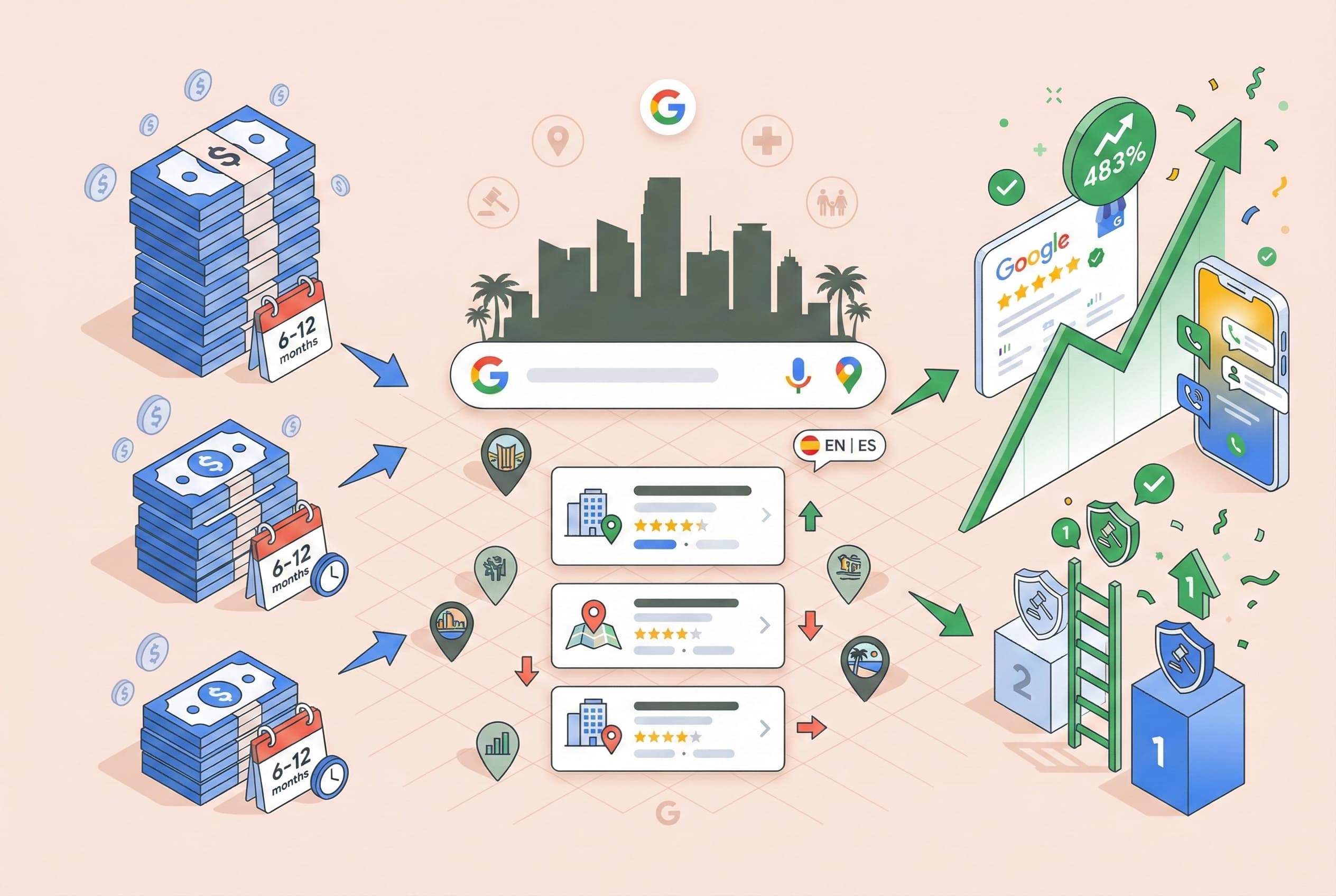
The first law firm I worked at had one attorney and a $500 marketing budget competing in Miami against billboard firms dropping $50,000 a month on TV. I was there for ten years, started as a paralegal, ended up running the marketing, and by the end we were ranking across four Florida cities and turning away case types we didn’t want, which shouldn’t have been possible given the budget gap. But I also spent the first couple of years paying agencies that sent dashboards full of numbers that had nothing to do with what was happening at intake, and I still don’t know why we kept them as long as we did.
Around 2015 or 2016 we bought a link building package from some agency, maybe 500 links for $2,000 or something like that, and three months later the rankings disappeared and we spent the next six months disavowing garbage links trying to get back to where we’d been. That probably cost us $50,000 in leads we never got and it’s the reason I won’t let anyone touch a site’s backlink profile without explaining exactly what they’re building and where, because I already learned what happens when you skip that conversation.
That firm now outranks Morgan and Morgan in Hialeah for Local Service Ads, and if you don’t know the Florida market, Morgan and Morgan is the biggest billboard firm in the state with TV ads running around the clock and offices in every city. One attorney with a $500 starting budget showing up above a firm with a $50 million ad spend; 483% traffic growth, 16,300 organic clicks in 16 months, 287 leads in 5 weeks at the end of 2025. None of that came from outspending anyone, it came from building the kind of reputation and site that both Google and actual people trust, which took years and a lot of mistakes I’d rather not repeat.
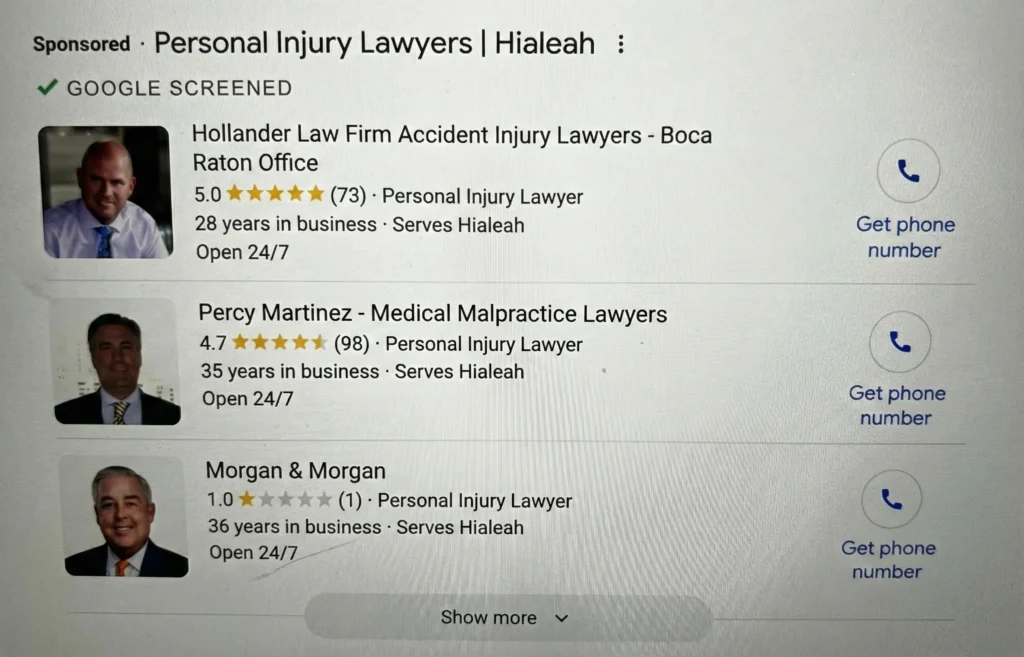
| Firm | Position | Rating | Reviews |
|---|---|---|---|
| Percy Martinez | #2 | 4.7 ★ | 98 |
| Morgan & Morgan | #3 | 1.0 ★ | 1 |
So when someone asks me how much law firm SEO costs in Miami I don’t give them the agency answer with the nice ranges and the professional tone or whatever. I tell them what I wish someone had told Percy before we figured it out ourselves, which took way longer than it should have.
What It Actually Costs
What does law firm SEO cost in Miami by firm size? Solo practitioners: $1,500 to $2,500/month for Google Business Profile optimization and basic content. Small firms (2-5 attorneys): $2,500 to $5,000/month for content strategy and link building. Mid-size firms (6-20 attorneys): $5,000 to $9,500/month for digital PR and multi-location. Large firms (21+ attorneys): $10,000 to $20,000+/month for regional dominance. Personal injury firms need $15,000+/month to compete for head terms like “Miami car accident lawyer.”
Look, I’ve seen a lot of proposals over the years and the numbers are all over the place but here’s roughly what agencies charge in Miami right now and these are real numbers not made-up ranges.
If you’re a solo practitioner or maybe a two-attorney shop doing something like estate planning or immigration, you’re looking at $1,500 to $2,500 a month and for that you get your Google Business Profile optimized and some basic content and local citations and honestly that’s probably fine for where you are, assuming you’re not trying to compete for personal injury terms against firms spending ten times that.
Small firms, maybe 2 to 5 attorneys, you’re in the $2,500 to $5,000 range and now you’re getting actual content strategy and link building and technical audits and maybe some neighborhood-specific pages for Hialeah or Coral Gables or wherever your clients actually come from.
Mid-size firms are $5,000 to $9,500 and that’s where you start seeing digital PR and video content and multi-location stuff if you have offices in Miami and Fort Lauderdale and West Palm or whatever.
And then large firms, 20+ attorneys, that’s $10,000 to $20,000 or more monthly and at that level you’re talking about regional dominance and national authority building and now AI optimization and all the new stuff that didn’t exist three years ago.
Miami Law Firm SEO Pricing (2025-2026):
| Firm Size | Monthly Cost | What You Actually Get |
|---|---|---|
| Solo / 2 attorneys | $1,500 – $2,500 | GBP optimization, basic content, local citations |
| Small firm (2-5) | $2,500 – $5,000 | Content strategy, link building, technical audits, neighborhood pages |
| Mid-size (6-20) | $5,000 – $9,500 | Digital PR, video content, multi-location optimization |
| Large (21+) | $10,000 – $20,000+ | Regional dominance, national authority, AI optimization |
| Personal Injury / Med Mal | $15,000+ | Required minimum to compete for head terms in Miami |
But here’s the thing nobody tells you, and I wish someone had told me this when I was at Percy: if you’re a personal injury firm expecting to rank for “Miami car accident lawyer” on $2,500 a month, you’re going to be disappointed because the firms dominating those terms are spending $15,000 or more every month and they’ve been doing it for years. The competition for PI and med mal in Miami is genuinely brutal and the budgets reflect that, but the case values also justify it so I don’t know, it depends on your situation.
How Long It Takes
How long does law firm SEO take to work? Weeks 0-4: foundation work, no visible ranking changes. Months 1-3: long-tail keyword rankings appear. Months 6-12: competitive keyword rankings and consistent leads. Months 18-24: full market maturity with compounding returns. Personal injury SEO in Miami takes 18+ months due to competition. Estate planning may see results in 6 months. Domain age, content velocity, and backlink quality affect timeline.
At Percy we didn’t see real results for about 8 months and we were doing everything right, or at least we thought we were, and that’s the uncomfortable truth nobody wants to tell you during the sales call because they know you’ll walk away if they say “yeah this is going to take a year before you see meaningful leads.”
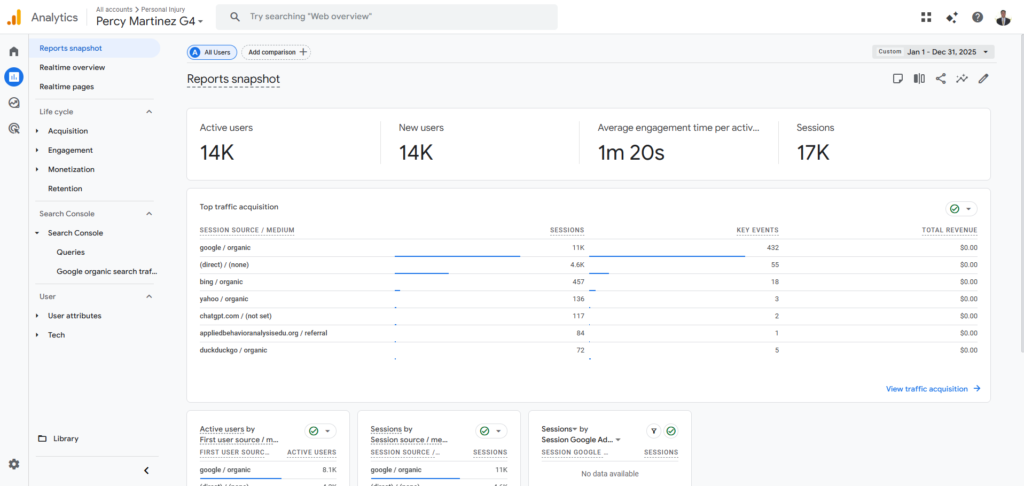
But here’s what happens when you stick with it: Percy went from 2,400 users in 2022 to 14,000 users in 2025, that’s 483% growth. Google organic specifically went from 1,900 to 11,000. And engagement time went from 55 seconds to 1 minute 20 seconds, which matters because it means people are actually reading, not bouncing.
The first month or so is all foundation work, technical fixes and citation cleanup and content planning, and you won’t see any ranking changes during this time because Google is basically re-evaluating your site and deciding whether to take you seriously. And then months 1 through 3 you start seeing what agencies call “long-tail wins,” which means you’re ranking for really specific questions that nobody else bothered to answer, like “can I sue for a slip and fall at a Miami cruise terminal” type stuff, and the volume is low but it proves the strategy is working.
At Percy we did this with medical conditions, surgical errors, anesthesia mistakes, birth injuries, misdiagnosis, and we built pages targeting searches nobody else was going after. By the time competitors caught on, we already owned those keywords.
Months 6 to 12 is when you start appearing for the money terms, the “Miami personal injury lawyer” searches or whatever your main keywords are, and this is when leads become consistent and you can actually track cost per acquisition and figure out if the ROI makes sense.
And then months 18 to 24 is what the research calls “market maturity,” which just means you’re now a fixture in search results and your cost per lead has dropped significantly because you’re building on equity instead of starting from scratch every month. At Percy we hit that point and then expanded to Orlando, Tampa, and Jacksonville, restructured the whole site by city, and other firms started copying the structure within months.
The biggest variable is competition, obviously. Ranking for personal injury in Miami takes 18+ months if you’re starting from zero, but estate planning might only take 6 months because fewer firms are fighting for those terms. And your existing domain authority matters too, like if you’ve had a website for 10 years with decent links you’ll rank faster than a brand new site, which seems obvious but I mention it because some agencies don’t.
Does It Actually Work
Does SEO work for law firms in Miami? Yes, but results take 6-12 months. SEO builds compounding equity: cost per lead decreases over time while PPC costs stay constant or increase. Percy Martinez P.A. reduced blended cost per signed case by 60% over three years through organic growth. SEO works best for firms that can wait 6-12 months, practice areas with research-heavy clients (med mal, family, immigration), and attorneys building long-term. SEO struggles for criminal defense (urgent needs) and firms needing immediate leads.
Yes but not the way most agencies describe it and definitely not on the timeline they imply during the sales process.
SEO doesn’t work like flipping a switch, it’s infrastructure, you’re building something that appreciates over time like real estate or whatever analogy makes sense to you. The first year feels expensive because you’re paying before you’re earning and that’s genuinely frustrating and I remember being frustrated at Percy wondering if we were just throwing money away. But year two and beyond, your cost per lead drops while your competitors’ paid advertising costs keep rising, and that’s when it starts to feel worth it.
At Percy the numbers eventually became undeniable: 483% traffic growth over three years, 16,300 clicks from organic search in 16 months, 287 leads in just 5 weeks at the end of 2025. The site scores 100 on PageSpeed performance, loads in under a second, while most law firm websites score in the 30s and lose visitors before they even load. Medical malpractice cases in Florida average six to seven figures, so a single signed case from organic search generates more revenue than years of marketing spend.
And people trust organic results more than ads, which sounds like marketing talk but it actually shows up in conversion rates. When someone finds you through search they’ve already kind of decided you’re credible, they did the research and you came up. When someone clicks your ad they’re still skeptical because they know you paid to be there. That trust difference matters.
But look, SEO doesn’t work for everyone and I think more agencies should be honest about this. If you’re a criminal defense attorney and someone just got arrested at 2am and needs a lawyer tonight, SEO isn’t going to help you in that moment, you need paid ads or LSAs or something immediate. And if you need leads this month to make payroll, SEO isn’t going to save you because the timeline just doesn’t work that way. But if you can wait 6 to 12 months and you’re building for long-term dominance and you want to reduce your dependence on paying Google forever, then yeah, it works.
Is It Worth It for Small Firms
Is SEO worth it for small law firms in Miami? Yes, if targeting niche long-tail keywords instead of competing for head terms. A $1,500/month budget can dominate “maritime injury attorney Coconut Grove” but cannot compete for “Miami car accident lawyer” against firms spending $15,000+/month. Strategy: geo-target neighborhoods (Brickell, Doral), publish educational content answering specific Florida law questions, build local links from chambers of commerce. Small firms should allocate 10-15% of revenue to SEO and expect 12+ months for meaningful results.
When I started at Percy we were a solo practice with a $500 marketing budget, competing against firms spending $50,000 a month on TV and billboards on every highway in South Florida. Most agencies would’ve said the budget was too small to matter.
So we didn’t try to compete head-on, which in retrospect was the smartest thing we did.
We went after specific medical conditions nobody else was targeting: surgical errors, anesthesia mistakes, birth injuries, misdiagnosis. We built pages for those searches while the big firms were fighting over “medical malpractice lawyer Miami.” And by the time they noticed we existed we already owned those keywords and had built enough authority to start competing for bigger terms.
So my advice to small firms is don’t compete for “Miami car accident lawyer,” you’ll just burn budget fighting firms with $15,000 monthly SEO spend and unlimited PPC behind them. Instead, geo-target neighborhoods, like “personal injury lawyer Brickell” has lower competition than “personal injury lawyer Miami,” and you can actually win that. Publish educational content answering specific Florida law questions nobody else is answering. Build local links from Miami chambers of commerce and community organizations because those carry more local authority than national directories.
We also did things competitors weren’t doing: real photos from each city when everyone else was using stock images, scholarship campaigns with universities that earned legitimate .edu backlinks, attorney-to-attorney outreach for placements on ABA and state bar sites. That stuff compounds.
On $1,500 a month you can realistically optimize your Google Business Profile, publish 2 to 4 blog posts monthly, build a few quality local citations, and monitor your rankings. What you can’t do is rank for head terms against $15K/month competitors or generate leads immediately or compete in multiple practice areas at once. But if you’re patient and you pick your battles, small firms can absolutely build something that matters over time, it just takes longer and requires more focus than agencies usually admit.
SEO vs PPC
Law firm SEO vs PPC in Miami: which is better? SEO builds compounding equity with decreasing cost per lead over time. PPC provides immediate visibility but costs $85-$175 per click for personal injury ($2,800-$5,800 per consultation at 3% conversion) with zero residual value when spend stops. Best approach: use PPC for immediate cash flow while SEO matures over 12 months, then reduce PPC as organic rankings improve. Percy Martinez went from 80% paid/20% organic to 30% paid/70% organic over three years, doubling leads while keeping spend flat.
I ran both at Percy for years so I have opinions about this.
Here’s the simplest way I can explain it: PPC is renting space from Google and SEO is buying the building. In Miami, rent goes up every year, and it’s been going up fast. A mortgage eventually gets paid off.
The Math That Matters:
Here’s how to know if SEO makes sense for you. If your average case is worth $50,000 and you close 1 out of 10 consultations, each consultation is worth $5,000. If SEO costs you $5,000/month and generates 3 consultations, that’s $15,000 in case value for $5,000 spent. If PPC costs you $5,000/month and generates 1 consultation at $175/click, that’s $5,000 in case value for $5,000 spent. The math changes completely based on your case values and close rate, which is why I always ask about those numbers before recommending a budget.
PPC reality in Miami is that personal injury clicks cost $85 to $175 each, and at a 3% conversion rate that’s $2,800 to $5,800 per consultation, not per signed case, per consultation, and most consultations don’t become cases. And the moment you stop paying, visibility stops, there’s no residual value, you’re renting attention not building anything.
SEO reality is that the first year feels expensive because you’re paying $5,000 a month or whatever and leads trickle in slowly and it’s genuinely frustrating. But year two your rankings hold even if you reduce budget, and your cost per lead drops as organic traffic compounds, and you’re basically earning interest on past investment.
At Percy we went from 80% paid and 20% organic to 30% paid and 70% organic over about three years. Our total marketing spend stayed roughly flat but our leads more than doubled. 287 leads in 5 weeks by the end of 2025. That’s the compounding effect nobody explains well during sales calls because it requires patience and most clients don’t want to hear about patience.
What actually works for most firms is using PPC to bridge the gap while SEO matures. Get immediate cash flow from ads, test which keywords convert, feed that data into your content strategy. Then as organic rankings improve, reduce PPC bids on terms where you rank well organically. Lower your blended cost per acquisition over time. But this requires thinking in years not months and I know that’s not what people want to hear but it’s the truth.
How to Actually Rank in Miami
How to rank a law firm on Google in Miami? Priority 1: Google Business Profile with correct primary category, 30+ photos, monthly Google Posts, and review management. Priority 2: Technical SEO with site speed under 2.5 seconds, mobile-first design, schema markup (LegalService, Attorney, LocalBusiness), and consistent NAP across directories. Priority 3: Bilingual content strategy since 66% of Miami-Dade speaks Spanish at home. Use native Spanish keywords (“abogado de accidentes” not literal translation). Map Pack dominance generates more leads than positions 1-10 for local queries.
The Map Pack is where you want to be because those three results at the top of local searches generate more leads than positions 1 through 10 combined for most local intent queries, which sounds like an exaggeration but I’ve seen the data.
Your Google Business Profile matters more than most people realize. The primary category you select has huge weight in local rankings, like “personal injury attorney” is different from “law firm” and you need to pick the one that matches your main practice area. Photo velocity matters too, which sounds weird but the algorithm favors quantity and recency over quality, so aim for 30 to 50 photos minimum and add new ones monthly. And publishing Google Posts about case results or legal FAQs correlates with 12 to 15% visibility improvement according to the research I’ve seen.
Technical stuff matters too. Site speed needs to be under 2.5 seconds, which means compressing images and using browser caching and maybe a CDN. Percy’s site loads in under a second and scores 100 on PageSpeed performance, 96 on accessibility, 100 on SEO, while most law firm websites score in the 30s because they’re bloated with scripts and slow on mobile.
We did two complete rebuilds over 10 years, 2016 to 2022 to 2025, and never lost traffic because we migrated URL by URL to preserve SEO equity. We don’t patch old sites, we rebuild clean and migrate carefully. When Google cracked down on virtual offices we consolidated to major metros only. That’s the kind of technical attention that keeps you ranking while competitors get penalized.
And I should mention this because it’s part of the reality: when you rank at the top, people try to knock you off. We dealt with spam reports, fake reviews, and listing disputes across all four cities at Percy. We had to travel to each location, photograph real signage, and prove physical presence to fight every false flag. Ten years later, still ranking.
And then the bilingual thing, which I probably don’t need to explain to anyone who knows Miami, but 66% of Miami-Dade speaks Spanish at home and if you’re ignoring Spanish search you’re ignoring the majority of the market. But here’s what matters: Spanish speakers don’t search for “personal injury lawyer” translated literally, they search for “abogado de accidentes,” and “employment attorney” becomes “abogado laboralista” not “abogado de empleo.” You need native speakers creating content, not Google Translate, because Miami Spanish is different from Mexican Spanish or Castilian Spanish and people can tell.
What I’d Tell Someone Starting From Zero
How should a new Miami law firm start SEO? Months 1-3: Perfect Google Business Profile (free, first lead source), pick ONE practice area, target ONE geographic area. Months 3-6: Publish weekly content answering actual client intake questions, build robust attorney bio with credentials and languages. Months 6-12: Earn links from Florida Bar and Miami-Dade Bar Association, track cost per lead not just rankings. Budget 10-15% of target revenue. Avoid agencies promising page one in 30 days, agencies that won’t explain their link building strategy, and long contracts with no exit clause.
If I were advising the version of Percy that existed 12 years ago with $500 and no digital presence, here’s what I’d say.
First 3 months, get your Google Business Profile perfect because it’s free and it’s where your first leads will come from. Pick one practice area, not three, one. Target one geographic area, rank in Hialeah before you try to rank in all of Miami-Dade.
Months 3 to 6, publish weekly, and don’t write what you think sounds impressive, answer questions your actual clients ask during intake because those are the questions people are Googling. Build your attorney bio page like Google is reading it, which it is, with credentials and bar admissions and case experience and languages spoken.
Months 6 to 12, earn links from Florida Bar and Miami-Dade Bar Association and local chambers because these count more than 100 random directory links. And start tracking cost per lead not just rankings, because rankings that don’t produce consultations are vanity metrics and I wasted months at Percy celebrating ranking improvements that didn’t move the needle.
And look, avoid agencies promising page one in 30 days because that doesn’t happen in Miami’s competition level. Avoid agencies that won’t explain what they’re actually doing, like if they can’t describe their link building strategy they’re probably doing something shady. Avoid agencies measuring success by traffic instead of consultations, and avoid long contracts with no exit clause because good agencies don’t need to trap you.
Want to Know If the Math Works for Your Firm?
I’ll look at your practice area, your competition, and your current situation and tell you whether SEO makes sense or whether you should put the money somewhere else. Sometimes the answer is PPC. Sometimes it’s wait six months and revisit. I’ll tell you what I actually think based on what I’ve seen work in Miami over 10 years.

See Miami SEO services | See Miami PPC services | Compare with AI optimization