
Most SEO agencies learn Miami from keyword tools. I learned it from sitting with families at Jackson Memorial, filing motions at the Richard E. Gerstein Justice Building, and watching which marketing actually produced signed retainers. I spent 10 years inside a Miami law firm (Percy Martinez, P.A.) and managed budgets at Swatch Group, so I track marketing like a financial asset on a balance sheet, not a gamble. That’s a different kind of local knowledge.
| Jackson Memorial | Gerstein Justice Building | Hialeah to Homestead |
|---|---|---|
| Intake experience | Court filing experience | Cases across Miami-Dade |
Why Miami SEO Is Different
Summary: Miami law firm SEO requires bilingual strategy (40% Spanish-dominant population), tri-county geographic targeting (Miami-Dade, Broward, Palm Beach overlap), and tourism-specific case types (cruise ship injuries, rental car accidents). Generic SEO agencies miss these Miami-specific dynamics.
I’m not going to repeat the SEO basics you can read on our main SEO page. You know what keywords are. You know content matters. Here’s what’s specific to Miami that agencies from outside don’t understand:
The Bilingual Reality
40% of Miami-Dade is Spanish dominant. “Abogado de accidentes Miami” isn’t a nice-to-have keyword; it’s half your market. Most agencies treat Spanish as an afterthought or run content through Google Translate. In Miami, that’s malpractice.
I’ve done intake calls in Spanish. I know how Miami’s Hispanic community searches, what questions they ask, what makes them trust a firm. That’s not something you learn from a keyword tool.
The Tri-County Blur
Miami-Dade, Broward, and Palm Beach bleed into each other. Someone in Aventura might hire a Fort Lauderdale firm. Someone in Homestead might drive to Coral Gables. Your Google Business Profile says “Miami” but your actual service area is fluid.
Generic “Miami SEO” ignores this. You need a strategy that captures searches across the tri-county reality without triggering Google’s spam filters for serving areas you can’t actually reach.
The Port and the Tourists
Cruise ship injuries. Theme park accidents. Rental car crashes from visitors who don’t know I-95. Miami has case types that don’t exist in other markets. If your SEO only targets “car accident lawyer Miami,” you’re missing the searches that are unique to a tourism economy.
The Competition
Morgan & Morgan. Steinger, Greene & Feiner. The billboard firms spending six figures monthly. You’re not going to outspend them on Google Ads. But SEO is a different game; it rewards expertise signals over budget. A firm that demonstrates genuine Miami knowledge can outrank a firm that just outspends.
The Neighborhoods Matter
Summary: Miami-Dade has 35 municipalities with different SEO competition levels and search patterns. Hialeah requires Spanish dominant strategy. Coral Gables expects polished presentation. Homestead has less competition but different case profiles. One “Miami” page doesn’t capture how locals actually search.
“Miami personal injury lawyer” is one search. But Miami-Dade is 35 municipalities, each with different search patterns and competition levels.
Hialeah searches look different than Coral Gables searches. Homestead has less competition but longer drive times that affect service area strategy. Each neighborhood needs different content and Google Business Profile optimization.
The point isn’t to build 35 pages. It’s to understand that “Miami SEO” is a simplification. Your strategy needs to account for how Miami-Dade actually works.
What “Local Knowledge” Actually Means
When I say I know Miami, I don’t mean I looked at a map:
I know Jackson Memorial’s intake flow. Which units produce which case types. How families move through the system. What they’re searching for at 2am when they’re scared.
I know the Gerstein Building’s rhythm. Filing deadlines, clerk preferences, which judges handle which dockets. Content that references real Miami court procedures signals expertise to Google and to potential clients.
I know the drive times. That someone in Kendall won’t drive to North Miami Beach for a consultation. That Homestead feels disconnected from “Miami” even though it’s the same county. Service area strategy isn’t about drawing circles on a map; it’s about understanding how Miami actually moves.
I know the referral networks. Which hospitals have case managers who recommend attorneys. Which churches in Little Havana are centers of community trust. Where the cases actually originate before anyone touches a keyboard.
This isn’t SEO knowledge. It’s operational knowledge from a decade inside a Miami firm. But it shapes everything about how I build search strategy.
The Spanish Content Problem
Summary: Miami Spanish SEO requires original Spanish keyword research, native-written content (not translations), and dialect-specific targeting for Cuban, Venezuelan, Colombian, and Nicaraguan communities. Generic “Universal Spanish” content sounds robotic to Miami locals and performs poorly in search.
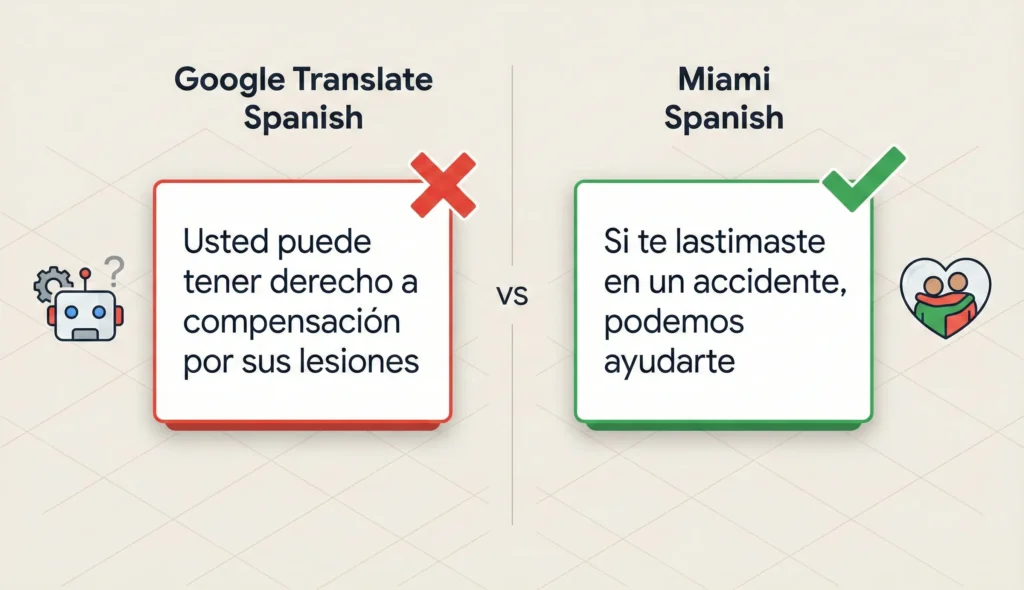
Let me be direct: most agencies will sell you “Spanish SEO” that’s garbage.
They’ll run your English content through a translator, maybe have someone “check” it, and call that bilingual optimization. The result reads like a legal document written by someone who learned Spanish from Duolingo.
Miami’s Spanish-speaking population knows the difference. They can tell when content was written by someone who actually speaks Spanish versus someone who translated it. And Google is increasingly sophisticated at detecting low-quality translated content.
Miami Spanish isn’t textbook Spanish. It’s Cuban, Venezuelan, Colombian. Generic “Universal Spanish” sounds robotic to a Hialeah local. We write for the specific dialect of your target demographic so you don’t sound like a gringo using Google Translate.
What actual Spanish SEO requires:
- Original Spanish keyword research (not translated English keywords)
- Content written in Spanish from scratch (not translated)
- Cultural context that resonates with Miami’s specific Hispanic communities (Cuban, Venezuelan, Colombian, Nicaraguan; each with different patterns)
- Spanish Google Business Profile optimization (posts, Q&A, responses)
- Review generation in Spanish (your Spanish-speaking clients should leave Spanish reviews)
- This costs more because it’s genuinely more work. But in Miami, it’s not optional; it’s half your market.
How This Connects to Results
I’m not going to repeat the Percy Martinez case study here; you can see the full results breakdown with before/after screenshots showing 483% traffic growth.
What’s relevant for Miami specifically:
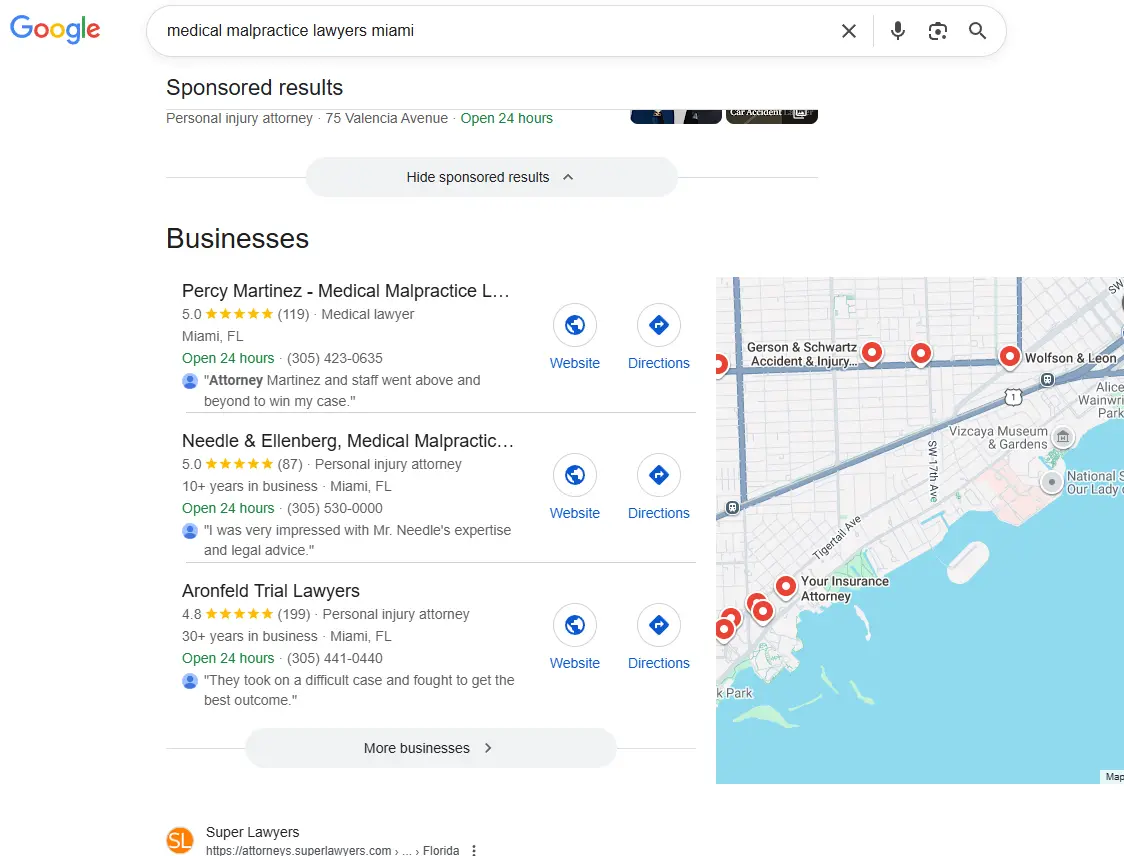
Percy ranks #1 in the Map Pack for Miami medical malpractice searches. Above Morgan & Morgan. Above firms spending 10x the budget.
That didn’t happen because we had more money. It happened because we understood Miami’s specific dynamics; the bilingual audience, the neighborhood-level competition, the E-E-A-T signals that matter for Florida medical malpractice content.
The methodology transfers. The local knowledge is what makes it work in Miami specifically.
SEO Strategy by Practice Area
Summary: Miami SEO strategy differs by practice area. Personal injury faces Morgan & Morgan dominance. Medical malpractice requires E-E-A-T compliance. Family law has fragmented competition. Criminal defense needs speed. Immigration requires community-specific targeting.
Personal Injury: Billboard firms dominate primary keywords. Strategy shifts to Spanish (abogado de accidentes Miami), tourism injuries, and neighborhoods where competition thins.
Medical Malpractice: YMYL category. Google filters thin content aggressively. You need E-E-A-T signals and Florida specific legal knowledge.
Family Law: Fragmented competition. Opportunity exists, but keywords split: divorce vs. custody vs. high net worth. One page won’t rank for all.
Criminal Defense: Speed over content depth. Someone searching “DUI lawyer Miami” at 3am needs fast load, easy call button, immediate answers.
Immigration: Community targeting is everything. Cuban asylum, Venezuelan TPS, Colombian investor visas; different audiences, different content.
Miami SEO Right for You?
Summary: Miami law firm SEO costs $5,000-$10,000/month due to high competition in the Tri-County area. Costs are driven by bilingual content requirements (Spanish/English), competitive link building against major firms like Morgan & Morgan, and aggressive Local Pack defense.
This makes sense if:
- Your cases are worth enough to justify 3-6 months of investment (medical malpractice, catastrophic PI, complex litigation)
- You want to build long-term search presence rather than rent attention through ads
- You’re willing to invest in genuine quality, including proper Spanish content
- You can wait for results; SEO isn’t overnight
This doesn’t make sense if:
- You need cases next week; that’s PPC, not SEO
- Your average case value is under $10,000; the math probably doesn’t work
- You want the cheapest option; quality Miami SEO costs $5,000-$10,000/month
- You’re not willing to commit for at least 6 months
- I’ll tell you honestly on a call whether SEO makes sense for your specific practice. Not every firm should invest in it.
One County, One Client
Summary: Argota Marketing does not take competing law firms in the same practice area within the same county. If hired for Miami-Dade medical malpractice SEO, competitors in that practice area and county cannot hire the agency. This prevents strategy recycling and conflicts of interest.
We don’t take competing firms in the same practice area in the same county.
If we work together on Miami-Dade medical malpractice, your competitors can’t hire me. Your SEO strategy, your keyword research, your content approach; none of it gets recycled for someone else in your market.
That’s not standard in this industry. Most agencies run the same playbook for competing firms in the same city. I think that’s a conflict of interest.
See Where You Actually Stand in Miami
I’ll audit your current Miami search presence; Map Pack position, local signals, content gaps, how you compare to your actual competitors in Miami-Dade. No sales pitch. Just clarity on where you are and what it would take to rank.