

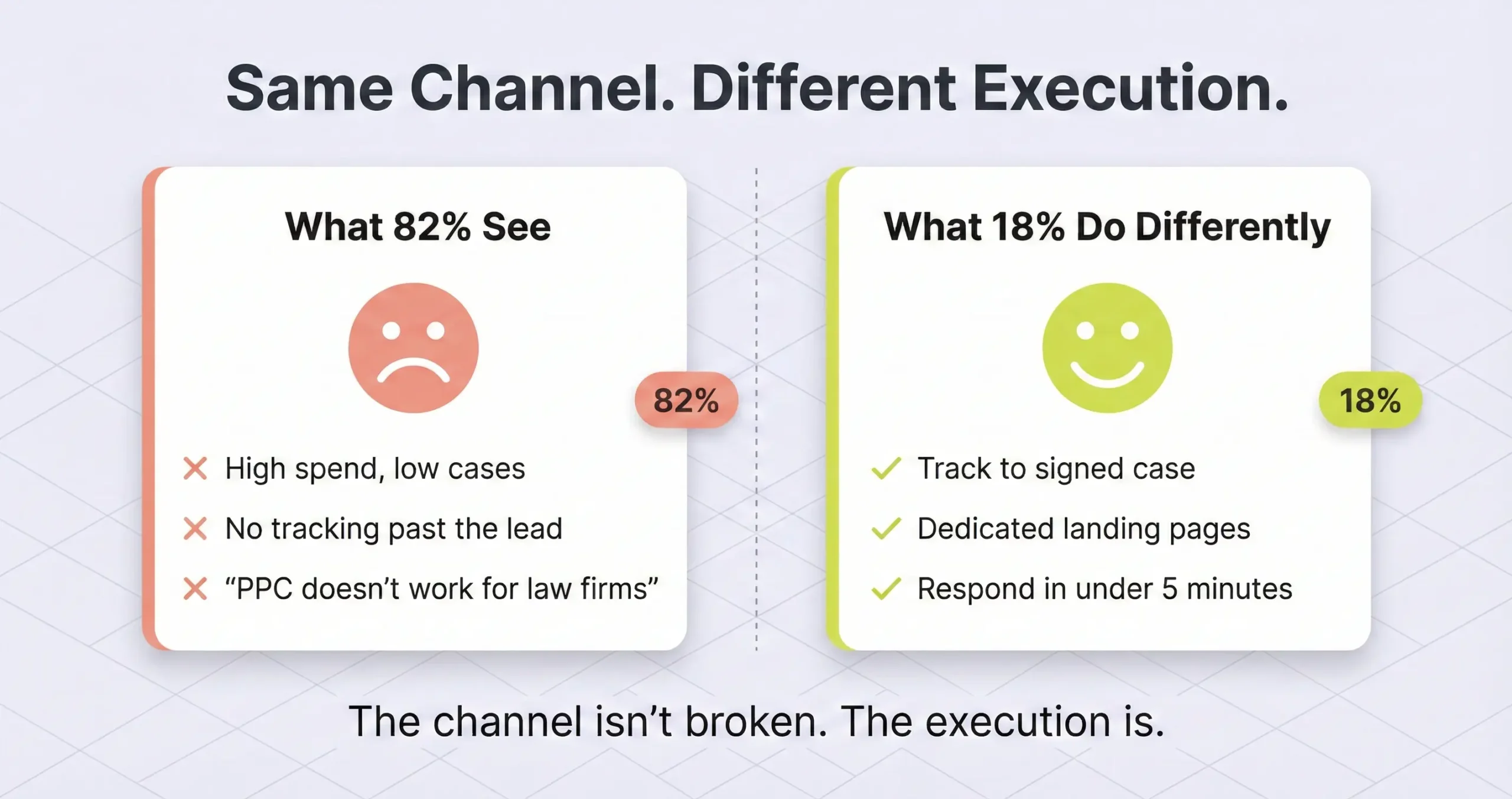
Is PPC worth it for law firms? For 82% of lawyers the answer is no, according to CallRail’s market research. But the data also shows that sentiment reverses when firms implement three specific fixes: tracking conversions to signed cases instead of calls, building dedicated landing pages instead of sending traffic to the homepage, and responding to leads within minutes instead of hours. The 18% who do those things treat PPC as a revenue channel. The 82% who don’t treat it as a money pit. Same platform, different execution, wildly different outcome.
The agency says the ads are working and the firm says they’re not and the frustrating part is that both sides have data supporting their version. The agency’s report shows hundreds of clicks, the phone rang, the budget was spent on real impressions served to real people. The firm’s intake log shows maybe 3 signed cases out of all of it. And neither side can prove the other one wrong because there’s no system connecting the ad click to the signed retainer, so the argument just circles until someone gives up or fires someone.
What’s usually happening underneath that argument is three things at once. Some of the clicks came from keywords that had nothing to do with hiring a lawyer. Some of the leads were real but nobody called them back fast enough and they hired whoever answered first. And the landing page sent paid traffic to the homepage where it competed with 40 other links instead of a dedicated page with one phone number and one thing to do. Any one of those is enough to kill a campaign’s return, and most underperforming accounts have all three running simultaneously.
This is why 82% of lawyers say PPC isn’t worth it and also why the other 18% treat it as their most reliable revenue channel. Same platform, same auction, wildly different outcomes based on execution details that most agencies either don’t know about or don’t bother fixing.
The Three Ways PPC Campaigns Bleed Money
Why do most law firm PPC campaigns fail? Three structural errors account for most of the waste. First, broad match keywords trigger ads for searches like “personal injury lawyer salary” and “pro bono lawyer near me” which burn budget on people who will never hire you. Second, sending paid traffic to the firm’s homepage instead of a dedicated landing page drops conversion rates because homepages have 40 clickable links competing with the phone number. Third, tracking “calls” as conversions without distinguishing between a 10-second wrong number and a 10-minute qualified conversation trains Google’s algorithm to find more cheap junk calls instead of actual clients.
The keyword match type problem is the most expensive one because it happens quietly and Google keeps changing the rules. What used to be called “broad match” was already dangerous, but then Google changed phrase match to behave more like the old broad match, which means even firms that thought they were being careful started showing up for searches they never intended to bid on.
A phrase match bid on “personal injury lawyer” can now trigger your ad for “personal injury lawyer internship” or “how much do personal injury lawyers make” and each of those clicks costs $100 or more and produces zero cases.
The fix is a negative keyword list and it needs to be long, like hundreds of terms long, covering things like “job,” “salary,” “free,” “school,” “definition,” “template,” “pro bono,” and anything else that signals someone researching a topic rather than hiring a lawyer. And it’s not something you build once and forget about. New junk queries show up every week in the search terms report and if nobody is checking that report the budget quietly leaks to people who were never going to call.
The landing page problem is something I still see every time I audit an account. A firm pays $200 for a click from someone searching “motorcycle accident attorney” and that click lands on the firm’s homepage, which talks about the firm’s history, lists a dozen practice areas in the navigation, has links to the blog and social media, and makes you scroll to find the phone number. That’s a page designed for browsing, not for someone in crisis who needs to call right now.
A dedicated page built for that one search term with one practice area, one phone number at the top, and no navigation links competing for attention converts at two or three times the rate. The click costs the same either way but the cost per signed case drops because more of those clicks turn into calls that turn into cases.
The vanity metric problem feeds the other two. If you’re tracking raw calls as conversions, Google’s algorithm will find the cheapest way to generate calls, which means low-intent searches from people who click to call and hang up in 10 seconds. If you track qualified leads or signed cases the algorithm learns which clicks produce actual clients and bids accordingly.
Why Small Budgets Guarantee Failure Without the Right Strategy
Why does PPC fail with a small budget? Because legal clicks cost $100 to $300 in competitive markets, a $1,000 test budget buys 5 to 7 clicks. Even a strong landing page converting at 10% is statistically likely to produce zero leads from 7 clicks. The firm concludes PPC doesn’t work when in reality the experiment was undercapitalized. Industry data suggests minimum viable ad spend for law firms is $3,000 to $10,000 per month depending on the practice area, and the first $10,000 to $15,000 of spend is essentially tuition that may produce negative ROI while the algorithm learns what works in your specific market.
This is the part that creates the most frustration because a solo reads that PPC can work for lawyers, puts $1,500 on a credit card, gets 8 clicks and zero leads, and walks away convinced the whole channel is a scam. And honestly from their perspective that’s a reasonable conclusion because they spent real money and got nothing back.
But the math was stacked against them from the start at that budget level. If a click costs $175 you get maybe 8 or 9 of them for $1,500, and even a strong landing page only converts maybe 1 in 10 visitors into a call, and that one person still needs to have a real case and your intake still needs to catch them before they call someone else. The odds of all of that lining up in a sample of 8 clicks are low.
The approach that works for solos at $2,000 to $3,000 a month is targeting long-tail keywords that cost $30 to $60 per click, which gets you 40 to 80 clicks instead of 8, and at that volume the conversion math starts producing actual leads.
The 9 Hour Intake Gap That Kills Good Leads
How does slow intake destroy PPC ROI? CallRail data shows the average law firm takes 9 hours to respond to a lead. Industry research shows leads contacted within 5 minutes convert at rates 9 times higher than those contacted after 30 minutes. If a firm pays $391 for an auto accident lead and calls back 2 hours later, the person has probably already talked to a competitor who answered in 3 minutes. The firm blames “bad leads” when the leads were real and the response time was the problem.
The fix that made the biggest difference at Percy and I only caught it because I was running the marketing and doing intake at the same time. The agency’s reports showed leads coming in and the leads were real people with real injuries, but some of them weren’t getting called back for hours because I was in the middle of other work. And by the time I reached them they’d already spoken to another firm or the urgency had passed.
On the monthly report those leads showed as “didn’t convert” and the natural conclusion was that the ads were pulling low-quality traffic. Once I started tracking the time between lead submission and first contact I could see the pattern, and when we tightened that gap the conversion rate jumped without changing anything about the ad campaigns themselves.
The math on this is worse than most firms realize. If your conversion rate drops from 15% to 10% because of slow response, your cost per signed case increases by 50% without anything changing in the ad campaign. You’re paying the same for the clicks, the leads are the same quality, but your intake process is turning a $2,000 cost per case into a $3,000 cost per case and the blame falls on the marketing because that’s where the invoice comes from.
The fix for small firms is dayparting, which means turning ads off when nobody is available to answer the phone. If you’re in court every morning, don’t run ads from 8 to noon. For growth firms the fix is 24/7 intake coverage through a qualified answering service or automated SMS response that at least acknowledges the lead within minutes and schedules a callback.
What the Firms Getting Results Actually Do Differently
What do profitable law firms do differently with PPC? They connect the ad data to the case data. Most firms track whether someone called or filled out a form, but they never tell Google which of those calls actually became a signed case. The firms getting strong returns send that outcome data back to the ad platform so the algorithm learns which types of clicks produce real clients. Once that feedback loop is running, the firm stops paying the same price for every click and starts paying more for the clicks that look like past clients and less for the ones that look like dead ends.
The reason most firms land in the 82% who think PPC isn’t worth it is that their ad account has no idea what a good outcome looks like. Google sees a form fill from someone looking for free advice and a form fill from someone with a $500,000 med mal case and treats them exactly the same, because nobody told it which one turned into money.
The fix is something called offline conversion tracking, and the way it works is simpler than the name suggests. When someone clicks your ad, Google attaches a unique tracking number to that click. If your site is set up right, that number follows the person from the click to the form or phone call and into your CRM.
When the case gets signed weeks later, you upload that tracking number back to Google along with the outcome, and now Google knows that this type of click from this type of person searching this keyword at this time of day produced a real case.
Over time the algorithm starts bidding smarter instead of just bidding on volume. It’ll pay $500 for a click it predicts will become a high-value case and $10 for one that looks like a dead end, and that’s why the same keyword can be profitable for one firm and a money pit for another. The firms feeding case data back into Google are playing a different game than the firms tracking form fills, and the ROI gap between the two gets wider every quarter.
Brand protection is the other piece most firms miss. If you’ve built name recognition through SEO or billboards and someone searches your firm’s name, a competitor can bid on that search and show their ad above your organic listing. A brand campaign costs maybe $1 to $5 per click because there’s no real competition for your own name, and it prevents the demand you’ve already paid to create from leaking to someone else.
Want to know why your PPC isn’t working?
Send me your Google Ads account summary and I’ll identify which of these three problems is costing you the most. If the campaigns are actually working fine and the issue is intake or attribution, I’ll tell you that instead.