

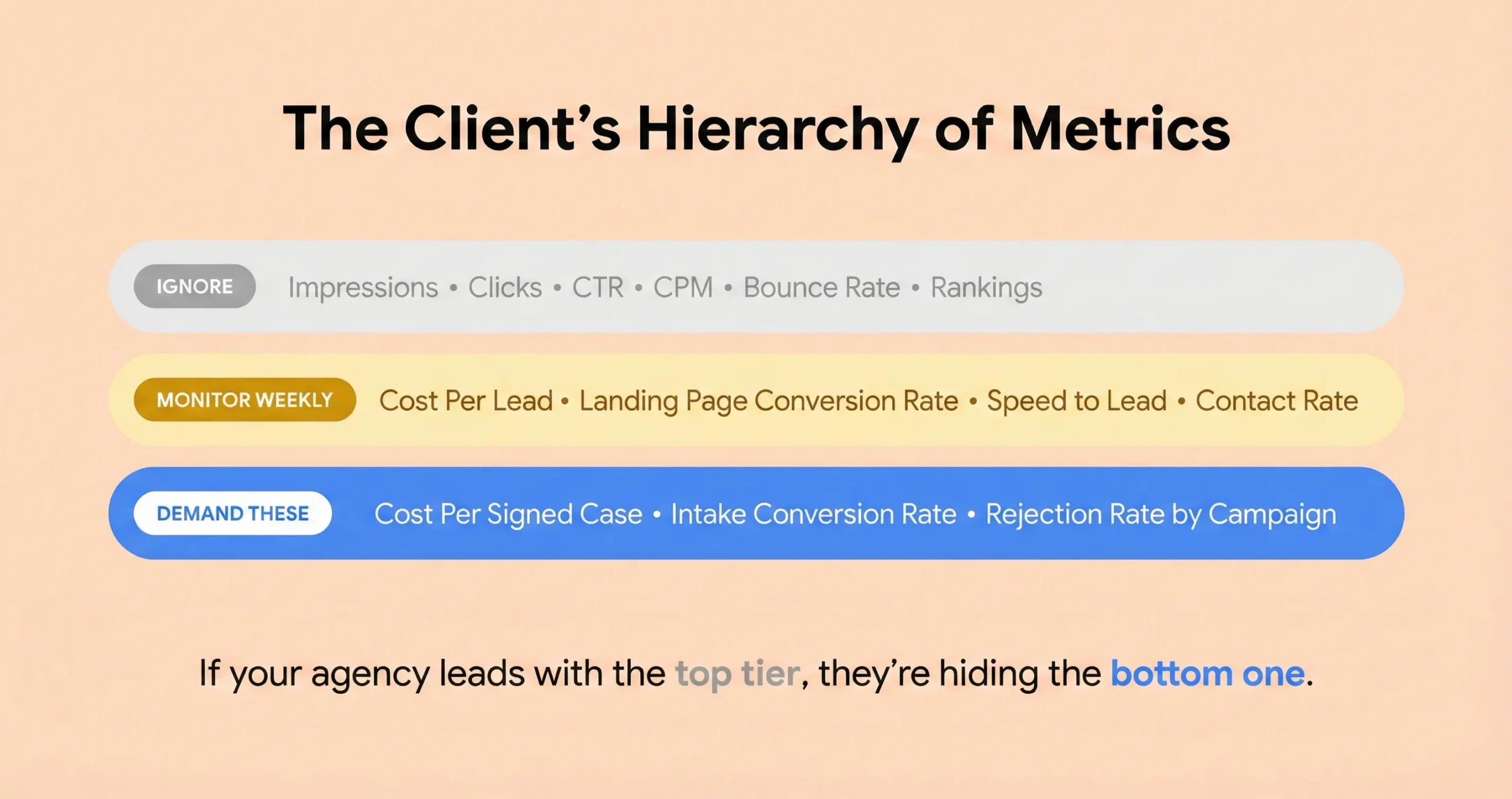
How do you read a law firm marketing report? Ignore the top section of the dashboard; impressions, clicks, click-through rate, and bounce rate describe advertising activity, not business results. Monitor the middle section weekly; cost per lead, landing page conversion rate, speed to lead, and contact rate tell you whether the machine is running efficiently. Demand the bottom section monthly; cost per signed case, intake conversion rate, and rejection rate by campaign tell you whether the money is coming back as cases. If your agency’s report leads with impressions and clicks and never reaches cost per signed case, the report is designed to look busy, not to answer the question that matters.
Your agency sends a report every month and you read maybe the first page before your eyes glaze over, and the reason they glaze over isn’t that you don’t understand marketing, it’s that the report is answering questions you didn’t ask. You asked “is the money working” and the report answered “here’s how many people saw your ad,” which is like asking your accountant whether the firm is profitable and getting a report on how many phone calls came in last Tuesday.
The metrics that determine whether your marketing spend is coming back as revenue fit on one line: what did you spend, how many cases did you sign, and what did each one cost. Everything else on the dashboard is either operational detail that your marketing manager should handle or filler designed to make the report look productive when the numbers that matter aren’t moving.
The Metrics That Don’t Tell You Anything Useful
Which marketing metrics should law firm partners ignore? Impressions measure how many times an ad appeared on a screen, which is the digital equivalent of counting how many cars drove past a billboard. Clicks measure how many people tapped the ad, which tells you the headline was interesting but not whether those people had a case. Click-through rate measures the percentage of impressions that became clicks, which describes the ad’s appeal but not the quality of who responded. Bounce rate measures how many people left the site after one page, which can mean the page was bad or can mean they called immediately. Rankings measure where the site appears on Google, but rankings don’t sign cases, intake teams do.
Impressions are the number your agency will always lead with because it’s always the biggest number on the page and it always goes up. Last month you got 200,000 impressions, this month you got 250,000, and the chart has a green arrow and everyone nods. But an impression just means your ad appeared on someone’s screen while they were scrolling through Facebook or reading a news article, and “appeared on a screen” and “considered hiring a lawyer” are so far apart that treating them as related is how agencies make bad months look productive.
Clicks sound more meaningful than impressions because at least someone took an action, but a click costs you money and doesn’t tell you whether the person who clicked has a case, lives in your state, or was even looking for a lawyer. In mass tort campaigns where click costs can run $10 to $50 each, a report showing 500 clicks and zero signed cases means you spent $5,000 to $25,000 on people who looked and left, and the agency will frame that as “awareness building” instead of what it actually is, which is a targeting problem.
The Metrics Your Marketing Manager Should Watch
Which marketing metrics should law firms monitor weekly? Cost per lead tells you how much the phone costs to ring, but only matters when paired with what happens after the call. Landing page conversion rate tells you whether people who click the ad actually fill out the form or call, and if it’s below 5% the page is broken. Speed to lead is the time between form submission and the first call attempt, and if it’s over 5 minutes the probability of reaching that person drops by 90%. Contact rate is the percentage of leads your intake team actually speaks to, and if it’s below 50% the lead source is contaminated or intake is too slow.
Cost per lead is the number agencies use as the headline metric because it sounds financial without being financial. “Your cost per lead is $150” feels like an answer to “is this working” but it’s not, because a $150 lead that never becomes a case cost you $150 for nothing, and a $500 lead that signs a retainer worth $200,000 is the best money you spent all month. The number means nothing without knowing what happened to the lead after the phone rang.
Speed to lead is the metric that nobody puts on the front page of the report but should, because the data shows that waiting more than 5 minutes to call a lead back reduces your chance of reaching them by 90%.
If your intake team works 9 to 5 and a lead submits a form at 7 PM, the person who called at 7:05 PM signed that case and you called at 9 AM the next morning and left a voicemail that nobody returned. That’s not a marketing failure, it’s an intake failure, and the agency’s report won’t distinguish between the two because from the agency’s perspective the lead was delivered.
The Three Numbers That Determine Whether the Firm Is Profitable
What is cost per signed case and why is it the most important metric? Cost per signed case is total marketing spend divided by total signed retainers. It tells you the actual price of acquiring a client, not the price of generating a phone call. In mass tort, benchmarks range from $350 to $750 for emerging torts like Ozempic to $2,600 to $5,600 for mature torts like Talcum Powder and NEC. If your agency can’t produce this number, they’re not tracking far enough downstream to know whether the marketing is working.
Cost per signed case should be the first line of the first page of the report, and if it’s not there, ask why. The calculation is simple: total spend divided by signed retainers. If the agency says they “don’t have visibility into what happens after the lead is delivered,” that means the report is measuring their work, not your results, and you’re paying for a document that describes activity without connecting it to revenue.
The second number to extract is what percentage of the agency’s leads your intake team actually reached by phone. Not how many were “delivered,” not how many showed up in the CRM, but how many resulted in an actual conversation. If the agency delivered 200 leads and your team spoke to 90 of them, your contact rate is 45%, and the report should tell you whether that’s because 110 people gave fake numbers, because intake didn’t call fast enough, or because the leads were shared with other firms who called first.
The third number is the one you’ll probably have to calculate yourself because almost no agency report includes it: what did the firm spend per case that actually stayed in the pipeline after initial screening. Not per signed case, per surviving case. If you signed 30 and 12 got rejected during records review, your real acquisition cost is the spend divided by 18, not 30, and that’s the number that tells you whether the marketing targeted the right people or just the cheapest ones.
What Your Agency’s Report Is Structured to Do
How are marketing reports designed to hide poor performance? Reports follow a visual hierarchy that puts large, growing numbers at the top and small, stagnant numbers at the bottom or omits them. The partner reads page one, sees green arrows on impressions and clicks, and assumes the campaign is working. The number that actually answers “is this working” is usually on page four or missing from the report, which means the document is architecturally designed to satisfy you before you reach the information that matters.
Notice what goes on page one of the report versus what goes on page four or gets left out. Impressions and clicks always lead because they’re always the largest numbers and they almost always trend upward, which means the partner opens the document, sees green, and feels like things are going in the right direction before they’ve encountered a single number connected to revenue or cases or anything the firm can deposit into a bank account.
The structure isn’t accidental and it isn’t lazy either. If cost per signed case were on page one, the partner would open the report and immediately know whether the spend produced cases or not, and the meeting would start with that answer instead of spending 20 minutes reviewing traffic charts.
I covered the specific inflation tactics agencies use to pad lead numbers in a separate post, but the structural problem is simpler than fraud; the report just buries the answer under 15 pages of activity metrics so you run out of patience before you find it.
How to Tell Whether the Problem Is Marketing or Intake
How can law firm partners tell if the problem is marketing or intake from the report? The report should contain two conversion rates that together pinpoint the failure. The first is the percentage of clicks that become leads, which tells you whether the ad and landing page are working. The second is the percentage of leads that become signed cases, which tells you whether the intake process is closing what marketing delivers. If the first number is healthy and the second is low, the problem is downstream in intake. If the first number is low, the problem is upstream in the ad or the landing page. A report that only shows total leads without these two rates is hiding the location of the failure.
Ask your agency to split the report into “before the lead arrives” and “after the lead arrives.” Those are two different systems with two different owners and two different fixes, and a report that blends them into one number is the reason you can never figure out what to change.
Before the lead arrives is the agency’s job: did the ad get clicked, did the page convert, did the person fill out the form or call. If 1,000 people clicked and 50 filled out a form, that’s a 5% landing page conversion rate and you can ask the agency whether that’s normal for this tort or whether the page needs work. That’s a conversation about their campaign performance and they should be able to answer it with data.
After the lead arrives is the firm’s job: did intake reach the person, did they qualify, did they sign. If the agency delivered 50 leads and intake signed 3, the question is where those 47 went. Did 20 never answer the phone? Did 15 not have the qualifying injury? Did 12 qualify but not sign? Each of those is a different problem with a different fix, and a report that just says “50 leads, 3 cases” is telling you the outcome without telling you the diagnosis.
How to Run the Monthly Agency Meeting Using the Report
What questions should law firm partners ask their marketing agency? Four questions that cut through dashboard noise: (1) Which page of this report shows me the cost per signed case, and if it’s not here, why not. (2) Break down the cost per lead by source so I can see which channels produce cases and which produce noise. (3) Show me last month’s report next to this month’s and tell me what changed and why. (4) What are you doing differently next month based on what this report shows.
Before the meeting starts, put last month’s report next to this month’s report and look at what metric is on page one. If it’s the same metric both months, that’s a good sign. If the agency moved from “clicks” last month to “impressions” this month, they’re leading with whichever number went up, and the number they moved away from probably went down.
The question that reframes the entire meeting is “show me where cost per signed case is on this report.” If it’s there, the conversation can start from the answer and work backward through the components. If it’s not there, the first question is why not, and the second question is when it will be, because a report without that number is a document about marketing activity that says nothing about business results.
Then ask the agency to break every metric by source instead of giving you a combined number. Cost per lead from Google search and cost per lead from Facebook and cost per lead from display ads should be three separate lines, because the single-line total hides the fact that one channel might be producing all the cases while the other two produce all the volume but none of the value, and you can’t make a budget decision without seeing them apart.
Not sure what your report is actually telling you?
Send me your last monthly agency report and I’ll translate it. I’ll tell you which numbers matter for your specific practice area, where the leakage is, and what questions to bring to your next agency meeting. If the report is solid I’ll tell you that too.